Within Strange Gabon
What Lurks in Gabon's River Monster Tales?
Gabonese river-beast stories mix dangerous waterways, local animal knowledge and later cryptozoological dinosaur claims.
On this page
- N'yamala and njago gunda
- From local reports to mokele mbembe
- Misidentification, folklore and warning stories
Page outline Jump by section
Introduction
The Ogooué River and its surrounding lagoons provide the strongest setting for Gabon’s monster traditions. Stories of huge, dangerous creatures inhabiting deep channels, swamps and backwaters long pre-date modern cryptozoology, but during the twentieth century many of these local traditions became entangled with the international idea that living dinosaurs might still survive in Central Africa. The result is a fascinating mixture of genuine oral tradition, colonial-era travel accounts, popular books and modern speculation. While no convincing physical evidence has ever emerged for unknown giant animals in the Ogooué basin, the stories remain an important part of Gabon’s strange-history landscape because they reveal how local knowledge, dangerous waterways and outside expectations merged into one enduring legend.[Wikipedia]WikipediaOpen source on wikipedia.org.

What lurks in Gabon’s river monster tales?
Unlike the famous Loch Ness Monster, Gabon’s river creatures are not tied to a single lake or one famous sighting. Instead they belong to a wider landscape of broad rivers, flooded forests and lagoons where visibility is poor, wildlife is abundant and large aquatic animals can appear suddenly before disappearing again.
The Ogooué, one of Central Africa’s largest rivers, supports crocodiles, hippopotamuses and manatees alongside dense vegetation and muddy channels. Such environments naturally encourage stories about unseen dangers beneath the surface. In many traditions the creatures are not simply mysterious animals but powerful beings whose presence explains dangerous stretches of water or serves as a warning against careless travel. These stories function as folklore as much as natural history.
N’yamala and njago gunda
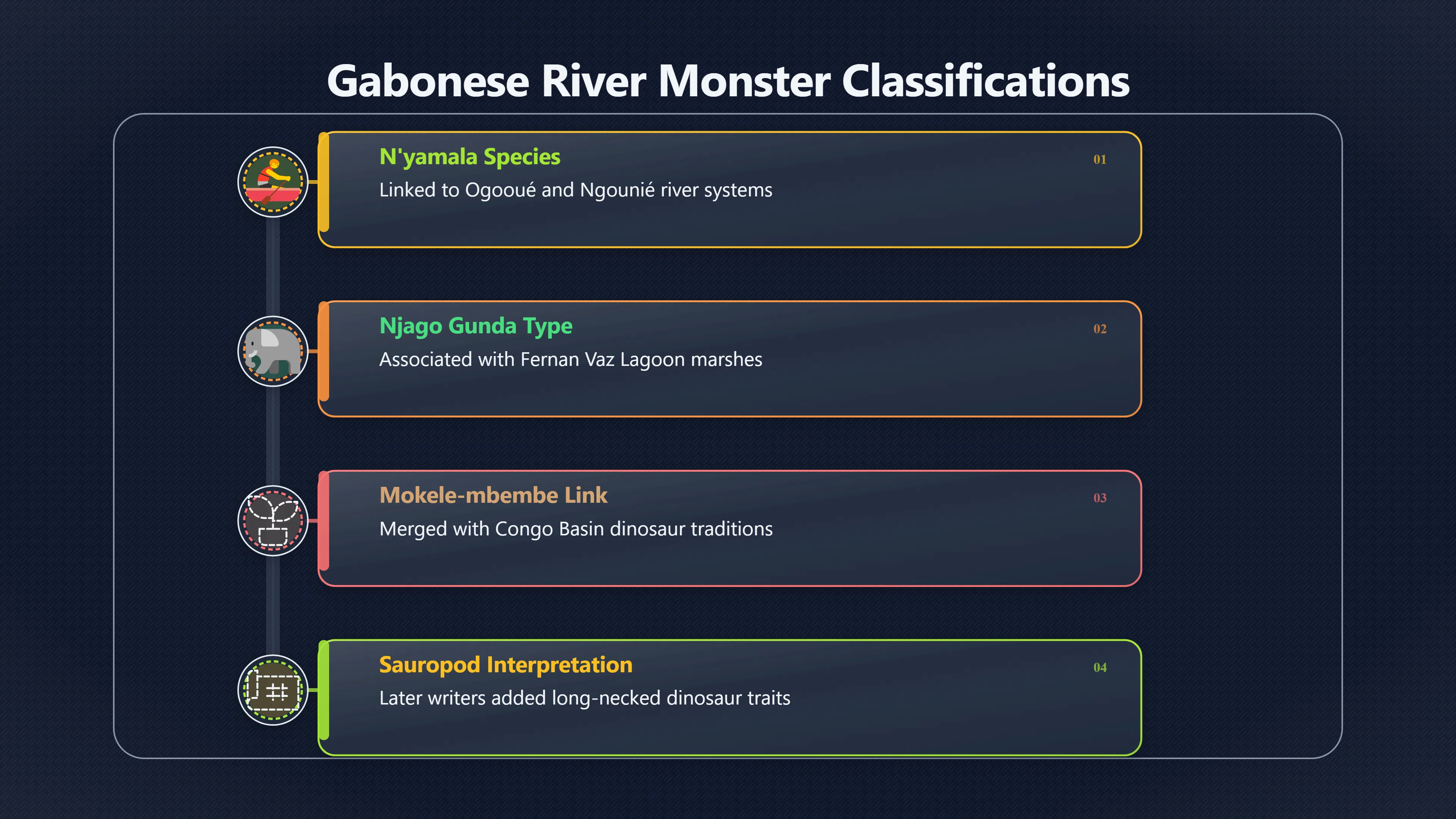
Among the names most often associated with Gabon are N’yamala and Njago Gunda, although surviving descriptions vary considerably from one source to another.
N’yamala
The creature usually called N’yamala is linked to the Ogooué and Ngounié river systems. Later writers often translated reports into the language of dinosaurs, describing it as having a long neck, long tail and a body roughly comparable to a hippopotamus or elephant. Some accounts claim local witnesses identified drawings of sauropod dinosaurs as resembling the animal, although these identifications generally came after explorers or researchers had introduced such illustrations.[Cryptid Archives]cryptidarchives.fandom.comRiver monsters · FreshwaterCryptid ArchivesN'yamala - Encyclopaedia of Cryptozoology - FandomThe n'yamala ("nya mala", Fang: "mother of canoes") is a neodinosaurian…
Not all descriptions agree. Earlier reports sometimes portray N’yamala less as a dinosaur than as a dangerous, powerful river beast capable of overturning canoes or frightening fishermen. The inconsistency itself is significant: rather than describing a single clearly recognised species, the stories appear to combine multiple traditions collected over many decades.
Njago Gunda
The Njago Gunda is associated with the Fernan Vaz Lagoon and nearby waterways connected to the Ogooué. Unlike N’yamala, it is frequently described as an enormous elephant-like animal inhabiting marshes and creeks. Some accounts claim it was twice the height of an ordinary elephant and aggressive towards boats, while others merged it with other Central African cryptids until its identity became increasingly blurred.[Cryptid Archives]cryptidarchives.fandom.comCryptid Archives Njago gunda | Encyclopaedia of CryptozoologyOgooué River, from which the neodinosaurian n'yamala is also reported. The njago gunda… Lake monsters of Africa · Freshwater monsters…
This illustrates a common feature of African cryptozoology: local names that may once have referred to different traditions gradually became grouped together by later writers seeking evidence for prehistoric survivors.
From local reports to mokele-mbembe
The transformation of Gabon’s river stories into dinosaur rumours owes much to developments outside Gabon itself.
During the early twentieth century, speculation that dinosaurs might have survived in remote parts of Africa gained popularity after zoologist Carl Hagenbeck suggested such a possibility in 1909. Explorers and journalists subsequently interpreted a wide variety of Central African traditions through this new lens. Reports from Gabon became linked with the much more famous mokele-mbembe tradition centred further east in the Congo Basin.[Wikipedia]WikipediaOpen source on wikipedia.org.
By the mid-twentieth century, books on cryptozoology often treated N’yamala as simply the Gabonese name for mokele-mbembe. This created the impression of one giant dinosaur-like creature ranging across several countries, despite the original reports differing in appearance, behaviour and cultural context.
As these stories spread internationally, repeated illustrations of long-necked sauropods reinforced the dinosaur interpretation. Yet many original descriptions mention only a large, dangerous aquatic animal, not an unmistakable dinosaur.
Why dinosaur claims proved so attractive
Several factors helped dinosaur interpretations flourish:
- Dense rainforest and swamp were seen by outsiders as ideal places for unknown animals to remain hidden.
- Central Africa still yielded spectacular zoological discoveries during the nineteenth and twentieth centuries, encouraging hopes that even larger surprises might exist.
- The immense popularity of dinosaurs in popular culture made sauropod interpretations more memorable than less dramatic possibilities.
- Cryptozoologists often combined reports from different regions and languages into a single narrative, smoothing over contradictions.
These factors produced a compelling adventure story even though direct evidence remained absent.
Misidentification, folklore and warning stories
Modern zoologists and sceptical researchers generally do not regard Gabon’s river monster traditions as evidence for surviving dinosaurs.
Several explanations are considered more plausible.
Known wildlife. Hippopotamuses, crocodiles, manatees and elephants can all produce surprising silhouettes in poor visibility. A swimming elephant, for example, exposes only parts of its back, trunk and head above water, creating unusual outlines. Large crocodiles and floating vegetation can also appear much larger than they really are.
Changing stories. Oral traditions evolve over time. Accounts collected by different travellers may describe separate animals or symbolic beings rather than one biological species.
Colonial interpretation. European explorers often filtered unfamiliar traditions through contemporary scientific debates. Once dinosaurs became fashionable, reports that might previously have been interpreted differently were increasingly described in dinosaur-like language.
Danger stories. Many river traditions appear to function as cautionary tales. Rivers in Gabon are genuinely hazardous because of strong currents, submerged obstacles and dangerous wildlife. Monster stories reinforce respect for these environments whether or not listeners believe the creatures literally exist.
Why the stories still matter
Although no expedition has produced verifiable remains, photographs, DNA or other physical evidence for unknown giant reptiles in the Ogooué basin, Gabon’s river monster traditions remain culturally significant.
They preserve fragments of local relationships with powerful waterways while also documenting how folklore can change when it encounters outside expectations. The shift from dangerous river spirit or mysterious beast to “living dinosaur” says as much about twentieth-century popular imagination as it does about Gabon’s forests.
Within Gabon’s wider strange-history tradition, the Ogooué monsters occupy an important middle ground between folklore and cryptozoology. They remind readers that many famous monster legends are not static tales handed down unchanged through history but living stories continually reshaped by explorers, journalists, scientists and enthusiasts.[wikipedia.org]WikipediaOpen source on wikipedia.org.
Amazon book picks
Further Reading
Books and field guides related to What Lurks in Gabon's River Monster Tales?. Use these as the next step if you want deeper reading beyond the article.

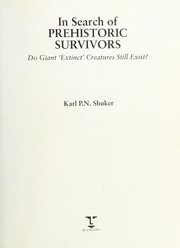
Still in Search of Prehistoric Survivors
Discusses Central African monster traditions.
eBay marketplace picks
Marketplace Samples
Live-tested eBay searches with available results related to this page.


Endnotes
1.
Source: Wikipedia
Link:https://en.wikipedia.org/wiki/Mokele-mbembe
2.
Source: ebsco.com
Link:https://www.ebsco.com/research-starters/science/mokele-mbembe-cryptozoology
Source snippet
Mokele-Mbembe (cryptozoology) | ScienceOften described as resembling a sauropod dinosaur, it has been likened to the Loch Ness Monster, c...
3.
Source: Wikipedia
Link:https://en.wikipedia.org/wiki/Emela-ntouka
4.
Source: youtube.com
Title: The Mokele-Mbembe Mystery: Dinosaur, Myth, or Unknown Animal?
Link:https://www.youtube.com/watch?v=sTVTuo48ZpQ
Source snippet
Mokele-Mbembe | The Living Dinosaur...
5.
Source: youtube.com
Title: Mokele-Mbembe | The Living Dinosaur
Link:https://www.youtube.com/watch?v=zcSxFeR3Ddk
Source snippet
The Lost Dinosaurs of the Congo | Documentary...
6.
Source: cryptidarchives.fandom.com
Title: River monsters · Freshwater
Link:https://cryptidarchives.fandom.com/wiki/N%27yamala
Source snippet
Cryptid ArchivesN'yamala - Encyclopaedia of Cryptozoology - FandomThe n'yamala ("nya mala", Fang: "mother of canoes") is a neodinosaurian...
7.
Source: cryptidarchives.fandom.com
Title: Cryptid Archives Njago gunda | Encyclopaedia of Cryptozoology
Link:https://cryptidarchives.fandom.com/wiki/Njago_gunda
Source snippet
Ogooué River, from which the neodinosaurian n'yamala is also reported. The njago gunda... Lake monsters of Africa · Freshwater monsters...
8.
Source: cryptidz.fandom.com
Link:https://cryptidz.fandom.com/wiki/N%27yamala
Source snippet
fandom.comN'yamala - Cryptid Wiki - FandomThe n'yamala ("nya mala", Fang: "mother of canoes" or "animal that resembles a large canoe") is...
9.
Source: cryptidarchives.fandom.com
Title: Mokele mbembe
Link:https://cryptidarchives.fandom.com/wiki/Mokele-mbembe
Source snippet
fandom.comMokele-mbembe | Encyclopaedia of Cryptozoology - FandomThe monster is herbivorous and mainly feeds on the luxuriant aquatic veg...
10.
Source: cryptidarchives.fandom.com
Title: Njago gunda · Nzemendim. Advertisement. More Information. Categories. African
Link:https://cryptidarchives.fandom.com/wiki/Category%3AGabon
Source snippet
fandom.comCategory:Gabon - Encyclopaedia of Cryptozoology - FandomTuttle Bottoms monster · Yukon giant worm · Sabre-toothed bear; Phantom...
Additional References
11.
Source: genesispark.com
Link:https://genesispark.com/exhibits/cryptozoological-evidence/the-sauropod-paddock/the-river-monster-of-cameroon-and-gabon/
Source snippet
The River Monster of Cameroon and GabonThe River Monster of Cameroon and Gabon. In Gabon, a group of African natives known as the Fang pe...
12.
Source: reddit.com
Link:https://www.reddit.com/r/Cryptozoology/comments/1d7vlla/the_njago_gunda_is_a_giant_elephantlike_cryptid/
Source snippet
It's known to live in creeks and swamps, attacking people in boats and being...
13.
Source: facebook.com
Link:https://www.facebook.com/johanegerkranspublic/posts/mokele-mbembe-is-a-mythical-water-dwelling-cryptid-rumoured-to-exist-in-the-cong/1301971888397055/
Source snippet
mbling a cross between a hippopotamus and a crocodile. It has...
14.
Source: youtube.com
Title: The Lost Dinosaurs of the Congo | Documentary
Link:https://www.youtube.com/watch?v=08R2KfEf7Ko
Source snippet
Living Dinosaurs in the Congo? Mokele Mbembe Part 1...
15.
Source: youtube.com
Title: Is Congo’s ‘Living Dinosaur’ Real?
Link:https://www.youtube.com/watch?v=vpygiIvXSKk
Source snippet
The Mokele-Mbembe Mystery: Dinosaur, Myth, or Unknown Animal?...
16.
Source: youtube.com
Title: Living Dinosaurs in the Congo? Mokele Mbembe Part 1
Link:https://www.youtube.com/watch?v=tDw7bkcvLJ0
Topic Tree