Within Bangladesh Weird
The Forest Guardian and the Tiger's Shadow
Bonbibi folklore gives ritual shape to the real dangers of tides, mud and tiger attacks in the Sundarbans.
On this page
- Bonbibi and Dakkhin Rai
- Rituals before entering the forest
- Tiger widows, stigma and living fear
Page outline Jump by section
Introduction
The folklore of Bonbibi sits at the heart of the Sundarbans, where the line between the natural and the supernatural has always been blurred by mud, tides and the constant threat of tigers. Rather than being a simple ghost story or religious legend, the tradition explains how people should behave in one of the world’s most dangerous working landscapes. Honey collectors, fishermen and woodcutters have long invoked Bonbibi before entering the mangrove forest, believing that she protects those who take only what they need, while the tiger lord Dakkhin Rai punishes greed and disrespect. Whether understood as religious belief, environmental ethics or psychological reassurance, the stories have become one of Bangladesh’s most enduring examples of folklore shaped by real danger rather than imagined horror.

Bonbibi and Dakkhin Rai
Bonbibi is revered throughout the Sundarbans by both Muslim and Hindu communities, an unusual example of a shared folk tradition crossing formal religious boundaries. Her story survives in narrative poems known collectively as the Bonbibi Johuranama or Bonbibir Jahuranama, composed in Bengali from at least the eighteenth and nineteenth centuries and still recited in villages around the forest. Rather than belonging neatly to either Islamic or Hindu theology, Bonbibi represents a local guardian whose authority is rooted in the mangrove landscape itself.[Wikipedia]WikipediaOpen source on wikipedia.org.
In the traditional narrative, Bonbibi arrives in the tide country with her brother Shah Jangali and confronts Dakkhin Rai, the powerful ruler of the deep forest. Dakkhin Rai often appears in the form of a tiger, embodying the deadly unpredictability of the mangroves. After conflict, the two reach a balance rather than a complete victory. Human beings are permitted to use parts of the forest for survival, while the deepest wilderness remains under the tiger lord’s control. The moral is not that nature has been conquered but that people must recognise limits.[NiCHE]niche-canada.orgUnder Bon Bibi'sNiCHEThe Parable of Bon Bibi and “Being” in the Sundarbans - NiCHEOctober 25, 2022 — Bon Bibi protected all those under her rule, and Dok…
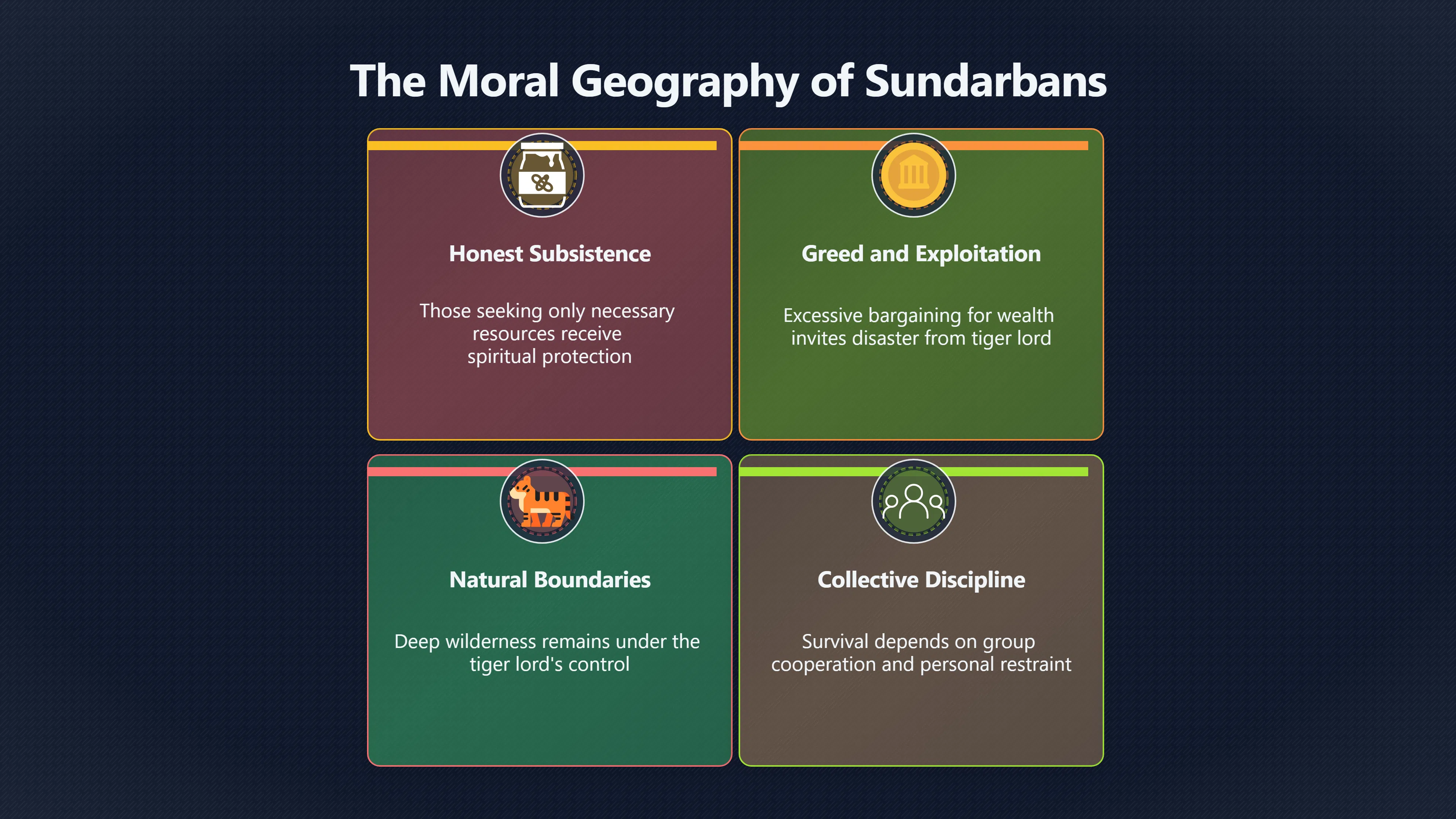
A second story, often called the tale of Dukhe, gives the legend its emotional force. A poor boy is abandoned in the forest as a sacrifice after a greedy honey trader bargains with Dakkhin Rai for wealth. Dukhe survives only because he calls upon Bonbibi, who rescues him and condemns human greed rather than the tiger itself. This episode has become the best-known expression of the Sundarbans’ moral geography: those entering the forest for honest subsistence deserve protection, while exploitation invites disaster.[Wikipedia]WikipediaOpen source on wikipedia.org.
From a Fortean perspective, the important point is that the tiger is never simply an animal nor simply a spirit. It occupies both roles simultaneously. A sudden tiger attack could be understood as an entirely natural event, yet it might also be interpreted as evidence that someone had violated the forest’s moral order.
Rituals before entering the forest
Before entering the mangroves, many forest workers perform rituals that ask Bonbibi for safe passage. Small shrines stand near river crossings and forest entrances, while prayers, offerings of sweets and the recitation of verses remain common in many communities. Honey collectors and woodcutters often begin expeditions only after seeking blessing from Bonbibi or from ritual specialists believed to provide spiritual protection.[wikipedia.org]WikipediaOpen source on wikipedia.org.
These practices are frequently misunderstood as attempts to summon supernatural protection against individual tiger attacks. Anthropologists instead point out that they also reinforce practical rules:
- enter the forest respectfully rather than recklessly;
- avoid taking more resources than necessary;
- recognise that parts of the forest belong to wildlife rather than people;
- work collectively rather than alone;
- accept that survival depends on discipline as much as courage.[environmentandsociety.org]environmentandsociety.orgBonbibi: A Religion of the Forest in the SundarbansThe imagination of Bonbibi as a forest goddess and the “religion of the forest” this h…
This gives Bonbibi folklore an unusually practical character. The rituals are woven into ecological knowledge, encouraging behaviour that may reduce risk even if they cannot eliminate it.
The same symbolic framework explains why tigers are rarely portrayed as evil. They are dangerous because they belong to the wilderness. The stories warn against arrogance more than they promise miraculous rescue.

Tiger spirits, fear and the psychology of the mangroves
The Sundarbans has long recorded some of the highest levels of fatal tiger encounters anywhere in the world. Although improved conservation, changing tiger numbers and better management have altered the pattern over time, entering the forest has remained an occupation with genuine risk. Against that background, stories of tiger spirits become easier to understand as cultural responses to constant uncertainty rather than evidence of paranormal encounters.[environmentandsociety.org]environmentandsociety.orgBonbibi: A Religion of the Forest in the SundarbansThe imagination of Bonbibi as a forest goddess and the “religion of the forest” this h…
Many forest workers describe an intense feeling of being watched while moving through dense mangroves. Visibility is poor, tidal channels shift constantly, and Bengal tigers are capable of stalking silently before attacking from behind. Such conditions naturally encourage stories in which unseen spiritual forces accompany physical predators.
Some protective customs blur folklore and practical experimentation. Workers have sometimes worn painted masks on the backs of their heads because tigers often attack from behind. The effectiveness of this method appears to have been limited, yet its existence illustrates how spiritual belief and practical defence have often developed together rather than separately.[Wikipedia]WikipediaTiger attacks in the SundarbansTiger attacks in the Sundarbans
The tiger, then, becomes both an ecological reality and a symbolic judge. A fatal encounter can be interpreted as bad luck, a natural accident or a sign that someone crossed an invisible moral boundary. Different explanations coexist without necessarily competing.
Tiger widows, stigma and living fear
Perhaps the most poignant legacy of Sundarbans folklore concerns the women known as “tiger widows”—wives of men killed during forest work.
Researchers have documented how these women often experience severe social stigma alongside economic hardship. In some communities they have been labelled bearers of bad fortune or even blamed for their husbands’ deaths through ideas rooted in local interpretations of Bonbibi’s stories. The belief that a tiger attack reflects moral failure can shift responsibility from the dangerous environment onto surviving family members.[King's College London]kcl.ac.ukKing's College LondonTiger widows of the Sundarbans: how religion and myth stigmatise…April 17, 2023 — Women who lose their husbands t…
The consequences are practical as well as emotional:
- reduced chances of remarriage;
- exclusion from community activities;
- financial insecurity after the loss of the family’s main earner;
- difficulties obtaining compensation where forest entry was unofficial or illegal.[King's College London]kcl.ac.ukKing's College LondonTiger widows of the Sundarbans: how religion and myth stigmatise…April 17, 2023 — Women who lose their husbands t…
Modern researchers stress that these beliefs should not be dismissed simply as superstition. They arise within communities where death from wildlife has been an ordinary possibility for generations. Folklore offers explanations for grief, but it can also reinforce inequalities that conservation programmes increasingly seek to address.

Why the legend still matters
Bonbibi remains one of the most distinctive examples of Bangladesh’s Fortean heritage because the tradition cannot be separated from the landscape that produced it. Unlike many ghost stories, it does not revolve around haunted ruins or unexplained apparitions. Instead, it gives moral and spiritual meaning to an environment where the dangers are undeniably real.
For believers, Bonbibi is a living protector whose intervention still shapes daily life. For sceptics, the stories encode practical environmental ethics, helping communities navigate one of the world’s most hazardous ecosystems. Scholars increasingly argue that both readings can be true in different senses: the supernatural claims remain matters of faith, while the folklore itself preserves generations of local knowledge about restraint, survival and coexistence with a formidable predator.[environmentandsociety.org]environmentandsociety.orgBonbibi: A Religion of the Forest in the SundarbansThe imagination of Bonbibi as a forest goddess and the “religion of the forest” this h…
Amazon book picks
Further Reading
Books and field guides related to The Forest Guardian and the Tiger's Shadow. Use these as the next step if you want deeper reading beyond the article.

The Hungry Tide
First published 2004. Subjects: Ecological disturbances, Tides, Fiction, Rural poor, Americans.

Folktales from India
First published 1991. Subjects: Tales, Oral tradition, Contes, Tradition orale, Mündliche Erzählung.

eBay marketplace picks
Marketplace Samples
Live-tested eBay searches with available results related to this page.




Endnotes
1.
Source: Wikipedia
Link:https://en.wikipedia.org/wiki/Bonbibi
2.
Source: environmentandsociety.org
Link:https://www.environmentandsociety.org/arcadia/bonbibi-religion-forest-sundarbans
Source snippet
Bonbibi: A Religion of the Forest in the SundarbansThe imagination of Bonbibi as a forest goddess and the “religion of the forest” this h...
3.
Source: Wikipedia
Title: Tiger attacks in the Sundarbans
Link:https://en.wikipedia.org/wiki/Tiger_attacks_in_the_Sundarbans
4.
Source: niche-canada.org
Title: Under Bon Bibi’s
Link:https://niche-canada.org/2022/10/25/the-parable-of-bon-bibi-and-being-in-the-sundarbans/
Source snippet
NiCHEThe Parable of Bon Bibi and “Being” in the Sundarbans - NiCHEOctober 25, 2022 — Bon Bibi protected all those under her rule, and Dok...
Published: October 25, 2022
5.
Source: kcl.ac.uk
Link:https://www.kcl.ac.uk/tiger-widows-of-the-sundarbans-how-religion-and-myth-stigmatise-human-wildlife-conflict
Source snippet
King's College LondonTiger widows of the Sundarbans: how religion and myth stigmatise...April 17, 2023 — Women who lose their husbands t...
Published: April 17, 2023
Additional References
6.
Source: roundglasssustain.com
Link:https://roundglasssustain.com/wild-vault/folklore-myths-tiger
Source snippet
A Forest of Folklore: Myths, Gods, and the Many Faces of the TigerThe mythology of Bonbibi started spreading when in the 19th century, Su...
7.
Source: facebook.com
Title: As we journey along India’s coasts and tropical forests
Link:https://www.facebook.com/GoodEarthIndia/posts/as-we-journey-along-indias-coasts-and-tropical-forests-we-explore-myths-memories/1195666429267338/
Source snippet
July 28, 2025 — Story: Bonbibi is the daughter of a Sufi fakir who defeated the tyrannical Dokkhin Rai, a zamindar who took the f...
Published: July 28, 2025
8.
Source: instagram.com
Link:https://www.instagram.com/reel/DZZ_38RPW0C/
Source snippet
June 10, 2026 — Bonbibi, the protector of the forest and its people. Dokkhin Rai, the tiger lord who embodies the untamed power...
Published: June 10, 2026
9.
Source: sahapedia.org
Link:https://www.sahapedia.org/bonbibi-r-palagaan-tradition-history-and-performance
Source snippet
Bonbibi-r Palagaan: Tradition, History and Performance - SahapediaTraditionally, Bonbibi-r Palagaan was simply recited or sung as a eulog...
10.
Source: sundarbantigerreserve.org
Title: Sundarban Tiger Reserve Sundarban Stories
Link:https://sundarbantigerreserve.org/?tab=Sb_story
Source snippet
Sundarban Stories - BanbibiBanbibi is the most celebrated demigod of both the Hindu and Muslim inhabitants of Sundarban, and she is the g...
11.
Source: academia.edu
Title: (PDF) Bonbibi of Sundarbans
Link:https://www.academia.edu/121351999/Bonbibi_of_Sundarbans
Source snippet
of Sundarbans protects her devotees from the tiger, king of the mangrove forest on the Gangetic belt of Bengal in the lap of the Ganges R...
12.
Source: youtube.com
Title: Sundarbans: Lives, Livelihoods and Landscapes | Visual Series | Episode 1
Link:https://www.youtube.com/watch?v=svIjsiw_usA
Source snippet
Tales of Bonbibi: The Forest Goddess worshipped by Hindus and Muslims...
13.
Source: youtube.com
Title: Bonbibi: Guardian of the sundarbans – The Sacred Law of the Sundarbans
Link:https://www.youtube.com/watch?v=D2TqC_e0ldU
Source snippet
Telling the tale of Bonbibi in the Sundarbans | West Bengal...
14.
Source: youtube.com
Title: Tales of Bonbibi: The Forest Goddess worshipped by Hindus and Muslims
Link:https://www.youtube.com/watch?v=28WTiKx9v3k
Source snippet
How Bonbibi -A Forest Goddess Protects Sundarbans | UnEarth...
15.
Source: youtube.com
Title: Telling the tale of Bonbibi in the Sundarbans | West Bengal
Link:https://www.youtube.com/watch?v=uXwn9unRkjw
Source snippet
Sundarbans: Lives, Livelihoods and Landscapes | Visual Series | Episode 1...
Topic Tree