Within Austria Strange
When Austrian Monsters Had Bones and Addresses
Austria's dragons and basilisks show how strange bones, dangerous wells and civic storytelling made monsters feel local.
On this page
- Klagenfurt's Lindwurm and the rhinoceros skull
- Vienna's basilisk and the deadly well
- How civic legends become monuments
Page outline Jump by section
Introduction
Austria’s best-known monster legends are striking because they are attached to places that still exist rather than to vague landscapes. In Klagenfurt, a dragon became the emblem of an entire city after an Ice Age fossil was mistaken for proof of the beast. In Vienna, a deadly basilisk was said to lurk in a well on a street that visitors can still walk today. These stories sit at the meeting point of folklore, mistaken natural history, civic pride and urban memory. They are not evidence that dragons or basilisks existed, but they do show how physical objects, dangerous places and memorable tales combined to create monsters with recognisable addresses and enduring cultural lives.
Klagenfurt’s Lindwurm and the rhinoceros skull
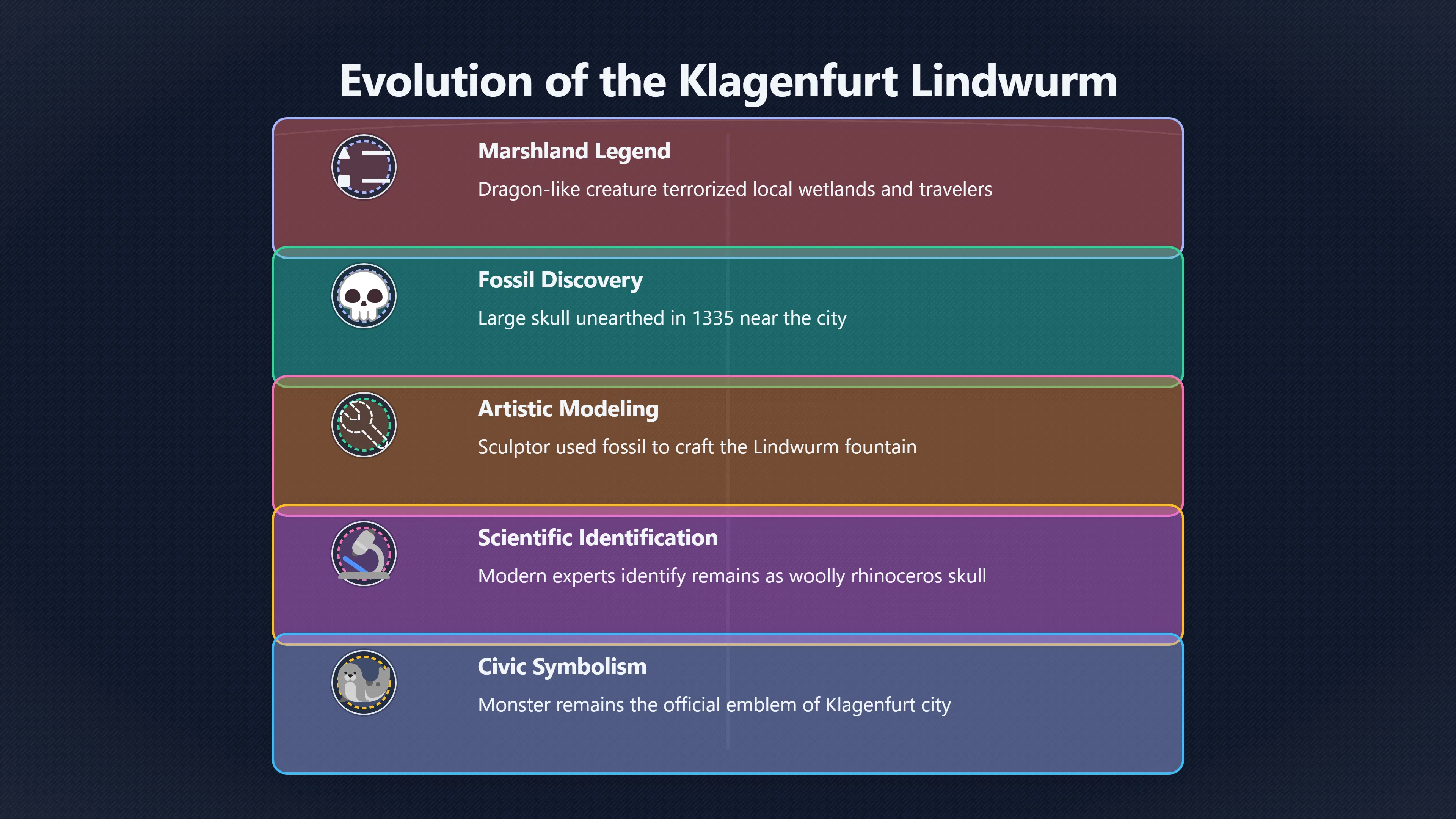
No Austrian monster has become more closely identified with a city than the Lindwurm of Klagenfurt. According to the traditional legend, a dragon-like creature terrorised the marshes where the city now stands, attacking travellers until local heroes trapped and killed it using a baited bull attached to chains and hooks. The story explained both the dangers of the old wetlands and the eventual founding of a safe settlement.[Austria in USA]austria.orgAustria in USAThe Lindwurm Dragon — Austria in USA5 Aug 2022 — The fountain shown here was built in 1583 from a solid piece of slate from…
What transformed this from a simple dragon tale into one of Europe’s most intriguing monster traditions was the discovery of a large skull in 1335. Unearthed near Klagenfurt, the fossil was interpreted as the head of the slain dragon. Modern palaeontology identifies it instead as the skull of a woolly rhinoceros (Coelodonta antiquitatis), an Ice Age mammal that disappeared thousands of years before recorded history.[austria.org]austria.orgAustria in USAThe Lindwurm Dragon — Austria in USA5 Aug 2022 — The fountain shown here was built in 1583 from a solid piece of slate from…
The fossil did more than reinforce belief. It influenced art. When the famous Lindwurm fountain was commissioned in the late sixteenth century, the sculptor appears to have modelled the dragon’s head on the fossil skull. Historians of palaeontology frequently note this as one of the earliest known attempts to reconstruct an extinct animal from fossil remains, even though the reconstruction was interpreted as a mythical creature rather than a prehistoric rhinoceros.[rhinoresourcecenter.com]rhinoresourcecenter.comthe klagenfurt lindwurmRhino Resource CenterThe Klagenfurt LindwurmThe monument was erected in Klagenfurt in 1590 after a discovery of a rhinoceros skull not fa…
The monument remains at the heart of Klagenfurt’s main square and has become far more than an illustration of an old legend. It serves simultaneously as:
- the city’s emblem and civic symbol;
- a reminder of medieval storytelling;
- an accidental landmark in the history of palaeontology;
- a tourist attraction whose meaning has evolved alongside scientific understanding.
Rather than replacing the legend, the scientific explanation has added another layer to it. Visitors now encounter both stories together: the medieval dragon and the Ice Age rhinoceros that inspired it. That combination is one reason the Lindwurm remains one of Austria’s most distinctive pieces of Fortean heritage.[austria.org]austria.orgAustria in USAThe Lindwurm Dragon — Austria in USA5 Aug 2022 — The fountain shown here was built in 1583 from a solid piece of slate from…
Vienna’s basilisk and the deadly well
If Klagenfurt’s monster belonged to the marshes, Vienna’s belonged to the city itself.
According to a long-standing Viennese legend, a baker’s servant discovered a basilisk living at the bottom of a well in what is now Schönlaterngasse. The creature’s poisonous breath supposedly killed anyone who approached, while its gaze was said to be fatal. Unlike many medieval monster tales, this one was given a remarkably precise setting, with later versions even assigning a specific date in 1212.[Wikipedia]WikipediaOpen source on wikipedia.org.
The story follows a familiar medieval pattern. A wise adviser explains that the basilisk can be defeated only by confronting it with its own reflection. Armed with a mirror, a courageous apprentice descends into the well. The monster sees itself, is overcome by its own deadly power and dies, allowing the neighbourhood to return to normal.[Vienna Würstelstand]viennawurstelstand.comVienna Würstelstand BasiliskVienna WürstelstandBasilisk - Historical Spots in ViennaA wise man passing by explained that it was a Basilisk, grown from a chicken's eg…
The legend probably reflects several overlapping realities rather than a remembered encounter with an unknown creature.
- Medieval wells could contain foul air capable of rendering people unconscious.
- Deep wells often produced mysterious echoes, smells and sounds.
- The basilisk itself was already an established creature in European bestiaries, making it a ready explanation for unexplained dangers below ground.
- The mirror motif echoed broader European folklore in which monsters are defeated by turning their own powers against them.[viennawurstelstand.com]viennawurstelstand.comVienna Würstelstand BasiliskVienna WürstelstandBasilisk - Historical Spots in ViennaA wise man passing by explained that it was a Basilisk, grown from a chicken's eg…
Today the building known as the Basiliskenhaus preserves the story through decorative artwork on its façade, ensuring that the legend remains physically attached to a recognisable location rather than surviving only in written collections of folklore.[Travelwriticus.com]travelwriticus.comThe fabulous creature lived in the well of the building.Read moreBasiliskenhaus in Vienna - Travelwriticus.comMay 18, 2026 — 19 May 2026 — The mural at this house shows a myth about a baker servant who…
Why these monsters feel unusually real
Many European towns have dragon stories, but Austria’s urban monster legends possess an unusual quality: each gained credibility through something tangible.
In Klagenfurt, that tangible object was a fossil whose true identity would not be recognised until centuries later. The existence of a real skull made the dragon appear historically grounded even though the interpretation proved incorrect. Modern science corrected the identification without removing the story’s cultural importance.[OEMG 2005]oemg2005.aau.atlindwurm storyOEMG 2005Lindwurm storyIn 1335 the cranium of a woolly rhinoceros from the ice-age was found in a gravel pit near Klagenfurt. It was inst…
In Vienna, the physical anchor was not a fossil but a location. A genuine well beneath a real house provided the perfect stage for explaining mysterious illnesses, dangerous gases or frightening experiences underground. The house itself became part of the legend, allowing each generation to point to the place where the monster supposedly lived.[Wikipedia]WikipediaOpen source on wikipedia.org.
In both cases, physical evidence was less important than physical presence. People could stand where the events were believed to have happened, making the stories feel more immediate than legends attached only to distant mountains or vanished castles.
How civic legends become monuments
These Austrian stories demonstrate how local identity can preserve legends long after belief in the monsters themselves has faded.
The Lindwurm became Klagenfurt’s heraldic symbol, appearing in public art, souvenirs and official imagery. Scientific reinterpretation did not diminish its value; instead, the city now celebrates both the dragon legend and the remarkable fossil that inspired its appearance. The story has become an example of how folklore and science can coexist rather than compete.[Austria in USA]austria.orgAustria in USAThe Lindwurm Dragon — Austria in USA5 Aug 2022 — The fountain shown here was built in 1583 from a solid piece of slate from…
Vienna’s basilisk followed a different path. Rather than becoming a city emblem, it became a neighbourhood landmark. The tale survives because the building and street remain part of the historic city, allowing residents and visitors to encounter the legend during an ordinary walk through the old town.[Wikipedia]WikipediaOpen source on wikipedia.org.
Together, these legends illustrate a recurring feature of Austrian strange history. The monsters endure not because anyone expects to find them today, but because they became woven into the physical fabric of the places they supposedly haunted. A fossil became a dragon, a dangerous well became a basilisk’s lair, and both stories outlived the beliefs that first gave them life.
Amazon book picks
Further Reading
Books and field guides related to When Austrian Monsters Had Bones and Addresses. Use these as the next step if you want deeper reading beyond the article.
The Mammoth Book of Unexplained Phenomena
Provides comparative unexplained folklore from Europe.

The Penguin Book of Dragons
Explores dragon legends that illuminate the Lindwurm tradition.

Dragons: A Natural History
Discusses dragon traditions through folklore and mistaken fossils.
eBay marketplace picks
Marketplace Samples
Live-tested eBay searches with available results related to this page.

Endnotes
1.
Source: austria.org
Link:https://www.austria.org/wahrzeichen/klagenfurt
Source snippet
Austria in USAThe Lindwurm Dragon — Austria in USA5 Aug 2022 — The fountain shown here was built in 1583 from a solid piece of slate from...
2.
Source: Wikipedia
Title: Woolly rhinoceros
Link:https://en.wikipedia.org/wiki/Woolly_rhinoceros
3.
Source: vanderkrogt.net
Link:https://vanderkrogt.net/statues/object.php?record=atka019&webpage=ST
Source snippet
It has been cited as the...Read more...
4.
Source: Wikipedia
Link:https://en.wikipedia.org/wiki/Sch%C3%B6nlaterngasse
5.
Source: Wikipedia
Link:https://en.wikipedia.org/wiki/Basilisk
6.
Source: travelwriticus.com
Title: The fabulous creature lived in the well of the building.Read more
Link:https://www.travelwriticus.com/vienna-basiliskenhaus-mural/
Source snippet
Basiliskenhaus in Vienna - Travelwriticus.comMay 18, 2026 — 19 May 2026 — The mural at this house shows a myth about a baker servant who...
Published: May 18, 2026
7.
Source: Wikipedia
Link:https://en.wikipedia.org/wiki/Lindworm
Source snippet
Lindworm(Lindwurmbrunnen [de]) in Klagenfurt, Austria, is modeled on the skull of a woolly rhinoceros found in a nearby quarry in 1335...
8.
Source: youtube.com
Title: Monsters of The Alps: Unearthing the Dragon’s Skull
Link:https://www.youtube.com/watch?v=ZKJeKqefJv8
Source snippet
Klagenfurt - Austria HD Travel Channel...
9.
Source: youtube.com
Link:https://www.youtube.com/watch?v=t-tvzsCtC_U
10.
Source: oemg2005.aau.at
Title: lindwurm story
Link:https://oemg2005.aau.at/lindwurm_story.html
Source snippet
OEMG 2005Lindwurm storyIn 1335 the cranium of a woolly rhinoceros from the ice-age was found in a gravel pit near Klagenfurt. It was inst...
11.
Source: rhinoresourcecenter.com
Title: the klagenfurt lindwurm
Link:https://rhinoresourcecenter.com/library/images/the-klagenfurt-lindwurm/
Source snippet
Rhino Resource CenterThe Klagenfurt LindwurmThe monument was erected in Klagenfurt in 1590 after a discovery of a rhinoceros skull not fa...
12.
Source: viennawurstelstand.com
Title: Vienna Würstelstand Basilisk
Link:https://viennawurstelstand.com/location/basilisk-historical-spots-in-vienna/
Source snippet
Vienna WürstelstandBasilisk - Historical Spots in ViennaA wise man passing by explained that it was a Basilisk, grown from a chicken's eg...
Additional References
13.
Source: mythosjourney.com
Link:https://www.mythosjourney.com/encyclopedia/pages/lindworm/
Source snippet
LindwormAn interesting historical connection exists at the Lindwurm Fountain (Lindwurmbrunnen) in Klagenfurt, Austria, where a 16th-centu...
14.
Source: secretvienna.org
Link:https://secretvienna.org/basilisk-of-vienna/
15.
Source: reddit.com
Link:https://www.reddit.com/r/interestingasfuck/comments/k6ktfq/the_skull_of_lindworm_was_discovered_in_a_quarry/
Source snippet
Austria in 1335. It was believed to be the skull of a dragon and gave birth to a popular myth.Read more...
16.
Source: facebook.com
Link:https://www.facebook.com/vikingverse/posts/the-head-of-the-16th-century-lindworm-statue-at-lindwurm-fountain-in-klagenfurt-/2102853596506213/
Source snippet
rt is modeled on the skull of a woolly rhinoceros found in a nearby quarry in 1335.Read more...
17.
Source: questoapp.com
Link:https://questoapp.com/vienna/places-to-visit/basilikenhaus
Source snippet
Basilikenhaus Vienna - The Legendary Basilisk House &...On June 26, 1212, something terrifying was discovered in the well of baker Marti...
Published: June 26, 1212
18.
Source: youtube.com
Link:https://www.youtube.com/watch?v=47ggYfdrQLY
Source snippet
Dinosaurs in Medieval Folklore? | How Fossils Inspired Legends of Dragons and Giants...
19.
Source: travelpotpourri.net
Title: Do not look at the basilisk!
Link:https://travelpotpourri.net/2015/10/29/do-not-look-at-the-basilisk/
Source snippet
travel potpourri29 Oct 2015 — The story about the basilisk. It was in 1212, a baker Garhiebl lived in a house in downtown. One day he sen...
20.
Source: wyrmflight.wordpress.com
Link:https://wyrmflight.wordpress.com/2016/09/28/the-klagenfurt-lindworm/
Source snippet
Klagenfurt Lindworm | Wyrmflight - WordPress.com28 Sept 2016 — As science advanced, scholars realized that the fossil skull was actually...
21.
Source: instagram.com
Link:https://www.instagram.com/p/DMKYLXfMchd/
Source snippet
to an old Viennese legend, in 1212, a journeyman baker...Read more...
22.
Source: youtube.com
Link:https://www.youtube.com/watch?v=aHum-qgkNAA
Source snippet
Monsters of The Alps: Unearthing the Dragon's Skull...
Topic Tree