Within Niger Weird
Were Niger's Monsters Ever Meant as Animals?
Niger's monster folklore uses ogres, buffalo-beasts and tiny tricksters to turn fear of river, bush and hunger into memorable stories.
On this page
- Hira and the monster buffalo motif
- Dodo, Zankallala and ogre storytelling
- Cryptid temptation versus folklore evidence
Page outline Jump by section
Introduction
Niger’s monster traditions rarely describe animals waiting to be discovered by zoologists. The more interesting pattern is that river, bush and wilderness become stages for stories about danger, courage and social order. Among Songhai and neighbouring river traditions, the Hira appears as a terrifying buffalo-like beast linked to the Niger River world, while Hausa storytelling preserves ogres such as Dodo and unlikely heroes such as Zankallala who defeat monsters through intelligence rather than strength.[Wikipedia]WikipediaHira (mythical monsterHira (mythical monster

These tales can look like early “cryptid” reports because they feature giant creatures, unusual powers and encounters in real landscapes. Yet the evidence points mainly towards oral literature and moral storytelling rather than forgotten species descriptions. Their importance for Niger’s strange-history record lies in the way they preserve human fears of rivers, forests, hunger and the unknown — not in proving that monsters once roamed the country.[Wikipedia]WikipediaHira (mythical monsterHira (mythical monster
Hira and the Monster Buffalo Motif
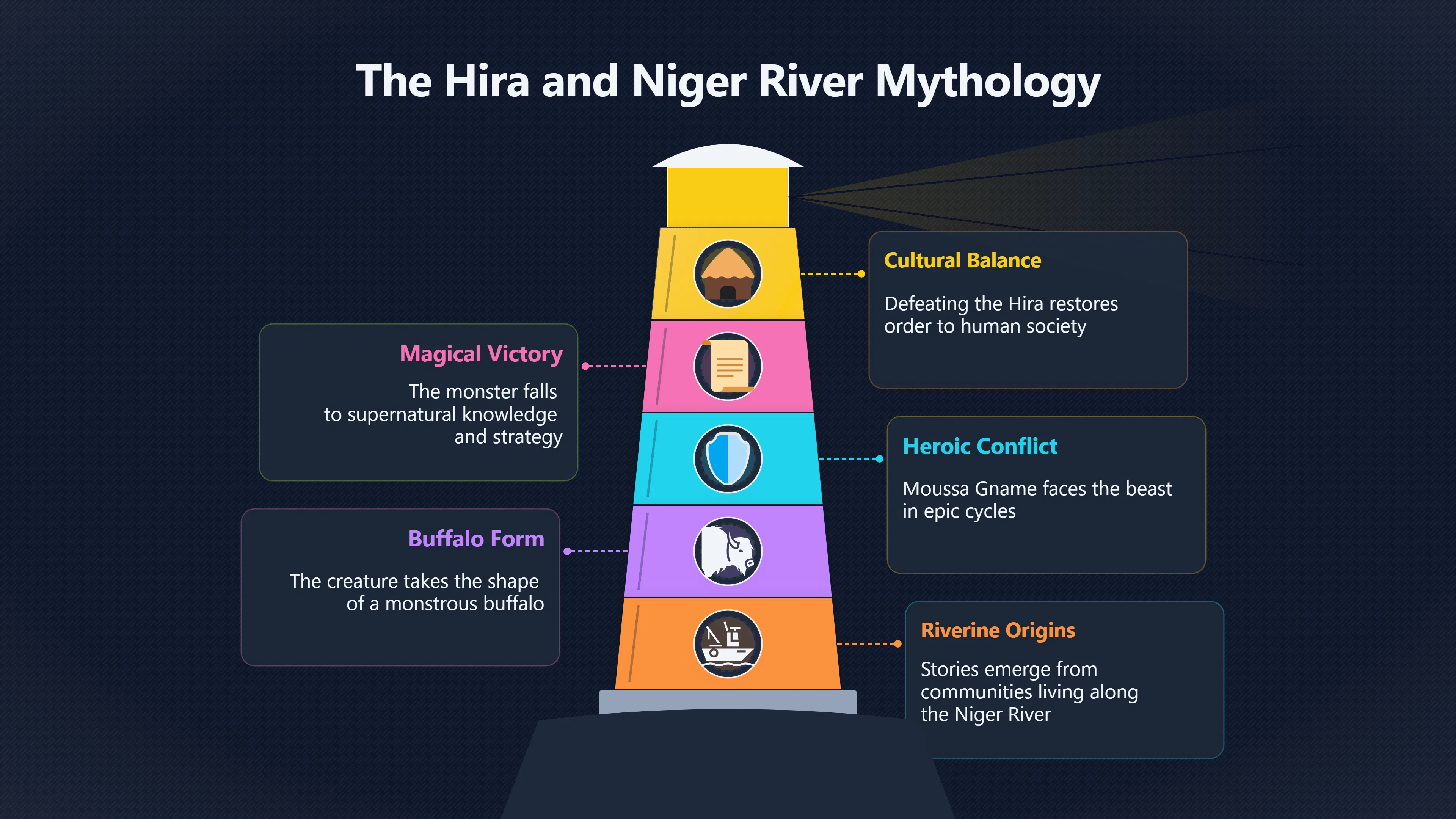
The Hira is one of the clearest examples of a creature that sits between natural animal imagery and mythic transformation. In Songhai epic tradition, particularly stories associated with river communities such as the Bozo, the Hira is portrayed as a monstrous buffalo of exceptional power and violence. The earliest published collections connected with this cycle include the work of M. A. Dupuis Yakouba, who recorded Songhai legends in the early twentieth century. Later studies of African epic traditions have discussed the Hira as part of the wider heroic cycle surrounding Moussa Gname.[Wikipedia]WikipediaHira (mythical monsterHira (mythical monster
The creature’s setting matters. The Niger River has long been a centre of fishing, travel and settlement, and communities living beside it developed stories that reflected both dependence on and anxiety about the landscape. The Hira is not simply a large animal. It represents uncontrolled force: something from outside ordinary human society that threatens farms, hunters and villages. The monster’s buffalo form also makes cultural sense in a region where powerful wild animals carried symbolic weight.[Wikipedia]WikipediaHira (mythical monsterHira (mythical monster
The Hira and the Hero Moussa Gname
In the epic tradition, the Hira is defeated by Moussa Gname, a culture hero whose own origins are supernatural. The story combines familiar heroic themes: a mysterious birth, hidden knowledge, a dangerous enemy and a final victory achieved through special understanding rather than ordinary combat.[Wikipedia]WikipediaMoussa GnameMoussa Gname
The details of the victory reveal that the tale is not trying to function like a hunting report. The Hira’s weakness involves magical knowledge, transformation and clever strategy. In one version, a female elephant becomes central to the defeat of the monster, and the hero uses a part of the creature itself as a means of overcoming it. Such elements belong to the logic of epic storytelling, where the monster’s defeat restores balance rather than solving a zoological mystery.[Wikipedia]WikipediaHira (mythical monsterHira (mythical monster
For modern readers interested in monsters, the Hira creates an obvious temptation: could an unusual buffalo sighting have become exaggerated over generations? That possibility cannot be ruled out for every animal legend, but the surviving evidence does not describe witnesses, tracks, specimens or repeated encounters. The Hira is best understood as a legendary beast shaped by river culture and heroic storytelling.

Dodo, Zankallala and Ogre Storytelling
Hausa oral traditions contain another family of frightening beings: ogres and man-eaters that test human cleverness. The Dodo is among the best-known examples. Unlike the extinct bird with the same name, the Hausa Dodo is a monstrous figure of folklore, commonly presented as a dangerous being associated with wilderness, fear and the threat of being consumed. Collections of Hausa tales recorded in the early twentieth century include stories such as “How Auta killed Dodo” and “How the Zankallala killed Dodo”, showing that the creature was already embedded in a recognised storytelling tradition.[Wikimedia Commons]upload.wikimedia.orgWikimedia CommonsHausa folk-tales: the Hausa text of the stories in Hausa superstitions and customs, in Folk-lore, and in other publicat…
The Dodo’s role is closer to an ogre in European fairy tales than to a proposed unknown animal. It exists to create a problem that demands courage, wit or moral judgement. The monster is frightening because it represents the dangers outside the protected world of family and settlement: hunger, isolation, violence and the unpredictable bush.[Mythlok]mythlok.comDodo: The Fearsome Forest Horror from African Folklore | MythlokDodo: The Fearsome Forest Horror from African Folklore | MythlokApril 2, 2024…
Zankallala provides the opposite image. Instead of defeating danger through size, this tiny trickster figure wins through intelligence. In Hausa tales, Zankallala’s confrontation with Dodo reverses expectations: the apparently weak creature defeats the giant threat. The contrast between enormous monster and small but clever opponent is a recurring pattern in folklore worldwide, where intelligence becomes a form of power.[Mythlok]mythlok.comZankallala: The Tiny MonsterZankallala: The Tiny Monster - MythlokMay 13, 2025…
The importance of these stories is therefore not that they preserve memories of literal monsters, but that they encode social lessons. A child hearing a Dodo tale is not simply being warned about a creature in the forest. The story teaches that danger exists, but also that bravery, patience and clever thinking can overcome it.
Cryptid Temptation Versus Folklore Evidence
Monster traditions often attract modern cryptozoological interest because they contain some of the same ingredients as mystery-animal reports: unusual bodies, frightening encounters and links to remote landscapes. Niger’s Hira, Dodo and related beings can easily be placed into that category by readers searching for “African monsters”. However, the evidence base is different from that of a claimed modern animal sighting.[Wikipedia]WikipediaHira (mythical monsterHira (mythical monster
A cryptid claim usually depends on questions such as:
- Are there independent witnesses?
- Are descriptions consistent across reports?
- Are there physical traces, photographs or remains?
- Does the creature fit a possible biological category?
The Hira and Dodo traditions answer different questions. They belong to oral performance, epic cycles and moral storytelling. Their “evidence” is cultural: repeated transmission, memorable characters and their ability to explain human experiences. The fact that a story survives does not mean the creature existed as an animal, but it does show that the creature mattered.
This distinction is especially important in Niger because the country’s monster traditions are tied closely to real environments. Rivers, floodplains, forests and savannahs contain genuine hazards: dangerous animals, isolation, drought and sudden environmental change. Folklore transforms those realities into memorable figures. The monster becomes a way of giving shape to uncertainty.
The lasting appeal of these tales comes from that overlap between reality and imagination. A buffalo can become a supernatural force. A dangerous wilderness can become the home of an ogre. A tiny trickster can defeat a giant. The stories do not need to describe undiscovered animals to remain powerful; they preserve how communities imagined survival in a demanding landscape.[Wikipedia]WikipediaHira (mythical monsterHira (mythical monster
Amazon book picks
Further Reading
Books and field guides related to Were Niger's Monsters Ever Meant as Animals?. Use these as the next step if you want deeper reading beyond the article.


Monsters: A Bestiary of the Bizarre
Directly fits monster traditions and creature narratives.

eBay marketplace picks
Marketplace Samples
Live-tested eBay searches with available results related to this page.

Endnotes
1.
Source: Wikipedia
Title: Hira (mythical monster)
Link:https://en.wikipedia.org/wiki/Hira_%28mythical_monster%29
2.
Source: upload.wikimedia.org
Link:https://upload.wikimedia.org/wikipedia/commons/8/80/Hausa_folk-tales.pdf
Source snippet
Wikimedia CommonsHausa folk-tales: the Hausa text of the stories in Hausa superstitions and customs, in Folk-lore, and in other publicat...
3.
Source: Wikipedia
Title: West African mythology
Link:https://en.wikipedia.org/wiki/West_African_mythology
4.
Source: Wikipedia
Title: Bozo people
Link:https://en.wikipedia.org/wiki/Bozo_people
5.
Source: Wikipedia
Title: Moussa Gname
Link:https://en.wikipedia.org/wiki/Moussa_Gname
6.
Source: commons.wikimedia.org
Title: Commons File:Hausa folk-tales.pdf
Link:https://commons.wikimedia.org/wiki/File%3AHausa_folk-tales.pdf
Source snippet
wikimedia.orgFile:Hausa folk-tales.pdf - Wikimedia CommonsFILE:HAUSA FOLK-TALES.PDF * File * Discussion [Input] English * Read * Edit * V...
7.
Source: mythlok.com
Title: Dodo: The Fearsome Forest Horror from African Folklore | Mythlok
Link:https://mythlok.com/dodo/
Source snippet
Dodo: The Fearsome Forest Horror from African Folklore | MythlokApril 2, 2024...
Published: April 2, 2024
8.
Source: mythlok.com
Title: Zankallala: The Tiny Monster
Link:https://mythlok.com/zankallala/
Source snippet
Zankallala: The Tiny Monster - MythlokMay 13, 2025...
Published: May 13, 2025
9.
Source: commons.wikimedia.org
Link:https://commons.wikimedia.org/wiki/File%3AHausa_folk-tales_-the_Hausa_text_of_the_stories_in_Hausa_superstitions_and_customs%2C_in_Folk-lore%2C_and_in_other_publications%28IA_hausafolktalesha00tremrich%29.pdf
Source snippet
wikimedia.orgFile:Hausa folk-tales.pdf - Wikimedia CommonsFILE:HAUSA FOLK-TALES.PDF * File * Discussion [Input] English * Read * Edit * V...
10.
Source: mythlok.com
Title: Immerse yourself in a world
Link:https://mythlok.com/world-mythologies/african/west-african-mythology/hausa/
Source snippet
Hausa Mythology: Spirit Lore, Creation Beliefs & Sacred Traditions | MythlokHAUSA MYTHOLOGY Embark on a captivating journey into the myst...
11.
Source: abookofcreatures.com
Title: He is only the size of two clenched fists, but he wields a snake as a walking-s
Link:https://abookofcreatures.com/2021/05/07/zankallala/
Source snippet
Zankallala | A Book of CreaturesMay 7, 2021 — A Book of Creatures ZANKALLALA The Zankallala is a terrifyingly mighty creature from the fo...
Published: May 7, 2021
12.
Source: noobs-guide-to-necromancy.fandom.com
Link:https://noobs-guide-to-necromancy.fandom.com/wiki/Hira
Source snippet
Noobs Guide to Necromancy Wiki | FandomHIRA Sign In to Save Save Edit * History * Purge * Talk (0) iframe HIRA SECTION HEADER NAME hira...
13.
Source: cryptidz.fandom.com
Link:https://cryptidz.fandom.com/wiki/Zankallala
Source snippet
is a legendary creature from the folklore of the Hausa people of West Afric...
14.
Source: wmic.net
Link:https://wmic.net/african-cultures/bozo/
Source snippet
The name Bozo is thought to derive from Bambara bo-so “straw house.” The people accept it as referring to the whole of the ethnic gro...
15.
Source: abookofcreatures.com
Link:https://abookofcreatures.com/category/niger/
Source snippet
22 Jul 2015 — The third time the dodo swallowed him, the Zankallala emerged from the monster's head, killing it.... African folklore, Bo...
Additional References
16.
Source: abookofcreatures.com
Link:https://abookofcreatures.com/tag/african-folklore/
Source snippet
African folkloreEven the dodo, the fearsome monster, the Swallower-of-Men, is powerless before the Zankallala. Once a boy was being chase...
17.
Source: hauniversity.org
Link:https://www.hauniversity.org/en/Bozo.shtml
Source snippet
Bozo (Mandinka): people of Mali, NigerBOZO (MANDINKA): PEOPLE OF MALI, NIGER BOZO PEOPLE (MASTERS OF THE RIVER, FISHING, NIGER, MALI, WES...
18.
Source: si.edu
Link:https://www.si.edu/object/siris_sil_746530
Source snippet
Conrad; narrated by Djanka Tassey Condé | Smithsonian InstitutionSUNJATA: A WEST AFRICAN EPIC OF THE MANDE PEOPLES / RECORDED, EDITED...
19.
Source: encyclopedia.com
Link:https://www.encyclopedia.com/arts/culture-magazines/epic-son-jara
Source snippet
The Epic of Son-Jara | Encyclopedia.comTHE EPIC OF SON-JARA views updated THE EPIC OF SON-JARA as told by Fa-Digi Sisòkò THE LITERARY WOR...
20.
Source: cir.nii.ac.jp
Link:https://cir.nii.ac.jp/crid/1390290699797082112
Source snippet
tu and Islam: Socioeconomic and Religious Changes among the Bozo | CiNii ResearchMarch 29, 1989 — JII TU AND ISLAM: SOCIOECONOMIC AND R...
Published: March 29, 1989
21.
Source: academia.edu
Link:https://www.academia.edu/115558863/Ogres_monsters_and_demons_in_the_oral_narratives_of_Africa_Dodo_the_Hausa_example
22.
Source: mukarasani.com
Link:https://www.mukarasani.com/mukarasani/index.php?id=975
Source snippet
February 16, 2026 — Moussa HAMIDOU IDRISSA ÉPOPÉE ET RÉSISTANCE DES HÉROS SONGHAÏ-ZARMA DANS LA CHANSON DITE MODERNE NIGÉRIENNE Article R...
Published: February 16, 2026
23.
Source: joshuaproject.net
Link:https://joshuaproject.net/people_groups/15003/NI
Source snippet
Bozo, Jenaama in Nigeria people group profile | Joshua ProjectJENAAMA BOZO IN NIGERIA IMAGE Image: Bozo, Jenaama Photo...
24.
Source: dandali.com
Link:https://www.dandali.com/Hausa_Folklore.html
Source snippet
COLLECTED AND TRANSLITERATED WITH ENGLISH TRANSLATION AND NOTES BY R. SUTHERLAND RATTRAY, F.R.G.S., F.R...
25.
Source: everand.com
Title: These groups have become assimilated to the larger populations tha
Link:https://www.everand.com/book/813579026/African-Myths-of-Origin
Source snippet
African Myths of Origin by Stephen Belcher (Ebook) - Read free for 30 daysDecember 1, 2005 — 3 THE SONGHAY HUNTERS OF THE NIGER RIVER The...
Published: December 1, 2005
Topic Tree