Within Weird Bulgaria
When Bulgarian Monsters Dance in Public
Bulgaria's winter masquerades and fire-walking rites show how fear, protection and spectacle can survive as public heritage.
On this page
- Surova masks, bells and winter protection
- Nestinarstvo fire walking and ritual context
- How heritage turns fear into spectacle
Page outline Jump by section
Introduction
Bulgaria’s most striking “monsters” are not creatures lurking in forests or lakes. They are people who deliberately become something uncanny through towering masks, animal skins, deafening bells and ritual performance. Alongside them, barefoot fire-walkers step across glowing embers during religious celebrations that blend Orthodox Christianity with much older local customs. Neither tradition asks spectators to believe in the supernatural as a matter of proof. Instead, both make the invisible visible by acting out fears about illness, bad luck, evil influences and the uncertainty of the changing seasons.
For anyone interested in Bulgaria’s strange traditions, these customs matter because they are living practices rather than forgotten legends. They continue to be performed by local communities, have been documented by ethnographers for generations and are recognised by UNESCO as part of humanity’s intangible cultural heritage. Rather than surviving in secret, the uncanny has become part of public cultural life, where ritual monsters and fire-walkers are celebrated, debated and photographed every year.[UNESCO ICH]ich.unesco.orgUNESCO ICHSurova folk feast in Pernik regionThe Surova folk feast in Pernik region takes place each year on 13 and 14 January to celebrat…
When Bulgarian Monsters Dance in Public
The winter masquerades associated with the Surova celebrations transform ordinary villagers into deliberately unsettling figures. Huge masks with exaggerated noses, horns, feathers, animal heads and painted faces erase individual identity. Heavy belts carrying dozens of bells announce the performers long before they appear, filling village streets with an almost overwhelming metallic roar.
The aim is not simply entertainment. Traditionally, the frightening appearance and relentless noise are understood as symbolic protection. Evil spirits, disease and misfortune are challenged by beings that look even more terrifying than the dangers they are supposed to repel. The performers become temporary guardians of the community, occupying the uncertain space between humans, animals and spirits.
UNESCO describes the Surova celebrations in the Pernik region as taking place on 13 and 14 January according to the old calendar. Groups of masked participants gather around large fires before processing through the village, visiting homes, performing ritual dances and offering blessings intended to encourage health, fertility and prosperity in the coming year. The tradition now includes men, women and children, reflecting its role as a community celebration rather than an exclusive ritual society.[UNESCO ICH]ich.unesco.orgUNESCO ICHSurova folk feast in Pernik regionThe Surova folk feast in Pernik region takes place each year on 13 and 14 January to celebrat…
Surova masks, bells and winter protection
The most memorable feature of the Surova tradition is the mask itself. Some stand several metres high, constructed from wood, feathers, cloth, horns and brightly coloured decorations. Others resemble exaggerated animals or grotesque human faces. Their purpose is symbolic rather than theatrical realism.
Several elements combine to create the uncanny effect:
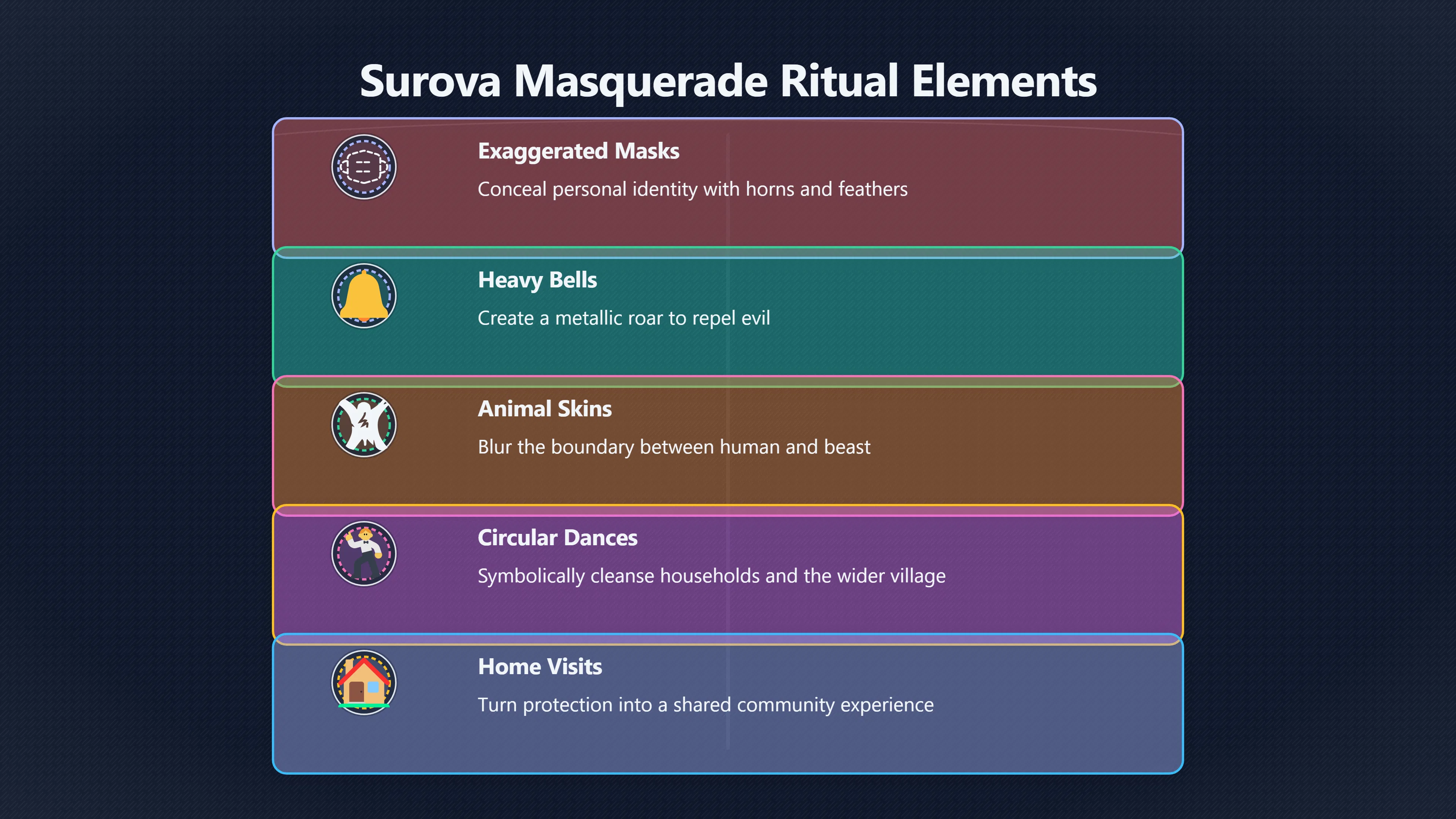
- Masks conceal personal identity and replace it with an exaggerated supernatural appearance.
- Animal skins and horns blur the boundary between human and beast.
- Massive bells create a physical wall of sound believed to drive away harmful influences.
- Circular dances and processions symbolically cleanse both households and the wider village.
- Visits to homes turn protection into something shared rather than merely observed.
To modern visitors the performances can resemble horror costumes mixed with carnival, but historically they functioned as seasonal rituals marking the dangerous transition between one year and the next. Winter represented scarcity, disease and uncertainty. Making frightening figures visible was a symbolic way of confronting invisible threats.
Researchers studying the Pernik region have also noted that the masquerades have adapted rather than fossilised. Costumes change, younger generations participate more actively than in the past, and festivals now welcome international performers while still preserving distinctive local forms passed through families and neighbourhood groups.[ResearchGate]researchgate.netResearchGate(PDF) Masquerade Games in the Pernik Region of BulgariaThe games with masks in the region are performed on the Surva feast da…
Why walking through fire is different from a stunt
If the masked dancers externalise fear through costume and noise, Bulgaria’s fire-walking tradition turns inward. The practice known as Nestinarstvo centres on barefoot dancing over glowing embers during celebrations honouring Saints Constantine and Helena in villages of the Strandzha region.
To outsiders the spectacle appears almost impossible. Participants carry sacred icons while musicians play traditional drums and bagpipes, eventually stepping calmly across the embers. The apparent absence of serious burns has inspired generations of visitors to search for supernatural explanations.
Within the tradition itself, however, the emphasis lies elsewhere. The fire is part of a religious and communal ritual rather than an attempt to demonstrate magical immunity. Experienced participants describe entering a highly focused emotional and spiritual state connected to prayer, music, movement and inherited custom rather than performing an endurance challenge. UNESCO identifies the ritual specifically with the village of Bulgari, where it survives as part of an annual celebration preserving both Orthodox Christian devotion and much older regional beliefs.[UNESCO ICH]ich.unesco.orgUNESCO ICHBulgaria - UNESCO Intangible Cultural Heritage2015: Surova folk feast in Pernik region (RL). 2014: The tradition of carpet-maki…
Nestinarstvo fire-walking and ritual context
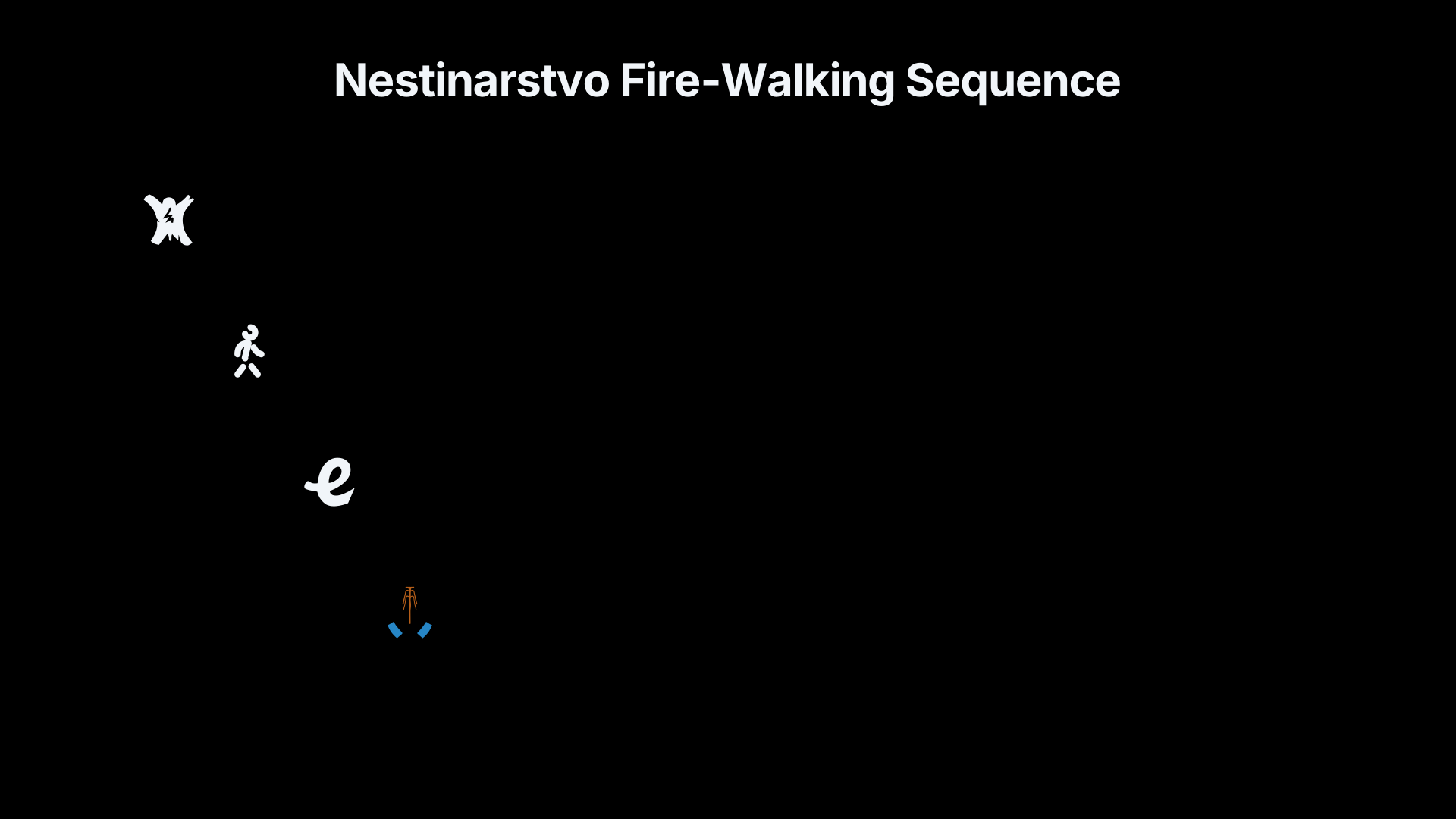
The ceremony follows a structured sequence rather than spontaneous spectacle.
Icons associated with Saints Constantine and Helena are treated with particular reverence. Traditional musicians maintain rhythmic accompaniment throughout the procession, and only after the ceremonial preparation do recognised fire-walkers enter the glowing embers.
Anthropologists have proposed several overlapping explanations for the remarkable performance:
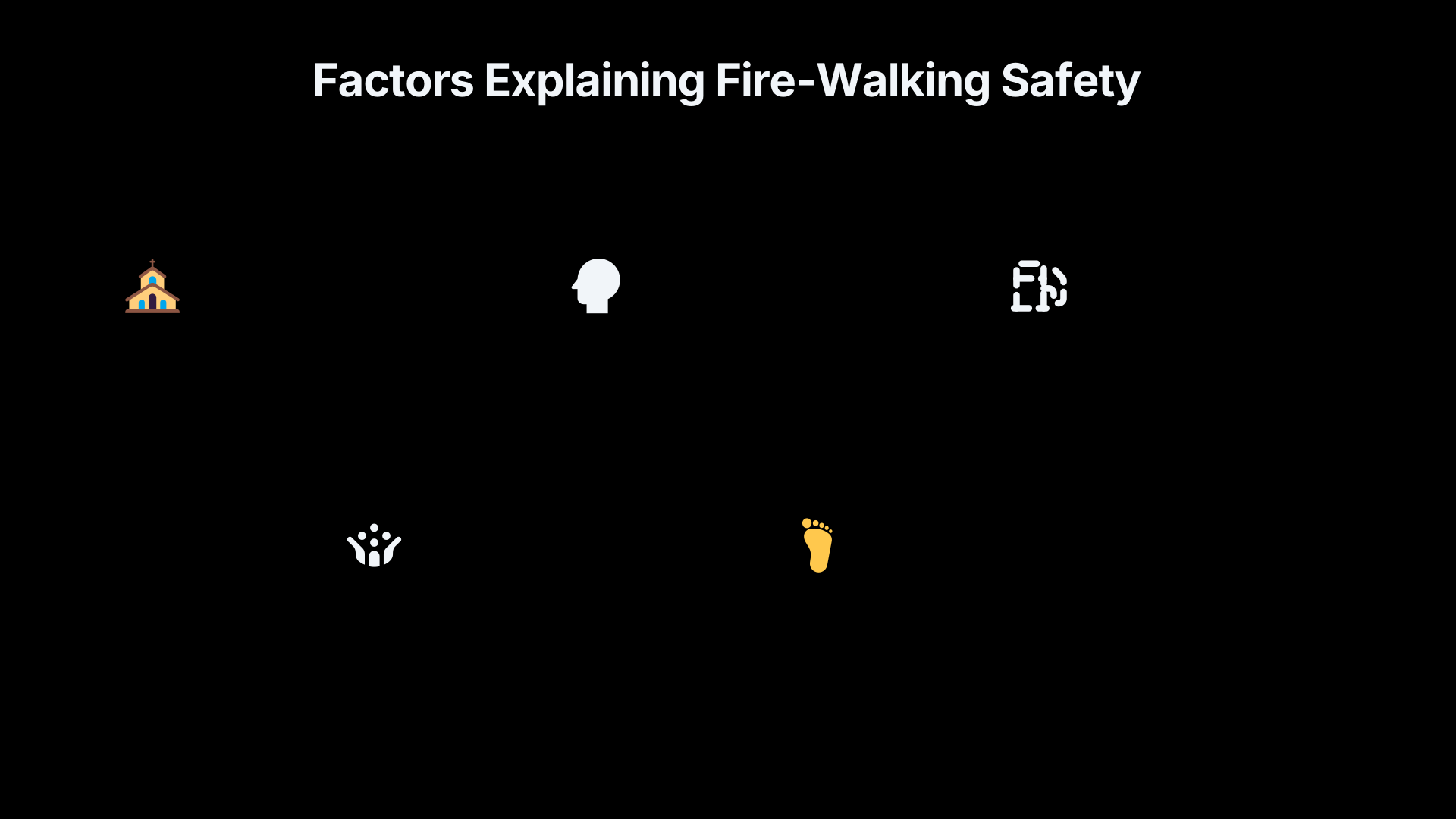
- Religious devotion encourages participants to understand the experience as service to the saints rather than personal achievement.
- Psychological absorption may reduce awareness of pain during highly emotional ritual states.
- Practical physical factors, including brief contact with the embers and the relatively poor heat transfer of charcoal, help explain why serious injuries are less common than many observers assume.
- Community tradition ensures that experienced practitioners guide the ceremony rather than encouraging reckless imitation.
None of these explanations completely removes the sense of wonder experienced by spectators. The ritual remains visually extraordinary precisely because it combines genuine physical risk with disciplined ceremonial control. Ethnographers generally caution against reducing it either to miraculous intervention or to a simple physics demonstration. Its meaning depends on the entire ritual setting rather than the embers alone.[Wikipedia]WikipediaOpen source on wikipedia.org.
How heritage turns fear into spectacle
One of the most intriguing aspects of these traditions is that they have shifted from local seasonal customs to internationally recognised cultural heritage without losing all of their mystery.
The Surova masquerades now attract thousands of performers and visitors to the international festival in Pernik. What was once primarily a village obligation has become a celebrated public event, yet many participants still describe themselves as continuing family traditions rather than staging historical re-enactments. The frightening masks remain symbols of protection even when photographed by tourists and shared on social media.[Wikipedia]WikipediaSurva FestivalSurva Festival
Nestinarstvo has undergone a similar transformation. Recognition as intangible cultural heritage has helped preserve the ceremony while also raising difficult questions about tourism and authenticity. Scholars note that staged demonstrations outside their traditional religious context can appear dramatically similar while lacking the ceremonial framework that gives the original practice its cultural meaning. Heritage recognition therefore protects not merely the visible act of fire-walking but the surrounding music, processions, sacred objects and community memory.[UNESCO ICH]ich.unesco.orgUNESCO ICHBulgaria - UNESCO Intangible Cultural Heritage2015: Surova folk feast in Pernik region (RL). 2014: The tradition of carpet-maki…
Why these traditions remain part of Bulgaria’s strange history
From a Fortean perspective, the enduring fascination lies not in proving paranormal powers but in understanding why these rituals continue to feel uncanny even after decades of careful documentation.
The masked figures deliberately resemble beings that should not exist: part human, part animal, part demon, part comic performer. Fire-walkers appear to accomplish something that instinct says should be impossible. Both traditions create experiences that challenge ordinary expectations while remaining firmly embedded in recognised cultural practice.
Believers may speak of spiritual protection, blessings or inherited sacred power. Sceptics point to symbolism, psychology, ritual performance and the physical properties of charcoal. Neither interpretation fully captures why these customs remain compelling. Their power comes from making invisible anxieties visible, allowing fear itself to become something that can be danced with, laughed at and, at least for a night, driven away.
That combination of documented history, living performance and lingering mystery explains why Bulgaria’s masked rites and fire-walking ceremonies occupy such an important place in the country’s catalogue of strange traditions. They are not forgotten relics of superstition but active reminders that communities have long used ritual, spectacle and shared belief to confront the unknown.
Amazon book picks
Further Reading
Books and field guides related to When Bulgarian Monsters Dance in Public. Use these as the next step if you want deeper reading beyond the article.


The Penguin Book of Dragons
Supports broader interest in European legendary traditions.


Endnotes
1.
Source: ich.unesco.org
Link:https://ich.unesco.org/en/RL/surova-folk-feast-in-pernik-region-00968
Source snippet
UNESCO ICHSurova folk feast in Pernik regionThe Surova folk feast in Pernik region takes place each year on 13 and 14 January to celebrat...
2.
Source: ich.unesco.org
Link:https://ich.unesco.org/en/state/bulgaria-BG
Source snippet
UNESCO ICHBulgaria - UNESCO Intangible Cultural Heritage2015: Surova folk feast in Pernik region (RL). 2014: The tradition of carpet-maki...
3.
Source: ich.unesco.org
Title: ICHDecision of the Intergovernmental Committee: 10.CO M 10
Link:https://ich.unesco.org/en/decisions/10.COM/10.B.10
Source snippet
Intangible Cultural Heritage of Humanity: The Surova folk feast in Pernik region takes place each year on 13 and 14 January to celebrate...
4.
Source: researchgate.net
Link:https://www.researchgate.net/publication/357203201_Masquerade_Games_in_the_Pernik_Region_of_Bulgaria_Preserving_and_Promoting_Intangible_Cultural_Heritage
Source snippet
ResearchGate(PDF) Masquerade Games in the Pernik Region of BulgariaThe games with masks in the region are performed on the Surva feast da...
5.
Source: Wikipedia
Title: List of Intangible Cultural Heritage elements in Eastern Europe
Link:https://en.wikipedia.org/wiki/List_of_Intangible_Cultural_Heritage_elements_in_Eastern_Europe
6.
Source: Wikipedia
Link:https://en.wikipedia.org/wiki/Anastenaria
7.
Source: Wikipedia
Title: Surva Festival
Link:https://en.wikipedia.org/wiki/Surva_Festival
8.
Source: unesco.org
Title: document 4031
Link:https://www.unesco.org/archives/multimedia/document-4031
Source snippet
the Folk Feast Surova In Pernik Region | Intangible HeritageNov 10, 2015 — The Surova folk feast, held in villages of the Pernik region...
9.
Source: ich.unesco.org
Link:https://ich.unesco.org/doc/src/29917.pdf
Source snippet
National Inventory of the Intangible Cultural Heritage – “Living Human...Read more...
10.
Source: ich.unesco.org
Link:https://ich.unesco.org/en/video/32972
Source snippet
unesco.orgVideo: Surova folk feast in Pernik regionVideo: Surova folk feast in Pernik region. Surova folk feast in Pernik region (Bulgari...
11.
Source: ich.unesco.org
Link:https://ich.unesco.org/en/RL/traditional-brass-and-copper-craft-of-utensil-making-among-the-thatheras-of-jandiala-guru-punjab-india-00845?call=film&id=32972&include=film_inc.php&width=700
Source snippet
© 2013 by Ministry of Culture of the Republic of...
12.
Source: ich.unesco.org
Title: 30406 EN.doc
Link:https://ich.unesco.org/doc/src/30406-EN.doc
Source snippet
folk feast Surova with the traditional masquerade games is a live practice in the following towns and villages in Pernik region: Bela Vod...
13.
Source: unesco.org
Link:https://www.unesco.org/en/articles/irina-bokova-presents-unesco-intangible-cultural-heritage-certificate-bulgarias-surova-folk-feast
Source snippet
It is held every year in the Pernik region on 13 and 14 January to celebrate the New...Read more...
14.
Source: ich.unesco.org
Title: 10b representative list 00779
Link:https://ich.unesco.org/en/10b-representative-list-00779?id=32972&include=film.inc.php
Source snippet
Tap to unmute. Your... © 2013 by Ministry of Culture of the Republic of Bulgaria.Read more...
15.
Source: facebook.com
Title: UNESC O
Link:https://www.facebook.com/unesco/photos/bulgaria-surova-folk-feast-in-pernik-regionthe-surova-folk-feast-held-in-village/10153768261173390/
Source snippet
UNESCO - #Bulgaria - Surova folk feast in Pernik region...Bulgaria - Surova folk feast in Pernik region The Surova folk feast, held in v...
Additional References
16.
Source: survakari.com
Link:https://survakari.com/en/
Source snippet
The Surova Folk Feast in Pernik Region is inscribed in UNESCO's Representative list of the Intangible Cultural Heritage of Human...
17.
Source: unesco-centerbg.org
Link:https://www.unesco-centerbg.org/wp-content/uploads/2019/08/nkn-brochure-en.pdf
18.
Source: slowphotojournalism.org
Title: Bulgaria’s Strangest Folk Festival
Link:https://slowphotojournalism.org/portfolio/bulgarias-strangest-folk-festival/
Source snippet
PORTFOLIO -The inclusion of the Surova folk feast on UNESCO's Representative List of Intangible Cultural Heritage has strengthened the se...
19.
Source: sofiaexpats.com
Link:https://sofiaexpats.com/blog/surva-pernik-2026-practical-visitor-guide
Source snippet
Surva Pernik 2026: Exact Dates, Costumes & Visitor GuideDec 22, 2025 — Surva is an international festival of traditional masquerade games...
20.
Source: diplomaticspectrum.com
Title: Print · Email.Read more
Link:https://diplomaticspectrum.com/en/bulgaria/culture/664-surva-folk-holiday-bulgarian-treasure-in-the-unesco-representative-list-of-the-intangible-cultural-heritage-of-humanity.html
Source snippet
Surva Folk Holiday - Bulgarian Treasure in the UNESCO...Jan 15, 2026 — Surva Folk Holiday - Bulgarian Treasure in the UNESCO Representat...
21.
Source: brilltravel.com
Link:https://brilltravel.com/about-us-brill-travel/about-bulgaria-facts-figures/unesco-intangible-cultural-heritage/
Source snippet
UNESCO Intangible Cultural Heritage in Bulgaria25 Feb 2026 — Surva festival of masquerade games - 11 years on the Representative List of...
22.
Source: youtube.com
Title: Bulgaria’s Centuries-Old Kukeri Festival Uses Masks and Bells to Scare Away Evil
Link:https://www.youtube.com/watch?v=HUak2Cqo5kQ
Source snippet
Nestinarstvo (Firewalking)...
23.
Source: youtube.com
Link:https://www.youtube.com/watch?v=QkrI59d4Cus
Source snippet
Bulgaria's Centuries-Old Kukeri Festival Uses Masks and Bells to Scare Away Evil...
24.
Source: youtube.com
Title: The SURVA Tradition
Link:https://www.youtube.com/watch?v=jKYFfwRlxvA
Source snippet
"Kukeri": New Year's Bad Spirit Chasers...
25.
Source: youtube.com
Title: “Kukeri”: New Year’s Bad Spirit Chasers
Link:https://www.youtube.com/watch?v=dXDBiUPFaBQ
Topic Tree