Turkey's Monsters, UFOs and Living Legends
Turkey’s strange-history record is unusually rich because it sits at a crossroads of empire, migration, religion, geology and mass media.
Page outline Jump by section
Introduction
The most useful way to read Turkey’s Forteana is not as a catalogue of monsters and miracles, but as a set of pressure points. Lake Van shows how local legend can be revived by television and regional tourism. Kumburgaz shows how ambiguous video becomes a global UFO argument. Cappadocia shows that real archaeology can look more fantastic than fiction. The Mount Ararat ark tradition shows how a landscape can become a magnet for religious expectation, even when geologists see ordinary rock.
Why Turkey produces such memorable strange reports
Turkey has several ingredients that make anomalous stories travel well. It has ancient ruins that are genuinely spectacular, such as Göbekli Tepe, where UNESCO dates monumental stone structures to the Pre-Pottery Neolithic period, roughly 9,600–8,200 BCE, and describes carved T-shaped pillars with wild animal imagery linked to ritual life about 11,500 years ago. That alone is strange enough without adding aliens, lost civilisations or secret codes. Yet sites of that kind are especially vulnerable to fringe over-reading because they are old, visually dramatic and still partly mysterious to the wider public.[UNESCO World Heritage Centre]whc.unesco.orgOpen source on unesco.org.
It also has landscapes that invite myth: the saline expanse of Lake Van in the east, the volcanic tuff of Cappadocia, the mountains associated with flood traditions, and skies dark enough in some eastern and south-eastern regions to support both astronomy and skywatching. A study of light pollution in Turkey using VIIRS satellite data found that artificial light increased substantially between 2012 and 2020, while some darker eastern and south-eastern regions remained comparatively stable, a useful reminder that “mystery lights” are often shaped by changing visibility, urban growth and observational conditions.[arXiv]arxiv.orgarXiv The Temporal Analysis of Light Pollution in Turkey using VIIRS dataarXiv The Temporal Analysis of Light Pollution in Turkey using VIIRS data
Finally, Turkey’s public culture has long mixed serious belief with playful scepticism. Protective charms, saints’ tombs, dream warnings, uncanny villages and religious legends can be part of ordinary cultural texture without requiring every listener to treat them as literal fact. That flexible middle ground is exactly where Fortean stories thrive: not fully believed, not fully dismissed, but repeatedly retold.
Lake Van’s monster: Turkey’s best-known cryptid
The Lake Van monster is Turkey’s closest equivalent to a national lake-monster case. The modern version centres on Lake Van in eastern Turkey, where reports became especially visible in the 1990s. The story usually describes a large, dark, serpentine or reptile-like creature surfacing in the water, though descriptions vary in size and shape. AP archive material from 1997 noted that professional camera crews hired boats after reported sightings but failed to capture clear footage of the alleged creature.[newsroom.ap.org]newsroom.ap.orgOpen source on ap.org.
The strongest cultural anchor is not a clean zoological record, but the way older water-dragon traditions, Ottoman newspaper curiosities and modern media blended together. Later summaries of the tradition point to an Ottoman newspaper report from 29 April 1889 claiming that a creature dragged a man into Lake Van, after which an official survey group reportedly found nothing. A 2024 Daily Sabah feature repeated this 1889 newspaper tradition and noted that the myth became especially popular in the 2000s, when journalists and documentary makers continued to visit Van.[Daily Sabah]dailysabah.comDaily Sabah Myth meets majesty in Türkiye's Van: Ancient rootsDaily Sabah Myth meets majesty in Türkiye's Van: Ancient roots
The 1997 footage associated with local man Ünal Kozak gave the story its modern engine. It was widely circulated, discussed on television and later folded into international cryptozoology. Sceptics have questioned the footage for familiar reasons: the object’s movement is limited, the camera does not explore the surrounding scene in a way that would rule out a boat, prop, logs or debris, and the region had an obvious incentive to welcome a curiosity that might draw visitors. Even sympathetic retellings usually admit that the evidence is inconclusive rather than biological proof.[Wikipedia]WikipediaLake Van MonsterLake Van Monster
What keeps the Lake Van monster alive is the fact that it is locally placeable. It has a lake, a city, a statue, alleged sightings, a supposed historical newspaper hook and a modern video. That is much more powerful than a vague “monster somewhere in Turkey”. It also lets different audiences read the story differently: believers see a surviving unknown animal; sceptics see tourist folklore and ambiguous footage; folklorists see a modern lake-monster narrative grafted onto older ideas of dangerous water and sudden storms.
Kumburgaz and the problem of “good” UFO footage
Turkey’s most internationally debated UFO case is the Kumburgaz footage, filmed between 2007 and 2009 near the Sea of Marmara by night watchman Yalçın Yalman. UFO enthusiasts often describe it as unusually clear because the footage appears to show a structured object rather than a fleeting light. That claim is exactly why it became so contested: the clearer a UFO video seems, the more pressure falls on camera optics, distance, horizon, ships, aircraft, reflections and expectations.[eurasianet.org]eurasianet.orgturkey ufo believers seek to shed quack statusturkey ufo believers seek to shed quack status
Contemporary reporting shows that the case quickly became more than a private sighting. Eurasianet reported in June 2009 that more than a thousand people paid to attend an Istanbul UFO conference where Yalman and international UFO figures discussed such material; Yalman himself described filming as a hobby and a way of passing the night. The Irish Times, covering the same public moment, noted that former UK Ministry of Defence UFO desk officer Nick Pope called the images “very interesting” but warned that without proper analysis there was a risk of misinterpretation.[eurasianet.org]eurasianet.orgturkey ufo believers seek to shed quack statusturkey ufo believers seek to shed quack status
The sceptical explanations are not all identical, but they cluster around mundane objects at distance: ships, lights, atmospheric distortion, camera zoom artefacts or reflections. Metabunk discussion of the footage has argued for distant marine or aerial sources in misty early-morning conditions and stresses that the burden of proof remains on extraordinary interpretations. Pro-UFO analysts counter that some angles and timings do not fit a simple cruise-ship explanation, and dedicated Kumburgaz advocacy sites have tried to rebut the ship hypothesis using horizon and moon-position arguments.[Metabunk]metabunk.orgpage 5page 5
The case is therefore useful less as proof of alien visitation than as a lesson in evidential ambiguity. It has video, witnesses, repeated filming and media attention, but still lacks the kind of independent, multi-sensor documentation that would settle distance, size and identity. Modern UAP researchers increasingly argue for calibrated, multi-instrument observation rather than isolated camera footage; the Galileo Project’s proposed UAP observatory model, for example, emphasises multiple cameras, spectra, passive radar, environmental sensors and triangulation precisely because single-sensor imagery is so easy to misread.[arXiv]arxiv.orgOpen source on arxiv.org.
Evil eyes, night pressure and everyday supernatural logic
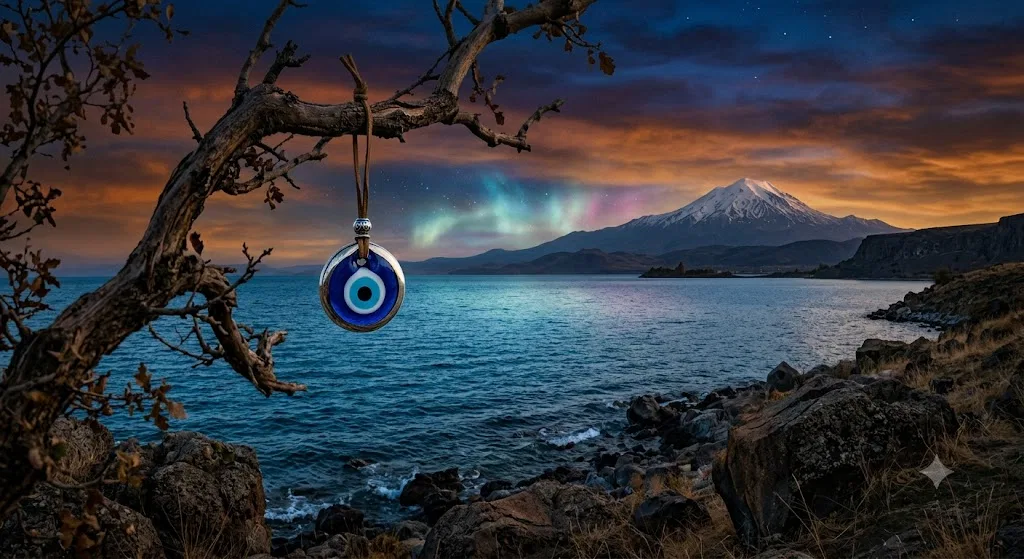
Not all Turkish Forteana is about spectacular monsters or aircraft-like lights. Some of the country’s most culturally significant strange beliefs are domestic, protective and routine. The most recognisable is the blue evil-eye bead, widely used in Turkey to ward off harmful envy or attention. UNESCO’s intangible heritage material describes the bead as handcrafted glass, shaped to resemble an eye, used as an accessory or decoration and believed to have positive effects in daily life, especially around births, circumcisions and marriages.[UNESCO]unesco.orgdocument 2243document 2243
For a Fortean reader, the evil-eye bead matters because it shows how an unseen force can be treated as socially real without requiring laboratory proof. The belief gives shape to a common anxiety: admiration, envy or careless attention may damage a child, animal, home, business or celebration. The bead turns that anxiety into an object. It can be hung, worn, gifted, sold to tourists, placed in cars and photographed. In that sense, the “anomaly” is not a single event but a whole system for managing invisible risk.
A darker domestic example is the Turkish sleep-paralysis figure often described as a night pressure or attack. A 2020 paper on sleep-paralysis beliefs in Turkey notes that the experience is associated in Turkish folk tradition with a supernatural assailant, sometimes understood as a type of jinn, while medical sleep research interprets the core event as a state in which a person wakes unable to move, often with frightening sensed presence, pressure or choking sensations.[PMC]pmc.ncbi.nlm.nih.govPMCBeliefs about sleep paralysis in Turkey: Karabasan attackPMCBeliefs about sleep paralysis in Turkey: Karabasan attack
This is a classic Fortean overlap: the experience is real to the sufferer, the cultural explanation is supernatural, and the physiological mechanism is increasingly well understood. Scepticism does not make the terror imaginary. Belief does not make the folklore creature zoological. The Turkish case belongs in the same cross-cultural family as the “old hag”, “devil on the back” and other sleep-visitation traditions, where biology supplies the paralysis and culture supplies the intruder.
Real places that look like impossible places
Some Turkish sites enter strange-history writing because they seem too theatrical to be ordinary archaeology. Cappadocia’s underground cities are the best example. UNESCO’s listing for Göreme National Park and the Rock Sites of Cappadocia describes a landscape shaped by erosion, rock-hewn sanctuaries with Byzantine art, troglodyte villages and underground towns representing a traditional human habitat dating back to at least the 4th century.[UNESCO World Heritage Centre]whc.unesco.orgOpen source on unesco.org.
Derinkuyu, the most famous of these underground cities, is often presented online in breathless terms: a hidden multi-level city discovered behind a wall, deep enough to shelter thousands, complete with ventilation, storage areas and defensive passages. Some of that popular drama is understandable. DigVentures summarises the modern rediscovery story as a 1963 basement renovation that exposed a larger abandoned complex, and notes that Derinkuyu had been abandoned after 1923.[DigVentures]digventures.comDig Ventures Derinkuyu, Turkey's Ancient Underground CityDig Ventures Derinkuyu, Turkey's Ancient Underground City
The sober interpretation is more impressive than the fringe one. These underground spaces were not built by aliens or vanished super-civilisations; they were human solutions to real insecurity, carved into workable volcanic rock and adapted over time. The Fortean pull comes from scale and atmosphere. A visitor descending into tunnels, shafts, churches and chambers can feel that the surface world has been peeled away. The “mystery” is not whether humans could build it, but how much hidden life can exist under an ordinary village.
Göbekli Tepe works in a similar way. Because it is extremely old and monumentally carved, it attracts claims about lost astronomy, catastrophes or forbidden prehistory. Some academic hypotheses do explore astronomical alignments; for example, Giulio Magli has proposed that the enclosures may have related to the appearance of Sirius, while other writers have suggested more speculative zodiacal or comet-impact readings. Those claims should be separated from the archaeological baseline: UNESCO’s description of hunter-gatherer monumental ritual architecture is already extraordinary and much firmer than fringe claims built on symbolic decoding.[unesco.org]whc.unesco.orgOpen source on unesco.org.
Noah’s Ark, Mount Ararat and the geography of expectation
Few Turkish mystery traditions have travelled as far as the search for Noah’s Ark. The attraction is obvious: eastern Turkey contains mountains associated in popular imagination with the biblical “mountains of Ararat”, and a boat-shaped formation near Doğubayazıt, commonly called the Durupınar site, has repeatedly been promoted as the remains of the Ark. The site has drawn aerial-photo interpretation, ground-penetrating radar claims, religious tourism, television attention and sceptical geological rebuttal.[Wikipedia]WikipediaDurupınar siteDurupınar site
The core claim is that the formation’s shape and dimensions resemble a large vessel. Recent promotional projects have continued to argue that radar, soil chemistry or internal patterns support a man-made structure. Popular media periodically recycles these claims in dramatic form, especially when a new scan or “anomaly” is announced.[New York Post]nypost.comFurther supporting their theory, soil analysis showed that the area inside the formation has double the organic matter, 40% more potassiu…
The best-known sceptical geological response is blunt. Geologist Lorence Collins and colleagues argued that the supposed Ark near Doğubayazıt is a natural rock formation, with alleged metal brackets, walls, wood and anchor stones explainable through ordinary geology: weathered volcanic minerals, limonite and magnetite concentrations, metamorphosed rock and local andesite. Their conclusion is not merely that the evidence is weak, but that the site has been misidentified because its boat-like form encouraged wishful interpretation.[California State University, Northridge]csun.eduOpen source on csun.edu.
That does not make the Ark tradition irrelevant to Turkey’s strange record. On the contrary, it is one of the clearest examples of a landscape acting as a belief machine. A suggestive shape, a sacred story, a mountain region, aerial photography and modern scanning technology combine to produce a repeating cycle: announcement, excitement, expert caution, renewed announcement. The unresolved feeling persists because the question being asked is not only “Is this a boat?” but “Can a sacred narrative leave a physical trace?”
Stones from the sky: when the strange is scientifically real
Turkey also has an anomalous “fall” that needs no supernatural framing: the Sariçiçek meteorite fall of 2 September 2015 near Bingöl. The Meteoritical Bulletin lists Sariçiçek as an official confirmed observed fall in Turkey, classified as a howardite, with a recorded mass of 15.24 kg.[LPI]lpi.usra.eduOpen source on usra.edu.
The scientific story is wonderfully Fortean in the old Charles Fort sense: stones really did fall from the sky, witnesses really did have something extraordinary to report, and the explanation reaches far beyond local experience. Research on the fall documented 343 stones and described it as the first documented howardite fall, with video observations of atmospheric entry, fragmentation at several altitudes and a reconstructed pre-atmospheric orbit.[Wiley Online Library]onlinelibrary.wiley.comOpen source on wiley.com.
A SETI Institute summary of the research reported that the meteorites were traced to asteroid Vesta, specifically material linked to an impact crater formed about 22 million years ago. That gives the Sariçiçek event a rare double identity: locally, it was a dramatic night-time fall in eastern Turkey; scientifically, it was a recoverable sample of another world’s impact history.[SETI Institute]seti.orgInstitute Turkish Meteorite Traced To Impact Crater On Asteroid VestaInstitute Turkish Meteorite Traced To Impact Crater On Asteroid Vesta
This is an important corrective in a country-level Fortean survey. Not every strange report is false, folkloric or misidentified. Sometimes the impossible-sounding event is real, but the explanation is natural and more astonishing than the rumour: a metre-scale object from the asteroid belt arrives over Turkey, breaks apart in the atmosphere and leaves collectable fragments in fields and villages.
Prophecy, conversion and the afterlife of a false messiah
Turkey’s weird-history record is not limited to creatures and places. One of the most consequential early modern religious shocks centred on Sabbatai Zevi, a rabbi and mystic from Smyrna, now İzmir, who became the focus of a major Jewish messianic movement in the 17th-century Ottoman world. Encyclopedia.com describes him as an Ottoman Jewish rabbi whose messianic claims and abrupt conversion to Islam in 1665–1666 convulsed Jewish communities in Europe and the Near East, calling the movement the most significant millenarian outpouring in modern Jewish history.[Encyclopedia.com]encyclopedia.comshabbetai tzevi also sabbatai sevi zevi or zebishabbetai tzevi also sabbatai sevi zevi or zebi
The drama peaked in 1666, a year already heavy with apocalyptic expectation. Jewish Virtual Library summarises the decisive moment: brought before the Sultan and given the choice of death or apostasy, Sabbatai Zevi chose conversion to Islam, symbolised by putting on a turban, and received an Ottoman title and pension.[Jewish Virtual Library]jewishvirtuallibrary.orgOpen source on jewishvirtuallibrary.org.
For believers, this was a crisis that demanded interpretation. Some abandoned him; others reinterpreted the conversion as part of a hidden divine plan. Ottoman History Podcast’s summary notes that after Sevi’s conversion, many followers also converted and became communities later known as Dönme, meaning converts.[ottomanhistorypodcast.com]ottomanhistorypodcast.comSabbatai Sevi and the Ottoman-Turkish DönmesSabbatai Sevi and the Ottoman-Turkish Dönmes
This belongs in Turkish Forteana because it shows prophecy as a social event rather than a private oddity. Rumour, letters, sermons, political authority, ecstatic expectation and public humiliation all mattered. Unlike a monster sighting, the evidence for the movement is historically strong; the “strange” element lies in the psychological and religious aftershock of a messiah who survived by changing religion, yet continued to inspire secretive or esoteric loyalty.
What sceptics and believers usually get right — and wrong
The best Turkish Fortean cases reward a double reading. Believers are often right that the stories should not be dismissed as meaningless. The Lake Van monster mattered to Van’s modern image; Kumburgaz genuinely became a major UFO-media episode; evil-eye beads really do structure everyday protective practice; Cappadocia’s underground cities really are astonishing; Sariçiçek really was a fall from space. A sceptic who treats all of this as mere nonsense misses the cultural and historical substance.
Sceptics are right, however, that “interesting” is not the same as “paranormal”. Lake Van has no solid biological evidence. Kumburgaz lacks the calibrated multi-sensor data needed to establish extraordinary aerial performance. Durupınar’s Ark claims face strong geological objections. Göbekli Tepe’s age and artistry do not license every speculative theory projected onto its carvings. Sleep paralysis can be culturally supernatural and medically explicable at the same time.[wikipedia.org]WikipediaLake Van MonsterLake Van Monster
A fair reading keeps four categories separate:
- Documented natural anomaly: Sariçiçek, where stones from space were recovered and classified.
- Historically real belief movement: Sabbatai Zevi and the Dönme, where the social facts are strong even if the messianic claim is a matter of faith.
- Folklore and protective practice: the evil eye and sleep-paralysis traditions, where lived experience and cultural interpretation matter.
- Unresolved or weakly evidenced claims: Lake Van, Kumburgaz and Ark-hunting sites, where the stories are culturally powerful but evidentially limited.
That separation lets the strangeness breathe without turning every claim into either a miracle or a fraud.

Why Turkey’s strange record still has cultural pull
Turkey’s Forteana endures because it is rarely just about “the unexplained”. It is about how people read landscapes and uncertainty. A lake becomes a monster’s hiding place. A mountain becomes a sacred destination. A bead becomes a shield against envy. A tunnel becomes proof that ordinary life once retreated underground. A blurry horizon becomes a spacecraft for some viewers and a ship or artefact for others.
The country’s strongest strange stories also have unusually good settings. Lake Van has scale and weather. Cappadocia has depth and darkness. Mount Ararat has scriptural gravity. İzmir and Istanbul have the urban networks through which prophecy and rumour could travel. The Sea of Marmara has ships, lights, haze and cameras — perfect conditions for modern UFO ambiguity.
Taken together, Turkey’s weird-history record is not a sideshow to its “real” history. It is one way people have processed danger, awe, envy, faith, ruins, night skies and the unknown. The most grounded conclusion is also the most interesting one: Turkey does not need proven monsters or alien craft to be Fortean. Its documented history, living folklore and unresolved claims already form a landscape where the ordinary and the uncanny keep meeting at the edge of the map.
Amazon book picks
Further Reading
Books and field guides related to Turkey's Monsters, UFOs and Living Legends. Use these as the next step if you want deeper reading beyond the article.


The field guide to lake monsters, sea serpents and other myst...
First published 2003. Subjects: Marine animals, Sea monsters, Folklore, Animals, folklore.
eBay marketplace picks
Marketplace Samples
Live-tested eBay searches with available results related to this page.




Endnotes
1.
Source: whc.unesco.org
Link:https://whc.unesco.org/en/list/1572/
2.
Source: arxiv.org
Title: arXiv The Temporal Analysis of Light Pollution in Turkey using VIIRS data
Link:https://arxiv.org/abs/2103.10456
3.
Source: newsroom.ap.org
Link:https://newsroom.ap.org/editorial-photos-videos/detail?itemid=198185451c2eff515d7a308f1b38e7a4&mediatype=video&source=youtube
4.
Source: Wikipedia
Title: Lake Van Monster
Link:https://en.wikipedia.org/wiki/Lake_Van_Monster
5.
Source: eurasianet.org
Title: turkey ufo believers seek to shed quack status
Link:https://eurasianet.org/turkey-ufo-believers-seek-to-shed-quack-status
6.
Source: metabunk.org
Title: page 5
Link:https://www.metabunk.org/threads/2008-ufo-footage-from-kumburgaz-turkey.9844/page-5
7.
Source: arxiv.org
Link:https://arxiv.org/abs/2305.18566
8.
Source: unesco.org
Title: document 2243
Link:https://www.unesco.org/archives/multimedia/document-2243
9.
Source: pmc.ncbi.nlm.nih.gov
Title: PMCBeliefs about sleep paralysis in Turkey: Karabasan attack
Link:https://pmc.ncbi.nlm.nih.gov/articles/PMC8060736/
10.
Source: whc.unesco.org
Link:https://whc.unesco.org/en/list/357/
11.
Source: digventures.com
Title: Dig Ventures Derinkuyu, Turkey’s Ancient Underground City
Link:https://digventures.com/2020/05/ancient-places-derinkuyu-underground-city-turkey/
12.
Source: arxiv.org
Title: arXiv Sirius and the project of the megalithic enclosures at Gobekli Tepe
Link:https://arxiv.org/abs/1307.8397
13.
Source: arxiv.org
Link:https://arxiv.org/abs/1806.00046
14.
Source: Wikipedia
Title: Durupınar site
Link:https://en.wikipedia.org/wiki/Durup%C4%B1nar_site
15.
Source: lpi.usra.edu
Link:https://www.lpi.usra.edu/meteor/metbull.php?code=62806
16.
Source: onlinelibrary.wiley.com
Link:https://onlinelibrary.wiley.com/doi/10.1111/maps.13258
17.
Source: arxiv.org
Link:https://arxiv.org/abs/2102.03733
18.
Source: seti.org
Title: Institute Turkish Meteorite Traced To Impact Crater On Asteroid Vesta
Link:https://www.seti.org/news-archive/news-archive-detail?id=2891
19.
Source: encyclopedia.com
Title: shabbetai tzevi also sabbatai sevi zevi or zebi 1626 1676
Link:https://www.encyclopedia.com/history/encyclopedias-almanacs-transcripts-and-maps/shabbetai-tzevi-also-sabbatai-sevi-zevi-or-zebi
20.
Source: ottomanhistorypodcast.com
Title: Sabbatai Sevi and the Ottoman-Turkish Dönmes
Link:https://www.ottomanhistorypodcast.com/2017/03/donme.html
21.
Source: Wikipedia
Link:https://en.wikipedia.org/wiki/Turkey
22.
Source: Wikipedia
Link:https://en.wikipedia.org/wiki/Jinn
23.
Source: Wikipedia
Title: Göbekli Tepe
Link:https://en.wikipedia.org/wiki/G%C3%B6bekli_Tepe
24.
Source: Wikipedia
Title: Derinkuyu underground city
Link:https://en.wikipedia.org/wiki/Derinkuyu_underground_city
25.
Source: Wikipedia
Title: Sabbatai Zevi
Link:https://en.wikipedia.org/wiki/Sabbatai_Zevi
26.
Source: Wikipedia
Link:https://en.wikipedia.org/wiki/D%C3%B6nmeh
27.
Source: Wikipedia
Title: Nazar (amulet)
Link:https://en.wikipedia.org/wiki/Nazar_%28amulet%29
28.
Source: Wikipedia
Title: Turkish language
Link:https://en.wikipedia.org/wiki/Turkish_language
29.
Source: ich.unesco.org
Title: photo pop up 00973
Link:https://ich.unesco.org/en/photo-pop-up-00973?photoID=15346
30.
Source: astronomy.com
Title: it turns out this turkish meteorite is a free sample from asteroid vesta
Link:https://www.astronomy.com/science/it-turns-out-this-turkish-meteorite-is-a-free-sample-from-asteroid-vesta/
31.
Source: youtube.com
Title: The Legend of the Lake Van Monster
Link:https://www.youtube.com/watch?v=bv9ByXMtALc
Source snippet
[Kumburgaz UFO]({{ 'kumburgaz-ufo/' | relative_url }}) Stabilized & Enhanced...
32.
Source: youtube.com
Title: Kumburgaz UFO Stabilized & Enhanced
Link:https://www.youtube.com/watch?v=tTcbuVocnuM
Source snippet
The Cities of the Ant-People - Visiting Cappadocia Underground Cities...
33.
Source: youtube.com
Title: The Cities of the Ant-People
Link:https://www.youtube.com/watch?v=H3XfHeY9HVA
Source snippet
The Oldest Known Temple in the World - Göbeklitepe...
34.
Source: youtube.com
Title: The Oldest Known Temple in the World
Link:https://www.youtube.com/watch?v=D4yBkJjyeBE
Source snippet
NEW DISCOVERY: 12,000-Year-Old Human Statue Discovered at Göbekli Tepe...
35.
Source: youtube.com
Title: NEW DISCOVERY: 12,000-Year-Old Human Statue Discovered at Göbekli Tepe
Link:https://www.youtube.com/watch?v=SLjib4wyExo
36.
Source: dailysabah.com
Title: Daily Sabah Myth meets majesty in Türkiye’s Van: Ancient roots
Link:https://www.dailysabah.com/arts/myth-meets-majesty-in-turkiyes-van-ancient-roots-legends-of-eastern-anatolia/news
37.
Source: nypost.com
Link:https://nypost.com/2025/05/13/science/noahs-ark-sites-fully-preserved-secrets-discovered-by-scientists/
Source snippet
Further supporting their theory, soil analysis showed that the area inside the formation has double the organic matter, 40% more potassiu...
38.
Source: csun.edu
Link:https://www.csun.edu/~vcgeo005/bogus.html
39.
Source: jewishvirtuallibrary.org
Link:https://jewishvirtuallibrary.org/shabbetai-zvi
40.
Source: youtube.com
Link:https://www.youtube.com/watch?v=xklLLI8fNRg
41.
Source: youtube.com
Link:https://www.youtube.com/watch?v=2iTzATVa21s
42.
Source: youtube.com
Link:https://www.youtube.com/watch?v=ufGOXLIG38g
43.
Source: youtube.com
Title: The Haunted House That Gave Birth
Link:https://www.youtube.com/watch?v=JsZVx_IFGDQ
44.
Source: youtube.com
Link:https://www.youtube.com/watch?v=SOGEUXU4YCo
45.
Source: youtube.com
Link:https://www.youtube.com/watch?v=99h3rsslmYg
46.
Source: youtube.com
Link:https://www.youtube.com/watch?v=ITEMLOag4bA
47.
Source: youtube.com
Title: Sabbatai Zevi
Link:https://www.youtube.com/watch?v=qxQIodTHhjI
48.
Source: youtube.com
Link:https://www.youtube.com/watch?v=a4MGDntafq0
49.
Source: facebook.com
Link:https://www.facebook.com/ForteanTimes/photos/in-this-collection-of-curious-weather-events-we-explore-fish-and-ice-falling-fro/1111315034336075/
50.
Source: jewishvirtuallibrary.org
Title: Witnesses to History: Shabbetai Zvi
Link:https://jewishvirtuallibrary.org/shabbetai-zvi-false-messiah-judaic-treasures
51.
Source: cryptidz.fandom.com
Title: Lake Van Monster
Link:https://cryptidz.fandom.com/wiki/Lake_Van_Monster
52.
Source: itsmth.fandom.com
Title: Lake Van Monster
Link:https://itsmth.fandom.com/wiki/Lake_Van_Monster
53.
Source: jstor.org
Link:https://www.jstor.org/stable/20101190
54.
Source: theguardian.com
Link:https://www.theguardian.com/world/turkey
55.
Source: x.com
Link:https://x.com/grok/status/2004801884016529630
56.
Source: jewishhistory.org
Title: Sabbatai Zevi
Link:https://www.jewishhistory.org/sabbatai-zevi/
57.
Source: getyourguide.com
Title: unesco sites tc266
Link:https://www.getyourguide.com/derinkuyu-l181427/unesco-sites-tc266/
58.
Source: tumblr.com
Title: Lake Van Monster
Link:https://www.tumblr.com/blog-ablue/tagged/Lake%20Van%20Monster
59.
Source: mfa.gov.tr
Title: no 176 gobekli tepe hk en.en.mfa
Link:https://www.mfa.gov.tr/no_-176_-gobekli-tepe-hk_en.en.mfa
60.
Source: bnposta.bingol.edu.tr
Link:https://bnposta.bingol.edu.tr/handle/20.500.12898/2151?locale-attribute=en
61.
Source: destinationhistorypod.com
Link:https://destinationhistorypod.com/episodes/derinkuyu
62.
Source: torahmusings.com
Title: Sabbatai Zevi
Link:https://www.torahmusings.com/wp-content/uploads/2006/01/Sabbatai_Zevi
63.
Source: unesco-centerbg.org
Title: craftsmanship practices and beliefs of nazar boncugu evil eye charms
Link:https://www.unesco-centerbg.org/en/2021/09/29/craftsmanship-practices-and-beliefs-of-nazar-boncugu-evil-eye-charms/
64.
Source: openaccess.dogus.edu.tr
Link:https://openaccess.dogus.edu.tr/bitstreams/36e39253-23e5-43a0-a7f5-111b7a94a4cc/download
65.
Source: dailysabah.com
Title: converting to ottoman world false messiah sabbatai zevi
Link:https://www.dailysabah.com/opinion/op-ed/converting-to-ottoman-world-false-messiah-sabbatai-zevi
66.
Source: kids.nationalgeographic.com
Link:https://kids.nationalgeographic.com/geography/countries/article/turkey
67.
Source: GOV.UK
Link:https://www.gov.uk/foreign-travel-advice/turkey
Additional References
68.
Source: thesun.co.uk
Link:https://www.thesun.co.uk/tech/38882164/noahs-ark-biblical-tale-durupinar-turkey/
Source snippet
Originally discovered in 1959, the 538-foot-long formation resembles the ark’s shape. The team plans to further explore the underground s...
69.
Source: facebook.com
Link:https://www.facebook.com/61566624771804/posts/nazar-boncu%C4%9Fu-or-evil-eye-bead-is-a-striking-blue-eye-shapedeye-like-glass-charm/122206961270554159/
70.
Source: researchgate.net
Link:https://www.researchgate.net/publication/331834828_The_Saricicek_howardite_fall_in_Turkey_Source_crater_of_HED_meteorites_on_Vesta_and_impact_risk_of_Vestoids
71.
Source: facebook.com
Link:https://www.facebook.com/altankns/videos/aliens-in-the-cockpit-night-security-guard-yalcin-yalman-filmed-disc-shaped-ufos/1510456620476174/
72.
Source: facebook.com
Link:https://www.facebook.com/thescarecast/posts/aliens-in-the-cockpit-night-security-guard-yalcin-yalman-filmed-disc-shaped-ufos/1841628430345456/
73.
Source: facebook.com
Link:https://www.facebook.com/dw.travel/posts/fascinating-time-travel-in-turkey-check-out-the-unesco-world-heritage-site-of-g%C3%B6/3395071480724693/
74.
Source: instagram.com
Link:https://www.instagram.com/reel/DUL1QGcjlzq/?hl=en
75.
Source: archiqoo.com
Link:https://archiqoo.com/locations/derinkuyu_underground_city.php
76.
Source: facebook.com
Link:https://www.facebook.com/thehistoriansden/posts/derinkuyu-wasnt-just-an-accidental-discovery-it-sits-in-cappadocia-where-volcani/923935730681436/
77.
Source: travelatelier.com
Link:https://travelatelier.com/blog/meaning-history-evil-eye/
Topic Tree
Follow this branch
Related pages 192
- Afghan Forteana
- Antigua Uncanny
- Bosnian Mysteries
- Botswana Weird
- Brazil Strange
- +187 more in sidebar