Within Weird Ukraine
Were Carpathian Molfars Healers or Magicians?
The molfar tradition turns healing, weather lore and village uncertainty into one of Ukraine's richest strange-history branches.
On this page
- Who the molfars were in Hutsul culture
- Healing, prophecy and weather magic claims
- Folklore, tourism and modern retellings
Page outline Jump by section
Introduction
Were Carpathian molfars healers or magicians? The historical answer is that they were usually regarded as both, depending on who was asking. In the Hutsul communities of Ukraine’s Carpathian Mountains, a molfar was understood as a ritual specialist whose knowledge combined herbal medicine, prayer, charms, divination and weather lore. To believers, a skilled molfar could cure illness, protect livestock, foresee danger or divert destructive storms. To sceptics, they were gifted healers, charismatic village advisers or practitioners of traditional folk medicine whose reputations grew through storytelling. Whatever their actual abilities, molfars occupy one of the richest intersections between folklore, religion and lived experience in Ukrainian strange history, where practical needs and supernatural belief merged in everyday mountain life.[Encyclopedia of Ukraine]encyclopediaofukraine.comEncyclopedia of Ukraine MagicEncyclopedia of Ukraine Magic
Who were the molfars in Hutsul culture?
The molfar tradition belongs primarily to the Hutsul region, the highland communities spread across the eastern Carpathians in what is now western Ukraine. Isolated mountain settlements developed distinctive customs, music, clothing and beliefs, preserving local traditions that differed noticeably from those of the lowlands. Ethnographers have documented the Hutsuls since the eighteenth and nineteenth centuries, recording a culture in which Christian worship coexisted comfortably with older ritual practices and folk explanations of misfortune.[Encyclopedia of Ukraine]encyclopediaofukraine.comEncyclopedia of Ukraine Hutsul regionEncyclopedia of UkraineHutsul regionJanuary 1, 1989…
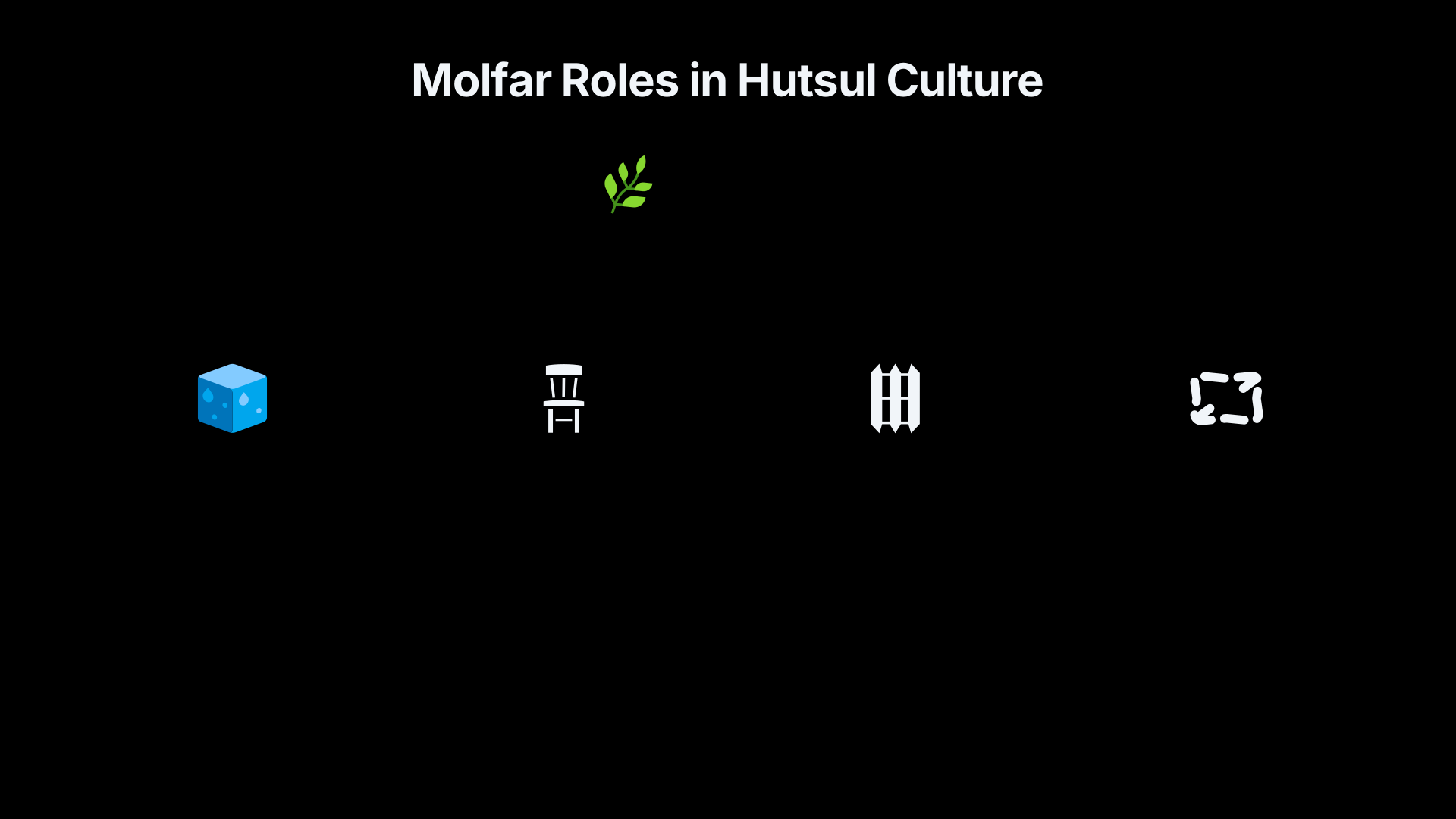
A molfar was never simply “a wizard” in the fantasy sense. The role could include several overlapping functions:
- Treating illnesses with herbs, ritual actions and spoken charms.
- Advising families on bad luck, disputes or unexplained misfortune.
- Performing protective rituals for homes, fields and livestock.
- Interpreting dreams, omens and unusual events.
- Allegedly influencing weather, especially hailstorms that threatened crops.
This mixture of practical and supernatural responsibilities reflected the realities of mountain life. Until relatively recently, doctors, veterinarians and clergy were often distant or difficult to reach. A respected ritual specialist therefore became both healer and counsellor, regardless of whether outsiders accepted claims of supernatural power.[Encyclopedia of Ukraine]encyclopediaofukraine.comEncyclopedia of Ukraine MagicEncyclopedia of Ukraine Magic
The exact origin of the word “molfar” remains uncertain. Linguists have proposed several competing explanations, illustrating how difficult it is to separate centuries of oral tradition from documented history.[Wikipedia]WikipediaOpen source on wikipedia.org.
Why were healing and weather magic so closely linked?
One reason molfars became central figures in Carpathian folklore is that the problems they supposedly addressed were immediate and existential.
A violent hailstorm could destroy an entire year’s harvest. An unexplained illness might threaten an isolated household with little access to professional medical care. Livestock represented wealth and survival. Under these conditions, rituals intended to influence nature or restore health were not abstract religious exercises but practical responses to uncertainty.
Traditional Ukrainian folk magic included medical, protective, agricultural and meteorological rituals. Spoken charms, blessed water, herbs, fire, eggs and symbolic actions all appeared in documented folk practices. These customs often blended Christian prayers with much older ritual ideas rather than replacing one belief system with another.[Encyclopedia of Ukraine]encyclopediaofukraine.comEncyclopedia of Ukraine MagicEncyclopedia of Ukraine Magic
Stories of molfars frequently describe them:
- Calling rain during drought.
- Turning hail away from villages.
- Preventing storms from crossing mountain ridges.
- Lifting curses or breaking malicious spells.
- Detecting hidden causes of illness.
No scientific evidence demonstrates that such rituals altered weather or physical events. Nevertheless, the persistence of these stories reflects the importance of weather in agricultural societies. When storms arrived immediately after a ritual, coincidence could easily reinforce belief, while failures were often forgotten or explained away.

Did people really believe molfars could see the future?
Prophecy occupies an uncertain place within molfar tradition because much of the evidence comes from oral accounts recorded long after the supposed predictions.
Many stories describe respected molfars warning individuals against dangerous journeys, foretelling accidents or predicting wider social upheaval. These tales often grew after dramatic events had already occurred, making it difficult for historians to determine which predictions were genuinely recorded beforehand and which became attached to famous figures through later retelling.
The best-known modern example is Mykhailo Nechai (also rendered Nychai), a Hutsul molfar from the village of Verkhnii Yaseniv. Visitors sought him for herbal remedies, advice and spiritual guidance well into the twenty-first century. Following his violent death in 2011, numerous reports circulated claiming he had predicted political crises, environmental disasters and his own murder. Most of these claims rely on interviews, recollections or media reports produced after the events, making independent verification extremely difficult. His reputation nevertheless transformed him into perhaps the most famous molfar of the modern era.[Wikipedia]WikipediaOpen source on wikipedia.org.
This pattern is familiar across many prophetic traditions: an individual’s reputation grows strongest after death, when scattered memories become organised into coherent narratives of foresight.
Where does folklore end and religion begin?
One of the most interesting features of the molfar tradition is that it rarely fits neat categories.
Rather than representing a surviving pre-Christian priesthood, most historical accounts describe a blend of influences. Christian prayers, saints, crosses and church festivals existed alongside charms, sacred herbs, protective objects and beliefs inherited from much older traditions. Ukrainian ethnographers describe this broader phenomenon as a form of “dual faith”, in which Christian practice absorbed rather than completely eliminated earlier folk beliefs.[Encyclopedia of Ukraine]encyclopediaofukraine.comEncyclopedia of Ukraine MagicEncyclopedia of Ukraine Magic
This also explains why attitudes towards molfars varied.
Some villagers regarded them as benevolent healers blessed with unusual gifts. Others feared that the same knowledge could be used for harmful purposes. Traditional Ukrainian folklore distinguished between beneficial magic and malicious sorcery, but the boundary was rarely clear in practice. A respected healer in one village might be viewed with suspicion elsewhere.[Encyclopedia of Ukraine]encyclopediaofukraine.comEncyclopedia of Ukraine MagicEncyclopedia of Ukraine Magic
Why have molfars become modern cultural icons?
Although belief in active weather magic has declined, the image of the molfar has become increasingly visible in literature, film and tourism.
A major turning point came with Mykhailo Kotsiubynsky’s celebrated novella Shadows of Forgotten Ancestors (1911), which introduced many readers outside the Carpathians to Hutsul beliefs. Sergei Parajanov’s visually striking 1964 film adaptation further popularised the region’s magical atmosphere, presenting mountain customs as inseparable from myth, ritual and supernatural possibility. These works did not invent the tradition, but they transformed local folklore into one of the defining images of Ukrainian mountain culture.[Wikipedia]WikipediaOpen source on wikipedia.org.
Today, visitors to the Carpathians often encounter museums, guided tours and local storytellers discussing molfars alongside Hutsul music, crafts and wooden churches. Modern tourism sometimes exaggerates the mystical elements, presenting molfars as secret magicians or “last shamans” of Europe. Historians generally treat such marketing with caution, noting that real village healers occupied more complex social roles than modern promotional material suggests.
Why molfars remain one of Ukraine’s most enduring Fortean traditions
Unlike ghost stories tied to one castle or reports of mysterious lights linked to a single incident, the molfar tradition represents an entire way of interpreting the world.
Its enduring appeal comes from several overlapping themes:
- It grew from genuine historical communities rather than isolated legends.
- It addressed practical concerns—health, weather and survival—as much as supernatural ones.
- It blurred the boundaries between religion, medicine, folklore and psychology.
- It survives through living cultural memory as well as historical documentation.
- It continues to evolve through literature, cinema and tourism.
From a Fortean perspective, molfars are significant not because there is compelling evidence they controlled storms or predicted the future, but because generations of people believed such powers could exist. Their stories reveal how mountain communities explained uncertainty before modern science became widely accessible, while reminding modern readers that extraordinary traditions often emerge from very ordinary human needs: keeping families healthy, protecting crops and making sense of an unpredictable world.
Amazon book picks
Further Reading
Books and field guides related to Were Carpathian Molfars Healers or Magicians?. Use these as the next step if you want deeper reading beyond the article.


The Last Kingdom: A History of the Carpathians and the Carpat...
Provides essential background on Hutsul communities and their traditions.
eBay marketplace picks
Marketplace Samples
Live-tested eBay searches with available results related to this page.
Endnotes
1.
Source: encyclopediaofukraine.com
Title: Encyclopedia of Ukraine Magic
Link:https://www.encyclopediaofukraine.com/display.asp?linkpath=pages%5CM%5CA%5CMagic.htm
2.
Source: encyclopediaofukraine.com
Title: Encyclopedia of Ukraine Hutsuls
Link:https://www.encyclopediaofukraine.com/display.asp?linkpath=pages%5CH%5CU%5CHutsuls
Source snippet
They are not only recorded and described in scholarly studies, but are also depicted in the literary...
3.
Source: encyclopediaofukraine.com
Title: Encyclopedia of Ukraine Hutsul region
Link:https://www.encyclopediaofukraine.com/display.asp?linkpath=pages%5C%5CH%5C%5CU%5C%5CHutsulregion
Source snippet
Encyclopedia of UkraineHutsul regionJanuary 1, 1989...
Published: January 1, 1989
4.
Source: Wikipedia
Link:https://en.wikipedia.org/wiki/Molfar
5.
Source: encyclopediaofukraine.com
Title: Encyclopedia of Ukraine Folk customs and rites
Link:https://www.encyclopediaofukraine.com/display.asp?linkpath=pages%5CF%5CO%5CFolkcustomsandrites.htm
Source snippet
Ritual actions and verbal formulas belonging to the tradi...
6.
Source: encyclopediaofukraine.com
Title: Encyclopedia of Ukraine Demonology
Link:https://www.encyclopediaofukraine.com/display.asp?linkpath=pages%5CD%5CE%5CDemonology.htm
Source snippet
With the institution of Christianity in Ukraine (see Christianization of Ukraine) and the official proscription of paganism a...
7.
Source: destinations.ua
Link:https://destinations.ua/archive-18-21/authentic-ukraine/246-molfars-mystic-wizards-and-guards-of-ukrainian-ethnic-code
Source snippet
Mystic Ukrainian WizardsSeptember 14, 2016 — MOLFARS: MYSTIC WIZARDS AND GUARDS OF UKRAINIAN ETHNIC CODE 14 September, 2016 Image: Molfar...
Published: September 14, 2016
8.
Source: encyclopediaofukraine.com
Title: People* * * | DEMONOLOGY IN UKRAINE
Link:https://www.encyclopediaofukraine.com/People.asp
Source snippet
With the institution of Christianity in Ukraine and the official proscription of paganism at the end of the 10th century, elements of the...
9.
Source: encyclopediaofukraine.com
Link:https://www.encyclopediaofukraine.com/display.asp?linkpath=pages%5CI%5CN%5CIncantation.htm
Source snippet
The use of chanted, spoken, or written formulas to bind spiritual powers to certain actions that will accompl...
10.
Source: dosen.profillengkap.com
Link:https://dosen.profillengkap.com/index.php/en/Molfar
Source snippet
Creature information --- Folklore | Slavic Mythology Origin --- Country | Ukraine, Romania Molfar (Ukrainian: мольфар) is a traditional H...
Additional References
11.
Source: karpacki.pl
Link:https://karpacki.pl/en/own-projects/in-the-land-of-carpathia-ethno-stories/
Source snippet
In the land of Carpathia – ethno stories | karpacki.plKarpacki IN THE LAND OF CARPATHIA – ETHNO STORIES Image: 01 znak podstawowy kolor b...
12.
Source: mdpi.com
Link:https://www.mdpi.com/2073-445X/13/8/1258
Source snippet
August 9, 2024 — NOSTALGIC GEOTOURISM AS A NEW FORM OF LANDSCAPE PRESENTATION: AN APPLICATION TO THE CARPHATIAN MOUNTAINS by Dana Tometzo...
Published: August 9, 2024
13.
Source: indianjournals.com
Link:https://indianjournals.com/article/voim
Source snippet
Syncretism of Healing Rituals in the Carpathian Mountains of Ukraine | Voice of Intellectual Man- An International Journal | IndianJourna...
14.
Source: lib.iitta.gov.ua
Link:https://lib.iitta.gov.ua/id/eprint/709467/
Source snippet
of Ethnographic Recreational Activity of Future Specialists in Tourism in the Carpathian Tourist Macro Region - Digital Library NAES of U...
15.
Source: debdsfdi.snspa.ro
Link:https://debdsfdi.snspa.ro/items/15519ea1-edd5-48e4-907d-529aa38827bc/full
Source snippet
peasant workers to amenity migrants: socialist heritage and the future of mountain rurality in RomaniaFROM PEASANT WORKERS TO AMENITY MI...
16.
Source: old.journals.um.si
Link:https://old.journals.um.si/index.php/geography/article/view/4035
Source snippet
and Authenticity in the Czech Villages of the Romanian Banat | Journal for GeographyDecember 31, 2010 — TOURISM AND AUTHENTICITY IN THE C...
Published: December 31, 2010
17.
Source: tandfonline.com
Link:https://www.tandfonline.com/doi/abs/10.1080/14766825.2025.2579922
Source snippet
of Tourism and Cultural Change: Vol 23, No 6October 30, 2025 — 132 Views 0 CrossRef citations to date 0 Altmetric Articles ‘IF YOU DID NO...
Published: October 30, 2025
18.
Source: eng.polgariszemle.hu
Link:https://eng.polgariszemle.hu/archive/148-vol-14-special-issue-2018/religious-policy-history-and-ideologies/930-taltos-witch-incubus-succubus-and-other-beings-in-hungarian-folklore-and-mythology
Source snippet
407-408). Wandering scholar The figure of the wandering scholar or wandering student was a generally known folk belief even in the 20th c...
19.
Source: carpathianculture.eu
Link:https://carpathianculture.eu/a-visit-at-a-herbalist/
Source snippet
A visit at a herbalist | World of the Carpathian RosettesJanuary 28, 2020 — 28 January 2020| Ivano-Frankivsk Oblast, People A VISIT AT A...
Published: January 28, 2020
20.
Source: nz.lviv.ua
Title: BELIE F OF HUNTERS OF UKRAINIAN CARPATHIANS | Narodoznavchi Zoshyty
Link:https://nz.lviv.ua/en/2021-en-5-7/
Source snippet
2...
0
2
- № 5 (161), 1078—1086 UDK 398.3:639.1(477.87)”19/20″ DOI https://doi.org/10.15407/nz2021.05.1078 THE TRADITIONAL KNOWLEDGE AND BELIE
Topic Tree