Why Does The Bahamas Feel So Uncanny?
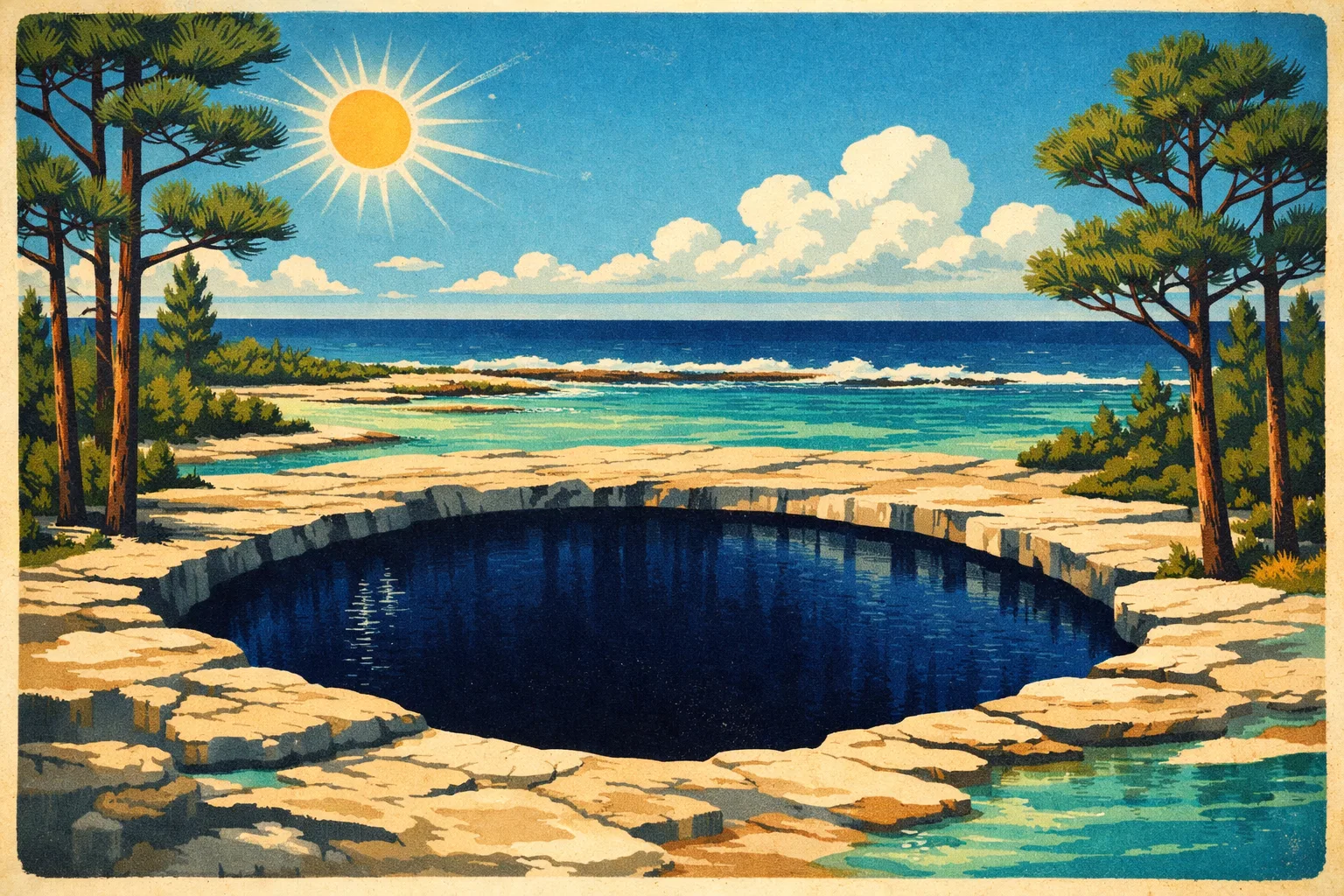
The Bahamas has a particularly strong claim on Caribbean strange history because many of its best-known mysteries grow out of the landscape itself: blue holes that look bottomless, reefs that break ships, pine forests with owl-like spirits, and shallow seas where natural rock can look disconcertingly like lost architecture.
Page outline Jump by section
Why The Bahamas attracts strange stories
The Bahamas is made for ambiguity. It is a low limestone archipelago set in bright, shallow water, with reefs, cays, caves, blue holes, wreck sites and sudden weather changes all close together. The Bahamas National Trust describes Andros as having more blue holes than anywhere else on Earth, with eroded limestone bedrock creating extensive underwater cave systems and habitats for unusual cave fish and invertebrates. That alone gives local legend excellent raw material: a dark circular pool in a flat landscape is not just a pond, but a doorway.[Bahamas National Trust]bnt.bsBahamas National Trust Blue Holes National ParkBahamas National Trust Blue Holes National Park
Modern science has made the blue holes stranger, not less strange. A 2020 study of ten inland blue holes on Andros found that most were sharply layered, with oxygenated freshwater over deeper anoxic saline water, and that hydrogen sulphide and reduced iron marked strongly reducing conditions below the halocline. In plain English, these places can contain invisible chemical borders: safe-looking water above, hostile water below, and microbial worlds living where larger animals cannot.[Langerhans Lab]gambusia.zo.ncsu.eduOpen source on ncsu.edu.
That physical reality matters because many Bahamian legends are not random inventions pasted onto the islands. They often attach themselves to dangerous or puzzling places. A person looking into a blue hole, hearing tidal movement in a cave, or seeing milky material pushed from an underwater opening has good reason to feel that something hidden is breathing beneath the surface. Fortean stories in The Bahamas tend to begin with that sensation, then turn it into a monster, a ghost, a curse, a lost city or a warning.
The Lusca and the blue-hole imagination
The Lusca is the great Bahamian water monster: usually described as a giant octopus, a shark-octopus hybrid, or a many-armed thing lurking in blue holes, especially around Andros. It is best treated as folklore rather than zoology. The creature’s appeal is obvious. Blue holes are real, deep, hazardous and only partly accessible; the sea around The Bahamas contains sharks, rays, octopuses, caves and strong tidal flows. Put those ingredients together and a monster with tentacles and predatory force almost writes itself.
King Kong Cavern on the Andros barrier reef shows how this works. George Mason University researchers discussing the site note that local claims include the Lusca and mermaids, but also explain that water coming from the cave is anoxic and loaded with hydrogen sulphide, conditions that would be lethal to ordinary large animals. Their sampling found mucoid filaments dominated by bacteria, especially Arcobacter, rather than evidence of a giant creature exhaling slime from the deep.[GMU College of Science]science.gmu.eduOpen source on gmu.edu.
That is a neat sceptical explanation, but it does not flatten the story. The Lusca survives because it gives personality to a genuinely alien environment. The blue hole is not just a geological feature; in folklore it becomes a lair, a mouth, a moral boundary. The scientific account explains why giant animals are unlikely to be living in such conditions, but the legend preserves the older human response: do not treat deep water casually, especially when you do not understand what is moving below.
The strongest evidence for the Lusca, therefore, is not biological evidence. It is cultural evidence: repeated association with Andros, blue holes, diving danger and Caribbean sea-monster motifs. Believers read that pattern as smoke from a hidden fire. Sceptics read it as a natural result of fear, misidentification, exaggerated animal encounters and the unsettling behaviour of caves and tides. The sceptical reading is much better supported, but the legend remains one of the clearest examples of Bahamian geography becoming myth.
The chickcharney: Andros’s owl-spirit with a political afterlife
If the Lusca belongs to the blue holes, the chickcharney belongs to the pine forests of Andros. It is usually described as an owl-like or bird-like creature, sometimes small and goblin-like, sometimes larger and more alarming, able to bring good luck if respected and misfortune if offended. It is not just a cryptid in the modern “mystery animal” sense; it is also a folk warning about conduct in the bush. The creature’s moral rule is simple: behave well in its territory.
The legend reached an unusually international audience through a 1947 Time article, which connected chickcharneys to Neville Chamberlain’s youthful management of his father’s sisal plantation on Andros. The article framed the plantation’s failure, and jokingly even Chamberlain’s later political failure at Munich, as the result of angering chickcharneys by disturbing their trees. That is not evidence of a creature, but it is excellent evidence of how flexible and exportable the legend had become: a Bahamian forest spirit was being used to explain, with a wink, one of the twentieth century’s most famous political reputations.[Time]time.comOpen source on time.com.
A common naturalistic suggestion is that the chickcharney may preserve a memory, however altered, of extinct Bahamian owls. The extinct barn owl Tyto pollens has often been linked to the legend, though the details are contested and the neatest version of the theory may overstate the overlap between fossil evidence and folklore. Even as a hypothesis, it is useful because it shows how a legendary creature can sit between palaeontology, island ecology and oral tradition: a real animal need not survive unchanged for a memory of “strange owls in the old woods” to become a spirit story.[Extinct Plants & Animals Database]recentlyextinctspecies.comtyto pollenstyto pollens
The chickcharney’s cultural pull is different from the Lusca’s. It is less about hidden depth and more about social behaviour: respect the forest, listen to local warning, do not assume outsiders know better. That is why the Chamberlain story works so well as folklore. Whether or not anyone believed it literally, it turned imperial ambition, plantation failure and political hubris into a compact island joke with claws.
Bimini Road and the Atlantis temptation
Bimini Road is the Bahamian anomaly most likely to attract lost-civilisation claims. It is an underwater formation near North Bimini made of large, roughly rectangular limestone blocks. To divers and aerial observers, the alignment can look like paving, a wall, a harbour work or a ceremonial road. Its fame was boosted by its association with Edgar Cayce’s prediction that evidence of Atlantis would appear near Bimini in 1968 or 1969, and by the reported sighting of the formation in 1968.[Scuba Diving]scubadiving.comOpen source on scubadiving.com.
The problem for the Atlantis reading is that the geological explanation is strong. Eugene Shinn, writing on Bimini beachrock, described the formation as natural submerged beachrock that had been claimed as Atlantis by believers despite geological research showing it to be natural. Beachrock can form in shallow tropical settings and fracture into blocks that look far more architectural than a casual observer expects.[Center for Inquiry]centerforinquiry.s3.amazonaws.comOpen source on amazonaws.com.
This is why Bimini Road is such a useful Fortean case. The visual impression is genuinely striking; the leap to ancient masonry is understandable; the evidence for human construction is weak. The formation’s straight edges and blocky pattern are the hook, but the absence of associated artefacts, inscriptions, tools, pottery or a broader archaeological context makes the “lost harbour” claim much less persuasive than the natural beachrock explanation.[SciSpace]scispace.comOpen source on scispace.com.
Bimini Road still matters because it shows how The Bahamas became part of a wider Atlantis map. The country’s shallow banks, drowned-looking landscapes and blue water make it easy to imagine a vanished world just below the surface. Sceptically, Bimini Road is a lesson in pattern recognition: humans are very good at seeing design, especially underwater, where scale, erosion and visibility are deceptive. Culturally, it remains a place where divers can encounter the pleasant shock of almost-believing.
Ghosts, pirates and haunted Nassau
Bahamian ghost traditions are often tied to colonial sites, forts, lighthouses and pirate memory. Nassau Paradise Island’s tourism material presents several examples: apparitions reported at John Watling’s Distillery in the historic Buena Vista Estate, uneasy feelings around Fort Fincastle, Fort Charlotte and Fort Montagu, and stories of Blackbeard’s ghost around the former site of Old Fort Nassau. These are presented as local lore rather than documented hauntings, which is exactly how they should be read.[Nassau Paradise Island]nassauparadiseisland.comNassau Paradise Island Ghost Stories from The Bahamas | Nassau Paradise IslandNassau Paradise Island Ghost Stories from The Bahamas | Nassau Paradise Island
Blackbeard is particularly useful to ghost tradition because he is both historical and theatrical. Edward Teach really belongs to the pirate history of the wider Atlantic world, and Nassau really did have a pirate-haunted reputation in the early eighteenth century. The ghost story turns that history into atmosphere: unexplained lights at sea become “Teach’s lights”, and the demolished fort becomes a stage on which the past can keep walking.[Nassau Paradise Island]nassauparadiseisland.comNassau Paradise Island Ghost Stories from The Bahamas | Nassau Paradise IslandNassau Paradise Island Ghost Stories from The Bahamas | Nassau Paradise Island
The Great Isaac Lighthouse legend, also repeated in Bahamian tourism lore, tells of a “Grey Lady” mourning a child after a shipwreck in the late nineteenth century. Again, the important point is not that the apparition has been proved. It has not. The point is that lighthouses are perfect ghost machines: remote, exposed, linked to wrecks, staffed by lonely keepers and built precisely where human fear of the sea is most justified.[Nassau Paradise Island]nassauparadiseisland.comNassau Paradise Island Ghost Stories from The Bahamas | Nassau Paradise IslandNassau Paradise Island Ghost Stories from The Bahamas | Nassau Paradise Island
These stories are softer evidence than blue-hole science or Bimini geology, but they are not meaningless. They show how The Bahamas packages memory: pirates, forts, rum estates, shipwrecks and lighthouses become a haunted heritage trail. The sceptical interpretation is that these are atmospheric legends, visitor stories and local embellishments. The believer’s interpretation is that old violence and loss leave traces. The public-facing truth is that the stories endure because the settings do much of the work.
The Bermuda Triangle and Bahamian waters
No discussion of Bahamian Forteana can avoid the Bermuda Triangle, though it should not be allowed to swallow the whole subject. The usual triangle is drawn between Florida, Bermuda and Puerto Rico, placing Bahamian waters inside or near the mythic zone. For decades, missing ships and aircraft in this part of the Atlantic have been repackaged as evidence of time warps, alien intervention, Atlantis technology, magnetic anomalies or other exotic forces.
NOAA’s position is a useful corrective. It describes the Bermuda Triangle as a western North Atlantic region where disappearances are alleged, but says environmental factors can explain many losses: hurricanes, sudden weather changes linked to the Gulf Stream, and treacherous shallow waters around Caribbean islands. NOAA also notes that the US Navy and Coast Guard do not accept supernatural explanations, that no official maps define the Triangle, and that there is no evidence disappearances occur there more often than in other large, heavily travelled ocean areas.[National Ocean Service]oceanservice.noaa.govNational Ocean Service What is the Bermuda Triangle?National Ocean Service What is the Bermuda Triangle?
Flight 19, the 5 December 1945 loss of five US Navy TBM Avenger aircraft after leaving Fort Lauderdale on a navigation training flight, is the classic Triangle case. The US Naval Institute’s account gives the ordinary but tragic frame: a routine overwater training mission led by Lieutenant Charles Taylor, an experienced pilot, became a navigational disaster. The later paranormal framing depends heavily on the emotional force of multiple aircraft vanishing, but the basic ingredients — overwater navigation, confusion, weather, fuel limits and nightfall — are enough to make the event frightening without making it supernatural.[U.S. Naval Institute]usni.orgmysterious disappearance flight 19mysterious disappearance flight 19
For The Bahamas, the Triangle myth is a double-edged inheritance. It draws attention to real maritime danger in a region of reefs, banks, storms and heavy traffic, but it can also bury local geography under imported sensationalism. The more grounded reading is not “nothing strange ever happened here”. It is that the sea is dangerous in ways that already exceed human control, and myth often begins when records are incomplete, wreckage is missing and grief looks for a shape.

Obeah, duppies and the problem of outsider labels
Bahamian strange history also overlaps with wider Caribbean traditions of spirits, protective or harmful ritual work, and ghostly presences often discussed under terms such as duppy and Obeah. These topics need care. Outsider writing has often treated them as sinister curiosities, while Caribbean communities have used them in more complex ways: as fear, healing, accusation, humour, social control, resistance, stigma and cultural memory.
General Caribbean scholarship and reference material describe Obeah as a set of ritual practices found in several Caribbean societies, including The Bahamas, historically condemned by colonial law and often portrayed as fraud or danger by authorities. The same material notes that in The Bahamas, practitioners might be called bush men or bush doctors rather than by the word Obeah itself. That distinction matters because local vocabulary can carry meanings that a broad outsider label misses.[Wikipedia]WikipediaOpen source on wikipedia.org.
Duppy lore likewise belongs to a wider Caribbean ghost-world rather than to The Bahamas alone. It gives a name to spirits, hauntings and night fears, and it helps explain why ghost stories in the islands are not merely imported Gothic decoration. They sit within a regional language of the dead, misfortune, restless presences and moral caution. For a Bahamas page, the best approach is to mention this background without pretending every Caribbean motif is uniquely Bahamian.
What is best supported, and what remains folklore?
The strongest Bahamian Fortean material is not the material with the most paranormal proof. It is the material with the clearest relationship between place, report and interpretation.
Bimini Road is physically real and visually puzzling, but the best-supported explanation is natural beachrock rather than Atlantis. The Lusca is culturally important and strongly tied to blue holes, but the scientific evidence points to dangerous cave chemistry, tidal flow, bacteria, misidentified animals and folklore rather than a giant hybrid monster. The chickcharney is a rich Andros legend with possible ecological echoes and a wonderfully odd political afterlife, but it is not evidenced as a surviving animal. Ghost stories around Nassau, forts, lighthouses and Blackbeard preserve historical atmosphere more than verifiable hauntings. The Bermuda Triangle includes real losses, but official and scientific explanations do not support a uniquely paranormal zone.[amazonaws.com]centerforinquiry.s3.amazonaws.comOpen source on amazonaws.com.
That balance is what makes The Bahamas so rewarding for strange-history readers. The country’s mysteries are rarely empty inventions. They cling to real features: blue holes, reefs, wrecks, old forts, failed plantations, lighthouses, fossil animals and navigational hazards. The sceptical explanations are often strong, but they do not remove the cultural charge. They show how ordinary evidence and extraordinary storytelling can grow from the same limestone, the same dark water and the same uneasy horizon.
Why these stories still have cultural pull
Bahamian Forteana lasts because it offers a way of talking about risk and memory in a beautiful but hazardous landscape. The postcard version of The Bahamas is sun, water and leisure. The strange-history version adds depth: holes beneath the water, ghosts behind the fort walls, monsters under the reef, curses in the pine forest and ruins that may be nothing more than stone behaving suspiciously like architecture.
The best stories also carry small lessons. The Lusca says: respect dangerous water. The chickcharney says: respect the forest and local knowledge. Bimini Road says: the eye can be fooled, but wonder is still worth having. The ghost stories say: tourism landscapes have older lives beneath them. The Bermuda Triangle says: mystery grows quickly when the sea keeps its evidence.
None of this requires treating legends as proven fact. The Bahamas is more interesting when the categories stay visible: folklore as folklore, geology as geology, disaster as disaster, and uncertainty as uncertainty. Its weird record is not a single grand secret. It is a set of encounters between people and a landscape that repeatedly invites the same thought: something could be down there.
Amazon book picks
Further Reading
Books and field guides related to Why Does The Bahamas Feel So Uncanny?. Use these as the next step if you want deeper reading beyond the article.


Underworld
Explores mysterious underwater environments similar to Bahamian blue holes.
eBay marketplace picks
Marketplace Samples
Live-tested eBay searches with available results related to this page.

Endnotes
1.
Source: science.gmu.edu
Link:https://science.gmu.edu/news/what-really-lives-king-kong-cavern
2.
Source: time.com
Link:https://time.com/archive/6823528/the-bahamas-chickcharneys-at-munich/
3.
Source: Wikipedia
Link:https://en.wikipedia.org/wiki/Chickcharney
4.
Source: scispace.com
Link:https://scispace.com/pdf/the-mystique-of-beachrock-41yjwawztr.pdf
5.
Source: Wikipedia
Title: Bimini Road
Link:https://en.wikipedia.org/wiki/Bimini_Road
6.
Source: oceanservice.noaa.gov
Title: National Ocean Service What is the Bermuda Triangle?
Link:https://oceanservice.noaa.gov/facts/bermudatri.html
7.
Source: history.navy.mil
Link:https://www.history.navy.mil/content/history/nhhc/about-us/leadership/director/directors-corner/h-grams/h-gram-057/h-057-4.html
8.
Source: Wikipedia
Link:https://en.wikipedia.org/wiki/Obeah
9.
Source: Wikipedia
Link:https://en.wikipedia.org/wiki/Lusca
10.
Source: Wikipedia
Title: Charles Fort
Link:https://en.wikipedia.org/wiki/Charles_Fort
11.
Source: Wikipedia
Title: Bermuda Triangle
Link:https://en.wikipedia.org/wiki/Bermuda_Triangle
12.
Source: Wikipedia
Title: Flight 19
Link:https://en.wikipedia.org/wiki/Flight_19
13.
Source: Wikipedia
Link:https://en.wikipedia.org/wiki/Tytonidae
14.
Source: Wikipedia
Link:https://ru.wikipedia.org/wiki/%D0%A7%D0%B8%D0%BA%D1%87%D0%B0%D1%80%D0%BD%D0%B8
15.
Source: Wikipedia
Title: Bimini Road
Link:https://it.wikipedia.org/wiki/Bimini_Road
16.
Source: history.navy.mil
Title: mil The Loss of Flight 19
Link:https://www.history.navy.mil/browse-by-topic/disasters-and-phenomena/flight-19.html
17.
Source: aoml.noaa.gov
Title: RG exu25
Link:https://www.aoml.noaa.gov/general/lib/CREWS/Cleo/Exuma/RG_exu25.pdf
18.
Source: time.com
Title: march 24th 1947 vol xlix no 12 u s
Link:https://time.com/magazine/us/3563714/march-24th-1947-vol-xlix-no-12-u-s/
19.
Source: content.time.com
Link:https://content.time.com/time/magazine/0%2C9263%2C7601470324%2C00.html
20.
Source: content.time.com
Link:https://content.time.com/time/static/sitemap/68_3_1.html
21.
Source: bnt.bs
Title: Bahamas National Trust Blue Holes National Park
Link:https://bnt.bs/explore/andros/blue-holes-national-park/
22.
Source: gambusia.zo.ncsu.edu
Link:https://gambusia.zo.ncsu.edu/Bjorneras%20et%20al%202020.pdf
23.
Source: recentlyextinctspecies.com
Title: tyto pollens
Link:https://recentlyextinctspecies.com/strigiformes-owls/tyto-pollens
24.
Source: scubadiving.com
Link:https://www.scubadiving.com/road-atlantis-diving-bahamas-mysterious-bimini-road
25.
Source: centerforinquiry.s3.amazonaws.com
Link:https://centerforinquiry.s3.amazonaws.com/wp-content/uploads/sites/29/2004/01/22164702/p38.pdf
26.
Source: nassauparadiseisland.com
Title: Nassau Paradise Island Ghost Stories from The Bahamas | Nassau Paradise Island
Link:https://www.nassauparadiseisland.com/blog/ghost-stories-from-the-bahamas
27.
Source: usni.org
Title: mysterious disappearance flight 19
Link:https://www.usni.org/magazines/naval-history-magazine/2021/october/mysterious-disappearance-flight-19
28.
Source: cryptidz.fandom.com
Link:https://cryptidz.fandom.com/wiki/Lusca
29.
Source: cryptidarchives.fandom.com
Link:https://cryptidarchives.fandom.com/wiki/Lusca
30.
Source: warriorsofmyth.fandom.com
Link:https://warriorsofmyth.fandom.com/wiki/Chickcharney
31.
Source: youtube.com
Link:https://www.youtube.com/watch?v=9cYjqNCmbdM
32.
Source: ebsco.com
Link:https://www.ebsco.com/research-starters/military-history-and-science/flight-19
33.
Source: allthatsinteresting.com
Title: bimini road
Link:https://allthatsinteresting.com/bimini-road
34.
Source: fischipedia.org
Link:https://fischipedia.org/wiki/Lusca
35.
Source: dailybestiary.blogspot.com
Link:https://dailybestiary.blogspot.com/2017/04/lusca.html
36.
Source: caribbeanfolkloremonth.wordpress.com
Link:https://caribbeanfolkloremonth.wordpress.com/2025/09/15/lusca/
37.
Source: bnt.bs
Link:https://bnt.bs/storage/2019/06/blueholes.pdf
38.
Source: cdn.centerforinquiry.org
Link:https://cdn.centerforinquiry.org/wp-content/uploads/sites/29/1981/04/22165433/p44.pdf
39.
Source: abookofcreatures.com
Link:https://abookofcreatures.com/2020/06/15/lusca/
Additional References
40.
Source: youtube.com
Title: Archaeologists Found A Perfectly Preserved Skeleton In This Blue Hole
Link:https://www.youtube.com/watch?v=TE-y_bShUwo
Source snippet
Exploring Blue Hole National Park in Andros, Bahamas...
41.
Source: youtube.com
Title: Mapping the Unknown, Part 1: Kenny Broad and Blue Holes
Link:https://www.youtube.com/watch?v=0y5sIKt_-TE
Source snippet
Archaeologists Found A Perfectly Preserved Skeleton In This Blue Hole...
42.
Source: academia.edu
Link:https://www.academia.edu/12724731/Bahamian_Atlantis_reconsidered
43.
Source: instagram.com
Link:https://www.instagram.com/p/DMLIzVdKcdp/
44.
Source: facebook.com
Link:https://www.facebook.com/liveloveandlegacy/videos/ancient-wisdom-of-water-100-day-serieschapter-9-atlantis-lemuriaday-87in-the-dec/1326023783037788/
45.
Source: fliesandfins.com
Link:https://www.fliesandfins.com/bahamas-bonefishing-weather-or-not/
46.
Source: discoverbahamas.com
Link:https://discoverbahamas.com/directory/the-chickcharney-of-andros-bahamas-folklore-giant-owl-legend-cultural-heritage-article-1023.aspx
47.
Source: bahamas4kids.com
Link:https://www.bahamas4kids.com/stories/stories-myths.html
48.
Source: facebook.com
Link:https://www.facebook.com/unrulynationn/videos/-bahamas-lusca-blue-hole-monster-or-marine-guardian/1844268956506169/
49.
Source: alamy.com
Link:https://www.alamy.com/stock-photo/barbados-tourist-attraction.html?page=17
Topic Tree
Follow this branch
Related pages 192
- Afghan Forteana
- Antigua Uncanny
- Bosnian Mysteries
- Botswana Weird
- Brazil Strange
- +187 more in sidebar