Within Kazakhstan Weird
How Did Barsa Kelmes Become a Time Anomaly?
Barsa-Kelmes shows how an ominous island name, Aral Sea disaster and Soviet media culture turned jokes into anomalous-zone lore.
On this page
- The island name and Aral Sea setting
- How literary jokes became paranormal rumour
- Ecology, isolation and the afterlife of a hoax
Page outline Jump by section
Introduction
Barsa-Kelmes is often presented as Kazakhstan’s answer to the Bermuda Triangle: a place where people supposedly vanished, clocks lost meaning and visitors returned believing only hours had passed while years had gone by. The reality is more interesting than a simple paranormal mystery. The island’s reputation grew from an unusual combination of an ominous name, fragments of local folklore, Soviet-era journalism, literary practical jokes and, later, the immense psychological impact of the Aral Sea’s environmental collapse. Rather than providing evidence that time behaves differently there, the history of the legend shows how rumours can evolve into accepted “fact” when they are repeatedly retold, embellished and detached from their original context.[skeptoid.com]skeptoid.comThe Legend of Barsa-Kelmes8 Jun 2021 — The story behind the story of the many paranormal events associated with this former island in the…
How did Barsa-Kelmes earn its uncanny reputation?
Barsa-Kelmes was once the largest island in the Aral Sea before shrinking waters eventually joined it to the mainland during the 1990s. Its Kazakh name is usually translated as “the place of no return” or “if you go there, you do not come back”. Long before UFO stories appeared, that dramatic name encouraged tales about danger, isolation and people who never returned from expeditions across the difficult waters.[Wikipedia]WikipediaOpen source on wikipedia.org.
The forbidding landscape also helped. Remote, salt-covered, windswept and difficult to reach, the island naturally encouraged exaggeration. In many cultures, isolated islands become settings for supernatural stories because ordinary explanations are difficult to verify. Barsa-Kelmes already possessed that narrative advantage before modern paranormal writers became interested.
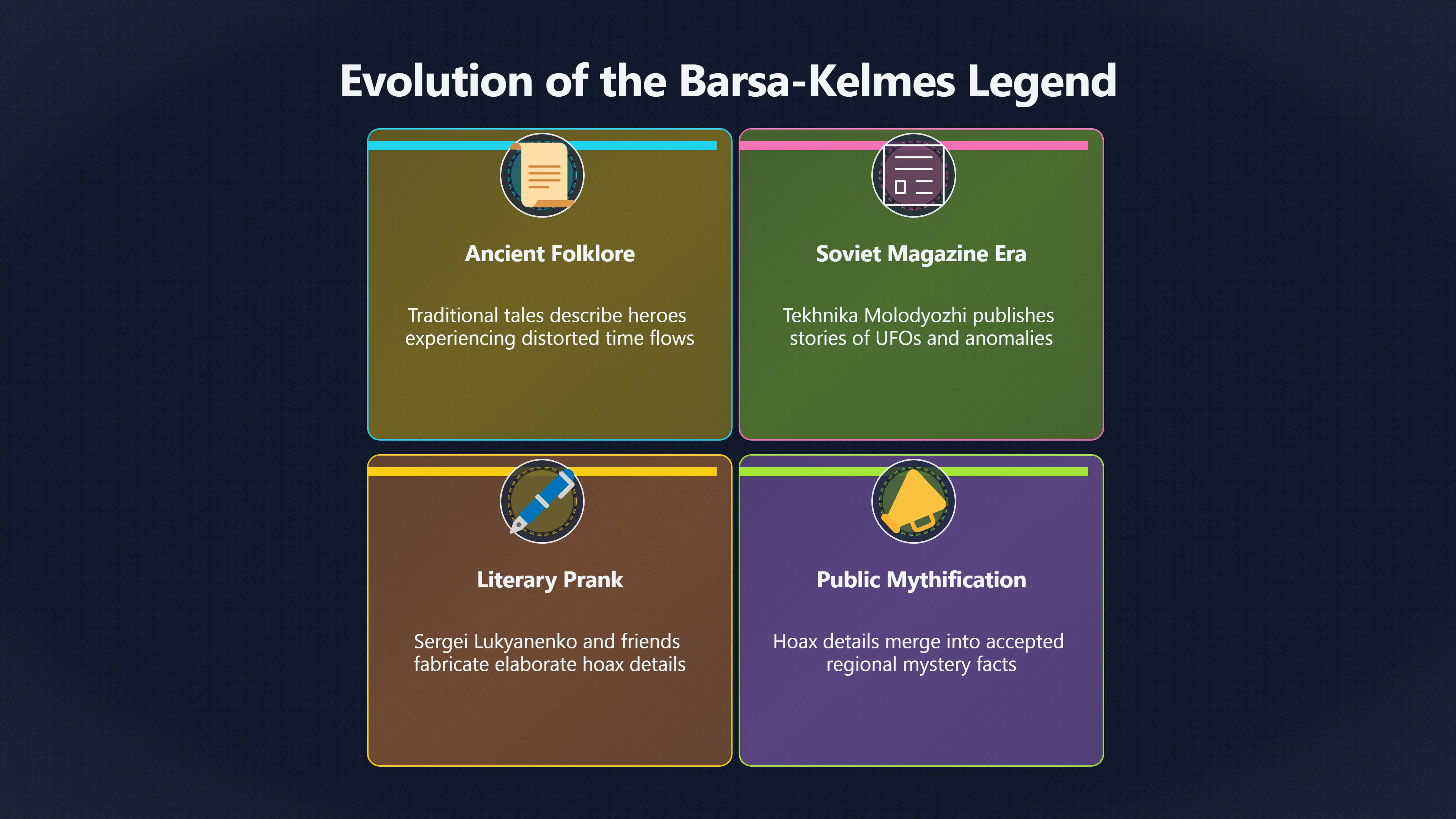
Older legends sometimes describe unusual flows of time, including stories in which heroes spend only a short period on the island while much longer passes elsewhere. Such motifs are common in world folklore and resemble “fairy time” traditions found far beyond Central Asia. They demonstrate that the idea of distorted time existed as folklore rather than as eyewitness evidence of a measurable physical anomaly.[nickhuntscrutiny.com]nickhuntscrutiny.comthe place of no returnIn 1992, the Russian sci-fi author Sergei Lukyanenko admitted that the UFO sightings had been a long-running hoax. The stories had been p…
How literary jokes became paranormal rumour
The modern time-slip legend owes far more to Soviet media culture than to unexplained events.
During the late Soviet period, enthusiasts of science fiction and anomalous phenomena exchanged regional mystery stories through clubs and magazines. According to later accounts by participants, the future novelist Sergei Lukyanenko and fellow enthusiasts expanded existing rumours about Barsa-Kelmes into an elaborate practical joke. They fabricated supporting details, invented witness letters and even created supposed historical references to strengthen the tale before it reached wider circulation.[Wikipedia]WikipediaOpen source on wikipedia.org.
The influential Soviet magazine Tekhnika Molodyozhi (“Technology for the Youth”) published stories describing disappearing expeditions, mysterious temporal distortions and UFO encounters. Readers encountered what appeared to be serious investigative reporting rather than an obvious work of fiction or satire. Once published nationally, the stories were copied into newspapers, magazines and later books discussing unexplained mysteries.[Wikipedia]WikipediaOpen source on wikipedia.org.
An unexpected twist followed. When Lukyanenko later admitted that key elements had been invented as a prank, researchers investigating the rumour discovered that some of the “original” local stories inspiring the hoax had themselves apparently been journalistic jokes from an earlier generation. Instead of uncovering a hidden paranormal mystery, they uncovered a chain of stories in which one fictional account inspired another.[Wikipedia]WikipediaOpen source on wikipedia.org.
What were the main time-slip claims?
Although details vary between retellings, several stories appear repeatedly.
- Lost expeditions: Groups supposedly vanished for days but believed only hours had passed.
- Ageing discrepancies: Visitors allegedly returned to discover that years or even decades had elapsed outside the island.
- Escaped prisoners: Some versions claimed fugitives hiding on the island experienced dramatic time shifts before reappearing.
- Mysterious fogs: Thick mist supposedly interfered with navigation, radio communication and perception of time.
- UFO connections: During the late 1980s and early 1990s, the island was increasingly described as an extraterrestrial “anomalous zone” where strange lights and unidentified craft accompanied temporal distortions.[wikipedia.org]WikipediaOpen source on wikipedia.org.
None of these stories has been supported by contemporary documentation demonstrating that the reported events actually occurred. Most trace back to repeated retellings rather than independently verified investigations.
Why did people believe the stories?
The rumours spread because they fit several powerful cultural patterns simultaneously.
First, Soviet popular culture had a growing appetite for anomalous zones, mysterious expeditions and unexplained scientific frontiers. Publications that mixed science with speculation attracted enthusiastic audiences during the final decades of the USSR.
Second, Barsa-Kelmes already sounded like a place where extraordinary things ought to happen. A location called “the place of no return” scarcely required much embellishment before readers expected disappearances.
Third, the collapse of the Soviet Union created an atmosphere in which long-suppressed secrets suddenly seemed plausible. Genuine revelations about classified military programmes encouraged many people to assume equally dramatic stories about UFOs or hidden experiments might also prove true.[nickhuntscrutiny.com]nickhuntscrutiny.comthe place of no returnIn 1992, the Russian sci-fi author Sergei Lukyanenko admitted that the UFO sightings had been a long-running hoax. The stories had been p…
Finally, the environmental destruction of the Aral Sea transformed the landscape itself into something almost unreal. An island literally disappearing because the sea vanished was astonishing enough that extraordinary stories no longer felt completely out of place.
Ecology, isolation and the afterlife of a hoax
Ironically, the real history of Barsa-Kelmes became stranger than the fictional one.[Wikipedia]WikipediaSource details in endnotes.
As irrigation projects diverted the rivers feeding the Aral Sea, the water retreated dramatically. Barsa-Kelmes ceased to be an island altogether, becoming connected to the mainland by newly exposed seabed. The surrounding region became internationally recognised as one of the world’s most severe environmental disasters.[nickhuntscrutiny.com]nickhuntscrutiny.comthe place of no returnIn 1992, the Russian sci-fi author Sergei Lukyanenko admitted that the UFO sightings had been a long-running hoax. The stories had been p…
This ecological catastrophe gave the old paranormal stories new emotional force. A landscape transformed beyond recognition encouraged writers and travellers to revisit older legends, sometimes blending genuine environmental tragedy with tales of UFOs, dinosaurs, vanished explorers and time anomalies. In many retellings, the environmental disaster itself almost overshadowed the earlier hoax, making the fictional mysteries seem like symbolic reflections of a place where reality had already become difficult to believe.
The island also became associated in popular writing with other regional mysteries, including nearby Cold War military secrecy and the notorious biological weapons testing site on the former Aral Sea island of Vozrozhdeniya. Although these are separate histories, they often became entangled in popular accounts, reinforcing the impression that the entire region concealed extraordinary secrets.[nickhuntscrutiny.com]nickhuntscrutiny.comthe place of no returnIn 1992, the Russian sci-fi author Sergei Lukyanenko admitted that the UFO sightings had been a long-running hoax. The stories had been p…

Why Barsa-Kelmes remains part of Kazakhstan’s Fortean history
Barsa-Kelmes is significant not because it offers persuasive evidence that time behaves differently there, but because it demonstrates how modern legends develop.
Unlike many paranormal stories whose origins are obscure, the evolution of the Barsa-Kelmes legend can be followed through folklore, local journalism, literary invention, Soviet popular magazines and later admissions by participants. That unusually traceable history makes it a valuable case study in the creation of modern myths.[Wikipedia]WikipediaOpen source on wikipedia.org.
Within Kazakhstan’s wider catalogue of strange places, Barsa-Kelmes occupies a distinctive position. Rather than illustrating an unexplained phenomenon awaiting scientific confirmation, it shows how an evocative place name, geographical isolation, environmental upheaval and media amplification combined to create one of Central Asia’s best-known “anomalous zones”. The enduring fascination lies less in evidence for time travel than in watching folklore, humour and historical circumstance merge into a legend that many readers still encounter as if it were a genuine mystery.
Amazon book picks
Further Reading
Books and field guides related to How Did Barsa Kelmes Become a Time Anomaly?. Use these as the next step if you want deeper reading beyond the article.
Why People Believe Weird Things
Highly relevant to time-slip legends and hoax evolution.

eBay marketplace picks
Marketplace Samples
Live-tested eBay searches with available results related to this page.



Endnotes
1.
Source: skeptoid.com
Link:https://skeptoid.com/episodes/783
Source snippet
The Legend of Barsa-Kelmes8 Jun 2021 — The story behind the story of the many paranormal events associated with this former island in the...
2.
Source: nickhuntscrutiny.com
Title: the place of no return
Link:https://nickhuntscrutiny.com/the-place-of-no-return/
Source snippet
In 1992, the Russian sci-fi author Sergei Lukyanenko admitted that the UFO sightings had been a long-running hoax. The stories had been p...
3.
Source: Wikipedia
Link:https://en.wikipedia.org/wiki/Barsa-Kelmes
Additional References
4.
Source: ancient-origins.net
Title: literary hoax. They had been contacted by UFO researchers in Moscow
Link:https://www.ancient-origins.net/news-history-archaeology/barsa-kelmes-enigma-00102670
Source snippet
The Barsa-Kelmes Enigma: Investigating Central Asia's...10 Apr 2026 — This "time-slip" narrative is a recurring theme in the history...
5.
Source: youtube.com
Title: What was the Aral Sea like before the disaster just 60 years ago?
Link:https://www.youtube.com/watch?v=TO6MH6QOsGk
Source snippet
Altyn Emel, Barsakelmes added to UNESCO World Heritage List | Silk way TV...
6.
Source: youtube.com
Title: THE ARAL SEA HID THIS ISLAND: THE MYSTERY OF BARSA-KELMES
Link:https://www.youtube.com/watch?v=snXWoG8AbiE
Source snippet
Galya Bisengalieva Shares: “Barsa-Kelmes” | 4:3 Music Videos...
7.
Source: youtube.com
Title: Barca Kelmes. Mysterious legend
Link:https://www.youtube.com/watch?v=2hCrOGOX5c8
Source snippet
What was the Aral Sea like before the disaster just 60 years ago?...
8.
Source: youtube.com
Title: Galya Bisengalieva Shares: “Barsa-Kelmes” | 4:3 Music Videos
Link:https://www.youtube.com/watch?v=4o25TbdbVBo
Source snippet
Barca Kelmes. Mysterious legend...
9.
Source: youtube.com
Title: Altyn Emel, Barsakelmes added to UNESCO World Heritage List | Silk way TV
Link:https://www.youtube.com/watch?v=Xjx3Se8ITJg
Topic Tree