Why Ireland Keeps Its Strangest Stories Alive
Ireland’s strange-history record is unusually rich because it sits at the meeting point of oral tradition, Catholic visionary culture, nineteenth-century newspapers, local humour, scientific curiosity and modern media. Its Fortean material is not one neat category of “the paranormal”.
Page outline Jump by section
Introduction
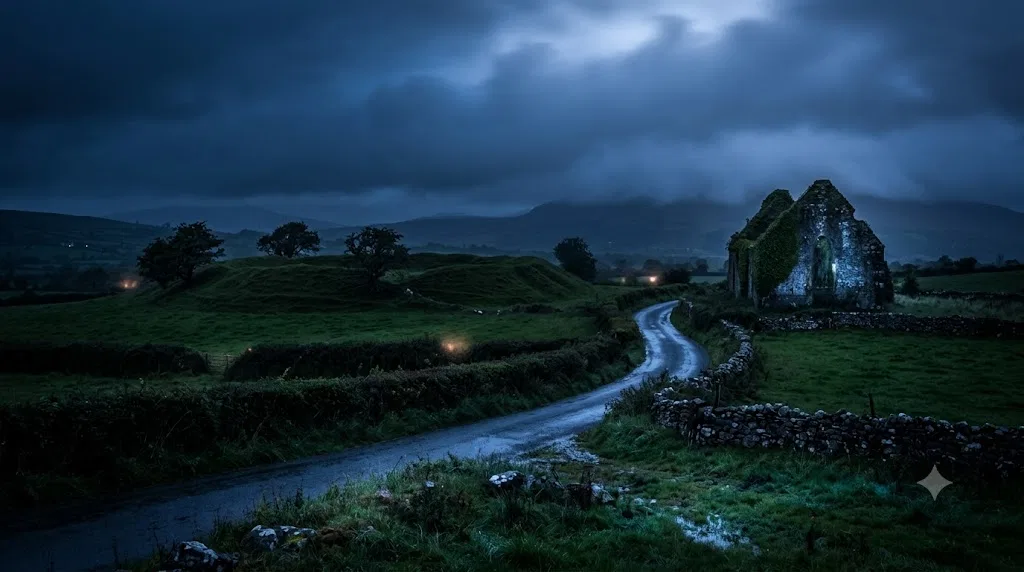
The best way to read Irish Forteana is not to ask whether “Ireland is haunted”. It is to ask why certain reports took hold. Many did so because they attached mystery to real places: Knock in County Mayo, Lough Derg on the Shannon, Mullinahone in County Tipperary, Ballybane in Galway, ringforts in fields, graveyards, bog roads, lonely lights and weather-stained skies. Ireland’s weird record matters because it shows how a country can preserve uncertainty without always pretending to solve it.
Why Ireland Has Such a Dense Weird-History Record
Ireland’s strongest Fortean source is not a single investigator, newspaper column or ghost book. It is the enormous body of collected folklore held by the National Folklore Collection at University College Dublin, described by Dúchas as a UNESCO-recognised archive and one of Europe’s largest collections of oral tradition and cultural history. Its holdings cover popular belief, religious traditions, oral literature, local history, folk medicine, customs and many other aspects of everyday life, collected across Ireland through fieldwork and archival projects.[Dúchas]duchas.ieDúchas National Folklore Collection | dúchas.ieDúchas National Folklore Collection | dúchas.ie
That matters because many Irish “strange” stories were not originally framed as entertainment. They were ways of explaining danger, grief, landscape, luck, illness, death, ancestry and social boundaries. A banshee tale might be a ghost story, but it is also a story about mourning. A fairy fort curse might sound supernatural, but it also preserved respect for old sites and marked off places people were nervous about disturbing. A wandering light could be an uncanny sign, a bog hazard, a moral warning or simply an odd natural observation retold in memorable form.
The Schools’ Collection is especially important. Between 1937 and 1939, senior primary school pupils, working with teachers and the Irish Folklore Commission, recorded more than 750,000 pages of local history and oral tradition from the 26 counties of the Irish Free State, including around 18,000 original school exercise books.[University College Dublin]ucd.ieUniversity College Dublin Schools' Collection (DúchasUniversity College Dublin Schools' Collection (Dúchas This gives Ireland something many countries lack: a large twentieth-century snapshot of what ordinary people said about ghosts, cures, fairies, forts, omens, lights, holy wells, strange animals and local marvels before television and mass tourism reshaped much of the storytelling.
The caveat is just as important. Folklore is evidence that a story was told, remembered or believed; it is not automatically evidence that the event happened literally. That distinction makes Irish material especially interesting. The archive lets us see not only strange claims, but also how communities sorted the strange into belief, joke, warning, family memory and place-lore.
Fairy Forts: When Folklore Protected Archaeology
Few Irish motifs show the overlap between Forteana and ordinary life better than the fairy fort. The visible ringforts, raths, lisses, duns and cashels scattered through the Irish countryside are archaeological features, broadly dating from the Iron Age to the early medieval period. Many once contained timber structures and fences, leaving only earthen or stone outlines in the landscape once the perishable buildings disappeared.[RTE.ie]rte.ieThe superstitions and mysteries around Ireland's 'fairy fortsThe superstitions and mysteries around Ireland's 'fairy forts
Their strange reputation came later, or at least became firmly attached through local tradition. In rural belief, such places could be occupied or guarded by fairies, with interference risking bad luck, illness, damage to livestock or household misfortune. RTÉ’s discussion of fairy forts notes that people avoided building homes on fairy paths or too close to places associated with fairy activity, while old objects found in fields might be explained as fairy property.[RTE.ie]rte.ieThe superstitions and mysteries around Ireland's 'fairy fortsThe superstitions and mysteries around Ireland's 'fairy forts
For a Fortean reader, the fairy fort is not interesting because it proves invisible beings live in old earthworks. It is interesting because belief affected behaviour. Farmers ploughed around certain places. Builders hesitated. Families passed on warnings. Archaeological remains survived partly because supernatural caution made practical sense: leave the old place alone.
Sceptics usually read this as cultural conservation wrapped in fear. Believers, or at least tradition-minded locals, may see it as evidence that old places have agency, memory or a kind of boundary that modern life ignores at its peril. The most grounded reading is that fairy-fort lore did several jobs at once. It preserved archaeology, explained misfortune, encoded respect for land, and gave the countryside a hidden map of places where ordinary rules did not quite apply.
Knock: Apparition, Pilgrimage and the Problem of Silent Evidence
The apparition at Knock, County Mayo, is one of Ireland’s most significant visionary cases because it is both local and national, religious and historical, specific and still disputed. On 21 August 1879, witnesses reported seeing the Virgin Mary, St Joseph, St John the Evangelist, angels, an altar, a cross and the Eucharistic Lamb at the gable wall of the parish church. According to Knock Shrine’s own history, the apparition lasted for about two hours and 15 official witnesses gave testimony to a Commission of Enquiry that October.[Knock Shrine]knockshrine.ieKnock Shrine History | Knock ShrineKnock Shrine History | Knock Shrine
The case has several features that keep it in the Irish Fortean record. It happened in rain and gathering darkness. The figures were reported as silent and motionless. The witnesses varied in age and social position. The church inquiry judged the testimony “trustworthy and satisfactory”, and a second commission in 1935–36 re-examined surviving witnesses and related evidence.[Knock Shrine]knockshrine.ieKnock Shrine The Commissions of Enquiry | Knock ShrineKnock Shrine The Commissions of Enquiry | Knock Shrine
For believers, Knock is not merely an anomaly but a sacred event that became a place of pilgrimage. For historians, it is also inseparable from late nineteenth-century Ireland: poverty, land agitation, Catholic devotional life, national identity and the speed with which news could travel through Irish and diaspora networks. History Ireland notes that the apparition occurred at the beginning of the Land War and that later devotional writing often handled the political setting carefully, preferring to present Knock as a sign for the Irish people rather than as a directly political event.[History Ireland]historyireland.comHistory Ireland The Cusack Papers; new evidence on the Knock apparitionHistory Ireland The Cusack Papers; new evidence on the Knock apparition
Sceptical interpretations have included optical effects, religious expectation, misperception, staging and later embellishment. None of those explanations is universally accepted, and some are more speculative than others. The more useful point is that Knock is a classic case where the evidence is strong in one sense and limited in another. There were named witnesses, inquiries and continuing tradition; but the event itself was not photographed, experimentally recorded or repeatable. Its power lies in testimony, ritual afterlife and the way a silent vision became a national religious symbol.
Black Rain and Other Falls from the Irish Sky
Charles Fort loved reports that seemed to fall between categories: weather, accident, hoax, natural history and cosmic absurdity. Ireland supplied him with several examples, especially coloured or dirty rains. In The Book of the Damned, Fort cited black rains in Ireland, including a rain on 14 May 1849 said to have fallen across a district of 400 square miles with an inky colour, bad smell and unpleasant taste; a “thick, black rain” at Castlecomer in 1887; and black rain in October 1907, later conventionally explained as soot carried from South Wales across the Irish Channel and over Ireland.[Wikisource]en.wikisource.orgThe Book of the Damned/Chapter 3The Book of the Damned/Chapter 3
These reports are useful because they show how Fortean material often begins as a perfectly real observation. Rain can indeed be discoloured by dust, soot, pollen, volcanic material or other particles. Smithsonian’s science coverage of strange rains notes that red rains may come from desert dust, black rains from volcanoes or pollution, and greasy nineteenth-century European rains from soot associated with industrial centres. It also notes Fort’s large appetite for reports of falls of frogs, snakes, cinders and salt.[Smithsonian Magazine]smithsonianmag.comOpen source on smithsonianmag.com.
The Irish black-rain cases are therefore not best treated as supernatural mysteries. They belong in Forteana because they once looked like violations of ordinary weather. A person watching ink-coloured rain stain fields and houses in nineteenth-century Ireland did not need a theory about atmospheric transport to find it disturbing. The later explanation does not erase the strangeness of the experience; it relocates it from “impossible event” to “unfamiliar mechanism”.
That pattern repeats across many anomalous falls. The report may be exaggerated, copied badly or misremembered. It may also be substantially true but naturally caused. Fort’s instinct was to resist premature tidy explanations; modern scepticism adds that some tidy explanations are, in fact, correct. Ireland’s black rains sit exactly in that productive tension.
Lake Monsters: Lough Derg, Lough Ree and the Irish Nessie Problem
Ireland has several lake-monster traditions, but they are more slippery than the tourist-friendly monster stories of Loch Ness. Lough Derg is a good example. A story found in the Schools’ Collection and discussed by the Tipperary Antiquarian describes a huge monster in Lough Derg in the time of the Fianna, causing havoc until Fionn killed it; the monster’s blood supposedly reddened the lake, helping explain the name Lough Derg.[thetipperaryantiquarian.blogspot.com]thetipperaryantiquarian.blogspot.comThe Tipperary Antiquarian: Lough Derg & its "MonsterThe Tipperary Antiquarian: Lough Derg & its "Monster
That tale is mythic rather than zoological. It reads like heroic folklore, not a field report. Yet Lough Derg also has more modern creature claims. The same discussion notes later reported sightings, including a 1961 fishing incident near Bushy Island, a 1980 black-hump sighting near Mountshannon, and a claimed sonar contact in the late 1960s. It also raises an awkward but important possibility: Irish monster stories recorded in the 1930s may have been shaped by the international publicity around the Loch Ness Monster after 1933.[thetipperaryantiquarian.blogspot.com]thetipperaryantiquarian.blogspot.comThe Tipperary Antiquarian: Lough Derg & its "MonsterThe Tipperary Antiquarian: Lough Derg & its "Monster
That does not make the stories worthless. It makes them culturally revealing. A lake monster can be an old myth, a misidentified animal, a newspaper-influenced retelling, a fisherman’s puzzle, a hoax, or a way of making a known place feel newly mysterious. Large pike, floating debris, swimming deer, otters, wave effects, low light and expectation can all produce monster-like reports.
Lough Ree has also appeared in Irish monster coverage. RTÉ Archives describes Lough Ree as a site where people searched for “unknown creatures”, linking it with other Irish lake-monster material.[RTE.ie]rte.ieOpen source on rte.ie. The important distinction is that Irish lake monsters rarely rest on a single clean evidential chain. They survive through layers: heroic tradition, local testimony, television curiosity, cryptozoological enthusiasm and sceptical naturalism.
Strange Lights, UFOs and the Irish Sky
Ireland’s modern UFO record follows the same pattern seen elsewhere: ordinary people report lights or objects that seem odd, official bodies often record them without investigating deeply, and later explanations range from aircraft and satellites to meteors, drones, rocket debris, military activity or misperception.
One archival example is Mullinahone, County Tipperary, where RTÉ records that reported UFO sightings in 1969 led Newsbeat to visit the area and speak with locals who said they had witnessed something unusual.[RTE.ie]rte.ie682218 ufo in mullinahone682218 ufo in mullinahone The value of such a case is not that it proves alien craft visited rural Ireland. It shows how a local sky report becomes a community event: witnesses compare notes, journalists arrive, and the story acquires a life beyond the original observation.
More recent material is better documented but often less romantic. In Northern Ireland, RTÉ reported on PSNI records showing a small number of UFO-related calls over recent years. One Armagh report described “three orange lights in the sky in a perfect triangle” that moved and dispersed; police recorded the reports for information and identified no lines of inquiry. The same report notes that a widely discussed wave of lights over Ireland in October was likely debris from a rocket launched in Florida.[RTE.ie]rte.ieLights in 'perfect triangle' among UFO reports to PSNILights in 'perfect triangle' among UFO reports to PSNI
That is a useful modern Fortean lesson. A UFO is literally unidentified at the point of report; it is not automatically alien, supernatural or important. Many reports are too thin to resolve. Some are later explained. Others remain unresolved because nobody gathered enough information at the time. Ireland’s UFO material is strongest when treated as sky folklore plus witness testimony, not as a shortcut to extraordinary conclusions.
Psychical Research, Poltergeists and Haunted Ireland
Irish ghost traditions are older than psychical research, but the late nineteenth and early twentieth centuries brought a different style of attention: investigators trying to test apparitions, hauntings, mediumship and poltergeist claims using interviews, controls and published reports. This did not make the subject straightforwardly scientific, but it changed the tone from fireside tale to contested evidence.
A notable Irish-linked figure was Sir William Fletcher Barrett, a physicist born in Jamaica to an Irish clerical family and later associated with the Society for Psychical Research. RTÉ’s account of Barrett’s ghost-hunting work places him in the Victorian world of psychical research, where educated investigators tried to study hauntings, spirit communication and related claims rather than simply dismiss or endorse them.[RTE.ie]rte.ie1256081 william barrett ghost hunter poltergeist derrygonnelly fermanagh1256081 william barrett ghost hunter poltergeist derrygonnelly fermanagh
Ireland also appears in older poltergeist literature. True Irish Ghost Stories, a 1914 collection available through Sacred Texts, presents poltergeist incidents attributed to a paper read by Barrett before the Society for Psychical Research, while later archives preserve reports such as the Enniscorthy “ghost” of 1910, which contemporary coverage itself suggested might be read rationally as a practical joke.[Internet Sacred Text Archive]sacred-texts.comInternet Sacred Text Archive True Irish Ghost Stories: Chapter IV. PoltergeistsInternet Sacred Text Archive True Irish Ghost Stories: Chapter IV. Poltergeists
That mixture is typical. Some Irish haunting stories are devotional or folkloric. Some are literary. Some are family traditions. Some were investigated by people who believed careful inquiry might reveal unknown powers of mind or survival after death. Sceptical readings point to fraud, suggestion, environmental causes, memory distortion, sleep states, grief, social contagion and the tendency of ambiguous noises or movements to grow into narratives. The Irish record contains all of those possibilities, which is why the best cases are not the loudest ones, but the ones with named witnesses, dates, documents and competing interpretations.
The Galway Spontaneous-Combustion Verdict
Not all Irish Forteana is old. In 2011, the death of 76-year-old Michael Faherty in Ballybane, Galway, became internationally reported after an inquest concluded that he had died as a result of spontaneous human combustion. The Guardian reported that the coroner gave that verdict after Faherty was found badly burned in his home in unexplained circumstances.[The Guardian]theguardian.comThe Guardian Spontaneous combustion killed Irish pensioner, inquest rulesThe Guardian Spontaneous combustion killed Irish pensioner, inquest rules ABC News reported that the fire damage was concentrated around the body, with scorch marks above and below, no accelerant found, and the nearby fireplace not judged by forensic experts to have caused the blaze.[ABC News]abcnews.comirishmans death ruled spontaneous combustionirishmans death ruled spontaneous combustion
This is a modern example of how a Fortean label can enter official language without settling the science. “Spontaneous human combustion” sounds as if a body burst into flame from within. Sceptics generally object that the label often means “we have not identified the ignition sequence”, not “a new human-burning mechanism has been demonstrated”. The common alternative explanation in such cases is some version of the wick effect, where clothing and body fat can sustain a localised fire after an external ignition source, leaving surprisingly limited damage nearby.
The Faherty case belongs in Ireland’s strange-history record because it was official, recent and genuinely puzzling in its immediate circumstances. It should not be inflated into proof that people ignite without cause. The most careful conclusion is that the inquest used a famous anomalous category for an unexplained death scene, while fire science and sceptical investigators continue to prefer external ignition and localised burning mechanisms unless stronger evidence demands otherwise.
How to Read Irish Forteana Without Flattening It
Ireland’s strange material is easy to spoil in two opposite ways. One is to turn every story into proof of the supernatural. The other is to flatten every story into “just superstition”. Neither approach does justice to the evidence or to the culture that preserved it.
A better reading uses a few practical distinctions:
A tradition is not the same as an event. A fairy-fort warning or lake-monster legend may prove that a belief was locally meaningful, not that its literal creature existed.
A witness report is not worthless because it is mistaken. UFOs, apparitions and monster sightings often preserve real perception under difficult conditions: darkness, rain, distance, fear, expectation or poor reference points.
A natural explanation does not make a story uninteresting. Black rain caused by soot is still strange if you are standing under it before the explanation exists.
A sceptical explanation should fit the case, not merely the genre. It is lazy to say “all apparitions are hallucinations” or “all monster sightings are logs”. It is better to ask what was reported, by whom, under what conditions, how soon it was recorded and what alternative explanations actually match.
A believer’s interpretation may explain cultural power even when it does not prove the claim. Knock cannot be understood only as an optical puzzle. Fairy forts cannot be understood only as bad archaeology. Their meanings outgrew the original reports.
Why Ireland’s Weird Record Still Has Pull
Ireland’s Forteana lasts because it is rooted in place. The stories do not float in an abstract paranormal universe. They cling to gable walls, ringforts, lakes, roads, bogs, graveyards, kitchens, skies and fields. Even when a claim is doubtful, the setting often remains real and visitable, and the story becomes part of how people notice that place.
It also lasts because Irish tradition is unusually good at keeping ambiguity alive. A story can be told with a wink and still carry a warning. A family can half-believe a banshee story without making a doctrine of it. A farmer can avoid a fort for reasons that are practical, inherited and supernatural all at once. A news report can laugh at a UFO while still interviewing the witnesses.
The strongest Irish strange-history material therefore does not ask the reader to abandon judgement. It asks for a more patient kind of judgement: one that can separate archive from evidence, evidence from interpretation, and explanation from meaning. Ireland’s Forteana is not a catalogue of solved and unsolved puzzles. It is a record of how a country has repeatedly met the odd, the frightening and the inexplicable, then turned them into stories durable enough to survive disbelief.
Amazon book picks
Further Reading
Books and field guides related to Why Ireland Keeps Its Strangest Stories Alive. Use these as the next step if you want deeper reading beyond the article.
Meeting the Other Crowd
Covers many of Ireland's best-known strange traditions and folklore.
The Mammoth Book of Irish Myths and Legends
Provides broad context for Ireland's legendary landscape.
eBay marketplace picks
Marketplace Samples
Live-tested eBay searches with available results related to this page.



Endnotes
1.
Source: rte.ie
Title: The superstitions and mysteries around Ireland’s ‘fairy forts’
Link:https://www.rte.ie/brainstorm/2025/0416/1237227-fairy-forts-ringforts-superstitions-rural-ireland/
2.
Source: en.wikisource.org
Title: The Book of the Damned/Chapter 3
Link:https://en.wikisource.org/wiki/The_Book_of_the_Damned/Chapter_3
3.
Source: thetipperaryantiquarian.blogspot.com
Title: The Tipperary Antiquarian: Lough Derg & its “Monster”
Link:https://thetipperaryantiquarian.blogspot.com/2016/06/lough-derg-its-monster.html
4.
Source: rte.ie
Link:https://www.rte.ie/archives/2016/0701/799606-lough-ree-monster/
5.
Source: rte.ie
Title: 682218 ufo in mullinahone
Link:https://www.rte.ie/archives/exhibitions/2770-weird-and-wonderful/682218-ufo-in-mullinahone/
6.
Source: rte.ie
Title: Lights in ‘perfect triangle’ among UFO reports to PSNI
Link:https://www.rte.ie/news/newslens/2026/0101/1551110-ufo-northern-ireland/
7.
Source: rte.ie
Title: 1256081 william barrett ghost hunter poltergeist derrygonnelly fermanagh
Link:https://www.rte.ie/brainstorm/2021/1027/1256081-william-barrett-ghost-hunter-poltergeist-derrygonnelly-fermanagh/
8.
Source: sacred-texts.com
Title: Internet Sacred Text Archive True Irish Ghost Stories: Chapter IV. Poltergeists
Link:https://sacred-texts.com/neu/celt/tigs/tigs06.htm
9.
Source: rte.ie
Link:https://www.rte.ie/archives/2017/0529/878703-lough-derg-monster/
10.
Source: rte.ie
Title: 1299728 the lough derg experience
Link:https://www.rte.ie/archives/2022/0518/1299728-the-lough-derg-experience/
11.
Source: rte.ie
Title: 801869 the monster of whitewood lake
Link:https://www.rte.ie/archives/2016/0712/801869-the-monster-of-whitewood-lake/
12.
Source: rte.ie
Title: 949136 ufos over ireland
Link:https://www.rte.ie/archives/2018/0331/949136-ufos-over-ireland/
13.
Source: rte.ie
Title: 1559224 on this week a riot a hovercroft crash and a ufo in tipperary
Link:https://www.rte.ie/history/100/2026/0223/1559224-on-this-week-a-riot-a-hovercroft-crash-and-a-ufo-in-tipperary/
14.
Source: rte.ie
Title: 1418178 ufo phenomenon
Link:https://www.rte.ie/news/primetime/2023/1123/1418178-ufo-phenomenon/
15.
Source: rte.ie
Title: 1542138 bugonia yorgos lanthimos aliens psychology
Link:https://www.rte.ie/brainstorm/2025/1107/1542138-bugonia-yorgos-lanthimos-aliens-psychology/
16.
Source: sacred-texts.com
Link:https://sacred-texts.com/fort/damn/damn07.htm
17.
Source: irishmysteries.blogspot.com
Title: the case of michael faherty
Link:https://irishmysteries.blogspot.com/2020/04/the-case-of-michael-faherty.html
18.
Source: archaeology.ie
Link:https://www.archaeology.ie/app/uploads/2025/03/Register-of-Historic-Monuments-09_V1.pdf
19.
Source: ia801305.us.archive.org
Title: Fortean Times March 2016
Link:https://ia801305.us.archive.org/6/items/Fortean_Times_March_2016/Fortean_Times_March_2016.pdf
Published: March 2016
20.
Source: archive.org
Link:https://archive.org/stream/symonssmeteorol00unkngoog/symonssmeteorol00unkngoog_djvu.txt
21.
Source: archive.org
Link:https://archive.org/download/psychicalresear00barr/psychicalresear00barr.pdf
22.
Source: hardimanlibrary.blogspot.com
Title: bealoideas national folklore collection
Link:https://hardimanlibrary.blogspot.com/2015/06/bealoideas-national-folklore-collection.html
23.
Source: history.com
Title: is spontaneous human combustion real
Link:https://www.history.com/articles/is-spontaneous-human-combustion-real
24.
Source: duchas.ie
Title: Dúchas National Folklore Collection | dúchas.ie
Link:https://www.duchas.ie/en/info/cbe
25.
Source: ucd.ie
Title: University College Dublin Schools’ Collection (Dúchas)
Link:https://www.ucd.ie/irishfolklore/en/collections/schoolscollectionduchas/
26.
Source: knockshrine.ie
Title: Knock Shrine History | Knock Shrine
Link:https://www.knockshrine.ie/history/
27.
Source: knockshrine.ie
Title: Knock Shrine The Commissions of Enquiry | Knock Shrine
Link:https://www.knockshrine.ie/the-commissions-of-enquiry-2/
28.
Source: historyireland.com
Title: History Ireland The Cusack Papers; new evidence on the Knock apparition
Link:https://historyireland.com/the-cusack-papers-new-evidence-on-the-knock-apparition/
29.
Source: smithsonianmag.com
Link:https://www.smithsonianmag.com/science-nature/strange-rain-why-fish-frogs-and-golf-balls-fall-skies-180956527/
30.
Source: theguardian.com
Title: The Guardian Spontaneous combustion killed Irish pensioner, inquest rules
Link:https://www.theguardian.com/world/2011/sep/23/irish-pensioner-killed-spontaneous-combustion
31.
Source: abcnews.com
Title: irishmans death ruled spontaneous combustion
Link:https://abcnews.com/blogs/health/2011/09/23/irishmans-death-ruled-spontaneous-combustion
32.
Source: duchas.ie
Link:https://www.duchas.ie/en/cbes/4921978/4914905/4942470
33.
Source: duchas.ie
Title: Transcripts · The Schools’ Collection
Link:https://www.duchas.ie/en/cbes/transcripts?Page=13&PerPage=20&SearchLanguage=ga&SearchText=Puca
34.
Source: duchas.ie
Link:https://www.duchas.ie/en/cbes/5070797/5064904/5098948
35.
Source: duchas.ie
Title: Transcripts · The Schools’ Collection
Link:https://www.duchas.ie/en/cbes/transcripts?SearchLanguage=ga&SearchText=lough+gur
36.
Source: duchas.ie
Link:https://www.duchas.ie/en/cbe/transcripts?SearchLanguage=en&SearchText=ghost+story
37.
Source: duchas.ie
Link:https://www.duchas.ie/ga/meitheal/log/cbes
38.
Source: duchas.ie
Link:https://www.duchas.ie/en/cbes/stories?NameKey=elizabeth-davitt
39.
Source: duchas.ie
Link:https://www.duchas.ie/en/meitheal/log/cbes?UserID=2677
40.
Source: duchas.ie
Link:https://www.duchas.ie/en/cbe/9001780/7304151/9112405?transcribe=true
41.
Source: duchas.ie
Link:https://www.duchas.ie/en/meitheal/log/cbes
42.
Source: duchas.ie
Link:https://www.duchas.ie/en/cbes/4922108/4852764/4954713
43.
Source: duchas.ie
Link:https://www.duchas.ie/en/cbes/4583331/4580303/4591830
44.
Source: duchas.ie
Link:https://www.duchas.ie/en/cbes/5044666/5030343/5142636?Route=stories
45.
Source: sacredtrails.ie
Link:https://www.sacredtrails.ie/heritage/category/ringforts
46.
Source: Wikipedia
Link:https://en.wikipedia.org/wiki/Fairy
47.
Source: Wikipedia
Title: Knock Shrine
Link:https://en.wikipedia.org/wiki/Knock_Shrine
48.
Source: Wikipedia
Title: Irish folklore
Link:https://en.wikipedia.org/wiki/Irish_folklore
49.
Source: Wikipedia
Title: Spontaneous human combustion
Link:https://en.wikipedia.org/wiki/Spontaneous_human_combustion
50.
Source: ucd.ie
Link:https://www.ucd.ie/irishfolklore/en/
51.
Source: irishfolklore.com
Link:https://www.irishfolklore.com/creatures/creatures-and-beings/
52.
Source: emmafcownie.com
Title: irish folklore
Link:https://emmafcownie.com/tag/irish-folklore/
53.
Source: bahaistudies.net
Title: book of the damned
Link:https://www.bahaistudies.net/asma/book_of_the_damned.pdf
54.
Source: irishmyths.com
Link:https://irishmyths.com/2022/07/25/banshee/
Additional References
55.
Source: youtube.com
Link:https://www.youtube.com/watch?v=utlz0Qf9AdU
Source snippet
Folklore Fragments Podcast - Episode 01 outlines the history and academic framework of the National Folklore Collection at University Col...
56.
Source: youtube.com
Title: Folklore Fragments Podcast
Link:https://www.youtube.com/watch?v=GX28lpTT9pQ
Source snippet
Fairy Encounters and Stories from Ireland, featuring Eddie Lenihan (County Clare)...
57.
Source: youtube.com
Title: Folklore Fragments Podcast
Link:https://www.youtube.com/watch?v=34CKDeKNSko
Source snippet
Online Folklore Collections from County Offaly. Lecture by Jonny Dillon, archivist, NFC...
58.
Source: youtube.com
Link:https://www.youtube.com/watch?v=dEqNsFAD0sI
Source snippet
Folklore Fragments Podcast - Episode 27: The Banshee (with Professor Patricia Lysaght)...
59.
Source: xyuandbeyond.com
Link:https://xyuandbeyond.com/ring-forts-in-ireland/
60.
Source: spr.ac.uk
Link:https://www.spr.ac.uk/9-hauntings-and-poltergeists
61.
Source: facebook.com
Link:https://www.facebook.com/100064642634339/posts/a-ringfort-fairy-fort-in-county-cork-that-survived-in-the-irish-countryside-for-/1102477236798741/
62.
Source: irishurns.com
Link:https://irishurns.com/banshees-in-irish-culture/
63.
Source: pearl-hifi.com
Link:https://pearl-hifi.com/11_Spirited_Growth/01_Books/Fort_Charles/Charles_Fort_The_Fortean_Society_Unidentified_Flying_Objects.pdf
64.
Source: facebook.com
Link:https://www.facebook.com/groups/2744997828852476/posts/5915622445123316/
Topic Tree
Follow this branch
Related pages 192
- Afghan Forteana
- Antigua Uncanny
- Bosnian Mysteries
- Botswana Weird
- Brazil Strange
- +187 more in sidebar