Within Nicaragua Weird
Why Do Nicaragua's Ghosts Guard The Road?
La Mocuana, El Cadejo, La Cegua and La Llorona make fear useful by turning night roads, caves and desire into warnings.
On this page
- La Mocuana and colonial betrayal in caves
- Cadejo, Cegua and night road discipline
- Fear, humour and moral memory in folklore
Page outline Jump by section
Introduction
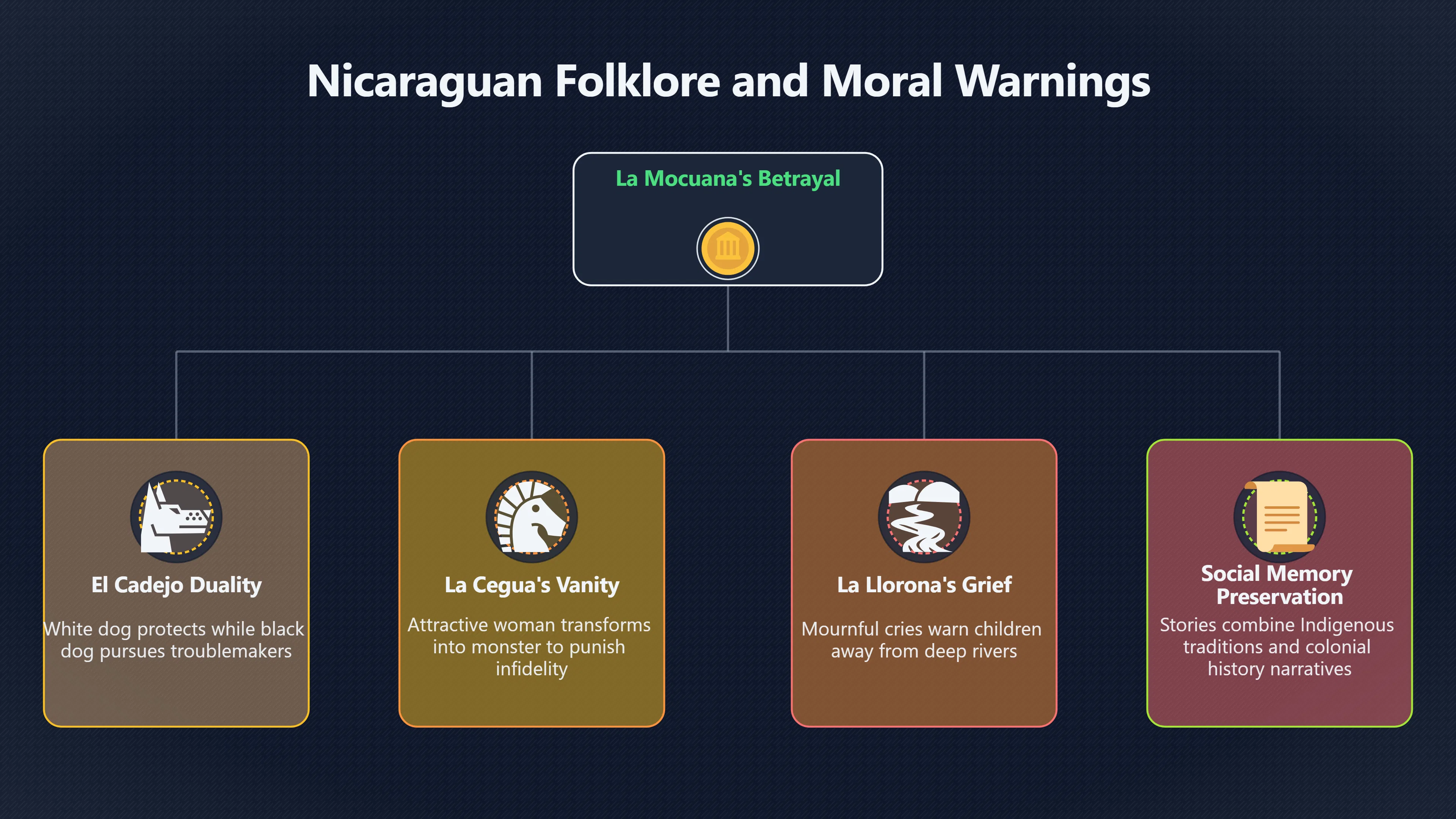
Nicaragua’s best-known ghost stories are not random scares. They are warning tales that place danger on lonely roads, beside rivers and around caves, turning ordinary journeys into moral tests. Figures such as La Mocuana, El Cadejo, La Cegua and La Llorona all occupy places where people travel, court, drink, wander or become lost after dark. Whether they are understood as ghosts, spirits or folklore, they share a practical purpose: encouraging caution, condemning betrayal or infidelity, and reminding listeners that poor choices have consequences. Rather than claiming the supernatural is real, these stories preserve social memory in vivid narrative form, combining Indigenous traditions, colonial history and later Christian moral ideas into some of Nicaragua’s most enduring pieces of folklore.[Visita Nicaragua]visitanicaragua.comVisita Nicaragua5 Nicaraguan myths and legendsLegend has it that the Mocuana was a beautiful indigenous woman, daughter of a chief, who fell in love with a Spaniard who deceived and r…
Why do Nicaragua’s ghosts guard the road?
Unlike haunted-house traditions found elsewhere, many Nicaraguan legends unfold outdoors. Roads, caves, forests and riverbanks are places where travellers are vulnerable, landmarks are uncertain and strangers may appear unexpectedly. In pre-modern rural Nicaragua these were genuine places of risk, making them natural settings for stories that encouraged sensible behaviour after dark.
The result is a recurring pattern. A traveller meets a mysterious woman, follows an unfamiliar path, ignores common sense or stays out drinking too late. The supernatural encounter becomes less important than the lesson. The landscape itself seems to judge human behaviour, transforming roads into places where honesty, loyalty and self-control are tested.[nicaragua.com]nicaragua.comFolklore in NicaraguaThe Nicaraguan folkloric legend of La Mocuana is believed to be based on genuine history and it is thought that La M…
La Mocuana and colonial betrayal in caves
Among Nicaragua’s most distinctive legends is La Mocuana, whose story is rooted not simply in fear but in betrayal during the Spanish conquest. Most versions describe her as the daughter of an Indigenous chief who knew where her people had hidden their treasure. She fell in love with a Spaniard who persuaded her to reveal the secret cave. Once the treasure was secured, he imprisoned her there and escaped with the gold. Although she eventually found a way out, the combined shock of betrayal, loss and shame drove her into madness.[Visita Nicaragua]visitanicaragua.comVisita Nicaragua5 Nicaraguan myths and legendsLegend has it that the Mocuana was a beautiful indigenous woman, daughter of a chief, who fell in love with a Spaniard who deceived and r…
Her ghost is said to wander hills, caves and lonely tracks, often appearing first as a beautiful young woman. Only when a man approaches does her terrifying appearance become visible, sending witnesses fleeing in panic or, in some versions, leaving them permanently disturbed. The cave is not merely a haunted location but a symbol of concealed wealth, colonial violence and broken trust.[visitanicaragua.com]visitanicaragua.comVisita Nicaragua5 Nicaraguan myths and legendsLegend has it that the Mocuana was a beautiful indigenous woman, daughter of a chief, who fell in love with a Spaniard who deceived and r…
Many folklorists interpret the tale as a cultural memory of conquest rather than a simple ghost story. The Spaniard’s deception mirrors wider historical experiences of exploitation, while La Mocuana herself becomes a tragic figure caught between two worlds. Her vengeance is directed particularly towards deceitful or lustful men, turning the legend into both a historical allegory and a moral warning.[Wikipedia]WikipediaOpen source on wikipedia.org.
Cadejo, Cegua and night-road discipline
La Mocuana warns against betrayal, but two other famous figures are more closely associated with the dangers of travelling after dark.
El Cadejo
El Cadejo appears throughout Central America, but Nicaraguan traditions give the spectral dog a distinctive moral role. Stories commonly distinguish between a white Cadejo, which protects honest travellers, and a black Cadejo, which pursues drunkards, troublemakers or those already heading towards misfortune. The black creature’s glowing eyes, heavy breathing and enormous size make it one of the country’s classic night-road apparitions.[Wikipedia]WikipediaCulture of NicaraguaCulture of Nicaragua
What is striking is that the legend is not simply about terror. The white Cadejo often functions as a supernatural guardian, suggesting that the road itself is not evil; behaviour determines which spirit accompanies the traveller. This duality reflects broader folklore themes in which good and bad choices attract different unseen companions.[Wikipedia]WikipediaOpen source on wikipedia.org.
La Cegua
If El Cadejo disciplines reckless travellers, La Cegua targets male vanity and infidelity. She typically appears on isolated roads as an attractive woman asking for help or a ride. Once a man agrees, her appearance transforms into something monstrous, often featuring a horse-like skull or grotesque face. The terrified victim may survive physically but is frequently described as losing his reason or never fully recovering from the encounter.[Wikipedia]WikipediaLeyendas de NicaraguaLeyendas de Nicaragua
In Nicaragua, some traditions add an unusual twist by suggesting that ordinary women may become a Cegua through witchcraft or as an instrument of revenge. Other versions place her beside rivers or woodland paths rather than highways. Despite these variations, the central lesson remains remarkably consistent: avoid predatory behaviour, excessive drinking and reckless wandering after nightfall.[Wikipedia]WikipediaLeyendas de NicaraguaLeyendas de Nicaragua
Why does La Llorona belong beside rivers?
La Llorona is known across much of Latin America, yet in Nicaragua she fits naturally into the same landscape of warning tales. Her mournful cries are associated with rivers and waterways, where children historically faced genuine dangers from deep currents and flooding.
Unlike La Cegua, who tempts travellers, La Llorona inspires avoidance. Hearing her cries is traditionally treated as an omen of misfortune or death rather than an invitation to approach. Parents have long used the story to discourage children from wandering near rivers after dark, giving the legend a practical safety function alongside its supernatural reputation.[Wikipedia]WikipediaLa LloronaNovember 13, 2003 — La Llorona is a vengeful ghost in Hispanic American folklore who is said to roam near bodies of water mourning her ch…
Because versions differ across countries, no single narrative should be treated as definitive. What remains consistent is the emotional image of grief transformed into a ghostly warning, making the riverbank another place where folklore encourages caution through fear.[Wikipedia]WikipediaLa LloronaNovember 13, 2003 — La Llorona is a vengeful ghost in Hispanic American folklore who is said to roam near bodies of water mourning her ch…
Fear, humour and moral memory in folklore
Modern readers sometimes assume these legends were intended to make people believe literally in ghosts. In practice, their social function is often more important than their supernatural content.
Several recurring themes unite these stories:
- Night travel carries risks. Dangerous roads become easier to remember when haunted by memorable figures.
- Desire clouds judgement. Beautiful strangers frequently conceal danger.
- Greed leads to ruin. La Mocuana’s betrayal links personal deception with colonial exploitation.
- Communities enforce behaviour through storytelling. Tales discourage drunkenness, infidelity and reckless wandering more effectively than abstract rules.
- The landscape remembers history. Caves, rivers and lonely paths become repositories of cultural memory rather than merely physical locations.[nicaragua.com]nicaragua.comFolklore in NicaraguaThe Nicaraguan folkloric legend of La Mocuana is believed to be based on genuine history and it is thought that La M…
Humour also plays a part. Someone behaving foolishly might be teased for having “met the Cegua” rather than genuinely suspected of encountering a ghost. In this way the legends remain active in everyday speech, reinforcing shared values while allowing room for playful exaggeration.[Wikipedia]WikipediaLeyendas de NicaraguaLeyendas de Nicaragua
Why these warning tales still matter
These stories continue to appear in festivals, museums, tourism materials and local storytelling because they connect history with landscape in memorable ways. Visitors may hear about La Mocuana near caves, El Cadejo on remote roads or La Llorona beside rivers not because there is evidence that ghosts inhabit those places, but because the legends help explain how earlier generations understood danger, betrayal and responsibility.[Visita Nicaragua]visitanicaragua.comVisita Nicaragua5 Nicaraguan myths and legendsLegend has it that the Mocuana was a beautiful indigenous woman, daughter of a chief, who fell in love with a Spaniard who deceived and r…
Taken together, Nicaragua’s road ghosts and cave women reveal a distinctive form of Fortean tradition. Their enduring power lies less in proving the supernatural than in showing how fear can become useful. Through vivid encounters with phantom women, spectral dogs and mournful spirits, ordinary choices are transformed into unforgettable stories that continue to shape cultural memory long after the original roads, caves and travellers have changed.
Amazon book picks
Further Reading
Books and field guides related to Why Do Nicaragua's Ghosts Guard The Road?. Use these as the next step if you want deeper reading beyond the article.

The vanishing hitchhiker
Closely matches warning tales, ghosts and travelling folklore.

The volcano adventure guide
Provides practical volcano science context for visitors and enthusiasts.

The Penguin Book of Ghost Stories
Fits readers seeking supernatural folklore collections.

The dictionary of mythology
Supports comparative understanding of spirits and legends.
eBay marketplace picks
Marketplace Samples
Live-tested eBay searches with available results related to this page.
Endnotes
1.
Source: nicaragua.com
Link:https://www.nicaragua.com/culture/folklore/
Source snippet
Folklore in NicaraguaThe Nicaraguan folkloric legend of La Mocuana is believed to be based on genuine history and it is thought that La M...
2.
Source: combonimissionaries.co.uk
Title: nicaragua journey into myths and legends in the land of volcanoes
Link:https://combonimissionaries.co.uk/index.php/2020/01/17/nicaragua-journey-into-myths-and-legends-in-the-land-of-volcanoes/
Source snippet
The legend has to do with women who by night disguise themselves as ghosts with painted...Read more...
3.
Source: Wikipedia
Link:https://es.wikipedia.org/wiki/Mocuana
4.
Source: Wikipedia
Title: Culture of Nicaragua
Link:https://en.wikipedia.org/wiki/Culture_of_Nicaragua
5.
Source: Wikipedia
Link:https://en.wikipedia.org/wiki/Cadejo
6.
Source: Wikipedia
Title: Leyendas de Nicaragua
Link:https://es.wikipedia.org/wiki/Leyendas_de_Nicaragua
7.
Source: Wikipedia
Title: La Llorona
Link:https://en.wikipedia.org/wiki/La_Llorona
Source snippet
November 13, 2003 — La Llorona is a vengeful ghost in Hispanic American folklore who is said to roam near bodies of water mourning her ch...
Published: November 13, 2003
8.
Source: visitanicaragua.com
Title: Visita Nicaragua5 Nicaraguan myths and legends
Link:https://www.visitanicaragua.com/en/5-Nicaraguan-myths-and-legends/
Source snippet
Legend has it that the Mocuana was a beautiful indigenous woman, daughter of a chief, who fell in love with a Spaniard who deceived and r...
9.
Source: folklore.usc.edu
Title: la cegua
Link:https://folklore.usc.edu/la-cegua/
Source snippet
USC Digital Folklore ArchivesLa Cegua7 May 2018 — According to M, legend has it that La Cegua is an evil woman, dressed in horse hair, an...
Published: May 2018
10.
Source: folktalesamerica.com
Title: la mocuana the lost maiden of leon nicaraguan folktale of greed and betrayal
Link:https://folktalesamerica.com/la-mocuana-the-lost-maiden-of-leon-nicaraguan-folktale-of-greed-and-betrayal/
Source snippet
La Mocuana | Nicaraguan Folktale of Betrayal and Greed1 Nov 2025 — Explore La Mocuana, a chilling Nicaraguan folktale about greed, betray...
Additional References
11.
Source: youtube.com
Link:https://www.youtube.com/watch?v=HbDi8-aIFwg
Source snippet
Simple Stories in Spanish: La Leyenda de la MocuanaThis third season of Simple Stories in Spanish is focusing on legends. In the mountain...
12.
Source: caminotravel.com
Link:https://caminotravel.com/three-traditional-and-scary-costa-rica-legends/
Source snippet
Three Traditional, Scary Costa Rican Legends - Camino TravelTraditionally, the Cadejos is the companion of drunkards and any who go out l...
13.
Source: youtube.com
Title: El Cadejo, the Phantom Hound That Stalks Central America’s Shadows
Link:https://www.youtube.com/watch?v=BuG7KApKf_s
Source snippet
Nicaraguan myths and legends La Mocuana Cadejo Cegua Mocuana / Leyendas de Nicaragua / Ático del Horror Leyendas de la Noche...
14.
Source: scribd.com
Link:https://www.scribd.com/document/972255509/Nicaraguan-Myths-and-Legends
Source snippet
is said to haunt rivers after losing her child.Read more...
15.
Source: youtube.com
Title: Learn English with Nicaraguan Myths | Aprende Inglés con la Historia del Cadejo
Link:https://www.youtube.com/watch?v=sg_JndnCCXU
Source snippet
Learn English | Aprende Inglés con la Leyenda de la Cegua...
16.
Source: youtube.com
Title: La Cegua: The Shape-Shifting Ghost of Central America
Link:https://www.youtube.com/watch?v=4xf3FD64sfk
Source snippet
El Cadejo, the Phantom Hound That Stalks Central America's Shadows...
17.
Source: youtube.com
Title: Learn English | Aprende Inglés con la Leyenda de la Cegua
Link:https://www.youtube.com/watch?v=4qvW0HNaA2A
Source snippet
La Cegua: The Shape-Shifting Ghost of Central America...
18.
Source: youtube.com
Title: Scary Legends from Nicaragua 🇳🇮
Link:https://www.youtube.com/watch?v=qICS2vIHoA8
Source snippet
Learn English with Nicaraguan Myths | Aprende Inglés con la Historia del Cadejo...
Topic Tree