Within Ethiopia Uncanny
Why Did Lalibela Become an Angel Story?
Lalibela's churches do not need alien builders to feel uncanny; the stronger story is how engineering became sacred memory.
On this page
- How the rock hewn churches were remembered
- What human workmanship explains
- Why false mysteries weaken the real one
Page outline Jump by section
Introduction
The story that angels helped build the rock-hewn churches of Lalibela is one of Ethiopia’s most enduring sacred traditions. It is also one of its most misunderstood. Popular books, television programmes and internet speculation sometimes treat the legend as evidence that ordinary people could not possibly have created such an extraordinary complex. Yet the historical and archaeological picture points in a different direction. The churches are remarkable because they demonstrate what determined human communities, working over many years, could achieve with careful planning, skilled stone-cutting and deep religious purpose. The angel story belongs to the churches’ spiritual memory, not to a gap in engineering knowledge.

Understanding that distinction makes Lalibela more, not less, fascinating. The miracle is not that historians cannot explain the site. It is that medieval builders transformed a volcanic landscape into one of Christianity’s greatest sacred complexes, while later generations remembered the achievement through a language of divine assistance rather than technical description.[UNESCO World Heritage Centre]whc.unesco.orgUNESCO World Heritage CentreRock-Hewn Churches, LalibelaThe 11 medieval monolithic cave churches of this 13th-century 'New Jerusalem' are…
Why Did Lalibela Become an Angel Story?
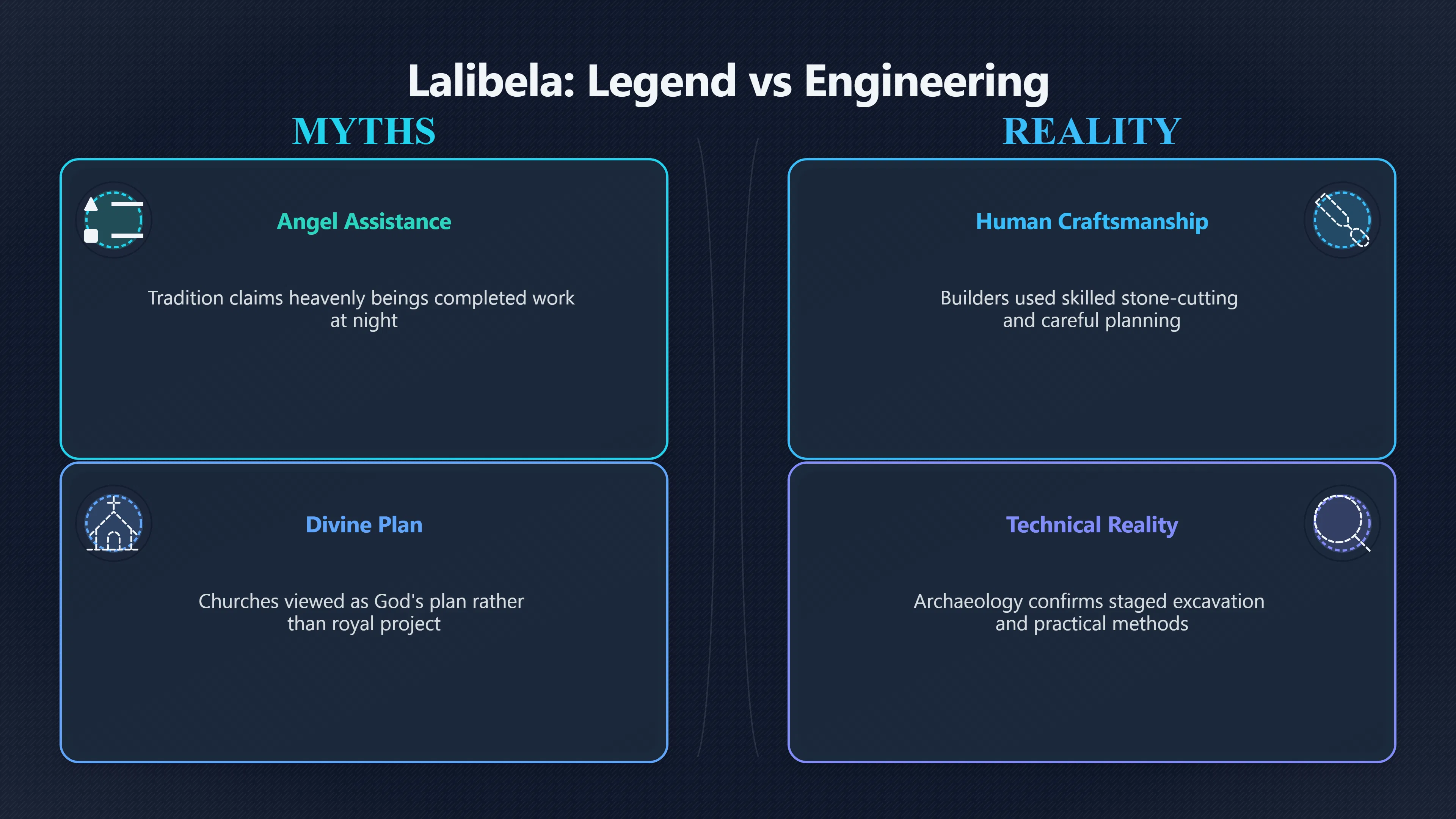
The best-known version of the tradition comes from the medieval life of King Lalibela, known as a hagiography rather than a modern historical biography. According to this account, the king established a “New Jerusalem” in Ethiopia after access to the Holy Land became increasingly difficult. During construction, angels were said to continue the work through the night after human labourers stopped at sunset, allowing the churches to be completed with astonishing speed.[The Metropolitan Museum of Art]metmuseum.orgthe rock hewn churches of lalibelaThe Metropolitan Museum of ArtThe Rock-hewn Churches of Lalibela1 Sept 2014 — According to the king's hagiography (gadl), Lalibela carved…
This legend serves several religious purposes.
- It presents the churches as part of God’s plan rather than simply a royal building project.
- It explains the astonishing scale of the complex through divine favour rather than political power alone.
- It places Lalibela within the long Christian tradition of miraculous building stories, where heavenly beings assist saints, kings or monasteries.
For Ethiopian Orthodox believers, the account is not merely decorative folklore. It forms part of the sacred history surrounding a living pilgrimage site. The churches continue to host worship, major festivals and religious processions, meaning the legend survives within active devotion rather than as an abandoned medieval tale.[UNESCO World Heritage Centre]whc.unesco.orgUNESCO World Heritage CentreRock-Hewn Churches, LalibelaThe 11 medieval monolithic cave churches of this 13th-century 'New Jerusalem' are…
What Human Workmanship Explains
The remarkable appearance of Lalibela can make the churches seem almost impossible until one understands how they were created.
Rather than building upwards with blocks of stone, the builders worked by removing rock. They first marked out the outline of each church on the surface, cut deep trenches around it to isolate a block, then carved the exterior before hollowing out the interior. This “top-down” method means the roof was completed first and the lowest parts last—the reverse of conventional masonry.[The Metropolitan Museum of Art]metmuseum.orgthe rock hewn churches of lalibelaThe Metropolitan Museum of ArtThe Rock-hewn Churches of Lalibela1 Sept 2014 — According to the king's hagiography (gadl), Lalibela carved…
The geology also helped.
The churches were cut into relatively workable volcanic rock rather than extremely hard granite. Builders took advantage of natural rock formations, slopes and drainage, incorporating channels that diverted water away from the structures. Roofs were shaped to shed rain, and trenches became part of an integrated hydraulic system protecting the monuments from flooding. These practical engineering choices are exactly the sort of solutions expected from experienced craftspeople adapting architecture to local conditions.[The Metropolitan Museum of Art]metmuseum.orgthe rock hewn churches of lalibelaThe Metropolitan Museum of ArtThe Rock-hewn Churches of Lalibela1 Sept 2014 — According to the king's hagiography (gadl), Lalibela carved…
Modern archaeological research also suggests that Lalibela was not created in a single burst of activity. Instead, the complex appears to have developed through multiple construction phases, with some structures possibly adapting earlier buildings or excavations before later additions unified the sacred landscape. That gradual evolution makes the achievement more understandable while remaining no less impressive.[The Metropolitan Museum of Art]metmuseum.orgthe rock hewn churches of lalibelaThe Metropolitan Museum of ArtThe Rock-hewn Churches of Lalibela1 Sept 2014 — According to the king's hagiography (gadl), Lalibela carved…

Why the Churches Feel Almost Impossible
Part of Lalibela’s reputation comes from visual illusion.
Visitors often see only the roofs from ground level before discovering entire buildings hidden below the surrounding surface. Narrow trenches, tunnels and passageways connect separate churches, making the landscape feel more like an underground city than a conventional architectural complex. The churches appear to emerge from the mountain itself.
The experience was designed to have spiritual meaning as well as practical function. Moving through descending passages and emerging into open courtyards mirrors ideas of death, pilgrimage and resurrection. The engineering therefore serves religious symbolism rather than existing purely for structural purposes.[The Metropolitan Museum of Art]metmuseum.orgthe rock hewn churches of lalibelaThe Metropolitan Museum of ArtThe Rock-hewn Churches of Lalibela1 Sept 2014 — According to the king's hagiography (gadl), Lalibela carved…
That combination of technical sophistication and symbolic design explains why so many early travellers described the churches with language usually reserved for miracles.
Why False Mysteries Weaken the Real One
Modern pseudo-historical claims sometimes argue that Lalibela required lost civilisations, extraterrestrials or unknown technology because medieval Africans supposedly lacked the necessary skills.
The evidence does not support those claims.
Archaeologists have identified the carving techniques, construction sequence, geological context and architectural development of the churches. Comparable rock-cut architecture exists elsewhere in Ethiopia and beyond, although nowhere on quite the same scale or with the same religious layout. The existence of other Ethiopian rock-hewn churches demonstrates that Lalibela belongs to a broader architectural tradition rather than appearing as an inexplicable anomaly.[metmuseum.org]metmuseum.orgthe rock hewn churches of lalibelaThe Metropolitan Museum of ArtThe Rock-hewn Churches of Lalibela1 Sept 2014 — According to the king's hagiography (gadl), Lalibela carved…
Ancient-astronaut or “impossible engineering” theories usually rely on arguments from disbelief rather than positive evidence:
- they assume medieval technology was incapable without demonstrating why;
- they ignore evidence for staged excavation and practical stone-working methods;
- they treat religious legends as literal engineering reports instead of sacred narratives.
Ironically, these theories diminish the historical achievement of the Ethiopian builders. Declaring the churches “too advanced” for their creators replaces documented human ingenuity with unsupported speculation.

Engineering Became Sacred Memory
The most interesting mystery is not whether angels literally carved the churches. It is why generations chose to remember an extraordinary engineering accomplishment in miraculous terms.
Across many cultures, exceptional monuments acquire stories of supernatural assistance. Such legends honour the monument by expressing that ordinary language seems inadequate to describe it. At Lalibela, the angel tradition also reinforces the site’s identity as a holy landscape where heaven and earth meet.
This means the legend and the engineering answer different questions.
Engineering explains how workers could excavate monolithic churches from volcanic rock using organised labour, planning and skilled craftsmanship. Sacred tradition explains what the achievement meant to the community that preserved it.
Seen this way, there is no need to choose between appreciating the legend and recognising the human accomplishment. The churches remain astonishing because they represent one of the medieval world’s greatest feats of rock-cut architecture, while the angel story reveals how that achievement became woven into Ethiopia’s living religious imagination rather than being remembered simply as a construction project.[The Metropolitan Museum of Art]metmuseum.orgthe rock hewn churches of lalibelaThe Metropolitan Museum of ArtThe Rock-hewn Churches of Lalibela1 Sept 2014 — According to the king's hagiography (gadl), Lalibela carved…
Amazon book picks
Further Reading
Books and field guides related to Why Did Lalibela Become an Angel Story?. Use these as the next step if you want deeper reading beyond the article.




Ethiopia: The Living Churches of an Ancient Kingdom
Focuses on Ethiopia's historic churches including Lalibela.
eBay marketplace picks
Marketplace Samples
Live-tested eBay searches with available results related to this page.


Endnotes
1.
Source: whc.unesco.org
Link:https://whc.unesco.org/en/list/18/
Source snippet
UNESCO World Heritage CentreRock-Hewn Churches, LalibelaThe 11 medieval monolithic cave churches of this 13th-century 'New Jerusalem' are...
2.
Source: smarthistory.org
Link:https://smarthistory.org/churches-lalibela/
Source snippet
Rock-hewn churches of Lalibela, EthiopiaLalibela's medieval churches were carved directly from Ethiopia's landscape, making t...
3.
Source: unesco.org
Title: document 886
Link:https://www.unesco.org/archives/multimedia/document-886
Source snippet
Ethiopian Pilgrimage: the Rock Churches of Lalibela15 Jun 2010 — The 11 medieval monolithic cave churches of this 13th-century 'New Jerus...
4.
Source: metmuseum.org
Title: the rock hewn churches of lalibela
Link:https://www.metmuseum.org/essays/the-rock-hewn-churches-of-lalibela
Source snippet
The Metropolitan Museum of ArtThe Rock-hewn Churches of Lalibela1 Sept 2014 — According to the king's hagiography (gadl), Lalibela carved...
5.
Source: Wikipedia
Link:https://en.wikipedia.org/wiki/Lalibela
Source snippet
LalibelaLocated in the Lasta district and North Wollo Zone, it is a tourist site for its famous rock-cut monolithic churches designed...
Additional References
6.
Source: facebook.com
Link:https://www.facebook.com/poaenglish/posts/african-heritage-lalibela-spotlightlalibelas-rock-hewn-churchesone-of-africas-gr/122186044772683092/
Source snippet
African HeritageThis week, we're spotlighting the incredible Rock-Hewn Churches of Lalibela in Ethiopia—a true wonder of ancient engineer...
7.
Source: youtube.com
Title: Lalibela Mystery | Who Really Built Ethiopia’s Impossible Rock Churches?
Link:https://www.youtube.com/watch?v=SBshSEqmqgo
Source snippet
Ethiopia's Rock-Hewn Churches | The Engineering Mystery the World Forgot...
8.
Source: youtube.com
Title: Ethiopia’s Rock-Hewn Churches | The Engineering Mystery the World Forgot
Link:https://www.youtube.com/watch?v=I93yHguOfgA
Source snippet
Were These Churches Built by Angels. The Ethiopian Churches of Lalibela...
9.
Source: youtube.com
Title: Were These Churches Built by Angels. The Ethiopian Churches of Lalibela
Link:https://www.youtube.com/watch?v=itRuWu4cpho
Source snippet
Lalibela Churches Ethiopia | The Most Mysterious Ancient Wonder...
10.
Source: youtube.com
Title: The Hidden Wonder Carved Into Solid Rock | Lalibela, Ethiopia
Link:https://www.youtube.com/watch?v=rXXMak5Ih4g
Source snippet
Lalibela Mystery | Who Really Built Ethiopia's Impossible Rock Churches?...
11.
Source: mdpi.com
Link:https://www.mdpi.com/2313-5778/3/4/66
Source snippet
Spiritual Genealogy beyond Epistemic Violence in Ethiopiaby YG Woldeyes · 2019 · Cited by 7 — The rock hewn churches of Lalibela have spe...
12.
Source: hunebednieuwscafe.nl
Title: lalibela rock hewn churches ethiopia
Link:https://www.hunebednieuwscafe.nl/2017/11/lalibela-rock-hewn-churches-ethiopia/
Source snippet
Rock-hewn church Bete Medhane Alem (House...Read more...
13.
Source: youtube.com
Title: Lalibela Churches Ethiopia | The Most Mysterious Ancient Wonder
Link:https://www.youtube.com/watch?v=GkbsZFAFpT8
14.
Source: Wikipedia
Title: Rock-Hewn Churches, Lalibela
Link:https://en.wikipedia.org/wiki/Rock-Hewn_Churches%2C_Lalibela
15.
Source: Wikipedia
Title: Monolithic church
Link:https://en.wikipedia.org/wiki/Monolithic_church
Topic Tree