Within France Forteana
When French Wonders Became Science or Heritage
French Forteana often turns sky-stones, odd falls and dragon legends into a tug-of-war between wonder, science and civic heritage.
On this page
- Meteorites and stones from the sky
- Strange rains and Fortean falls
- The Tarasque and dragon processions
Page outline Jump by section
Introduction
France has a distinctive way of remembering strange events from the sky. What may once have been interpreted as divine warnings, monstrous visitations or miraculous signs often became, over time, objects of scientific study or cherished local traditions. That transformation is especially clear in two areas: spectacular meteorite falls and enduring dragon legends. Rather than replacing one another, folklore and science often coexist. A stone that frightened medieval villagers may now sit in a museum as an invaluable scientific specimen, while a dragon once blamed for terrorising a river valley survives in colourful annual festivals. Together they show how French cultural memory has preserved wonder without requiring belief in the supernatural.[Wikipedia]WikipediaEnsisheim meteoriteEnsisheim meteorite

Meteorites and stones from the sky
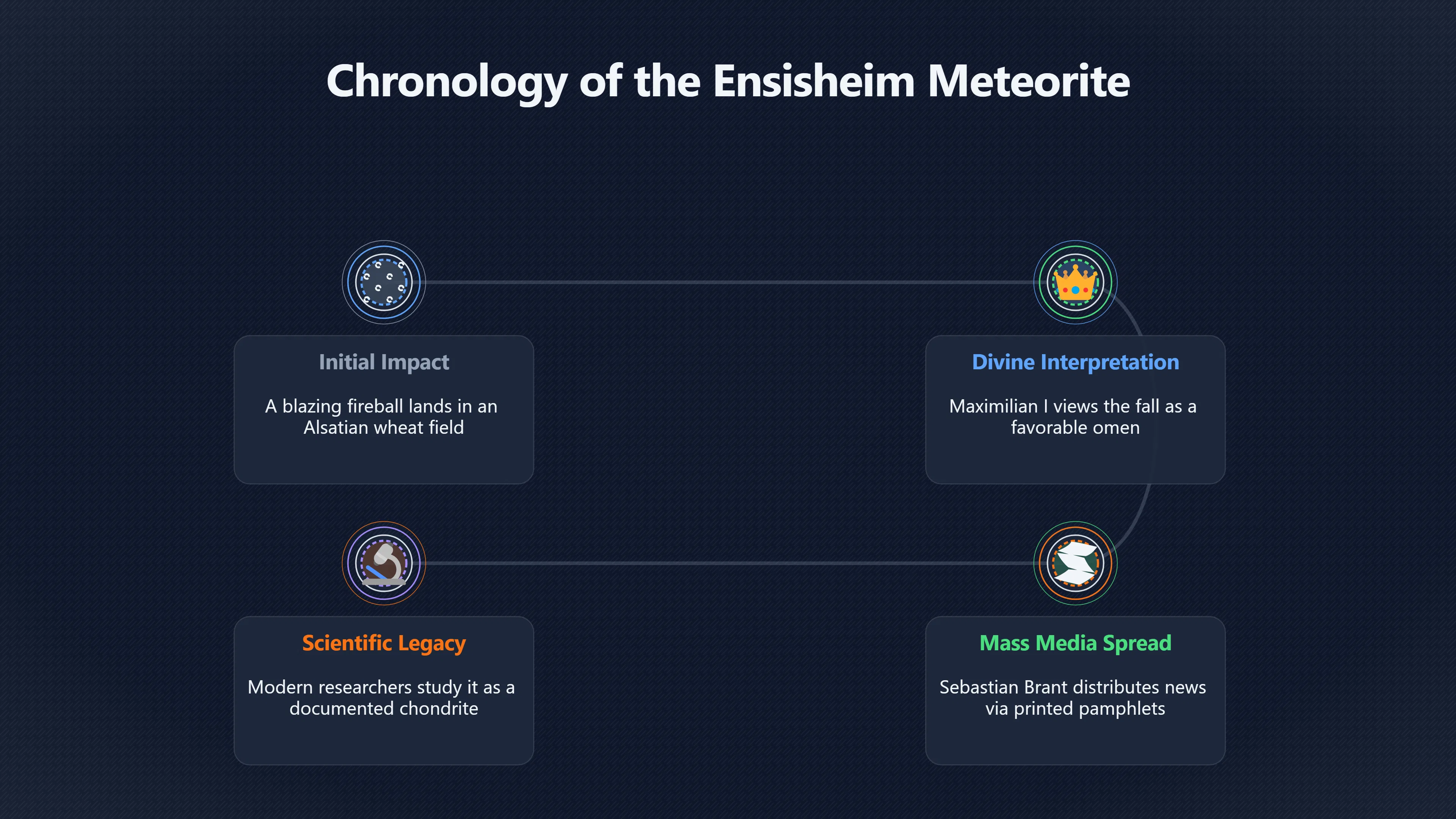
No sky-fall has had a greater impact on French historical memory than the meteorite that landed near Ensisheim in Alsace on 7 November 1492. Witnesses reported a blazing fireball crossing the sky before a large stone buried itself in a wheat field. The explosion was heard over a wide area, and crowds quickly gathered to remove fragments, believing the stone possessed extraordinary powers. Local authorities intervened to preserve what remained, recognising that the object had become politically and spiritually significant.[Wikipedia]WikipediaEnsisheim meteoriteEnsisheim meteorite
The timing made the event even more remarkable. Europe was already experiencing enormous political change, and the future Holy Roman Emperor Maximilian interpreted the fall as a favourable omen before military campaigns. Humanist writer Sebastian Brant helped spread that interpretation through one of the new technologies of the age: printed pamphlets. In other words, the Ensisheim meteorite became one of Europe’s earliest examples of a strange natural event amplified by mass media.[French Moments]frenchmoments.euensisheim meteoriteFrench MomentsThe Ensisheim meteorite: a divine omen for Austria?7 Nov 2025 — The Ensisheim meteorite, which fell in 1492 in front of the…
Modern science tells a different story. The stone is an ordinary chondrite meteorite that arrived from space, and it remains one of the oldest documented meteorite falls in Europe from which substantial material survives. Instead of being remembered purely as an omen, it has become a landmark in both astronomy and the history of science.[Wikipedia]WikipediaEnsisheim meteoriteEnsisheim meteorite
The Ensisheim case also illustrates a recurring pattern in French Forteana. An unexplained event initially entered public memory through religion, politics and folklore before gradually being reinterpreted through geology and astronomy. The story survived because each generation found a different meaning in it.
When France helped prove that rocks really do fall from space
By the eighteenth century, many educated Europeans still doubted that stones could genuinely fall from the sky. Reports existed, but they were often dismissed as superstition or misunderstanding.
France became central to changing that view after the spectacular meteorite shower at L’Aigle in Normandy in 1803. Hundreds or even thousands of stones reportedly fell over the countryside following a brilliant fireball. The French Academy of Sciences sent the physicist Jean-Baptiste Biot to investigate. Rather than relying on rumour, he interviewed witnesses, mapped where the stones landed and compared their physical characteristics. His careful investigation persuaded much of the scientific world that meteorites were real extraterrestrial objects.[Wikipedia]WikipediaL'Aigle (meteoriteL'Aigle (meteorite
The shift was profound. Earlier sky-stones had often been interpreted as divine messages. After L’Aigle, they increasingly became evidence about the Solar System.
Other important French meteorite falls reinforced that scientific legacy. The Alais meteorite of 1806 became the first recognised carbonaceous chondrite, while the Orgueil meteorite of 1864 remains one of the most chemically primitive meteorites ever recovered, providing clues to the early Solar System and the organic compounds present before Earth formed.[Wikipedia]WikipediaAlais meteoriteAlais meteorite
Strange rains and Fortean falls
France also appears regularly in collections of Fortean curiosities because newspapers and local chronicles recorded unusual falls from the sky. Reports described showers of fish, frogs, seeds, insects, coloured dust or mysterious gelatinous material. These accounts fascinated later compiler Charles Fort, who gathered thousands of similar reports from around the world as examples of events that seemed to fall outside conventional explanation.
Most individual French cases now have plausible natural explanations, although few can be demonstrated with complete certainty. Small animals may be carried by waterspouts before being dropped elsewhere. Pollen, volcanic dust or industrial pollution can colour rain. Wind can transport insects over remarkable distances. Gelatinous masses sometimes prove to be colonies of microorganisms, amphibian remains left by predators, or simple misidentifications.
What makes these reports Fortean is therefore less the phenomenon itself than the way people interpreted it. Before meteorology became well understood, an unexpected shower of frogs or fish naturally encouraged supernatural explanations or rumours of divine intervention. Later generations preserved the stories because they remained memorable examples of nature behaving in unexpected ways.
French newspapers of the nineteenth century were particularly enthusiastic in reporting such oddities, helping them pass from local incidents into national folklore. Even where the original evidence is weak, the stories illustrate how journalism, curiosity and popular imagination reinforced one another.
The Tarasque and dragon processions
If meteorites represent wonders descending from the sky, the Tarasque represents the opposite: a monster emerging from the landscape and becoming part of civic identity.
According to medieval tradition, the Tarasque was a terrifying dragon-like creature living near the River Rhône around Tarascon in Provence. Accounts differ, but the beast was usually described as heavily armoured, with a powerful tail, fearsome jaws and a habit of attacking travellers and boats. Unlike many dragon stories, the monster was not primarily defeated through combat. Instead, Saint Martha was said to have subdued it through prayer and holy water before local people killed the now-docile creature.
Whether viewed as Christian legend, symbolic storytelling or inherited folklore, the tale illustrates the medieval habit of explaining dangerous landscapes through monstrous beings. Floods, marshes and hazardous river crossings acquired memorable personalities in the form of dragons.
Rather than disappearing, the Tarasque became a civic emblem. Tarascon developed elaborate dragon processions in which enormous painted figures were carried or wheeled through the streets during public celebrations. Over centuries these shifted from religious observances into expressions of regional identity and popular culture. The processions themselves are now recognised as important examples of intangible cultural heritage, demonstrating how a feared monster evolved into a beloved mascot rather than being forgotten.
The Tarasque also reflects a wider European pattern in which dragons gradually lost their role as literal threats while remaining powerful cultural symbols. In France, that transformation is unusually visible because the festivals preserve the creature in physical form, allowing folklore to remain part of everyday public life rather than surviving only in books.

Why these stories still matter
Meteorites and dragons might seem unrelated, yet they reveal the same underlying process in French strange history.
Both began as attempts to explain extraordinary experiences. A blazing object falling from the heavens demanded interpretation just as much as a dangerous river or unexplained natural hazard inspired stories of dragons. Over time, improved scientific understanding changed how people interpreted sky-stones, while changing religious and social attitudes transformed dragons from objects of fear into symbols of local pride.
Neither development erased the older stories. Instead, France preserved both layers of memory. Museums display meteorites that were once treated as heavenly omens, while festivals celebrate dragons that no longer need to be believed in to remain culturally meaningful. For students of Forteana, that coexistence is perhaps the most interesting feature of all: the country’s strangest memories survive not because they resisted explanation, but because they adapted to it.[Wikipedia]WikipediaEnsisheim meteoriteEnsisheim meteorite
Amazon book picks
Further Reading
Books and field guides related to When French Wonders Became Science or Heritage. Use these as the next step if you want deeper reading beyond the article.
The Cambridge Encyclopedia of Meteorites
Provides scientific background for famous French meteorite events.
Wonders in the Sky
Examines historical sky phenomena that bridge folklore and science.

eBay marketplace picks
Marketplace Samples
Live-tested eBay searches with available results related to this page.


Endnotes
1.
Source: Wikipedia
Title: Ensisheim meteorite
Link:https://en.wikipedia.org/wiki/Ensisheim_meteorite
2.
Source: Wikipedia
Title: L’Aigle (meteorite)
Link:https://en.wikipedia.org/wiki/L%27Aigle_%28meteorite%29
3.
Source: Wikipedia
Title: Alais meteorite
Link:https://en.wikipedia.org/wiki/Alais_meteorite
4.
Source: Wikipedia
Title: Orgueil (meteorite)
Link:https://en.wikipedia.org/wiki/Orgueil_%28meteorite%29
5.
Source: youtube.com
Title: Tarasque – THE DARK Chimera of French Folklore
Link:https://www.youtube.com/watch?v=wRfrP9DLEL8
Source snippet
Ensisheim meteorite - the oldest recorded fall in Europe (1492)...
6.
Source: youtube.com
Title: Ensisheim meteorite
Link:https://www.youtube.com/watch?v=kXo8IdrsKRA
Source snippet
The Garden of Memory...
7.
Source: frenchmoments.eu
Title: ensisheim meteorite
Link:https://frenchmoments.eu/ensisheim-meteorite/
Source snippet
French MomentsThe Ensisheim meteorite: a divine omen for Austria?7 Nov 2025 — The Ensisheim meteorite, which fell in 1492 in front of the...
Additional References
8.
Source: amnh.org
Link:https://www.amnh.org/exhibitions/permanent/meteorites/meteorites/historic-meteorites
Source snippet
Historic Meteorites on DisplayThe Ensisheim meteorite was considered a sign of good luck from God. Immediately after it fell, people bega...
9.
Source: facebook.com
Link:https://www.facebook.com/MonnigMeteoriteGallery/posts/%EF%B8%8F-meteorite-monday-meet-ensisheimimagine-youre-walking-through-a-wheat-field-in-/1507716424487509/
Source snippet
Ensisheim meteorite: one of the oldest documented fallsImagine you're walking through a wheat field in France in 1492 when suddenly a mas...
10.
Source: adsabs.harvard.edu
Link:https://adsabs.harvard.edu/full/1914JRASC…8..349C
Source snippet
Astrophysics Data SystemThe Meteor-Fall of Ensisheim (1492)by CA Chant · 1914 — This was esp~cia11y so in the case of the famous meteorit...
11.
Source: frenchamericancultural.org
Link:https://frenchamericancultural.org/2020/05/15/a-french-meteorite-takes-manhattan/
Source snippet
A French Meteorite Takes Manhattan15 May 2020 — The Ensisheim meteor was discovered in 1492 by a young boy in Alsace, France...
Published: May 2020
12.
Source: youtube.com
Title: The DANGEROUS Dragon of the Provence Region – Coulobre – French Folklore
Link:https://www.youtube.com/watch?v=uXLVBjpbGeg
Source snippet
Graoully, The Dragon of Metz... - Metz France - ECTV...
13.
Source: facebook.com
Link:https://www.facebook.com/groups/293131130735001/posts/8628552577192773/
Source snippet
Oldest European meteorite falls in Ensisheim, FranceNovember 7, 1492, in the late morning hours a "thunderstone" falls from the sky into...
Published: November 7, 1492
14.
Source: instagram.com
Title: Czt1k Osqqm5
Link:https://www.instagram.com/p/Czt1kOsqqm5/
Source snippet
for good or bad. Maximilian I, soon to be...In November 1492 a large meteorite fell on the town of Ensisheim, in Alsace. Weighing 127 kg...
Published: November 1492
15.
Source: youtube.com
Title: Graoully, The Dragon of Metz
Link:https://www.youtube.com/watch?v=ByLhWOgkZTc
Source snippet
Ensisheim Meteorite 1492 CLOSE-UP...
16.
Source: youtube.com
Link:https://www.youtube.com/watch?v=8i5j3760pVA
Topic Tree