Within Burundi
Why Did Burundi's Drums Feel Sacred?
Burundi's royal drums were ritual instruments of authority, memory and ceremony rather than simple musical curiosities.
On this page
- Drums as royal authority
- Umuganuro and seasonal ritual
- Heritage performance after monarchy
Page outline Jump by section
Introduction
Burundi’s royal drums were never simply musical instruments. For centuries they stood at the heart of kingship, public ceremony and collective memory, acting as symbols of authority that linked the monarch to the well-being of the kingdom. To outsiders this relationship could seem almost mystical, because the drums were treated with extraordinary reverence, kept in protected sanctuaries, and played only during carefully prescribed occasions. Yet the tradition is better understood as a powerful blend of politics, ritual and culture rather than evidence of the supernatural. Within Burundi’s wider catalogue of unusual history, the royal drums show how an object can acquire an aura that feels uncanny without requiring paranormal explanations. Their continuing importance, long after the monarchy disappeared, demonstrates how ritual can outlive the political system that created it.[UNESCO ICH]ich.unesco.orgUNESCO ICHRitual dance of the royal drumThe ritual dance of the royal drum is a spectacle combining powerful, synchronized drumming with…
Why did Burundi’s drums feel sacred?
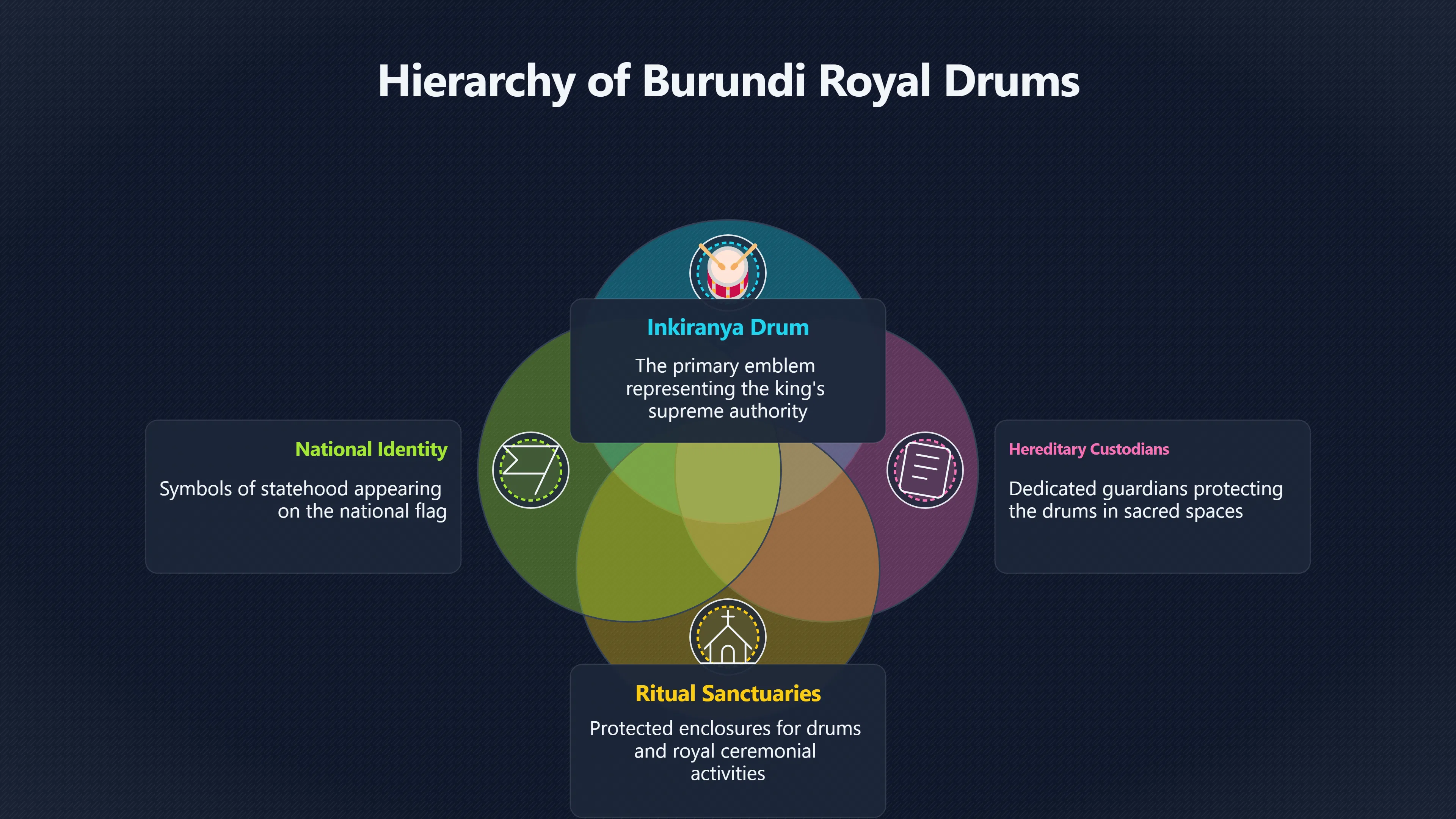
The sacred status of Burundi’s royal drums came from their role as living emblems of the kingdom rather than from any belief that they possessed magical powers in themselves. The most revered drum, often identified as the Inkiranya within the wider royal drum tradition, symbolised the authority of the mwami, or king. In older traditions, the drum represented continuity between successive rulers and the prosperity of the land. Royal ceremonies, agricultural festivals, coronations and important state occasions all revolved around its sound.[Wikipedia]WikipediaOpen source on wikipedia.org.
This gave rise to stories that the drums could “speak” on behalf of the king or embody the spirit of the kingdom. Such accounts should be understood as political and ritual language rather than literal claims. Across many African kingdoms, sacred regalia expressed authority through symbolism; Burundi’s drums became one of the clearest examples of that tradition.
Unlike ordinary musical instruments, the royal drums were:
- kept in dedicated sanctuaries under ritual protection;
- guarded by hereditary custodians;
- brought out only for major ceremonies;
- associated with the fertility of both the land and the monarchy;
- treated as national rather than personal possessions.[Wikipedia]WikipediaOpen source on wikipedia.org.
To colonial visitors unfamiliar with these customs, the level of respect surrounding the drums sometimes appeared mysterious or even supernatural. Modern historians instead interpret the practice as a sophisticated system through which political legitimacy became visible and audible.
Drums as royal authority
In pre-colonial Burundi, power was communicated through ceremony as much as through force. The sounding of the royal drums announced major events, marked the king’s daily routine, accompanied coronations, weddings and funerals, and proclaimed moments of national importance. Their rhythms carried authority over considerable distances, making them both ceremonial objects and practical instruments of government.[Wikipedia]WikipediaOpen source on wikipedia.org.
The drums themselves occupied an unusual constitutional role. Rather than being decorative court instruments, they effectively stood for the monarchy. Burundi’s national flag after independence even featured the royal drum, reflecting how deeply it symbolised statehood before the monarchy was abolished in 1966.[Wikipedia]WikipediaOpen source on wikipedia.org.
The best-known surviving royal sanctuary is Gishora, established during the nineteenth century near modern Gitega. The complex combined royal residence, ceremonial space and sacred drum sanctuary, illustrating how closely political leadership and ritual performance were intertwined.[Wikipedia]WikipediaOpen source on wikipedia.org.
For readers interested in Fortean themes, this political symbolism is important. The atmosphere surrounding the drums can easily encourage legends about enchanted objects or supernatural authority, yet the historical evidence consistently points towards ritual legitimacy rather than paranormal belief.
How Umuganuro strengthened sacred kingship
One of the clearest demonstrations of the drums’ importance came during Umuganuro, Burundi’s traditional first-fruits and harvest celebration.
The festival celebrated agricultural renewal, but it also reaffirmed the relationship between ruler, people and land. During these ceremonies, the royal drums announced the event and accompanied ritual performances that linked successful harvests with the health of the kingdom itself. Heroic poetry, song and synchronised drumming reinforced ideas of unity and continuity between generations.[UNESCO ICH]ich.unesco.orgUNESCO ICHRitual dance of the royal drumThe ritual dance of the royal drum is a spectacle combining powerful, synchronized drumming with…
Because prosperity depended upon both political stability and successful farming, later retellings sometimes gave these ceremonies an almost miraculous quality. From a historical perspective, however, they functioned as public rituals that bound together religion, agriculture and government in a society where those spheres were not sharply separated.
This helps explain why later observers sometimes described the drums in mystical language. The performances created an overwhelming sensory experience in which music, movement and political symbolism became inseparable.
Heritage performance after the monarchy
When Burundi became a republic in 1966, the royal institution disappeared, but the drums did not.
Instead, their meaning gradually shifted from active royal regalia to cultural heritage. The famous Royal Drummers of Burundi introduced elements of the tradition to international audiences from the 1960s onwards, while sanctuaries such as Gishora continued preserving the older performance style.[Wikipedia]WikipediaRoyal Drummers of BurundiRoyal Drummers of Burundi
A major milestone came in 2014, when UNESCO inscribed the Ritual Dance of the Royal Drum on the Representative List of the Intangible Cultural Heritage of Humanity. UNESCO emphasised that the performances combine drumming, dance, heroic poetry and traditional songs, and that they now serve not only to preserve historical knowledge but also to encourage social cohesion across generations.[UNESCO ICH]ich.unesco.org00989) for inscription on the Representative List of the Intangible Cultural Heritage…Read more…
This transformation is significant. The drums no longer legitimise a reigning monarch, yet they continue to embody ideas of national identity, continuity and shared history. Their survival illustrates how ritual traditions can adapt after dramatic political change without losing their symbolic force.
Why the tradition belongs in Burundi’s strange history
The royal drums occupy an unusual place within Burundi’s wider landscape of legends and curious traditions. Unlike cryptid stories or ghost tales, there is no unresolved mystery about whether the drums existed or how they were used. The fascination lies instead in the extraordinary social power invested in physical objects.
From a Fortean perspective, they show how apparently ordinary artefacts can acquire an almost supernatural reputation through centuries of ritual use. Travellers encountered drums treated as if they embodied the kingdom itself, guarded in sanctuaries, surrounded by strict ceremonial rules and capable of transforming public gatherings through carefully choreographed performance. Such practices naturally generated stories that blurred the boundary between political symbolism and sacred power.
Modern scholarship offers a grounded interpretation. The drums mattered because communities collectively accepted their symbolic authority. Their “power” was cultural rather than paranormal, yet it was no less real in shaping behaviour, legitimising rulers and preserving historical memory. That combination of tangible objects, powerful ritual and enduring legend explains why Burundi’s royal drums remain one of the country’s most distinctive contributions to the study of strange cultural history.[unesco.org]ich.unesco.orgUNESCO ICHRitual dance of the royal drumThe ritual dance of the royal drum is a spectacle combining powerful, synchronized drumming with…
Amazon book picks
Further Reading
Books and field guides related to Why Did Burundi's Drums Feel Sacred?. Use these as the next step if you want deeper reading beyond the article.

eBay marketplace picks
Marketplace Samples
Live-tested eBay searches with available results related to this page.
Endnotes
1.
Source: ich.unesco.org
Link:https://ich.unesco.org/en/RL/ritual-dance-of-the-royal-drum-00989
Source snippet
UNESCO ICHRitual dance of the royal drumThe ritual dance of the royal drum is a spectacle combining powerful, synchronized drumming with...
2.
Source: Wikipedia
Title: Kingdom of Burundi
Link:https://en.wikipedia.org/wiki/Kingdom_of_Burundi
3.
Source: Wikipedia
Link:https://en.wikipedia.org/wiki/Karyenda
4.
Source: Wikipedia
Link:https://en.wikipedia.org/wiki/Gishora
5.
Source: Wikipedia
Title: Royal Drummers of Burundi
Link:https://en.wikipedia.org/wiki/Royal_Drummers_of_Burundi
6.
Source: ich.unesco.org
Link:https://ich.unesco.org/en/decisions/9.COM/10.10
Source snippet
00989) for inscription on the Representative List of the Intangible Cultural Heritage...Read more...
7.
Source: ich.unesco.org
Link:https://ich.unesco.org/en/video/21396
Source snippet
unesco.orgVideo: Ritual dance of the royal drumUNESCO Culture Intangible Heritage Video Video: Ritual dance of the royal drum Ritual danc...
8.
Source: Wikipedia
Title: Ritual dance of the royal drum
Link:https://en.wikipedia.org/wiki/Ritual_dance_of_the_royal_drum
Source snippet
Ritual dance of the royal drumThe Ritual dance of the royal drum is a drumming tradition from Burundi that combines synchronised drumm...
9.
Source: youtube.com
Title: Ritual dance of the royal drum
Link:https://www.youtube.com/watch?v=JHHI4UmvYVc
Source snippet
Royal Drummers of Burundi - African Traditional Dance...
10.
Source: youtube.com
Title: Royal Drummers of Burundi
Link:https://www.youtube.com/watch?v=qzkDg6H3ELQ
Source snippet
Burundi's timeless drumming tradition thrives through generations...
Additional References
11.
Source: nyumbujourneys.com
Link:https://www.nyumbujourneys.com/travel-blogs/gishora-drum-sanctuary/
Source snippet
Nyumbu Beyond JourneysGishora Drum SanctuaryThe sanctuary is famous for its royal drums and serves as a historical and spiritual symbol o...
12.
Source: gazellefoundation.org
Title: The Rhythm of Celebration: Traditional Burundian Drumming
Link:https://www.gazellefoundation.org/blog/2019/11/25/the-sound-of-burundian-drumming-sacred-tradition-dating-back-centuries
Source snippet
May 20, 2020 — The joy and expression of Burundian drumming have the power to bring people together from all walks of life, thereby promo...
Published: May 20, 2020
13.
Source: zanzibargateway.com
Title: gishora drum sanctuary echoes of burundi s royal past
Link:https://www.zanzibargateway.com/post/gishora-drum-sanctuary-echoes-of-burundi-s-royal-past
Source snippet
Gishora Drum Sanctuary – Echoes of Burundi's Royal Past20 Oct 2025 — Home to Burundi's royal drums and drummers · Recognized as a UNESCO...
14.
Source: kuwaittimes.com
Title: burundi drummers forced to dance to official beat
Link:https://kuwaittimes.com/burundi-drummers-forced-to-dance-to-official-beat
Source snippet
22 Jun 2022 — In 2014, UNESCO recognized the cultural value of the tradition, inscribing the ritual dance of the royal drum on its list o...
15.
Source: instagram.com
Link:https://www.instagram.com/p/DU27nODksiq/
Source snippet
emony honouring births, coronations, and pivotal...Read more...
16.
Source: youngpioneertours.com
Title: It preserves a tradition that predates
Link:https://www.youngpioneertours.com/gishora-drummers-burundi-tradition/
Source snippet
5 powerful reasons to experience the Royal Drum TraditionLocated just outside Gitega, the Gishora Drummers Sanctuary is the most complete...
17.
Source: facebook.com
Link:https://www.facebook.com/tariqzaidiphotography/posts/burundian-drummers-perform-the-ritual-dance-of-the-royal-drum-a-centuries-old-sa/1402875754641149/
Source snippet
with dancing, heroic poetry and traditional songs.Read more...
18.
Source: roadsofadventuresafaris.com
Title: gishora drums royal drums in burundi
Link:https://www.roadsofadventuresafaris.com/blogs/gishora-drums-royal-drums-in-burundi
Source snippet
Gishora drums, Royal drums in Burundi25 Jan 2026 — In 2014, UNESCO recognized the ritual dance of the royal drum, including the performan...
19.
Source: travel2unlimited.com
Link:https://travel2unlimited.com/burundi-gishora-drumming-ritual-performance/
Source snippet
Burundi: Gishora Drumming Ritual PerformanceIt's believed that when the drums are played, they invite the ancestors into the ritual and b...
20.
Source: zamundatravels.com
Title: gishora drum sanctuary burundi
Link:https://zamundatravels.com/2026/04/21/gishora-drum-sanctuary-burundi/
Source snippet
Gishora Drum Sanctuary: A Hidden Gem in the Heart of Africa21 Apr 2026 — This sacred place preserves centuries of royal drumming traditio...
Topic Tree