Within Libya Weird
Was Zerzura a Lost Oasis or a Mirage?
Zerzura turns Libya's desert margins into a puzzle of caravan rumour, explorer ambition and the lure of water beyond the map.
On this page
- The white city and hidden oasis tradition
- Interwar explorers and desert mapping
- Why lost oasis stories survive
Page outline Jump by section
Introduction
Was Zerzura a lost oasis, a hidden white city, or simply one of the Sahara’s greatest rumours? The honest answer is that nobody has ever demonstrated that the legendary Zerzura existed as described in medieval tales. Yet the search for it transformed knowledge of the Libyan Desert. What began as stories shared by caravan travellers became one of the great exploration mysteries of the early twentieth century, drawing explorers into some of the least-mapped landscapes on Earth. Although the legend stretches across the wider Libyan Desert region, including areas now divided between Libya and Egypt, it has become inseparable from the history of Libya’s desert frontiers and the enduring fascination of supposedly forgotten places beyond the last reliable map. Rather than ending in treasure, the hunt for Zerzura produced new maps, geological discoveries and one of the twentieth century’s most remarkable chapters of desert exploration.[AramcoWorld]archive.aramcoworld.comSaudi Aramco World: Searching for ZerzuraRumors of a lost oasis named Zerzura—with buried treasure, of course—tugged hard at…
The white city and hidden oasis tradition
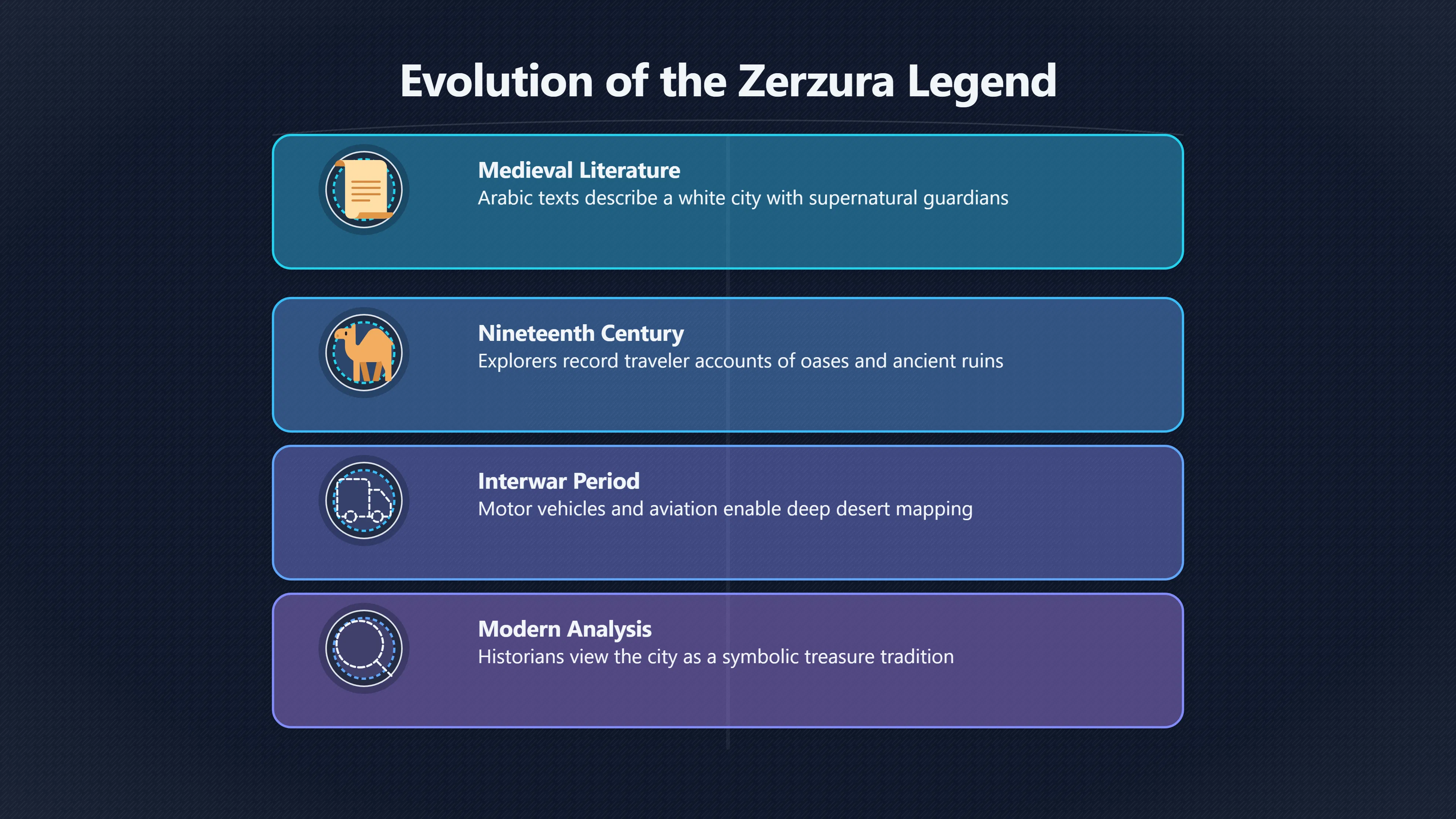
The earliest surviving references to Zerzura belong to medieval Arabic literature rather than to historical geography. A thirteenth-century administrative text mentions a place whose name is associated with small birds, while a later treasure-hunters’ manual, the Kitab al-Kanuz (“Book of Hidden Pearls”), describes a white city in the desert with a bird carved above its gate. Beyond the entrance lay fabulous wealth, together with sleeping royal figures and supernatural guardians. The tale combines motifs familiar from folklore across North Africa and the Middle East: hidden kingdoms, buried treasure and dangerous knowledge reserved for only a fortunate few.[AramcoWorld]archive.aramcoworld.comSaudi Aramco World: Searching for ZerzuraRumors of a lost oasis named Zerzura—with buried treasure, of course—tugged hard at…
By the nineteenth century the story had shifted from legend towards geography. In 1835 the explorer and Egyptologist John Gardner Wilkinson recorded testimony from an Arab traveller who claimed to have stumbled upon an oasis while searching for a missing camel. According to the account, the place contained palms, springs and ancient ruins somewhere west of the known oasis routes. Similar stories circulated among caravan travellers for decades. Importantly, several supposedly mythical locations mentioned alongside Zerzura were eventually shown to exist, encouraging explorers to wonder whether the famous oasis might also be real.[AramcoWorld]archive.aramcoworld.comSaudi Aramco World: Searching for ZerzuraRumors of a lost oasis named Zerzura—with buried treasure, of course—tugged hard at…
That uncertainty gave Zerzura unusual credibility. It was never merely a fairy tale; it was a rumour attached to an immense landscape that remained poorly surveyed well into the twentieth century.
Why explorers believed there might be something to find
Modern readers often wonder why experienced explorers devoted serious effort to chasing what sounds like a fantasy. The answer lies in how incomplete knowledge of the Libyan Desert remained before aircraft, satellite imagery and systematic surveys.
Large stretches of the desert west of the Nile consisted of blank spaces on official maps. Even experienced caravan guides possessed only local knowledge, while isolated mountain massifs and rain-fed valleys could remain unknown to outsiders for generations. Explorers repeatedly discovered genuine oases, mountain ranges and ancient routes that European cartographers had never recorded. Every new expedition proved that seemingly impossible discoveries were still possible.[AramcoWorld]archive.aramcoworld.comSaudi Aramco World: Searching for ZerzuraRumors of a lost oasis named Zerzura—with buried treasure, of course—tugged hard at…
Reports of birds flying from unknown directions, stories of hidden water sources and occasional discoveries of remote vegetation all seemed to hint that isolated valleys might survive beyond the great dune fields. Some explorers reasoned that if rainwater collected in sheltered mountain basins, small fertile refuges could exist without appearing on existing maps.
Interwar explorers and desert mapping
The search reached its peak between the 1920s and the early 1930s, when improvements in motor vehicles and aviation made deep-desert exploration practical for the first time.
Several figures became closely associated with the hunt:
- Ahmed Hassanein Bey demonstrated that supposedly mythical places such as Jebel Uweinat could indeed be reached and mapped, encouraging further exploration of the western desert.[AramcoWorld]archive.aramcoworld.comSaudi Aramco World: Searching for ZerzuraRumors of a lost oasis named Zerzura—with buried treasure, of course—tugged hard at…
- Prince Kemal el Din Hussein financed ambitious expeditions that mapped vast sections of the Great Sand Sea and discovered the Gilf Kebir plateau, dramatically reducing the number of blank areas on contemporary maps.[AramcoWorld]archive.aramcoworld.comSaudi Aramco World: Searching for ZerzuraRumors of a lost oasis named Zerzura—with buried treasure, of course—tugged hard at…
- Ralph Bagnold, later famous as founder of the Long Range Desert Group, explored the Libyan Desert using specially adapted motor vehicles and regarded the search as an opportunity to improve geographical knowledge even if the legendary city never appeared.[Wikipedia]WikipediaRalph BagnoldRalph Bagnold
- László Almásy, whose life later inspired parts of The English Patient, remained convinced that the old traditions might preserve memories of real hidden valleys. His expeditions combined motor vehicles with aerial reconnaissance, allowing previously inaccessible country to be examined from above.[Wikipedia]WikipediaLászló AlmásyLászló Almásy
In 1932 and 1933 Almásy and his colleagues identified previously unknown valleys within the Gilf Kebir plateau. These rain-fed wadis contained vegetation and seasonal water unlike the surrounding desert. Almásy suggested that these hidden valleys could have inspired the Zerzura tradition, although they did not contain the legendary white city or fabulous treasure described in medieval stories. Bagnold remained more sceptical, arguing that the legend had probably grown beyond any original geographical reality.[Wikipedia]WikipediaLászló AlmásyLászló Almásy
Ironically, the search’s greatest success was not finding Zerzura but revealing landscapes that had genuinely been unknown to modern cartography.
Was there ever a real Zerzura?
No archaeological discovery has confirmed the existence of the legendary white city.
Instead, historians generally see several possibilities that are not mutually exclusive.
One possibility is that caravan stories preserved memories of genuine but extremely isolated rain-fed valleys. These would have seemed miraculous to travellers crossing hundreds of kilometres of barren sand.
Another is that reports from different hidden locations gradually merged into a single legendary destination. A traveller might discover an unknown spring, another might encounter ruins elsewhere, while a third reported birds flying from an unseen valley. Over generations these fragments could evolve into one irresistible story.
There is also the influence of optical illusion. The Sahara regularly produces superior mirages, heat shimmer and distorted horizons capable of making distant cliffs resemble walls, lakes or settlements. Such phenomena would not create a city from nothing, but they could reinforce expectations among travellers already primed by local stories.
Finally, some historians argue that Zerzura belongs chiefly to the tradition of treasure literature rather than geography. In that reading, the white city functions much like mythical lost kingdoms elsewhere in world folklore: its purpose is symbolic as much as literal.[AramcoWorld]archive.aramcoworld.comSaudi Aramco World: Searching for ZerzuraRumors of a lost oasis named Zerzura—with buried treasure, of course—tugged hard at…
Why lost-oasis stories survive
Zerzura has endured because it sits at the meeting point of folklore and genuine exploration. Unlike many mythical places, it emerged in a landscape where astonishing discoveries really were still being made. Hidden valleys, prehistoric rock art, unknown mountain ranges and ancient caravan routes all emerged from the supposedly empty desert during the same period that explorers searched for the lost oasis.
That combination makes the legend unusually resilient. Every confirmed discovery suggested there might be one more beyond the next ridge.
The story also reflects the psychology of desert travel. In environments where water means survival, rumours of an undiscovered oasis carry enormous emotional weight. Even implausible reports become difficult to dismiss entirely when so much of the landscape remains beyond direct observation.
Within Libya’s broader strange-history tradition, Zerzura therefore occupies a distinctive place. It is less a tale of ghosts or supernatural forces than of possibility itself: a reminder that vast deserts encourage both careful science and imaginative storytelling. The legend persists not because explorers proved it true, but because the search revealed that reality could sometimes be almost as extraordinary as the rumour that inspired it.
Amazon book picks
Further Reading
Books and field guides related to Was Zerzura a Lost Oasis or a Mirage?. Use these as the next step if you want deeper reading beyond the article.
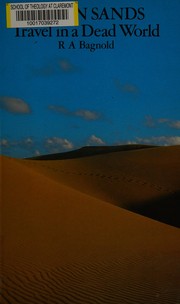
Libyan sands
Directly tied to exploration of the Libyan Desert and the era of Zerzura searches.
Rocks from Space
Appendices A-C: Meteorite verification laboratories, Commercial meteorite dealers, Selected list of suspected impact craters worldwide.
eBay marketplace picks
Marketplace Samples
Live-tested eBay searches with available results related to this page.
Endnotes
1.
Source: archive.aramcoworld.com
Link:https://archive.aramcoworld.com/issue/200206/searching.for.zerzura.htm
Source snippet
Saudi Aramco World: Searching for ZerzuraRumors of a lost oasis named Zerzura—with buried treasure, of course—tugged hard at...
2.
Source: Wikipedia
Title: Ralph Bagnold
Link:https://en.wikipedia.org/wiki/Ralph_Bagnold
3.
Source: Wikipedia
Title: László Almásy
Link:https://en.wikipedia.org/wiki/L%C3%A1szl%C3%B3_Alm%C3%A1sy
4.
Source: Wikipedia
Link:https://en.wikipedia.org/wiki/Zerzura
Source snippet
ZerzuraZerzura (Arabic: زرزورة) is a legendary city or oasis located in the Sahara Desert. Contents. 1 The rumor; 2 Zerzura the white...
5.
Source: books.google.com
Title: The Lost Oasis
Link:https://books.google.com/books/about/The_Lost_Oasis.html?id=KIKKWORTYz8C
Source snippet
Google BooksThe Lost Oasis: The Desert War and the Hunt for ZerzuraWhen war erupted in 1939, Ralph Bagnold founded the British Long Range...
Additional References
6.
Source: history.icaci.org
Title: Crossing the sands of Libya, he heard old-timers tell legends of the desert
Link:https://history.icaci.org/wp-content/uploads/2016/09/Torok.pdf
Source snippet
exploration, mapping and war in the Libyan Desertby ZG Török · Cited by 4 — During this expedition Almásy fell in love with the immense w...
7.
Source: sahara-overland.com
Title: Our caravan in the Immidir (Alg) Misty morning on the Rekkam plateau, (Mk)
Link:https://sahara-overland.com/tag/lost-oasis-of-zerzura/
Source snippet
Tag Archives: Lost Oasis of Zerzura9 May 2021 — Wadi abd el Malik – the Lost Oasis of Zerzura according to the English Patient...
Published: May 2021
8.
Source: shadowofthecrescent.blogspot.com
Title: newcombe bagnold and hunt for lost
Link:https://shadowofthecrescent.blogspot.com/2015/03/newcombe-bagnold-and-hunt-for-lost.html
Source snippet
Newcombe, Bagnold and the hunt for the lost oasis of...22 Mar 2015 — Ralph Bagnold was drawn into the hunt for the so-called “lost oasis...
9.
Source: europebetweeneastandwest.wordpress.com
Title: No one could
Link:https://europebetweeneastandwest.wordpress.com/tag/lost-oasis-of-zerzura-zerzura/
Source snippet
Oasis of Zerzura Zerzura | Europe Between East And WestExploration of the Libyan Desert was a collective effort, no matter what feats Bag...
10.
Source: instagram.com
Title: DZt Mm5FFb Bn
Link:https://www.instagram.com/reel/DZtMm5FFbBn/
Source snippet
Lost city of Zerzura How the search for a legendary Saharan...In 1929, British explorer Ralph Bagnold and Hungarian aviator Laszlo Almas...
11.
Source: youtube.com
Title: ZERZURA: The Lost City That Doesn’t Want To Be Found
Link:https://www.youtube.com/watch?v=JIcmXcreLpg
Source snippet
Zerzura: The lost city of the Sahara Desert...
12.
Source: youtube.com
Title: The Mythical Lost City of Zerzura
Link:https://www.youtube.com/watch?v=xd5AhRu173Y
Source snippet
Sahara's Secret: Did Explorers Really Find the Lost City of Zerzura?...
13.
Source: youtube.com
Title: Zerzura – Myth or Hidden Sahara Oasis?
Link:https://www.youtube.com/watch?v=U0B6znARpVM
Source snippet
ZERZURA: The Lost City That Doesn't Want To Be Found...
14.
Source: youtube.com
Title: Sahara’s Secret: Did Explorers Really Find the Lost City of Zerzura?
Link:https://www.youtube.com/watch?v=XG_mEbVVfWo
Source snippet
Zerzura – Myth or Hidden Sahara Oasis?...
15.
Source: youtube.com
Title: Zerzura: The lost city of the Sahara Desert
Link:https://www.youtube.com/watch?v=0Yfl6Blb_DM
Source snippet
Music...
Topic Tree