Within Sudan Strange
Why Sudanese Spirit Stories Are More Than Ghost Tales
Sudanese spirit traditions are less about horror than about illness, social pressure, memory, protection and the stories people tell at home.
On this page
- Zar as possession and healing
- Jinn, houses and everyday uncanny stories
- Memory, gender and social survival
Page outline Jump by section
Introduction
Sudanese spirit traditions are often described from the outside as tales of ghosts or possession, but that misses what they mean to the people who tell them. In much of Sudan, stories about spirit possession, jinn and ritual healing are less about proving the supernatural than about making sense of illness, family conflict, emotional distress, bad luck and social pressure. The best-known tradition is zār, a healing practice centred on people believed to be troubled by spirits, while everyday stories about jinn place the uncanny in ordinary houses, abandoned buildings, riverbanks and lonely roads rather than in spectacular haunted locations. Together these traditions occupy an important place in Sudan’s strange cultural history because they blur the boundaries between religion, folklore, medicine, psychology and community life without fitting neatly into any single category.[AnthroSource]anthrosource.onlinelibrary.wiley.comspirits and selves in Northern Sudan: the cultural therapeutics of possession and trance - BODDY - 1988 - American Ethnologis…
Zar as possession and healing
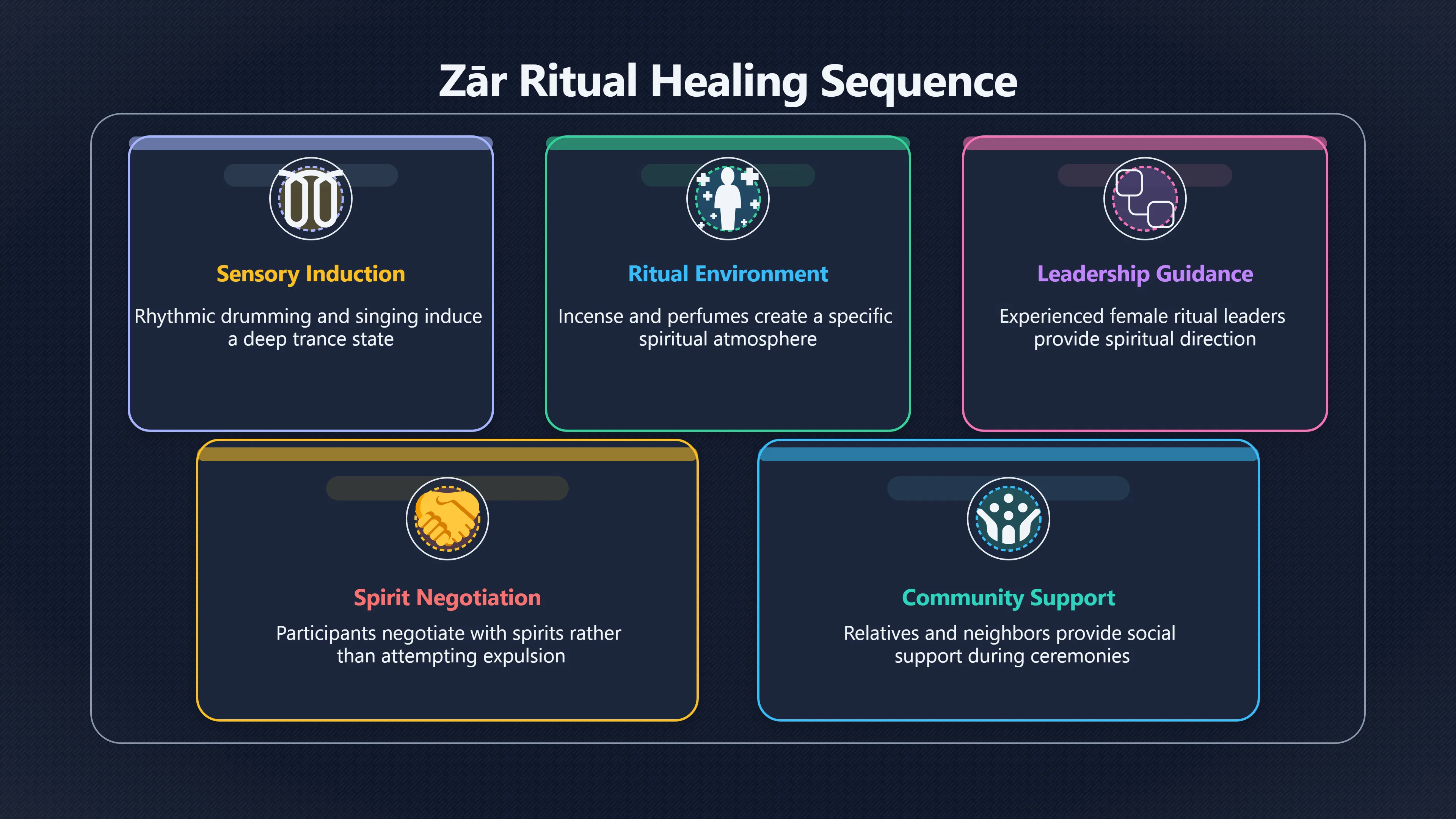
Among Sudan’s best-known uncanny traditions, zār is remarkable because it has generally been understood as a form of healing rather than an exorcism. Anthropologists who worked extensively in northern Sudan describe it as a structured social institution in which a person’s persistent illness, anxiety or misfortune may be interpreted as the work of spirits whose demands must be recognised rather than violently expelled.[AnthroSource]anthrosource.onlinelibrary.wiley.comspirits and selves in Northern Sudan: the cultural therapeutics of possession and trance - BODDY - 1988 - American Ethnologis…
The ceremonies themselves vary between communities, but several features appear repeatedly in ethnographic accounts:
- Rhythmic drumming, singing and dancing intended to induce trance.
- Incense, perfumes and distinctive clothing associated with particular spirits.
- Guidance from experienced female ritual leaders.
- Participation by relatives, neighbours and other women from the community.
- Negotiation with, rather than destruction of, the possessing spirit.[AnthroSource]anthrosource.onlinelibrary.wiley.comspirits and selves in Northern Sudan: the cultural therapeutics of possession and trance - BODDY - 1988 - American Ethnologis…
This makes zār unusual compared with many popular images of possession. Rather than portraying the sufferer as morally corrupt or dangerously evil, the tradition often treats the afflicted person as someone requiring care, ritual attention and social support. The spirit becomes part of an ongoing relationship that must be managed instead of defeated once and for all.[Taylor & Francis Online]tandfonline.comOpen source on tandfonline.com.
Researchers such as Janice Boddy and P. Constantinides argued that, in northern Sudan, zār also functioned as a culturally recognised way for women to express distress within a society where public expressions of frustration or conflict could otherwise be restricted. The ceremonies created a socially acceptable space in which personal suffering, marital tensions, fertility concerns or emotional strain could be acknowledged collectively without directly challenging accepted social norms. Their interpretation remains influential, although not all scholars agree that gender alone explains the tradition’s persistence.[wiley.com]anthrosource.onlinelibrary.wiley.comspirits and selves in Northern Sudan: the cultural therapeutics of possession and trance - BODDY - 1988 - American Ethnologis…
Jinn, houses and everyday uncanny stories
Alongside organised healing traditions sits a much broader world of everyday supernatural belief centred on jinn. Unlike zār, which follows recognised ritual patterns, jinn stories usually circulate through family conversations, neighbourhood memories and local folklore.
Many Sudanese accounts describe jinn not as theatrical monsters but as unseen neighbours sharing the landscape with humans. Stories commonly place them in:
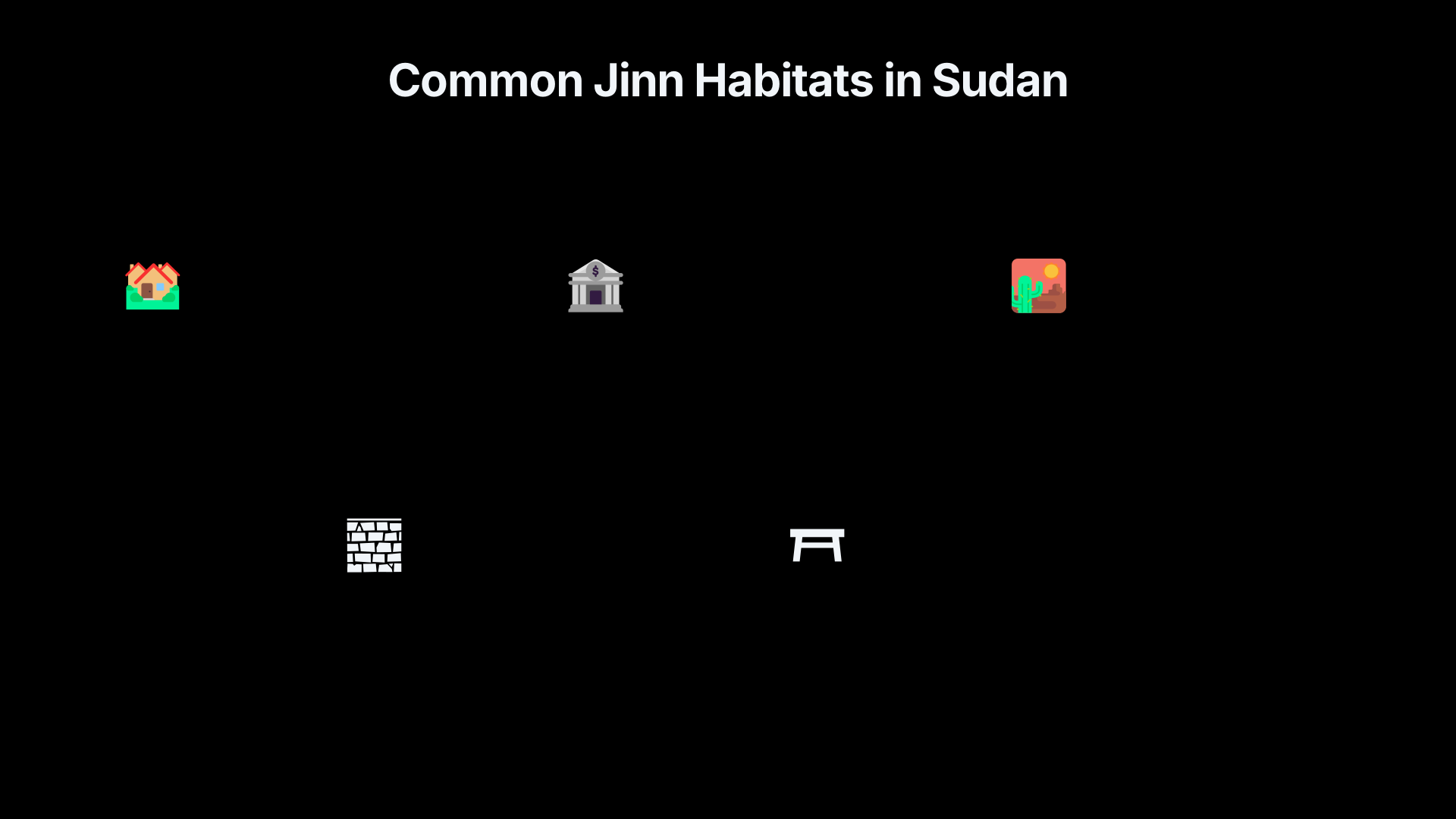
- Old or abandoned houses.
- Wells and isolated buildings.
- Riverbanks and stretches of the Nile.
- Desert ruins.
- Historic settlements such as Suakin on the Red Sea coast.[Al Jazeera]aljazeera.comAl JazeeraSpooky Arab tales for Halloween: Sudan’s ‘houseguests’ | Arts and Culture | Al JazeeraOctober 31, 2023…
The stories often concern unexplained footsteps, doors moving without obvious cause, missing household objects or strange sounds heard after dark. In many tellings the spirits are mischievous rather than murderous, capable of frightening people but also simply coexisting with them. Al Jazeera’s collection of Sudanese spirit stories describes these supernatural “houseguests” as familiar parts of local storytelling rather than exceptional paranormal events.[Al Jazeera]aljazeera.comAl JazeeraSpooky Arab tales for Halloween: Sudan’s ‘houseguests’ | Arts and Culture | Al JazeeraOctober 31, 2023…
For Fortean readers, this distinction matters. Sudanese jinn traditions usually present the uncanny as woven into ordinary domestic life instead of existing in isolated haunted castles or dramatic ghost sites. The strange appears in courtyards, kitchens and family homes, making these tales feel intimate rather than spectacular.
Why believers and sceptics see different things
Because zār combines ritual, illness and altered states of consciousness, it has attracted several competing explanations.
Believers generally understand possession literally, regarding spirits as genuine unseen beings whose wishes influence human health and fortune. Within this framework, ritual specialists help restore balance between the human and spirit worlds rather than merely treating psychological symptoms.
Anthropologists have often approached the same ceremonies differently. Rather than asking whether spirits objectively exist, many researchers examine what the rituals accomplish socially. They note that ceremonies create supportive networks, reduce isolation, provide symbolic explanations for suffering and allow difficult emotions to be expressed in culturally meaningful ways.[AnthroSource]anthrosource.onlinelibrary.wiley.comspirits and selves in Northern Sudan: the cultural therapeutics of possession and trance - BODDY - 1988 - American Ethnologis…
Mental health researchers have also pointed out that the structure of zār shares features with therapeutic systems found elsewhere: a trusted healer, an accepted explanation for distress, communal participation and an expectation that recovery is possible. That observation does not prove or disprove spirit possession; instead it helps explain why the practice has remained meaningful despite the spread of biomedical healthcare.[Taylor & Francis Online]tandfonline.comOpen source on tandfonline.com.
These perspectives are not always mutually exclusive. Many Sudanese participants may simultaneously value religious belief, traditional healing and modern medicine, moving between them according to the circumstances.
Memory, gender and social survival
One reason zār occupies such an important place in Sudan’s cultural history is that it has preserved women’s voices in settings where formal historical records often did not.
Ethnographic research found that ceremonies became spaces where participants could discuss marriage, childbirth, infertility, grief, financial hardship and family conflict through the language of spirits. A possessing spirit might complain, demand gifts or criticise behaviour in ways that reflected tensions within everyday life. Read literally, these were conversations with spirits. Read symbolically, they could also express frustrations that were otherwise difficult to articulate publicly.[AnthroSource]anthrosource.onlinelibrary.wiley.comspirits and selves in Northern Sudan: the cultural therapeutics of possession and trance - BODDY - 1988 - American Ethnologis…
This does not mean the tradition can be reduced to psychology or social protest. Participants have understood it in religious, emotional and spiritual terms at the same time. The endurance of zār probably reflects that ability to serve several purposes simultaneously: healing ritual, community gathering, cultural performance and spiritual practice.
Why these traditions matter in Sudan’s strange history
For a catalogue of Sudanese Forteana, spirit traditions are important precisely because they resist simple labels. They are neither straightforward ghost stories nor easily dismissed superstition.
Zār is documented through decades of ethnographic fieldwork rather than sensational newspaper reports, making it one of the country’s best-studied uncanny traditions. Jinn stories, meanwhile, continue to circulate as living folklore, especially around historic settlements, family homes and landscapes already rich in memory.[AnthroSource]anthrosource.onlinelibrary.wiley.comspirits and selves in Northern Sudan: the cultural therapeutics of possession and trance - BODDY - 1988 - American Ethnologis…
Neither tradition provides scientific evidence for supernatural beings, and sceptics interpret possession through psychology, social anthropology or medicine. Yet reducing them solely to misunderstanding also overlooks their cultural function. Whether understood as encounters with spirits or as powerful symbolic systems, they have shaped how generations of Sudanese people have explained illness, misfortune, protection and resilience.
That enduring mixture of belief, ritual, memory and everyday storytelling is what makes Sudan’s spirit lore one of the country’s richest contributions to the wider history of the uncanny.

Amazon book picks
Further Reading
Books and field guides related to Why Sudanese Spirit Stories Are More Than Ghost Tales. Use these as the next step if you want deeper reading beyond the article.
The Varieties of Religious Experience
Examines religious experiences without reducing them to simple superstition.
The Oxford history of Islam
Explains Islamic concepts including jinn within a broader historical framework.
The Encyclopedia of Ghosts and Spirits
Provides accessible context for spirit beliefs and folklore.
The Demon-Haunted World
NEW YORK TIMES BESTSELLER • From the renowned astronomer and author of Cosmos comes a “powerful [and] stirring defense of informed ration...
eBay marketplace picks
Marketplace Samples
Live-tested eBay searches with available results related to this page.

Endnotes
1.
Source: sciencedirect.com
Link:https://www.sciencedirect.com/science/article/pii/0277953685902084
Source snippet
Women heal women: Spirit possession and sexual segregation in a Muslim society - ScienceDirectSOCIAL SCIENCE & MEDICINE Volume 21, Issue...
2.
Source: sciencedirect.com
Title: Women heal women: Spirit possession and sexual segregation in a Muslim society
Link:https://www.sciencedirect.com/science/article/abs/pii/0277953685902084
Source snippet
SOCIAL SCIENCE & MEDICINE Volume 21, Issue 6, 1985, Pages 685-692 WOMEN HEAL WOMEN: SPIRIT POSSESSION AND SEXUAL SEGREGATION...
3.
Source: anthrosource.onlinelibrary.wiley.com
Link:https://anthrosource.onlinelibrary.wiley.com/doi/abs/10.1525/ae.1988.15.1.02a00020
Source snippet
spirits and selves in Northern Sudan: the cultural therapeutics of possession and trance - BODDY - 1988 - American Ethnologis...
4.
Source: tandfonline.com
Link:https://www.tandfonline.com/doi/abs/10.1300/J015v10n03_02
5.
Source: aljazeera.com
Link:https://www.aljazeera.com/features/2023/10/31/spirittales-sudans-houseguests
Source snippet
Al JazeeraSpooky Arab tales for Halloween: Sudan’s ‘houseguests’ | Arts and Culture | Al JazeeraOctober 31, 2023...
Published: October 31, 2023
6.
Source: onlinelibrary.wiley.com
Title: The qualitative thematic analysis revealed 12 themes
Link:https://onlinelibrary.wiley.com/doi/full/10.1002/ece3.72959
Source snippet
Ecological Knowledge and Cultural Perceptions of Snakes in Sudan - Baleela - 2026 - Ecology and Evolution - Wiley Online LibraryJanuary 1...
Additional References
7.
Source: pubmed.ncbi.nlm.nih.gov
Link:https://pubmed.ncbi.nlm.nih.gov/4059951/
Source snippet
1985;21(6):685-92. doi: 10.1016/0277-9536(85)90208-4. WOMEN HEAL WOMEN: SPIRIT POSSESSION AND SEXUAL SEGREGATION IN A MUSLIM SOCIETY P Co...
8.
Source: africabib.org
Link:https://www.africabib.org/rec.php?DB=i&RID=215682971
Source snippet
The Case of the Butcher's Wife: Illness, Possession and Power in Central SudanImage: Book chapter Book chapter | Image: Leide...
9.
Source: folktalesfromsudan.org
Link:https://www.folktalesfromsudan.org/
Source snippet
Folktales from SudanFOLKTALES FROM SUDAN Stories from Sudanese folklore for the whole family, told by award-winning public radio journali...
10.
Source: researchgate.net
Link:https://www.researchgate.net/publication/227689720_Spirits_and_Selves_in_Northern_Sudan_The_Cultural_Therapeutics_of_Possession_and_Trance
Source snippet
N: THE CULTURAL THERAPEUTICS OF POSSESSION AND TRANCE American Ethnologist * October 2009 * 15(1):4 - 27 DOI:10.1525/ae.1988.15.1.02a0002...
Published: October 2009
11.
Source: nli.org.il
Link:https://www.nli.org.il/he/books/NNL_ALEPH997007877004805171/NLI
Source snippet
ספר * שמירה Based on nearly two years of ethnographic fieldwork in a Muslim village in northern Sudan, Wombs and Alien Spirits explores t...
12.
Source: cir.nii.ac.jp
Link:https://cir.nii.ac.jp/crid/1364233268181343232
Source snippet
and selves in Northern Sudan: the cultural therapeutics of possession and trance | CiNii ResearchSPIRITS AND SELVES IN NORTHERN SUDAN: TH...
13.
Source: scielo.org.za
Link:https://scielo.org.za/scielo.php?lng=en&pid=S0041-476X2011000200011&script=sci_arttext&tlng=en
Source snippet
Not just a pretty face: women as storytellers and subjects in the folktales of Northern SudanJanuary 1, 2011 — Not just a pretty face: wo...
Published: January 1, 2011
14.
Source: sslh.info
Title: One practice for seeking blessings, alleviating hardships, or expressing grat
Link:https://www.sslh.info/en/themes/unwritten-languages
Source snippet
Unwritten languages - SSLH MuseumFebruary 15, 2025 — Beyond the world of jinn and magic, Muslims often prefer seeking assistance direct...
Published: February 15, 2025
15.
Source: sslh.online
Title: These stories, traditionally shared by grandmothers, aunts, and older me
Link:https://www.sslh.online/en/themes/messages-through-time
Source snippet
Messages through time - SSLH MuseumMarch 25, 2025 — Artwork designed by Hind Abdelbagi Sudanese folktales (أحاجي) hold a cherished...
Published: March 25, 2025
16.
Source: koha.ista.ac.at
Link:https://koha.ista.ac.at/cgi-bin/koha/opac-ISBDdetail.pl?biblionumber=754469
Source snippet
Wombs and alien spirits: women, men, and the Zār cult in northern Sudan / Janice Boddy. - 1 online...
Topic Tree