Why Does Andorra Feel So Uncanny?
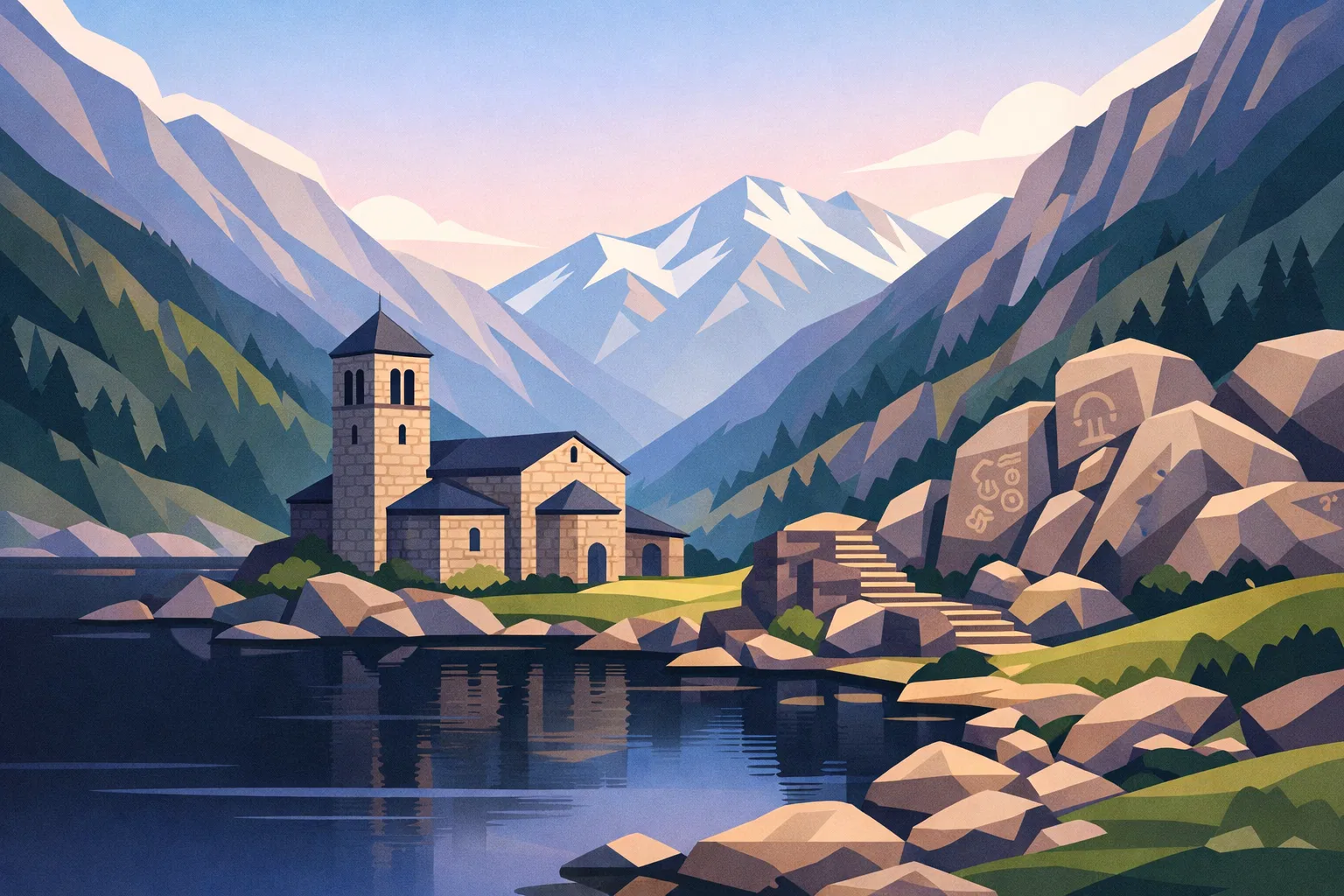
Andorra’s strange-history record is not built around one spectacular monster, crash, or haunting. It is more interesting than that: a compact Pyrenean country whose Fortean texture comes from witchcraft trials, “witch” landscapes, mountain legends, sacred-statue miracles, odd sky reports, and modern folklore repackaged for walkers and families.
Page outline Jump by section
Why Andorra’s weird record feels different
Many country-level Fortean traditions rely on a famous “case”: a lake monster, a flying-saucer landing, a ghost at a castle. Andorra’s pattern is more local and layered. Its strangeness clings to passes, lakes, sanctuaries, rocks and old legal records. The country’s scale matters. A few valleys, a small population, difficult winter terrain and strong oral traditions mean that a legend can remain tied to a specific path or stone rather than becoming a mass-media mystery.
The most substantial material falls into three overlapping groups. First, there is documented witch-hunt history: accusations, trials and punishment carried out by Andorran courts. Secondly, there is legendary geography: lakes formed by divine punishment, witches bathing at night, protective ladies, uncanny animals and magical forest beings. Thirdly, there are modern anomalous reports, especially sky sightings, which are much thinner in Andorra than in neighbouring Spain or France but still appear in UFO bibliographies and report databases.
That mix makes Andorra a good example of grounded Forteana. The important question is not “were witches real?” or “was the UFO alien?” but how a small mountain society recorded fear, misfortune, weather, illness, religion and the unknown.
The strongest strange evidence: Andorra’s witch trials
The most serious Fortean material in Andorra is not a campfire tale but a documentary archive. The Andorran project “Andorra, terra de bruixes” describes the valleys as a privileged place for studying European witch-hunting because trials were held before the Tribunal de Corts and preserved in Andorran records. It says accusations were fed by neighbourly suspicion and rumour, with women blamed for illness, death, destructive hailstorms, poisons, devilish gatherings and allegiance to a feared demonic sect.[Historia.ad]historia.adOpen source on historia.ad.
This matters because it turns “witch country” from a romantic tourism phrase into a legal and social history. The project states that research in recently catalogued National Archive material made it possible to gather the trials and actions against witchcraft in the valleys from 1400 to 1700, and that the Andorran archive is unusually fertile for this kind of European documentation.[Historia.ad]historia.adOpen source on historia.ad. A Government-linked educational resource likewise describes the research as a Government of Andorra-funded Cebrià Baraut project and says the recent cataloguing of National Archive holdings made the full body of Andorran witchcraft trials and actions available for that period.[Portal Educatiu]portaleducatiu.adOpen source on portaleducatiu.ad.
The historical lesson is sobering. The “witch” in these records is not a fantasy villain with a cauldron. She is often a neighbour, usually a woman, caught in a mesh of fear, local conflict, bad harvests, disease, storms and coercive justice. Catalan News, reporting on wider Pyrenean and Catalan witch-hunt research curated by historian Pau Castell, notes that some of Europe’s earliest witchcraft prosecutions occurred in the Pyrenees and that victims were commonly accused by neighbours rather than by the Spanish Inquisition.[Catalan News]catalannews.comthe first witches in europe were in the pyreneesthe first witches in europe were in the pyrenees
For Andorra’s Fortean record, this is the anchor: witchcraft was both imagined and prosecuted. The supernatural claims are not proven, but the social consequences were real.
Engolasters Lake: drowned village, witches and moral geography
Engolasters Lake is one of Andorra’s most memorable strange places. Official tourism material describes the modern walk to the lake as a short, fairly flat two-kilometre route in the parish of Encamp, but the folklore around the water is much darker than the day-hike description suggests.[Visit Andorra]visitandorra.comOpen source on visitandorra.com.
The core legend says that a village once stood where the lake is now. A hungry stranger, sometimes interpreted as Christ in disguise, asked for bread. Most people refused him; one compassionate girl helped. She was warned to flee, and the settlement was drowned by a sudden flood. In later versions, the lake became a night-time meeting or bathing place for witches. A travel account preserving the local legend says witches cast spells on those who spied on them, even turning intruders into black cats.[Hotel Camp del Serrat]hotelrestaurantcampdelserrat.comOpen source on hotelrestaurantcampdelserrat.com. Another modern Andorran tourism-adjacent source summarises the tradition as a village engulfed by water and witches bathing in the lake, adding with a wink that the witches supposedly left at the beginning of the twentieth century.[Grandvalira]grandvalira.comLake Engolasters in AndorraLake Engolasters in Andorra
The Fortean value of Engolasters is not that it proves a lost village or nocturnal witch sabbaths. It shows how a natural feature becomes a moral machine. The lake explains punishment, charity, forbidden looking and the danger of crossing boundaries at night. It also fits a wider Pyrenean pattern in which lakes, high pastures and remote clearings become places where ordinary village rules no longer fully apply.
Sceptically, Engolasters is best read as folklore shaped by landscape. Mountain lakes invite origin stories because they look enclosed, sudden and self-contained. Believers in the tradition might see the repeated details — the beggar, the one merciful girl, the drowning, the witches — as memory-fragments of older beliefs. A cautious reading treats them as Christian moral legend overlaid on older mountain unease.
Roc de les Bruixes: when archaeology becomes witchcraft
The Roc de les Bruixes, or “Witches’ Rock”, near Prats in Canillo is one of Andorra’s clearest examples of a real object carrying a supernatural interpretation. Andorra’s cultural heritage law lists the Gravats de la Roca de les Bruixes among protected archaeological zones in the parish of Canillo. Portal jurídic del Principat d’Andorra[portaljuridicandorra.ad]portaljuridicandorra.adOpen source on portaljuridicandorra.ad. Government cultural material says Pere Canturri documented the site in 1962 while surveying places whose names or legends were linked to beliefs and superstitions.[Govern d’Andorra]govern.adOpen source on govern.ad.
The site’s strangeness comes from the gap between what is visible and what can be confidently explained. The rock bears engravings that have been interpreted as prehistoric or protohistoric markings, with later layers of meaning added by local people. A Spanish-language summary describes the engravings as a Bronze Age rock-art group south of Prats, covering about two square metres, and notes that discoverers interpreted them as a funerary sanctuary and among the earliest evidence of writing in Andorra.[Wikipedia]WikipediaGrabados del roc de les BruixesGrabados del roc de les Bruixes
Folklore gives the rock a livelier explanation. Local tradition interpreted the marks as scratches left by the Devil’s nails during a fight with the witches of Canillo; in the tale, the witches hurl him into an abyss and he claws the rock as he falls. The same tradition held that the place was where witches invoked evil forces.[Wikipedia]WikipediaGrabados del roc de les BruixesGrabados del roc de les Bruixes
For a Fortean reader, the Roc de les Bruixes is valuable because it shows the full life cycle of an anomaly. First there is an odd physical trace. Then there is local naming. Then comes a demonic story. Later archaeology separates the rock from the legend without killing the legend entirely. The mystery is no longer “did the Devil scratch this stone?” but “how did marks in rock become a supernatural memory?”
Meritxell: miracle, loss and national identity
The Sanctuary of Meritxell brings Andorra’s weird history into contact with official religion and national symbolism. The Andorran museum booklet on the Historic Ensemble of Meritxell says the site consists of the old and new sanctuaries, both declared cultural heritage of interest under Andorra’s 2009 cultural heritage law.[museus.ad]museus.admeritxell engmeritxell eng The same booklet explains that the old sanctuary was a Romanesque chapel built before the second half of the twelfth century.[museus.ad]museus.admeritxell engmeritxell eng
The legend is classic Marian folklore. On the Day of the Magi, villagers travelling to Mass saw a dog-rose bush blooming in midwinter. In its thorns they found an image of Our Lady. They took it to Canillo, but it vanished and reappeared at the rose bush; the same happened when people from Encamp tried to take it. The repeated return signalled that the Virgin wished to remain at Meritxell.[museus.ad]museus.admeritxell engmeritxell eng
The booklet is unusually useful because it does not simply retell the story. It also interprets it as part of a wider Mediterranean and Pyrenean legendary model in which sacred images are found in caves, trees, fountains or brambles, moved to a village church, and then mysteriously return to the discovery place until a chapel is built there.[museus.ad]museus.admeritxell engmeritxell eng That makes Meritxell less a one-off miracle claim than Andorra’s local version of a repeated sacred-place pattern.
The modern twist is tragic and culturally powerful. The Meritxell fire of 8–9 September 1972 destroyed the entire sanctuary and its contents, provoking a national sense of loss; the booklet notes that questions still remain about what became of the image of the patron saint.[museus.ad]museus.admeritxell engmeritxell eng A new sanctuary, led by architect Ricardo Bofill, was inaugurated in 1976, blending Romanesque references and the ruins of the old sanctuary with other architectural influences.[museus.ad]museus.admeritxell engmeritxell eng
In Fortean terms, Meritxell is not a ghost story. It is a “returning image” legend attached to a national shrine, followed centuries later by a disaster that deepened the aura of absence. The uncanny element is not merely the blooming rose but the way an object, a place and a loss became part of Andorra’s identity.
Protective ladies, pipers and forest beings
Andorra’s folklore is not all witches and punishment. Some of its best-known legends are protective, comic or ecological.
The White Lady of Auvinyà is one of the clearest examples. Official tourism material for family hiking says the route is based on one of Andorra’s best-known legends and describes the White Lady as a figure with magical powers who guarded the border with Spain from the Roc de la Senyoreta.[Visit Andorra]visitandorra.comOpen source on visitandorra.com. A Sant Julià de Lòria cultural page says the legend is one of the most representative not only of the parish but of Andorra, and notes that characters from the story appear in the decoration of a local fountain.[Visit Sant Julià de Lòria]visitsantjulia.comVisit Sant Julià de Lòria Doctor Palau Street (Cavallers StreetVisit Sant Julià de Lòria Doctor Palau Street (Cavallers Street
The Buner d’Ordino is a different sort of strange tale: more comic survival story than supernatural warning. In the folktale, a bagpiper from Ordino is travelling to a festival in Canillo when wolves chase him up a tree on Casamanya mountain. He accidentally or deliberately sounds his pipes, frightening the animals away. A summary of the tale notes that a French postal administration stamp commemorated it in 2002, and that it has been represented in performance.[Wikipedia]WikipediaEl buner d'OrdinoEl buner d'Ordino
Then there are the Tamarros, modern folklore figures that sit somewhere between old creature tradition, children’s trail and nature education. Visit Andorra describes them as mischievous beings, “half legend and half popular imagination”, very hard to see and said to emerge when needed.[Visit Andorra]visitandorra.comOpen source on visitandorra.com. The Ordino tourism site presents them as protectors of Andorra’s nature and forests, with seven in the country and one in Ordino.[VisitOrdino]visitordino.comOpen source on visitordino.com.
These stories matter because they show how Andorra’s strange tradition has been domesticated without disappearing. The White Lady becomes a heritage walk. The piper becomes a national folktale. The Tamarro becomes a child-friendly guardian of forests. This is folklore doing public work: teaching place, identity, caution, courage and environmental care.
UFOs and sky anomalies: a very thin Andorran file
Compared with the witchcraft archive and landscape legends, Andorra’s UFO record is sparse. The strongest trace found in accessible archival material is bibliographic rather than evidential: a digitised annotated UFO bibliography lists “Midsummer sightings over Andorra” in Flying Saucer Review, volume 13, November–December 1967, page 25, described as a report of UFO sightings around Andorra la Vella during 17–22 June 1967.[Internet Archive]archive.orgDTIC AD0688332 djvu.txtDTIC AD0688332 djvu.txt
That entry is useful, but limited. It shows that Andorra entered the international UFO literature of the 1960s, not that the reported objects were extraordinary craft. Without the original report, witness statements, weather data, astronomical checks and independent local press comparison, the case should be treated as a pointer to a claimed sighting cluster, not as a resolved mystery.
Modern fireball and meteor-reporting systems also remind us that many dramatic sky events have ordinary astronomical explanations. The European Space Agency explains that fireballs and bright meteors are small near-Earth objects, often centimetres to metres across, that collide with Earth’s atmosphere, usually disintegrating but sometimes leaving meteorites.[NEO]neo.ssa.esa.intOpen source on esa.int. The International Meteor Organization’s fireball reporting system includes Andorra among selectable reporting countries, showing that contemporary witnesses can submit bright-meteor observations from there just as they can elsewhere.[fireball.imo.net]fireball.imo.netOpen source on imo.net.
The fair conclusion is modest: Andorra has reported sky-strangeness, but no widely documented, well-evidenced UFO case comparable with famous Iberian or French incidents. Its skies belong in the article because mountains, darkness, weather and tourism all create conditions for unusual perceptions. They should not be inflated into a national UFO mythology.
What sceptics and believers are really arguing about
The Andorran material rarely leaves us with a simple yes-or-no puzzle. Most cases are about interpretation.
A sceptical reading sees the witch legends as moral tales and social history. Engolasters becomes a warning story about charity and forbidden watching. Roc de les Bruixes becomes archaeology wrapped in demonic folklore. Meritxell becomes a local version of a widespread Marian “found image” legend. UFO reports become likely mixtures of meteors, aircraft, planets, weather, misperception and sparse documentation.
A believer, or a reader more sympathetic to tradition, might argue that dismissing these stories too quickly misses their persistence. Why do certain places attract the same kind of story for generations? Why do lakes, rocks and sanctuaries become charged? Why did fear of witchcraft become strong enough to leave a deep legal record? These are not proofs of the paranormal, but they are evidence that communities experienced the world as more dangerous, responsive and morally alive than modern tourist maps suggest.
The most careful position sits between those readings. Andorra’s Forteana is strongest when treated as a record of claims, fears, sacred geography and historical action. The witches of Engolasters do not need to have danced naked by the lake for the legend to matter. The witchcraft accusations do not need to be true for the trials to be historically important. The Roc de les Bruixes does not need a Devil to be one of Andorra’s great strange places.
Why Andorra’s strange stories still work
Andorra’s weird-history record has cultural pull because it is unusually place-specific. A reader can still walk to Engolasters, visit Meritxell, look for the Roc de les Bruixes, follow family trails around Auvinyà, or encounter modern Tamarro routes in the forest. The strangeness is not abstract. It is attached to paths, lakes, stones, shrines and parishes.
It also works because the country’s traditions have not been frozen in one form. Witchcraft moved from accusation to archive to public history. A sacred-image legend became a national shrine and then a story of fire and reconstruction. Old supernatural beings and protective figures have been softened into heritage, tourism and environmental storytelling. Even the thin UFO record fits the same pattern: a small country appears briefly in a wider international network of anomaly collecting, then fades back into the mountains.
For Fortean readers, Andorra is therefore less a land of spectacular monsters than a lesson in how strangeness is made. It is made from hard weather, narrow valleys, religious imagination, neighbourly fear, unexplained marks, legal documents, children’s trails, and the human habit of treating certain places as if they remember more than they say.
Amazon book picks
Further Reading
Books and field guides related to Why Does Andorra Feel So Uncanny?. Use these as the next step if you want deeper reading beyond the article.
The Mammoth Book of Unexplained Phenomena
Matches the page's survey of folklore and unexplained traditions.

Mysteries of the Unexplained
Appeals to readers interested in strange places and traditions.
eBay marketplace picks
Marketplace Samples
Live-tested eBay searches with available results related to this page.


Endnotes
1.
Source: historia.ad
Link:https://www.historia.ad/terra-de-bruixes/
2.
Source: grandvalira.com
Title: Lake Engolasters in Andorra
Link:https://www.grandvalira.com/en/blog/lake-engolasters
3.
Source: govern.ad
Link:https://www.govern.ad/ca/l/4671443
4.
Source: Wikipedia
Title: Grabados del roc de les Bruixes
Link:https://es.wikipedia.org/wiki/Grabados_del_roc_de_les_Bruixes
5.
Source: museus.ad
Title: meritxell eng
Link:https://museus.ad/media/files/publicacions/meritxell_eng.pdf
6.
Source: Wikipedia
Title: El buner d’Ordino
Link:https://en.wikipedia.org/wiki/El_buner_d%27Ordino
7.
Source: visitordino.com
Link:https://www.visitordino.com/en/what-to-do/%40%40activity_view/troba-el-tamarro
8.
Source: archive.org
Title: DTIC AD0688332 djvu.txt
Link:https://archive.org/stream/DTIC_AD0688332/DTIC_AD0688332_djvu.txt
9.
Source: neo.ssa.esa.int
Link:https://neo.ssa.esa.int/search-for-fireballs
10.
Source: fireball.imo.net
Link:https://fireball.imo.net/members/imo_view/browse_reports
11.
Source: fireball.imo.net
Title: browse events
Link:https://fireball.imo.net/members/imo_view/browse_events
12.
Source: Wikipedia
Title: List of reported UFO sightings
Link:https://en.wikipedia.org/wiki/List_of_reported_UFO_sightings
13.
Source: Wikipedia
Title: Our Lady of Meritxell
Link:https://en.wikipedia.org/wiki/Our_Lady_of_Meritxell
14.
Source: Wikipedia
Title: Sac de gemecs
Link:https://en.wikipedia.org/wiki/Sac_de_gemecs
15.
Source: Wikipedia
Title: UFO sightings in Spain
Link:https://en.wikipedia.org/wiki/UFO_sightings_in_Spain
16.
Source: Wikipedia
Link:https://en.wikipedia.org/wiki/Andorra
17.
Source: Wikipedia
Title: Navarre [witch trials]({{ ‘witch-trials/’ | relative_url }}) (1525–1526)
Link:https://en.wikipedia.org/wiki/Navarre_witch_trials_%281525%E2%80%931526%29
18.
Source: Wikipedia
Title: Witch trials in Catalonia
Link:https://en.wikipedia.org/wiki/Witch_trials_in_Catalonia
19.
Source: Wikipedia
Title: Gravats de la Roca de les Bruixes
Link:https://fr.wikipedia.org/wiki/Gravats_de_la_Roca_de_les_Bruixes
20.
Source: Wikipedia
Title: Gravats del Roc de les Bruixes
Link:https://de.wikipedia.org/wiki/Gravats_del_Roc_de_les_Bruixes
21.
Source: Wikipedia
Link:https://es.wikipedia.org/wiki/Canillo
22.
Source: Wikipedia
Title: Gravats del Roc de les Bruixes
Link:https://ca.wikipedia.org/wiki/Gravats_del_Roc_de_les_Bruixes
23.
Source: govern.ad
Link:https://www.govern.ad/ca/w/s-amplia-el-fons-documental-sobre-la-cacera-de-bruixes-a-l-arxiu-nacional-amb-una-tesi-doctoral-de-l-historiador-pau-castell-1
24.
Source: govern.ad
Link:https://www.govern.ad/ca/tematiques/cultura-i-esports/espais-publicacions-i-concursos/publicacions-i-recursos/catalegs
25.
Source: govern.ad
Link:https://www.govern.ad/documents/1898932/2636872/Avaluacio-llei-Consell-Assessor-2008-2010.pdf/5b6fbce8-69f9-68dc-bfb7-6d1300fbf4bb?t=1721718662510
26.
Source: encamp.ad
Title: Llac d’Engolasters
Link:https://www.encamp.ad/en/encamp-el-pas-de-la-casa/map/%40%40place_view/llac-dengolasters
27.
Source: encamp.ad
Title: Troba el Tamarro
Link:https://www.encamp.ad/en/what-to-do/%40%40activity_view/troba-el-tamarro
28.
Source: historia.ad
Title: laparicio de la metallurgia
Link:https://www.historia.ad/del-big-bang-fins-avui/prehistoria/laparicio-de-la-metallurgia/
29.
Source: grandvalira.com
Link:https://www.grandvalira.com/en/leisure-dining/restaurants/roc-de-les-bruixes
30.
Source: visitandorra.com
Title: essential information about andorra
Link:https://visitandorra.com/en/essential-information-about-andorra/
31.
Source: portaleducatiu.ad
Link:https://www.portaleducatiu.ad/recursos/andorra-terra-de-bruixes
32.
Source: catalannews.com
Title: the first witches in europe were in the pyrenees
Link:https://www.catalannews.com/culture/item/the-first-witches-in-europe-were-in-the-pyrenees
33.
Source: visitandorra.com
Link:https://visitandorra.com/en/nature–sports/hiking-route-llac-d-engolasters/
34.
Source: hotelrestaurantcampdelserrat.com
Link:https://www.hotelrestaurantcampdelserrat.com/en/lake-engolasters
35.
Source: portaljuridicandorra.ad
Link:https://portaljuridicandorra.ad/L2003009_0
36.
Source: visitandorra.com
Link:https://visitandorra.com/en/with-family/hiking-with-children-in-andorra/
37.
Source: visitsantjulia.com
Title: Visit Sant Julià de Lòria Doctor Palau Street (Cavallers Street)
Link:https://visitsantjulia.com/en/what-to-do/cultural-proposals/carrers-i-cases-sant-julia-de-loria/carrers/carrer-doctor-palau-carrer-cavallers/
38.
Source: visitandorra.com
Link:https://visitandorra.com/nl/natuur-en-sport/find-the-tamarro/
39.
Source: visitandorra.com
Link:https://visitandorra.com/en/nature–sports/macarulla-quela-the-witch-s-potion/
40.
Source: visitandorra.com
Title: roc de les bruixes restaurant
Link:https://visitandorra.com/en/nature–sports/roc-de-les-bruixes-restaurant/
41.
Source: visitandorra.com
Title: restaurant roc de les bruixes el forn
Link:https://visitandorra.com/de/natur-und-sport/restaurant-roc-de-les-bruixes-el-forn.html/
42.
Source: visitandorra.com
Title: basilica sanctuary of meritxell
Link:https://visitandorra.com/en/nature–sports/basilica-sanctuary-of-meritxell/
43.
Source: visitandorra.com
Link:https://visitandorra.com/content/dam/visitandorra/de/assets/documents/cfs/itinerary/sant-julia-magica/cami-senyoreta-quadern-en.pdf
44.
Source: visitandorra.com
Link:https://visitandorra.com/de/kultur/must-visit-spots-in-ordino/
45.
Source: visitandorra.com
Link:https://visitandorra.com/content/dam/visitandorra/ca/assets/documents/cfs/activity/find-the-tamarro/ANG-25.pdf
46.
Source: catalannews.com
Title: what to expect from the witchcraft exhibition in the pyrenees
Link:https://www.catalannews.com/culture/item/what-to-expect-from-the-witchcraft-exhibition-in-the-pyrenees
47.
Source: cneos.jpl.nasa.gov
Link:https://cneos.jpl.nasa.gov/fireballs/
48.
Source: ufouap.net
Link:https://www.ufouap.net/en/countries/spain
49.
Source: emeteornews.net
Link:https://www.emeteornews.net/category/fireballs/
Additional References
50.
Source: youtube.com
Title: The Hidden History of Andorra: Europe’s Smallest Survivor Between Empires
Link:https://www.youtube.com/watch?v=UjLJGhxx2gQ
Source snippet
Andorra: Europe's Forgotten Nation | Boring History for Sleep...
51.
Source: youtube.com
Title: Andorra: Europe’s Forgotten Nation | Boring History for Sleep
Link:https://www.youtube.com/watch?v=ukqN-Yi4COk
Source snippet
The Dark Secret Behind the Basque Witch Trials...
52.
Source: academia.edu
Link:https://www.academia.edu/47784055/They_were_talked_about_and_they_were_out_there_Witchcraft_in_the_Pyrenees_and_western_districts
53.
Source: dfat.gov.au
Link:https://www.dfat.gov.au/geo/andorra/andorra-country-brief
54.
Source: ebsco.com
Link:https://www.ebsco.com/research-starters/geography-and-cartography/andorra-la-vella-andorra
55.
Source: facebook.com
Link:https://www.facebook.com/IndiaInSpain/posts/the-ambassador-of-india-to-the-kingdom-of-spain-and-principality-of-andorra-call/1351732933653430/
56.
Source: facebook.com
Link:https://www.facebook.com/architecturelab/posts/santuario-de-meritxell-in-canillo-andorra-redesigned-by-ricardo-bofill-embodies-/873313178169127/
57.
Source: instagram.com
Link:https://www.instagram.com/arxiu_nacional_andorra/?hl=en
58.
Source: arxiuenlinia.ad
Link:https://www.arxiuenlinia.ad/fotoweb/
59.
Source: recursoseducatius.ad
Link:https://recursoseducatius.ad/fr/tags/bruixeria
Topic Tree
Follow this branch
Related pages 192
- Afghan Forteana
- Antigua Uncanny
- Bosnian Mysteries
- Botswana Weird
- Brazil Strange
- +187 more in sidebar