Within Indonesia Weird
When Indonesian Ghosts Enter Public Life
Pocong and kuntilanak stories show how Indonesian ghosts can become cinema monsters, social warnings and public-health theatre.
On this page
- Pocong patrols during COVID
- Kuntilanak from river legend to horror icon
- Why ghost imagery still changes behaviour
Page outline Jump by section
Introduction
Indonesia’s best-known ghost stories do more than frighten audiences. Figures such as the pocong and the kuntilanak have become part of everyday public life, appearing not only in folklore and horror films but also in public-health campaigns, neighbourhood humour and discussions about social behaviour. Their importance lies less in whether anyone believes they literally exist than in the way familiar supernatural imagery can shape real-world decisions.

This blending of folklore with practical life is unusual even within Southeast Asia. A ghost wrapped in a burial shroud has been used to encourage people to obey pandemic restrictions, while the image of a ghostly woman has evolved from local river and village legends into one of Indonesian cinema’s defining horror icons. These examples show how traditional ghost stories remain adaptable, carrying messages about danger, morality and community responsibility into the modern age.
Pocong patrols during COVID
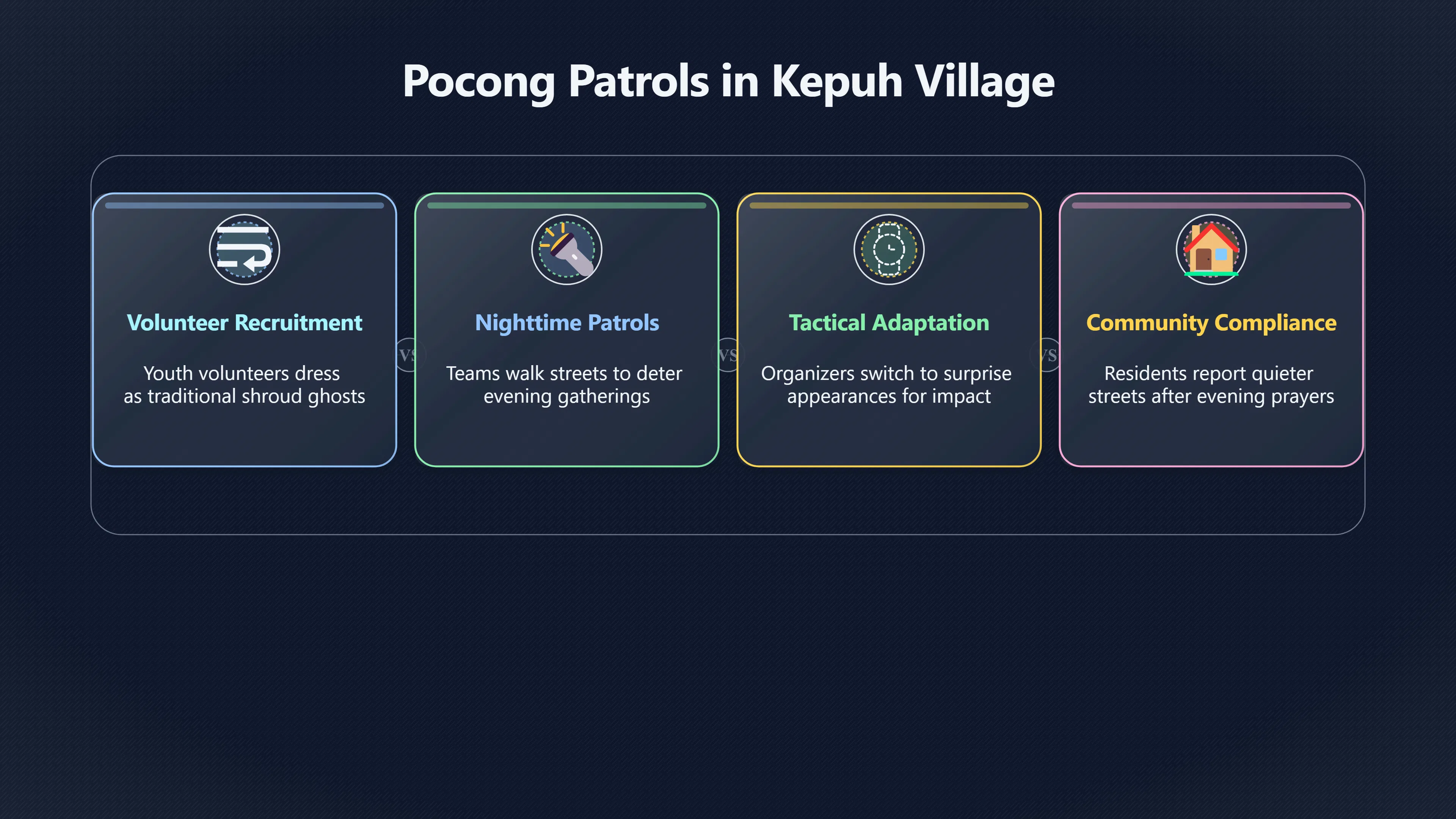
Perhaps the clearest example of folklore becoming a public intervention came during the COVID-19 pandemic in 2020. In Kepuh village, Central Java, youth volunteers dressed as pocong—ghosts traditionally depicted as corpses wrapped in white burial shrouds—and patrolled the streets after dark. Their goal was simple: frighten residents into staying indoors and discourage evening gatherings while the coronavirus spread.[Reuters]reuters.comGhosts' scare Indonesians indoors and away fromReuters'Ghosts' scare Indonesians indoors and away from…April 13, 2020 — 12 Apr 2020 — The village on Java island has deployed a cast…
The approach reflected a practical understanding of local culture. Rather than relying solely on official instructions, village leaders and youth organisations used a figure already embedded in popular imagination. According to organisers interviewed by Reuters, the idea was to create a stronger psychological deterrent because almost everyone recognised the character immediately. Early patrols actually attracted curious spectators, but organisers adapted by making surprise appearances instead, after which local residents reported quieter streets and fewer people lingering outside after evening prayers.[Reuters]reuters.comGhosts' scare Indonesians indoors and away fromReuters'Ghosts' scare Indonesians indoors and away from…April 13, 2020 — 12 Apr 2020 — The village on Java island has deployed a cast…
The episode attracted worldwide attention because it illustrated an important point about folklore. Ghost imagery was not replacing science or medical advice; instead, it became an informal communication tool supporting public-health measures at community level. It was a striking example of cultural symbolism being deployed alongside modern policy rather than against it.[Reuters]reuters.comGhosts' scare Indonesians indoors and away fromReuters'Ghosts' scare Indonesians indoors and away from…April 13, 2020 — 12 Apr 2020 — The village on Java island has deployed a cast…
Kuntilanak from river legend to horror icon
If the pocong represents death made visible, the kuntilanak has become Indonesia’s defining supernatural woman. Traditionally portrayed as a pale woman in white with long black hair, the ghost appears in many regional legends associated with lonely roads, rivers, trees and abandoned places. Different traditions explain her origins differently, but almost all present her as a tragic or vengeful spirit whose appearance warns of danger rather than offering simple entertainment.[Wikipedia]WikipediaOpen source on wikipedia.org.
Modern Indonesian cinema transformed this traditional figure into a cultural superstar. Beginning with earlier films in the 1960s and 1970s and accelerating after the revival of Indonesian horror in the 2000s, the kuntilanak became a recurring screen villain whose appearance was instantly recognisable. Entire film series were built around the character, while later productions reinterpreted the legend for new audiences without abandoning its folkloric roots.[Wikipedia]WikipediaOpen source on wikipedia.org.
The transition from oral legend to commercial entertainment also changed the ghost’s meaning. On screen, the kuntilanak often combines fear with themes of injustice, revenge and unresolved trauma. Film scholars have argued that Indonesian horror after the fall of the New Order government increasingly used supernatural stories to explore broader social anxieties rather than merely delivering scares. In that sense, familiar ghosts became symbols through which filmmakers could discuss violence, family tensions and historical memory.[Wikipedia]WikipediaIndonesian horrorIndonesian horror
Why ghost imagery still changes behaviour
The continuing influence of Indonesian ghost imagery is not simply about belief in the supernatural. These stories work because they provide familiar cultural shortcuts for communicating risk.
Several features help explain their persistence:
- Instant recognition. Characters such as the pocong and kuntilanak require little explanation because they are already embedded in popular culture through films, television, stories and internet memes.
- Emotional impact. Fear often captures attention more effectively than formal instructions, making ghost imagery memorable in public campaigns.
- Moral storytelling. Traditional ghost tales frequently reinforce ideas about respect for the dead, personal responsibility, unsafe places or inappropriate behaviour.
- Shared humour. Ghost costumes, parody videos and social-media jokes keep these figures culturally alive even among younger Indonesians who may treat them as entertainment rather than literal beings.
This flexibility allows the same characters to appear in children’s stories, blockbuster horror films, Halloween-style attractions, internet jokes and serious public messaging without losing their recognisable identity.
Between folklore and belief
It would be misleading to suggest that Indonesians share a single view of these ghosts. Beliefs vary widely by region, religion, generation and personal experience. For some people, the pocong and kuntilanak remain genuine supernatural possibilities. Others see them as inherited folklore, psychological stories or simply popular fictional characters.
Researchers studying folklore generally approach these figures as cultural traditions rather than evidence for paranormal phenomena. Their historical importance lies in how communities use supernatural narratives to express fears about death, childbirth, isolation, disease and social order. Horror filmmakers then reinterpret those same traditions for commercial audiences, often amplifying familiar visual motifs while adapting them to contemporary concerns.[Wikipedia]WikipediaIndonesian horrorIndonesian horror
The COVID-19 patrols demonstrated that these traditions remain socially powerful even when nobody involved claims that ghosts are real. Volunteers deliberately performed as fictional apparitions because they understood that the image itself carried emotional weight. The effectiveness of the tactic depended not on proving the supernatural but on the enduring cultural life of Indonesian ghost stories.[Reuters]reuters.comGhosts' scare Indonesians indoors and away fromReuters'Ghosts' scare Indonesians indoors and away from…April 13, 2020 — 12 Apr 2020 — The village on Java island has deployed a cast…

Amazon book picks
Further Reading
Books and field guides related to When Indonesian Ghosts Enter Public Life. Use these as the next step if you want deeper reading beyond the article.

Element Encyclopedia of Ghosts and Hauntings
Includes worldwide ghost traditions comparable to Indonesian beliefs.


eBay marketplace picks
Marketplace Samples
Live-tested eBay searches with available results related to this page.



Endnotes
1.
Source: reuters.com
Title: ‘Ghosts’ scare Indonesians indoors and away from
Link:https://www.reuters.com/article/world/ghosts-scare-indonesians-indoors-and-away-from-coronavirus-idUSKCN21V0EC/
Source snippet
Reuters'Ghosts' scare Indonesians indoors and away from...April 13, 2020 — 12 Apr 2020 — The village on Java island has deployed a cast...
Published: April 13, 2020
2.
Source: Wikipedia
Link:https://en.wikipedia.org/wiki/Kuntilanak
3.
Source: Wikipedia
Title: Ghosts in Malay culture
Link:https://en.wikipedia.org/wiki/Ghosts_in_Malay_culture
4.
Source: Wikipedia
Title: Indonesian horror
Link:https://en.wikipedia.org/wiki/Indonesian_horror
5.
Source: reutersconnect.com
Title: d GFn On Jld XRlcn Mu Y29t LDIw Mj A6bm V3c21s X1ZBQzl CT1VPNw
Link:https://www.reutersconnect.com/item/ghost-volunteers-scare-indonesians-into-staying-home/dGFnOnJldXRlcnMuY29tLDIwMjA6bmV3c21sX1ZBQzlCT1VPNw
Source snippet
GHOST FROM INDONESIAN FOLKLORE, PATROLS THE VILLAGE POCONG WALKING VARIOUS OF YOUTH GATHERING OUTDOORS 'pocong' is spooky...
Additional References
6.
Source: english.alarabiya.net
Title: Coronavirus Ghosts patrol streets in Indonesia to keep people indoors
Link:https://english.alarabiya.net/coronavirus/2020/04/13/Coronavirus-Ghosts-patrol-streets-in-Indonesia-to-keep-people-indoors
Source snippet
alarabiya.netCoronavirus: 'Ghosts' patrol streets in Indonesia to keep...13 Apr 2020 — Researchers at the University of Indonesia estima...
7.
Source: facebook.com
Title: Indonesia’s latest viral scare: Fake ghosts!
Link:https://www.facebook.com/abcnews.au/posts/indonesias-latest-viral-scare-fake-ghosts-people-dressed-as-pocong-a-corpse-wrap/1594706165343981/
Source snippet
People dressed...A pocong, also known as shroud ghost, is an Indonesian and Malaysian ghost that is said to be the soul of a dead person...
8.
Source: facebook.com
Link:https://www.facebook.com/QatarDay/posts/a-village-in-indonesia-has-deployed-ghosts-to-patrol-the-streets-and-scare-peopl/900227623752764/
Source snippet
e people into staying home #COVID19Pandemic #Coronalockdown...
9.
Source: facebook.com
Link:https://www.facebook.com/DreadCentral/posts/safety-measures-got-some-supernatural-enforcement-in-indonesia-where-volunteers-/10158509307919170/
Source snippet
dress as "shroud ghosts" to remind residents of the danger...
10.
Source: facebook.com
Link:https://www.facebook.com/kuwait.upto.date/posts/indonesian-village-uses-ghosts-to-scare-people-into-staying-home/2978694462186994/
Source snippet
Indonesian village uses "ghosts" to scare people into...In Indonesian folklore, ghostly figures known as "pocong" are said to represent...
11.
Source: youtube.com
Title: ‘Ghosts’ Haunt the Streets to Scare People Into Quarantine
Link:https://www.youtube.com/watch?v=Sc37TOw3DAA
Source snippet
Indonesians Dress As Ghosts To 'Scare' Residents Into Staying Home...
12.
Source: youtube.com
Title: ‘Ghosts’ scare Indonesians indoors and away from Covid-19
Link:https://www.youtube.com/watch?v=dKtS7nIQ9jM
Source snippet
'Ghosts' Haunt the Streets to Scare People Into Quarantine...
13.
Source: youtube.com
Title: Indonesian village uses “ghosts” to scare people into staying home
Link:https://www.youtube.com/watch?v=U7NaxvAmpzA
Source snippet
The Complete Legend of Pocong Indonesia's Most Terrifying Ghost Explained...
14.
Source: youtube.com
Title: Indonesians Dress As Ghosts To ‘Scare’ Residents Into Staying Home
Link:https://www.youtube.com/watch?v=WAXxnFHXzvY
Source snippet
Indonesian village uses "ghosts" to scare people into staying home...
15.
Source: youtube.com
Title: The Complete Legend of Pocong Indonesia’s Most Terrifying Ghost Explained
Link:https://www.youtube.com/watch?v=o01ARNb65HI
Topic Tree