Within Sweden Strange
Why Sweden's Folklore Belongs to the Landscape
Sweden's trolls, forest spirits and water beings make sense as stories tied to woods, lakes, mountains and everyday caution.
On this page
- Forests, lakes and mountains as story settings
- Water spirits, trolls and warning tales
- How legends attach to real places
Page outline Jump by section
Introduction
Swedish folklore is inseparable from Swedish geography. Rather than placing monsters in distant fantasy kingdoms, traditional stories locate them in familiar forests, lakes, meadows, rivers and mountains where ordinary people worked, travelled and raised families. The result is a body of folklore that feels unusually grounded: legends are attached to named places, dangerous stretches of water, isolated farms and distinctive rocks, making the landscape itself part of the story. These traditions were not simply entertainment. They offered memorable ways to explain hazards, encourage respect for nature and reinforce social rules while giving voice to genuine anxieties about getting lost, drowning, becoming isolated or crossing into places that seemed to belong to something else.[Institute for Language and Folklore]isof.seInstitute for Language and FolkloreThe Map of Nordic Legends | Institutet för språk och folkminnenJune 14, 2021…

Forests, lakes and mountains became natural stages for fear
For most of Swedish history, forests and wetlands were places of work as much as wilderness. Charcoal burners, hunters, herders and travellers often spent long periods alone in landscapes where weather changed quickly, paths disappeared and help could be far away. It is therefore unsurprising that many supernatural beings were imagined not as abstract demons but as guardians or tricksters tied to specific environments.
Unlike fairy tales that begin “once upon a time”, Swedish legends were commonly told as things that had happened to someone nearby. The Institute for Language and Folklore notes that legends were presented as true accounts occurring in the real world, often linked to identifiable locations. Its Map of Nordic Legends contains thousands of archive records demonstrating how stories became attached to particular lakes, hills, stones and forests across Sweden.[Institute for Language and Folklore]isof.seInstitute for Language and FolkloreThe Map of Nordic Legends | Institutet för språk och folkminnenJune 14, 2021…
This attachment to place is one reason the traditions remain culturally powerful. A traveller can still visit a lake said to house a water spirit or hike through woodland associated with trolls. Even when nobody expects to encounter a supernatural being, the landscape retains the memory of the story.
Why the beings fit their landscapes
The creatures of Swedish folklore are less a random collection of monsters than a system in which each being reflects the risks and character of a particular environment.
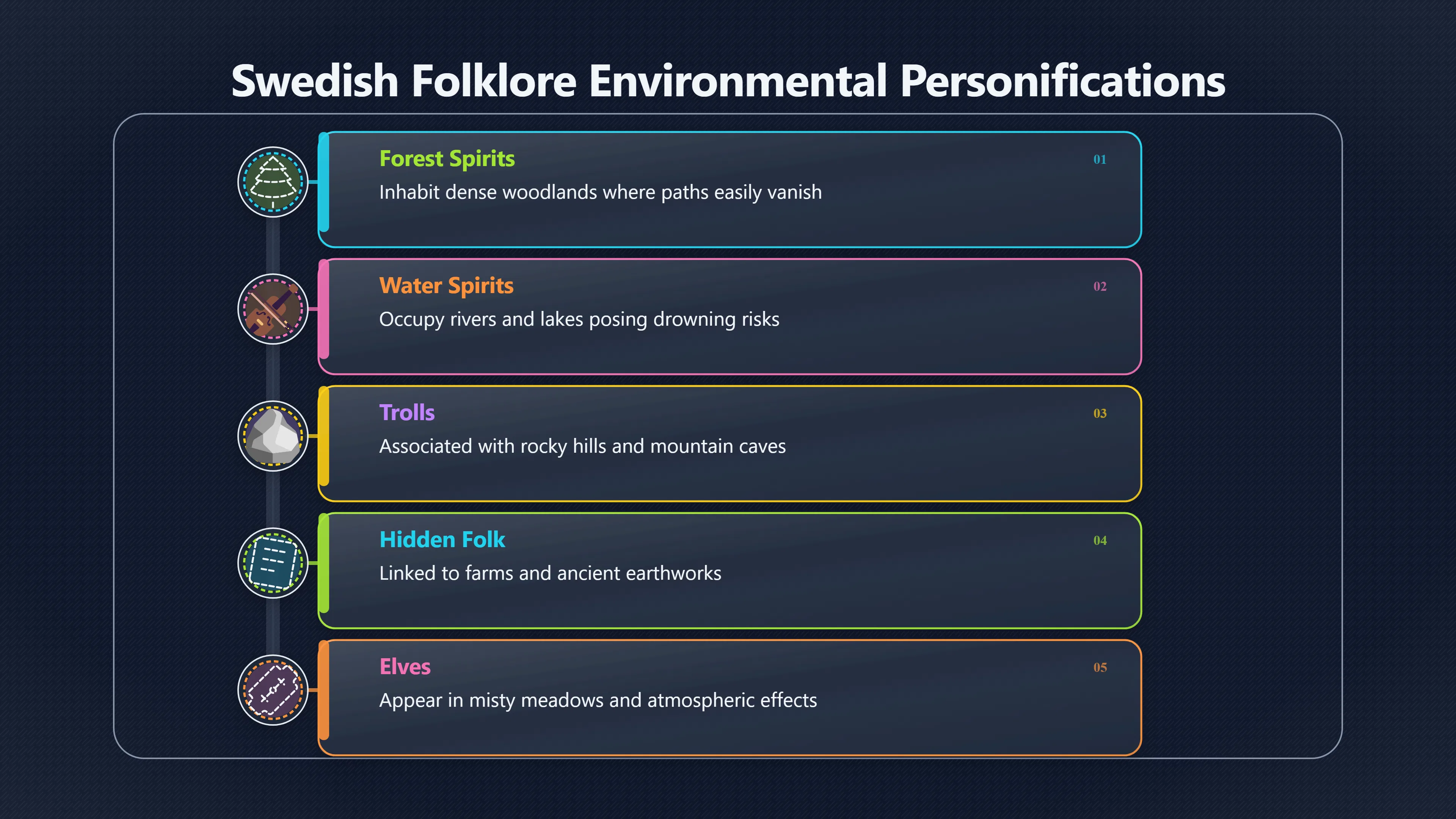
- Forest spirits belong to dense woodland, where paths vanish easily and unfamiliar sounds encourage disorientation.
- Water spirits inhabit rivers, lakes and streams where drowning was a constant danger.
- Trolls are associated with rocky hills, caves and mountains whose unusual shapes invited imaginative explanations.
- Hidden underground folk are linked with farms, meadows and ancient earthworks, encouraging respect for places thought to possess unseen inhabitants.
- Elves appear in misty meadows, connecting natural atmospheric effects with stories of enchantment.[Visit Sweden]visitsweden.comOpen source on visitsweden.com.
Rather than existing independently of nature, these beings effectively personified different landscapes. Respect for the place became respect for the creature believed to inhabit it.
Water spirits, trolls and other warning figures
The water spirit as a lesson about drowning
Among Sweden’s best-known legendary beings is the water spirit often depicted as a naked violinist beside streams and rivers. His beautiful music supposedly lured listeners into the water, where they drowned. Modern readers naturally see this as fantasy, but the underlying message is practical. Fast-moving rivers, cold lakes and deep pools posed genuine dangers, especially to children and lone travellers.
The same tradition also explains why the water spirit is attractive rather than monstrous. Danger in nature rarely announces itself openly. Calm-looking water can conceal strong currents, thin ice or sudden depth. Giving those risks a seductive personality made the warning memorable across generations. Historical references to the figure stretch back to seventeenth-century writings, demonstrating that the tradition has deep roots rather than being a recent invention.[Visit Sweden]visitsweden.comOpen source on visitsweden.com.
The forest spirit and the fear of becoming lost
Another enduring figure is the beautiful female forest spirit. She could reward respectful charcoal burners or woodland workers, yet she also tempted men away from familiar paths. In many versions, those who followed her became hopelessly lost or never returned unchanged.
This legend mirrors one of the oldest fears associated with Sweden’s vast forests: losing one’s bearings. Before detailed maps, modern forestry roads and satellite navigation, becoming disoriented could quickly become life-threatening. The supernatural explanation reinforced practical caution by suggesting that wandering too confidently into unfamiliar woodland invited consequences beyond ordinary bad luck.[Visit Sweden]visitsweden.comOpen source on visitsweden.com.
Trolls as the people of the rocks
Modern popular culture often portrays trolls as comic creatures, but older Swedish traditions present a more ambiguous picture. They inhabit mountains, caves and great boulder fields, blending into moss-covered rocks and ancient forests. They may deceive travellers, steal livestock or resent human intrusion, yet they are not simply villains.
Their association with dramatic geological features also reflects attempts to explain striking landscapes. Massive glacial boulders scattered across Sweden inspired stories that giants or trolls had thrown them, a motif well represented in Nordic legend collections. Before geology explained glaciation, folklore supplied a memorable narrative for otherwise puzzling features.[Institute for Language and Folklore]isof.seInstitute for Language and FolkloreThe Map of Nordic Legends | Institutet för språk och folkminnenJune 14, 2021…
Landscape fear was often practical rather than supernatural
Modern readers sometimes interpret these stories as evidence that earlier generations literally believed monsters lurked behind every tree. The historical picture is more subtle.
Folklore often acted as a cultural language for discussing genuine hazards:
- Deep lakes could kill the careless.
- Forests could confuse even experienced travellers.
- Marshes and mist reduced visibility.
- Mountains isolated communities and distorted sound.
- Darkness during long northern winters encouraged uncertainty and misidentification.
By giving these dangers personalities, communities created stories that were easier to remember than simple instructions. Parents warning children away from dangerous water did not need a lecture about hydrology if a mysterious violinist waiting beneath the surface achieved the same result.
Folklorists therefore tend to study these traditions as expressions of how people understood everyday life rather than as straightforward records of supernatural encounters.[Institute for Language and Folklore]isof.seInstitute for Language and FolkloreThe Map of Nordic Legends | Institutet för språk och folkminnenJune 14, 2021…
How legends become attached to real places
One striking feature of Swedish folklore is its geographical precision. A legend is rarely located in an imaginary kingdom. Instead, it belongs to a particular stream, hill, cave or meadow.
This creates a distinctive relationship between story and landscape. Even after belief weakens, local identity often preserves the association. Place names containing references to trolls, giants or hidden beings continue to appear throughout Sweden, while nature reserves and national parks sometimes embrace these traditions as part of their cultural interpretation. For example, areas such as Trollberget (“Troll Mountain”) are promoted alongside the legends connected with them, illustrating how folklore has become part of the visitor experience without requiring belief in the creatures themselves.[Visit Sweden]visitsweden.comVisit SwedenNational parks in Sweden – where myths and legends come to life | Visit SwedenApril 24, 2023…
The legends also help explain why many supposedly supernatural encounters remain intensely local. Instead of one universal monster, each valley or lake develops its own history and personality.
Why these stories still matter
Swedish folklore continues to influence literature, art and tourism because it presents nature as something worthy of respect rather than conquest. The famous illustrations of John Bauer helped establish the enduring visual image of Swedish trolls and forest beings, while contemporary tourism frequently uses these traditions to interpret landscapes rather than simply decorate them.[Visit Sweden]visitsweden.comOpen source on visitsweden.com.
From a Fortean perspective, these beings occupy an intriguing middle ground. They are not supported by scientific evidence as real creatures, yet neither are they merely fictional inventions detached from experience. Instead, they preserve centuries of testimony about how people interpreted strange sights, dangerous environments, unexplained disappearances and emotionally powerful places.
That is why Swedish folklore remains so closely tied to the land itself. Remove the forests, lakes, mountains and mist, and many of the stories lose their meaning. Keep the landscape, however, and it remains remarkably easy to understand why generations imagined that something unseen might already be living there.

Amazon book picks
Further Reading
Books and field guides related to Why Sweden's Folklore Belongs to the Landscape. Use these as the next step if you want deeper reading beyond the article.
Norse Mythology
Introduces the mythic tradition underlying later Scandinavian folklore.

The Element Encyclopedia of Magical Creatures
Includes Scandinavian trolls, spirits and legendary beings.
eBay marketplace picks
Marketplace Samples
Live-tested eBay searches with available results related to this page.

Endnotes
1.
Source: isof.se
Link:https://www.isof.se/other-languages/english/the-map-of-nordic-legends
Source snippet
Institute for Language and FolkloreThe Map of Nordic Legends | Institutet för språk och folkminnenJune 14, 2021...
Published: June 14, 2021
2.
Source: visitsweden.com
Link:https://visitsweden.com/what-to-do/culture-history-and-art/culture/mythological-creatures/
3.
Source: visitsweden.com
Link:https://visitsweden.com/what-to-do/nature-outdoors/nature/national-parks/national-parks-where-myths-and-legends-come-to-life/
Source snippet
Visit SwedenNational parks in Sweden – where myths and legends come to life | Visit SwedenApril 24, 2023...
Published: April 24, 2023
4.
Source: visitsweden.fr
Title: Les arbres verts et le ciel gris se reflètent sur l’eau calme. Envoûté par
Link:https://visitsweden.fr/voir-faire/culture-art-histoire/culture/decouvrez-creatures-mythologiques-suedoises/
Source snippet
Esprits, trolls, elfes et « näcken » – Découvrez les créatures mythol… | Visit SwedenMay 26, 2023 — * Esprits, trolls, elfes et « näcken...
Published: May 26, 2023
5.
Source: visitsweden.de
Title: Schwedens bekannteste Fabelwesen | Visit Sweden
Link:https://visitsweden.de/aktivitaten/kultur-geschichte-und-kunst/kultur/schwedens-bekannteste-fabelwesen/
Source snippet
Green trees and the gray sky are reflected in the calm water. Verzaubert von Schweden Die tie...
6.
Source: visitsweden.nl
Title: Geesten, trollen, elfen en ‘näcken’ | Visit Sweden
Link:https://visitsweden.nl/te-doen/cultuur-historie-kunst/cultuur/mythologische-wezens/
Source snippet
Groene bomen en de grijze lucht worden weerspiegeld in het kalme water. Betoverd door Zw...
7.
Source: isof.se
Title: Näcken | Institutet för språk och folkminnen
Link:https://www.isof.se/folkminnen/amnesomraden/folktro-och-forestallningsvarldar/lar-dig-mer-om-vasen-i-folktron/vasengalleriet/nacken
Source snippet
Image: Tecknad bild. Näcken som sitter på en sten i en å och tar emot en svart katt av en man som samtidigt lyfter på mössa...
8.
Source: isof.se
Title: Skogsrå | Institutet för språk och folkminnen
Link:https://www.isof.se/folkminnen/amnesomraden/folktro-och-forestallningsvarldar/lar-dig-mer-om-vasen-i-folktron/vasengalleriet/skogsra
Source snippet
För människorna kunde hon vara både farlig och hjälpsam. Image: Teckning. Man som häller en skopa tjära efter e...
9.
Source: isof.se
Title: Övernaturliga händelser och magiska ritualer hör hemma i det vi samlar un
Link:https://www.isof.se/folkminnen/amnesomraden/folktro-och-forestallningsvarldar
Source snippet
Folktro och föreställningsvärldar | Institutet för språk och folkminnenFOLKTRO OCH FÖRESTÄLLNINGSVÄRLDAR Här kan du läsa om övernaturliga...
Additional References
10.
Source: sweden3.uk
Title: CONTENTS * Swedish Folklore and Mythology * Trolls
Link:https://www.sweden3.uk/folk/folklore-mythology/
Source snippet
Swedish Folklore and Mythology | Sweden InfoBuffoon — The TableSWEDISH FOLKLORE AND MYTHOLOGY Trolls, tomtar, näcken, and skogsrå — the s...
11.
Source: youtube.com
Title: How to Understand: The Skogsrå, the Seductive Forest Ruler of Nordic Folklore!
Link:https://www.youtube.com/watch?v=_x4OOw38Pmw
Source snippet
How to understand. The Vittra/Vittror, the Unseen Ones in Swedish Folklore...
12.
Source: youtube.com
Title: How to Understand: The Night Ravens of Sweden! Nattramnar! Evil Bird Ghosts!
Link:https://www.youtube.com/watch?v=wzhpO3YaWTs
Source snippet
How to Understand: The Kyrko(Church) Grim, The Swedish Church Guardian...
13.
Source: youtube.com
Title: How to Understand: The Kyrko(Church) Grim, The Swedish Church Guardian!
Link:https://www.youtube.com/watch?v=wFDfeSjjFbY
Source snippet
Sweden's Great Lake Monster - The Untold Mystery of Storsjöodjuret...
14.
Source: sagobygden.se
Title: Legendary places
Link:https://sagobygden.se/en/legendary-places/
Source snippet
Welcome on a tour of magic destinations for the whole family. You can visit trolls’ mountains and...
Topic Tree