Within Liberia Weird
Is the Gbahali Liberia's Real River Monster?
The Gbahali is Liberia's clearest mystery-animal story, sitting between crocodile ecology, testimony and cryptid retelling.
On this page
- What witnesses and cryptid writers describe
- Known crocodiles in Liberian rainforest rivers
- Why the evidence remains suggestive but unproven
Page outline Jump by section
Introduction
The Gbahali is Liberia’s best-known mystery animal: a huge reptile said to inhabit remote rainforest rivers in the north of the country, especially in Lofa County near the Guinean border. Unlike many legendary monsters, it is not usually described by local witnesses as a supernatural being. Instead, those who speak of it reportedly treat it as an exceptionally dangerous but ordinary animal that shares their rivers with crocodiles and other wildlife. That distinction makes the Gbahali particularly interesting. If the stories are based on real observations, they might represent misidentified crocodiles, exaggerated encounters with known reptiles, or—in the most speculative cryptozoological interpretation—a genuinely unknown species. The evidence, however, remains limited to testimony, second-hand reports and later retellings, with no preserved specimen, verified photograph or scientific documentation to settle the question.[karlshuker.blogspot.com]karlshuker.blogspot.comTH E GRUESOME GBAHALITHE GRUESOME GBAHALI - LURKING IN LIBERIA?2 Mar 2024 — When interviewing the villagers, Sheppard showed them various illustrations of mod…
What witnesses and cryptid writers describe
Nearly all modern English-language accounts trace back to reports gathered around 2007 by American missionary and aid worker John-Mark Sheppard (sometimes spelled Shephard), who was working in northern Liberia. After interviewing villagers and fishermen, he relayed descriptions of an animal they called the Gbahali to cryptozoologist Loren Coleman, bringing the story into wider cryptid literature.[karlshuker.blogspot.com]karlshuker.blogspot.comTH E GRUESOME GBAHALITHE GRUESOME GBAHALI - LURKING IN LIBERIA?2 Mar 2024 — When interviewing the villagers, Sheppard showed them various illustrations of mod…
According to those reports, the creature differs from an ordinary crocodile in several consistent ways:
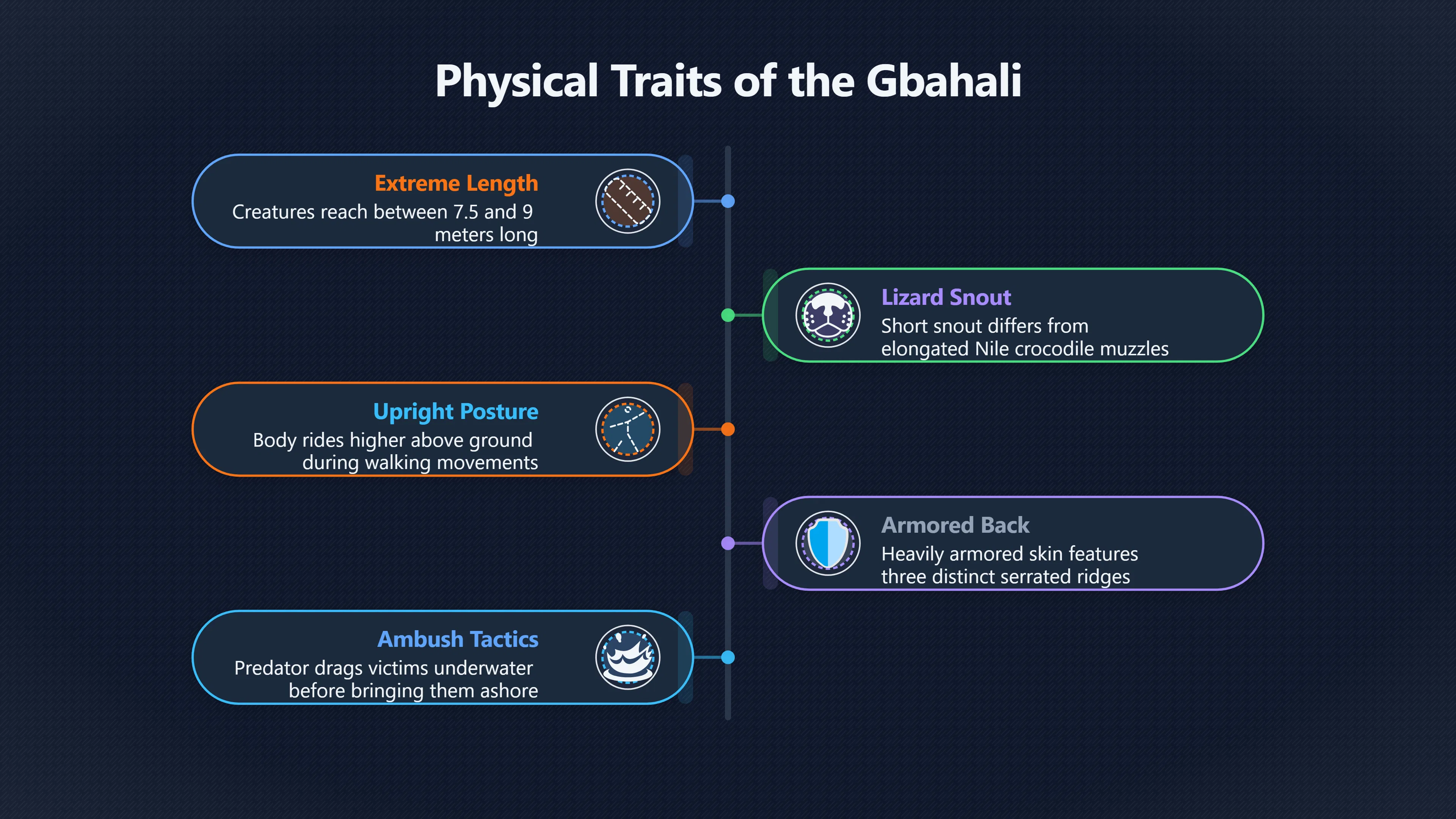
- It is said to reach around 7.5–9 metres (25–30 feet) in length.
- Witnesses describe a comparatively short, lizard-like snout rather than the elongated muzzle associated with large Nile crocodiles.
- Its body supposedly rides higher above the ground, giving it a more upright stance when walking.
- Its back is described as heavily armoured, with three ridges or rows of serrations.
- It is portrayed as an ambush predator that drags victims underwater before bringing them ashore to feed.[karlshuker.blogspot.com]karlshuker.blogspot.comTH E GRUESOME GBAHALITHE GRUESOME GBAHALI - LURKING IN LIBERIA?2 Mar 2024 — When interviewing the villagers, Sheppard showed them various illustrations of mod…
Several reported incidents add dramatic detail. One frequently repeated story concerns fishermen who allegedly caught and killed Gbahalis using nets and shotguns, then butchered the carcasses for meat. A skull was reportedly preserved until it was destroyed when fighting during Liberia’s civil war devastated the village. Another account describes a fatal attack near the village of Gelema, where investigators allegedly recovered only partial human remains. None of these events has been independently documented in scientific publications or official wildlife records, so they remain unverified claims rather than established historical facts.[karlshuker.blogspot.com]karlshuker.blogspot.comTH E GRUESOME GBAHALITHE GRUESOME GBAHALI - LURKING IN LIBERIA?2 Mar 2024 — When interviewing the villagers, Sheppard showed them various illustrations of mod…
An intriguing feature of the testimony is that villagers reportedly rejected suggestions that the animal was magical or a forest spirit. Instead, they described it simply as another dangerous river creature that sensible people avoided. That differs from many cryptid traditions in which mystery animals are closely tied to supernatural beliefs.[karlshuker.blogspot.com]karlshuker.blogspot.comTH E GRUESOME GBAHALITHE GRUESOME GBAHALI - LURKING IN LIBERIA?2 Mar 2024 — When interviewing the villagers, Sheppard showed them various illustrations of mod…
Known crocodiles in Liberian rainforest rivers
The Gbahali story sounds more plausible than many monster tales because Liberia already possesses genuine crocodile diversity.
The country’s waterways are home to several crocodilian species, including the West African slender-snouted crocodile, the dwarf crocodile and populations associated with the Nile crocodile complex. Some inhabit dense rainforest rivers that remain difficult to survey comprehensively, while others are uncommon or locally rare. Large reptiles therefore belong naturally in the landscape rather than being an impossible addition to it.[karlshuker.blogspot.com]karlshuker.blogspot.comShukerNature: March 20242 Mar 2024 — However, native Liberians also speak of a fifth crocodile-like creature, currently unknown to scienc…
This creates an important challenge for interpreting sightings. People encountering an unusually large crocodile in poor visibility may notice only a handful of distinctive features. Memory, distance, fear and local storytelling can all magnify differences over time.
At the same time, experienced local hunters and fishermen generally know the animals that share their rivers. Their insistence that the Gbahali differs from ordinary crocodiles cannot simply be dismissed, although it also cannot be accepted uncritically without physical evidence. Cryptozoology often sits precisely in this uncomfortable middle ground: local expertise deserves attention, but eyewitness testimony alone cannot establish a new species.
Why comparisons with prehistoric reptiles are unconvincing
One of the most widely repeated elements of the story involves comparisons with extinct reptiles.
Sheppard reportedly showed villagers illustrations of both modern crocodilians and prehistoric species. They considered one reconstruction of the Triassic predator Postosuchus to resemble the Gbahali more closely than living crocodiles. Later writers have also suggested similarities with the Cretaceous crocodile relative Kaprosuchus.[karlshuker.blogspot.com]karlshuker.blogspot.comTH E GRUESOME GBAHALITHE GRUESOME GBAHALI - LURKING IN LIBERIA?2 Mar 2024 — When interviewing the villagers, Sheppard showed them various illustrations of mod…
These comparisons are interesting as descriptions of appearance rather than evidence of identity.
Several problems make a surviving Postosuchus or Kaprosuchus extraordinarily unlikely:
- Both belong to lineages believed extinct for tens or hundreds of millions of years.
- Their known fossil distributions do not match modern Liberia.
- No fossils indicate survival into recent geological times.
- No physical remains from Liberia bridge the enormous evolutionary gap.
In other words, witness descriptions may resemble artists’ reconstructions without implying that the witnesses actually observed a surviving prehistoric reptile. Human beings often compare unfamiliar animals with the closest visual match available.

Could the Gbahali simply be a giant crocodile?
The simplest explanation is that reports exaggerate encounters with unusually large crocodiles.
Several factors support this possibility:
- Large crocodiles are capable of killing people.
- River attacks naturally become memorable stories.
- Exceptional individuals often receive their own names in local traditions.
- Features such as size, aggression and rarity tend to grow in repeated retelling.
However, this explanation also has weaknesses. Many witnesses reportedly emphasised characteristics beyond sheer size, including the short snout, higher posture and unusual feeding behaviour. If those observations were accurate, they are not straightforward matches for typical Nile crocodiles.[karlshuker.blogspot.com]karlshuker.blogspot.comTH E GRUESOME GBAHALITHE GRUESOME GBAHALI - LURKING IN LIBERIA?2 Mar 2024 — When interviewing the villagers, Sheppard showed them various illustrations of mod…
Some writers have proposed an unknown oversized crocodile or an unusual population of dwarf crocodiles adapted to remote rainforest habitats. Such ideas remain speculative because no specimens, bones, DNA or verified photographs have ever emerged.
Why the evidence remains suggestive but unproven
The Gbahali occupies an unusual place in African cryptozoology because the reports are internally consistent enough to remain intriguing, yet lack the physical evidence needed for scientific acceptance.
The strongest points in favour include:
- multiple witness accounts collected from different people;
- a remote habitat where wildlife surveys remain difficult;
- local descriptions that present the animal as an ordinary species rather than a supernatural being;
- Liberia’s genuine history of biologically important wildlife discoveries.
Against these points stand equally significant problems:
- no museum specimen;
- no authenticated photograph or video;
- no preserved skull or skeleton available for study;
- no peer-reviewed zoological documentation;
- heavy reliance on second-hand retellings through cryptozoological sources rather than primary field research.[karlshuker.blogspot.com]karlshuker.blogspot.comTH E GRUESOME GBAHALITHE GRUESOME GBAHALI - LURKING IN LIBERIA?2 Mar 2024 — When interviewing the villagers, Sheppard showed them various illustrations of mod…
For zoologists, these shortcomings are decisive. New large vertebrates are not impossible to discover, particularly in biodiverse tropical regions, but a predator reportedly exceeding the size of most known crocodiles would normally be expected to leave clearer physical traces.
Why the story endures in Liberia’s Fortean history
The Gbahali remains Liberia’s signature cryptid because it sits exactly where folklore, ecology and genuine scientific uncertainty meet.
Unlike tales that rely entirely on ghosts or supernatural beings, the Gbahali exists within an environment already populated by dangerous reptiles. That makes the reports sound plausible enough to sustain debate while still resisting confirmation. Every unexplained river death, every glimpse of a large reptile in muddy water and every retelling of old encounters helps keep the legend alive.
For students of Forteana, the Gbahali is valuable not because it proves a giant unknown reptile inhabits Liberia, but because it illustrates how eyewitness testimony, difficult terrain, conservation biology and local knowledge can combine to produce one of West Africa’s most persistent mystery-animal traditions. Even after years of discussion, the central question remains unchanged: are the stories preserving observations of an unusual but ordinary crocodile, or are they describing something that has yet to be properly documented? The available evidence does not allow a confident answer.
Amazon book picks
Further Reading
Books and field guides related to Is the Gbahali Liberia's Real River Monster?. Use these as the next step if you want deeper reading beyond the article.
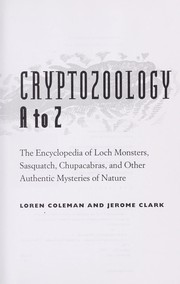
Cryptozoology A to Z
Includes many legendary animal traditions and investigative context.


eBay marketplace picks
Marketplace Samples
Live-tested eBay searches with available results related to this page.



Endnotes
1.
Source: karlshuker.blogspot.com
Title: TH E GRUESOME GBAHALI
Link:https://karlshuker.blogspot.com/2024/03/the-gruesome-gbahali-lurking-in-liberia.html
Source snippet
THE GRUESOME GBAHALI - LURKING IN LIBERIA?2 Mar 2024 — When interviewing the villagers, Sheppard showed them various illustrations of mod...
2.
Source: karlshuker.blogspot.com
Link:https://karlshuker.blogspot.com/2024/03/
Source snippet
ShukerNature: March 20242 Mar 2024 — However, native Liberians also speak of a fifth crocodile-like creature, currently unknown to scienc...
Additional References
3.
Source: tumblr.com
Link:https://www.tumblr.com/cryptidchronicles/28475161064/on-the-track-of-the-gbahali
4.
Source: facebook.com
Title: Gbahali, the killer reptile In Liberia, a country
Link:https://www.facebook.com/groups/1002571683091379/posts/7894165853931893/
Source snippet
American aid worker and missionary John-Mark Shephard collected reports of the gbahali in Liberia, which he sent to Loren Coleman...
5.
Source: youtube.com
Link:https://www.youtube.com/watch?v=ZMR-MG4HYC0
6.
Source: youtube.com
Link:https://www.youtube.com/watch?v=ppZ15D__HcA
7.
Source: youtube.com
Link:https://www.youtube.com/watch?v=zoh692qfJE0
Topic Tree