Within Niger Weird
When Spirits Replayed Colonial Power
Songhay Hauka possession turns colonial power into ritual performance, making Niger's spirit traditions both uncanny and historically sharp.
On this page
- What Hauka possession looked like
- Why colonial figures became spirits
- Belief, performance and social memory
Page outline Jump by section
Introduction
The Hauka spirits are among the most striking and best-documented examples of spirit possession in Niger. Unlike many possession traditions, Hauka ceremonies are famous because the spirits often appeared in the guise of colonial officials, soldiers, engineers and administrators. During trance, mediums marched, saluted, barked orders and enacted exaggerated versions of colonial authority. To outsiders the performances could seem bizarre or even frightening. To many Songhay communities, however, they were neither simple theatre nor random madness. They were a way of making sense of overwhelming political change, illness, power and memory through ritual. Rather than asking whether the spirits were “really” colonial officials returned from the dead, the more revealing question is why colonial power became embodied as spirits at all. Anthropologists have argued that Hauka possession transformed domination into something that could be confronted, mocked, negotiated and ritually controlled.[africabib.org]africabib.orgspirit possession, power and the Hauka in West Africaby P Stoller · 1995 · Cited by 806 — Abstract: The author uses the example…

What Hauka possession looked like
Hauka possession emerged among Songhay-speaking communities during the period of French colonial rule in what is now western Niger before spreading more widely across parts of West Africa. Earlier Songhay possession traditions already recognised numerous spirit families associated with rivers, the landscape, disease and other aspects of life. The Hauka represented something new: spirits identified with the colonial world itself.[dokumen.pub]dokumen.pubn Songhay (Tooru, Genji Kwari; Hausa, spirits of sickness and death; Genji…
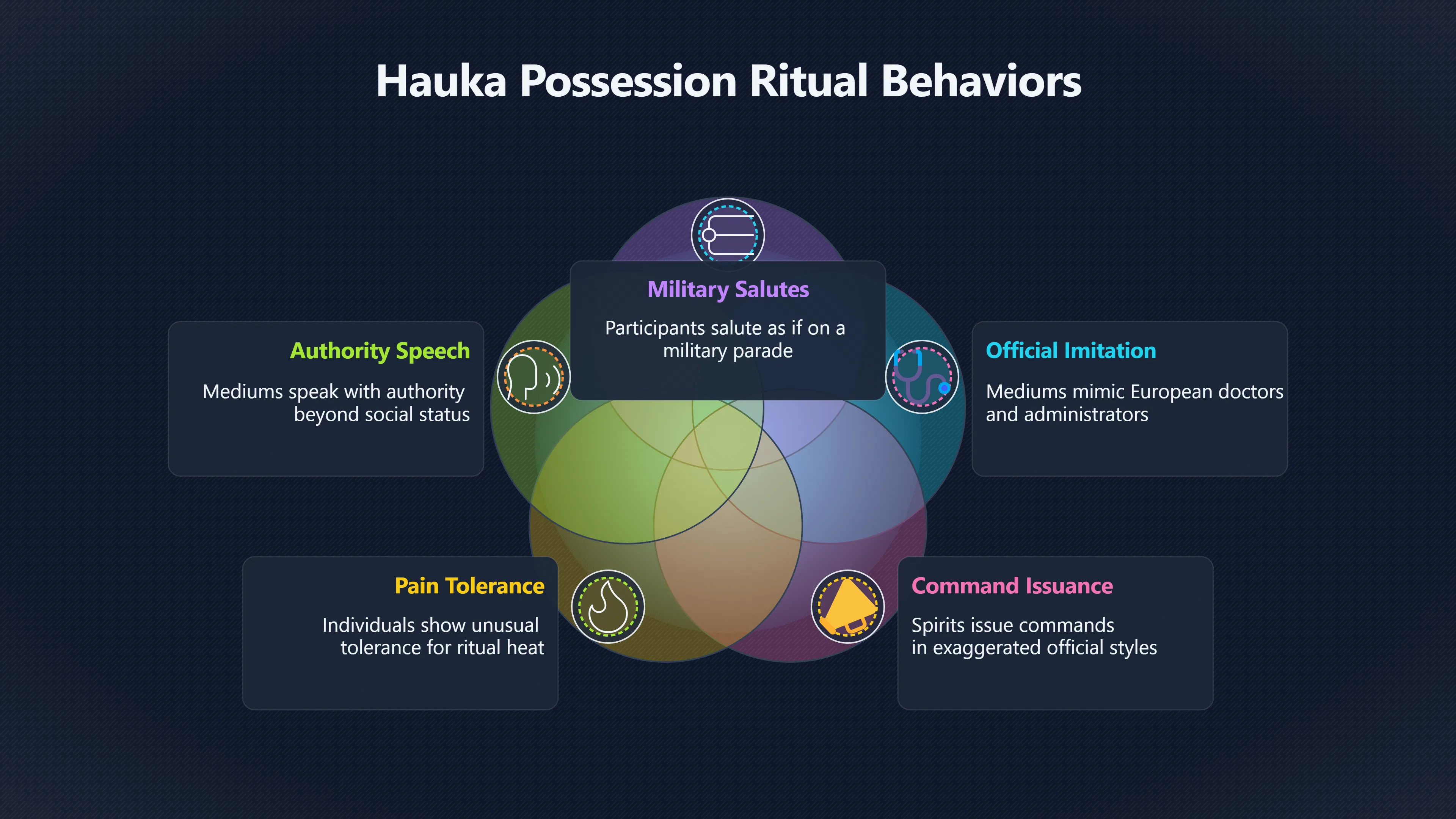
Observers described ceremonies in which mediums entered trance through music, drumming and dance before becoming possessed by named spirits. Once possessed, individuals might:
- salute as though on military parade;
- imitate European officers, doctors or administrators;
- issue commands in an exaggerated official style;
- display unusual tolerance for pain or heat during ritual performance;
- speak with authority beyond their ordinary social position.
To unfamiliar audiences these actions appeared uncanny because participants seemed temporarily transformed into entirely different personalities. Within the ritual community, however, these behaviours followed recognised patterns associated with particular spirits rather than being treated as spontaneous eccentricity.[AfricaBib]africabib.orgspirit possession, power and the Hauka in West Africaby P Stoller · 1995 · Cited by 806 — Abstract: The author uses the example…
For Fortean readers, the remarkable aspect is not simply the trance itself but the consistency with which colonial authority became part of the spirit world. Possession was experienced publicly, with witnesses recognising recurring spirit identities and expected ritual behaviours.
Why colonial figures became spirits
One of the enduring puzzles surrounding the Hauka is why foreign rulers became supernatural beings rather than remaining merely political enemies.
Paul Stoller, whose long-term fieldwork among Songhay communities in Niger remains one of the most influential studies of the tradition, argues that mimicry was fundamentally about power. By ritually copying colonial officials, mediums were not necessarily celebrating them. Instead, imitation became a means of appropriating, redirecting or domesticating the authority that Europeans appeared to possess. In this interpretation, performance became a practical form of social thinking rather than simple parody.[Google Books]books.google.comIn this innovative book, Stoller argues that mimicry is about power. To copy something is to…Read more…
The ceremonies also reflected an important feature of many possession traditions: spirits often represent forces that profoundly affect everyday life. During colonial rule, administrators, soldiers and officials shaped taxation, labour, law and violence. They became unavoidable presences in ordinary experience. Incorporating them into the spirit world acknowledged that they exercised a power which felt almost supernatural in its reach.
At the same time, the rituals inverted ordinary relationships. A colonial officer could command villagers in daily life, but within a possession ceremony that officer-spirit appeared only because ritual specialists summoned and managed it. This symbolic reversal gave participants a framework for engaging with otherwise overwhelming political realities.[JSTOR]jstor.orgSonghay, which did not yet include the Hauka, was a well-org social institution consisting of an…Read more…
Belief, performance and social memory
Modern readers sometimes assume Hauka ceremonies were either genuine supernatural experiences or deliberate political satire. The historical evidence suggests the reality was more complex.
Stoller describes possession as an embodied form of cultural memory. Rather than existing primarily in stories or written history, memories of colonial domination were carried through sounds, rhythms, gestures, smells and bodily experience. The ceremonies allowed historical experience to be repeatedly enacted instead of merely remembered.[Persée]persee.frassr 0335 5985 1992 numPerséeEmbodying Cultural Memory in Songhay Spirit Possession…by P Stoller · 1992 · Cited by 23 — In this essay pursue theoretically ex…
This helps explain why the performances could appear simultaneously serious and theatrical. Ritual specialists did not necessarily separate symbolic performance from spiritual reality in the same way many modern Western observers do. A possessed medium could be understood as genuinely hosting a spirit while also expressing social truths about power, suffering and authority.
The ceremonies therefore operated on several levels at once:
- as healing rituals for afflicted individuals;
- as recognised religious practice;
- as dramatic public performance;
- as a shared language for discussing colonial experience;
- as a living archive of historical memory.
Because these functions overlapped, reducing Hauka either to “mass hysteria” or to political theatre misses much of what participants themselves understood the ceremonies to accomplish.[Persée]persee.frassr 0335 5985 1992 numPerséeEmbodying Cultural Memory in Songhay Spirit Possession…by P Stoller · 1992 · Cited by 23 — In this essay pursue theoretically ex…
Why the Hauka fascinated – and unsettled – outsiders
No discussion of Hauka traditions can avoid the influence of the French ethnographer and filmmaker Jean Rouch. His 1955 film Les maîtres fous (“The Mad Masters”) introduced Hauka possession to international audiences and remains one of the most debated ethnographic films ever made.[Wikipedia]WikipediaLes maîtres fousLes maîtres fous
Many viewers were shocked by scenes showing possessed participants behaving in ways that appeared violent, ecstatic or disturbing. Some praised the film as a groundbreaking attempt to document colonial experience from within African ritual life. Others criticised it for presenting African religion through an exoticising colonial lens or for encouraging audiences to see participants as irrational rather than historically situated.[Wikipedia]WikipediaJean RouchJean Rouch
The controversy itself illustrates why Hauka possession occupies an unusual place in Niger’s strange-history record. It is simultaneously:
- an ethnographic subject;
- a religious tradition;
- a historical document of colonial experience;
- a frequently misunderstood spectacle.
Its reputation owes as much to debates over interpretation as to the ceremonies themselves.
How believers and sceptics interpret the experience
Interpretations differ according to worldview.
Those who participate within Songhay religious traditions may understand Hauka spirits as genuine spiritual beings whose presence is recognised through established ritual practice. Possession is treated as a meaningful encounter requiring experienced ritual specialists rather than as entertainment.
Anthropologists generally avoid deciding whether spirits objectively exist. Instead they ask what possession accomplishes socially, psychologically and historically. In this view, the ceremonies organise memory, express identity, provide healing and give communities a way to negotiate changing political realities.[AfricaBib]africabib.orgspirit possession, power and the Hauka in West Africaby P Stoller · 1995 · Cited by 806 — Abstract: The author uses the example…
Medical or psychological explanations, meanwhile, focus on trance states, dissociation and culturally learned forms of altered consciousness. These approaches can explain aspects of behaviour without necessarily accounting for why the same colonial figures repeatedly appeared within the possession system.
None of these interpretations fully excludes the others. The enduring interest of the Hauka lies precisely in the fact that religious experience, historical trauma, performance and social commentary became inseparable.
Why Hauka remains central to Niger’s strange history
Among Niger’s many unusual traditions, the Hauka stand out because they blur categories that modern readers often prefer to keep separate. They are simultaneously accounts of spirit encounters, records of colonial history and examples of ritual performance.
For Fortean readers, the fascination does not come from proving supernatural intervention. It comes from witnessing how an entire community transformed one of the most disruptive forces in its history into a population of spirits that could be summoned, recognised and confronted. The ceremonies remain one of the clearest examples anywhere in the world of the uncanny serving as a language for remembering political power—where history itself became something that could possess the living.[africabib.org]africabib.orgspirit possession, power and the Hauka in West Africaby P Stoller · 1995 · Cited by 806 — Abstract: The author uses the example…
Amazon book picks
Further Reading
Books and field guides related to When Spirits Replayed Colonial Power. Use these as the next step if you want deeper reading beyond the article.
Possession, demoniacal and other, among primitive races, in a...
Connects spirit possession traditions across cultures.
eBay marketplace picks
Marketplace Samples
Live-tested eBay searches with available results related to this page.

Endnotes
1.
Source: africabib.org
Link:https://www.africabib.org/rec.php?RID=124976263
Source snippet
spirit possession, power and the Hauka in West Africaby P Stoller · 1995 · Cited by 806 — Abstract: The author uses the example...
2.
Source: jstor.org
Link:https://www.jstor.org/stable/639964
Source snippet
Songhay, which did not yet include the Hauka, was a well-org social institution consisting of an...Read more...
3.
Source: dokumen.pub
Link:https://dokumen.pub/fusion-of-the-worlds-an-ethnography-of-possession-among-the-songhay-of-niger-9780226775494.html
Source snippet
n Songhay (Tooru, Genji Kwari; Hausa, spirits of sickness and death; Genji...
4.
Source: books.google.com
Link:https://books.google.com/books/about/Embodying_Colonial_Memories.html?id=KqOscLnNC10C
Source snippet
In this innovative book, Stoller argues that mimicry is about power. To copy something is to...Read more...
5.
Source: Wikipedia
Title: Les maîtres fous
Link:https://en.wikipedia.org/wiki/Les_ma%C3%AEtres_fous
6.
Source: Wikipedia
Title: Jean Rouch
Link:https://en.wikipedia.org/wiki/Jean_Rouch
7.
Source: persee.fr
Title: assr 0335 5985 1992 num 79 1 1547
Link:https://www.persee.fr/doc/assr_0335-5985_1992_num
Source snippet
PerséeEmbodying Cultural Memory in Songhay Spirit Possession...by P Stoller · 1992 · Cited by 23 — In this essay pursue theoretically ex...
8.
Source: persee.fr
Title: Paul Stoller, Embodying Colonial Memories
Link:https://www.persee.fr/doc/hom_0439-4216_1999_num_39_149_453537
Source snippet
JP Olivier de Sardan · 1999 — Embodying Colonial Memories. Spirit Possession, Power and the Hauka in West Africa... An Ethn...
Additional References
9.
Source: scribd.com
Link:https://www.scribd.com/document/984054432/Embodying-Colonial-Memories
Source snippet
Colonial Spirits in Niger's Ceremonies | PDF | EthnographyIn 'Embodying Colonial Memories,' Paul Stoller explores the Hauka spirit posses...
10.
Source: staff.washington.edu
Link:https://staff.washington.edu/ellingsn/Stoller-Horrific_Comedy.pdf
Source snippet
washington.edu18 Horrific comedyby P Stoller — At the onset of French colonial rule, the possession cult of the Songhay, which did not ye...
11.
Source: api.pageplace.de
Link:https://api.pageplace.de/preview/DT0400.9781136652592_A24439317/preview-9781136652592_A24439317.pdf
Source snippet
MemoriesThe Hauka, Songhay spirits that mimic Nigerien colonial culture, "com- missioned" this book in Tillaberi, Niger in June of 1987...
12.
Source: researchgate.net
Link:https://www.researchgate.net/publication/230331355_Embodying_Colonial_Memories_Spirit_Possession_Power_and_the_Hauka_In_West_Africa
Source snippet
Spirit Possession, Power, and the Hauka In West AfricaEmbodying Colonial Memories: Spirit Possession, Power, and the Hauka In West Africa...
13.
Source: proquest.com
Link:https://www.proquest.com/scholarly-journals/embodying-colonial-memories-spirit-possession/docview/209758657/se-2
Source snippet
ger, Stoller clearly thinks that memories have little to do with "...Read more...
14.
Source: fondationalaindanielou.org
Link:https://www.fondationalaindanielou.org/intellectual-dialogue/transversal-paths/transversal-paths-n-3-july-2025-3/
Source snippet
Transversal Paths N°3 – SHARED ANTHROPOLOGYPaul Stoller: Spirit possession among Songhay people is a symbolic reenactment of Songhay exp...
15.
Source: books.google.co.ve
Link:https://books.google.co.ve/books?cad=4&id=KqOscLnNC10C&source=gbs_citations_module_r
Source snippet
In this innovative book, Stoller argues that mimicry is about power. To copy something is to...Read more...
16.
Source: medimops.de
Link:https://www.medimops.de/paul-stoller-embodying-colonial-memories-spirit-possession-power-and-the-hauka-in-west-africa-taschenbuch-M00415908779.html
Source snippet
Spirit Possession, Power and the Hauka in West Africa von...Paul Stoller, who was initiated into a spirit possession troupe, recounts an...
17.
Source: youtube.com
Title: Bori Niger, spirit possession ceremonies in Hausa land
Link:https://www.youtube.com/watch?v=uCL2VuMMPHA
Source snippet
The Groundbreaking Ethnography of Jean Rouch | Hand-Picked by MUBI...
18.
Source: journals.openedition.org
Link:https://journals.openedition.org/etnografica/3517
Source snippet
Paul Stoller, Embodying Colonial Memories: Spirit Possession, Power and the Hauka in West Africa, Londres, Routledge, 1995.Read more...
Topic Tree