Within Botswana Weird
Why Did Drought Become a Supernatural Rumour?
Botswana's rainmaking stories and El Negro rumours show how drought can turn grief, authority and misfortune into public strange history.
On this page
- Rain chiefs and the politics of blessing
- El Negro's return and the failed rains
- What drought rumours reveal about public anxiety
Page outline Jump by section
Introduction
Botswana’s rain stories are not simply about unusual weather. In a country where drought has repeatedly threatened crops, cattle and livelihoods, rain has long carried political, spiritual and emotional weight. That helps explain why periods of failed rainfall have sometimes generated rumours that linked environmental crisis to human actions, ancestral displeasure or hidden wrongdoing rather than to meteorology alone. One of the best-documented examples followed the 2000 return of the remains known as “El Negro”, when whispers spread that the reburial of a man once exhibited in Europe had somehow driven the rains away. The episode is significant not because there is evidence that it affected the weather, but because it reveals how drought, historical injustice and uncertainty can combine to produce powerful public narratives.

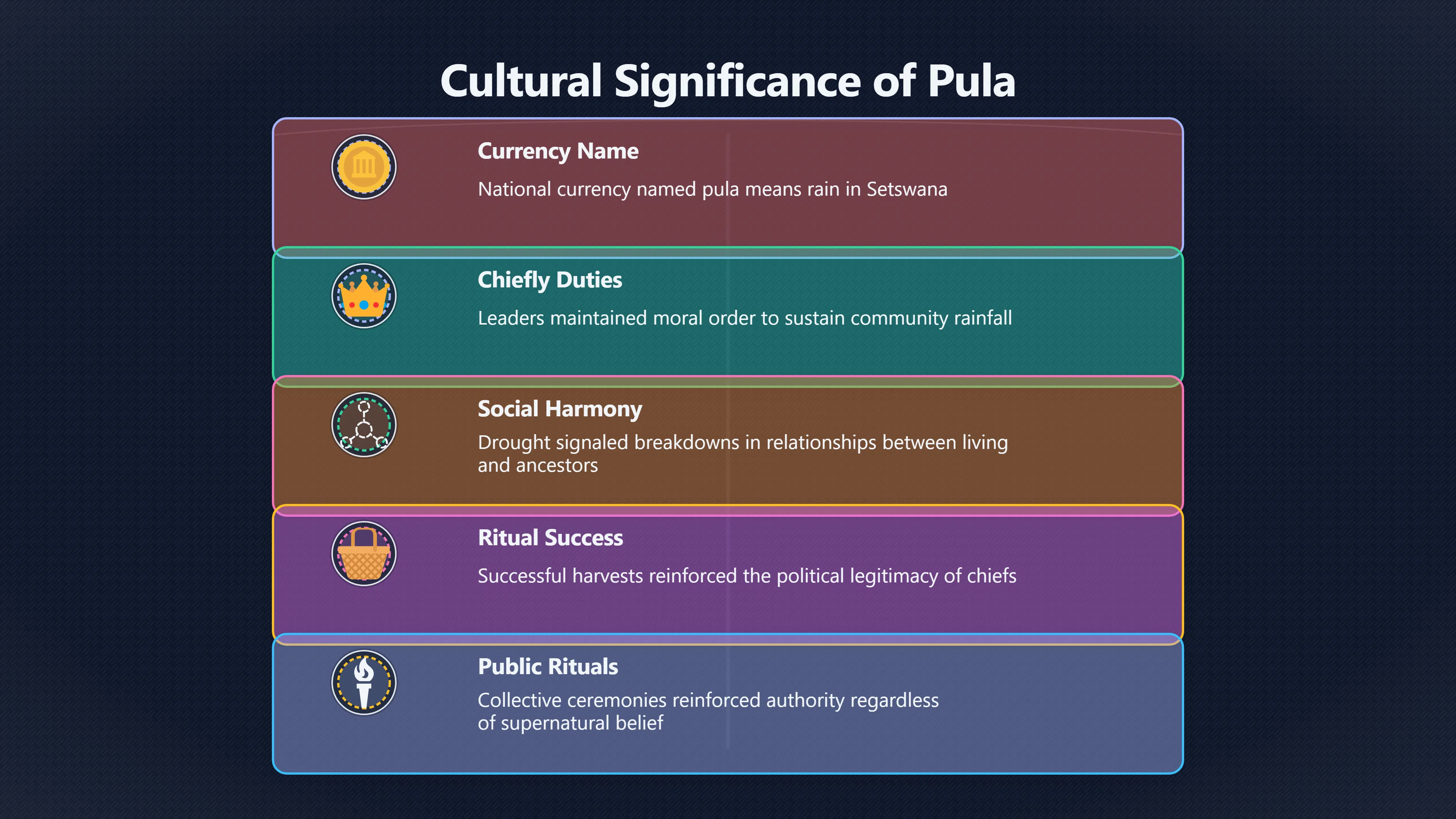
Why rain has always been more than weather
Botswana’s dry climate has given rainfall an importance that extends well beyond agriculture. The national currency is called pula, the Setswana word for “rain”, reflecting the idea that rain is both prosperity and blessing. Historically, Tswana chiefs were expected not merely to govern but also to maintain the moral and ritual order believed to sustain the community, including ceremonies associated with rainfall. When drought struck, people often judged leadership through the lens of whether harmony between the living, the ancestors and the natural world had been maintained.[South African History Online]sahistory.org.zaWhile early.Read moreSouth African History OnlineCulture and Customs of BotswanaJune 21, 2010 — by J Denbow · Cited by 245 — when chiefs, through neglect of t…
This did not mean everyone literally believed chiefs could command the clouds. Rather, rainmaking formed part of a wider social understanding in which environmental disaster could indicate that relationships within society had broken down. The expectation created a political dimension to weather: prolonged drought invited questions about authority, justice and moral responsibility as much as it did questions about climate.[South African History Online]sahistory.org.zaWhile early.Read moreSouth African History OnlineCulture and Customs of BotswanaJune 21, 2010 — by J Denbow · Cited by 245 — when chiefs, through neglect of t…
Rain chiefs and the politics of blessing
Traditional rainmaking ceremonies occupied an important place in Tswana political life. Chiefs organised communal rituals, consulted ritual specialists and demonstrated that they remained in good standing with both ancestors and the community. Success or failure therefore carried symbolic consequences.
Historical accounts describe several recurring themes:
- Rain reflected good leadership. A respected chief was expected to protect both people and livestock, with successful harvests reinforcing political legitimacy.
- Drought invited criticism. Failed rains could be interpreted as evidence that leaders had neglected customary obligations or that social harmony had been disturbed.
- Public ritual mattered. Rainmaking ceremonies were collective events that reinforced political authority regardless of whether participants understood them in strictly supernatural terms.
Modern historians argue that these beliefs should not be dismissed as simple superstition. Instead, they functioned as a language through which communities discussed governance, inequality and crisis. When environmental shocks occurred, weather became a way of talking about politics without necessarily talking about politics directly.[South African History Online]sahistory.org.zaWhile early.Read moreSouth African History OnlineCulture and Customs of BotswanaJune 21, 2010 — by J Denbow · Cited by 245 — when chiefs, through neglect of t…
El Negro’s return and the failed rains
The most famous modern rain rumour emerged after the repatriation of “El Negro”, the preserved remains of a Tswana man who had spent more than 160 years displayed in museums in Europe. Following international negotiations, the remains were returned from Spain and buried with state honours in Gaborone during October 2000.[ResearchGate]researchgate.netResearchGate(PDF) El Negro, El Niño, Witchcraft and the absence of rain…This article charts the progress of the rumours relating to El…
The following rainy season disappointed expectations. By January 2001, rumours circulating in Gaborone claimed that the arrival and burial of El Negro had somehow caused the rains to fail. Different versions offered different explanations. Some suggested that the disturbed dead could not rest properly. Others argued that ritual procedures had been mishandled or that government officials had ignored customary knowledge. Still others folded the story into wider ideas about witchcraft and hidden spiritual forces.[ResearchGate]researchgate.netResearchGate(PDF) El Negro, El Niño, Witchcraft and the absence of rain…This article charts the progress of the rumours relating to El…
At the same time, southern Africa was experiencing complex climate conditions associated with the changing effects of the El Niño–Southern Oscillation. The similarity between the names “El Negro” and “El Niño” even became part of the popular conversation, creating an ironic coincidence that helped rumours spread despite there being no scientific connection between the two.[ResearchGate]researchgate.netResearchGate(PDF) El Negro, El Niño, Witchcraft and the absence of rain…This article charts the progress of the rumours relating to El…
The historian Jan-Bart Gewald, who documented the episode in detail, stresses that the importance of the rumours lies not in whether they were true but in the fact that many people discussed them seriously. The rumours became a vehicle for expressing dissatisfaction with government, unease about rapid social change and unresolved feelings about colonial humiliation embodied by El Negro’s long exhibition overseas.[ResearchGate]researchgate.netResearchGate(PDF) El Negro, El Niño, Witchcraft and the absence of rain…This article charts the progress of the rumours relating to El…

What drought rumours reveal about public anxiety
The El Negro episode illustrates a wider pattern found in Botswana and elsewhere in southern Africa. Environmental stress often encourages stories that connect unrelated events into meaningful narratives.
Several factors helped these rumours gain traction:
- Historical injustice. The treatment of El Negro symbolised colonial exploitation, making his return emotionally charged long before the drought began.
- Economic vulnerability. Poor rainfall threatened livelihoods, increasing the demand for explanations that felt morally satisfying.
- Political uncertainty. Rumours allowed criticism of leaders without requiring formal political confrontation.
- Cultural continuity. Older ideas linking rain, ancestors and leadership remained available as ways of interpreting unexpected events.
Rather than replacing scientific explanations, these narratives often existed alongside them. People could understand meteorological forecasts while still debating whether deeper social or spiritual causes lay behind a difficult season.[ResearchGate]researchgate.netResearchGate(PDF) El Negro, El Niño, Witchcraft and the absence of rain…This article charts the progress of the rumours relating to El…
Why these stories remain part of Botswana’s strange history
From a Fortean perspective, the El Negro rumours are compelling because they show how an apparently supernatural claim can emerge from entirely real historical pressures. There was no mysterious weather event requiring paranormal explanation. Instead, an unusual sequence—a long-lost ancestor returned from Europe, followed by disappointing rains—provided the raw material for folklore in real time.
Unlike classic ghost stories or monster legends, this case can be traced through newspapers, academic research and eyewitness accounts. It demonstrates that modern rumours often grow not from ignorance but from the search for meaning during periods of uncertainty. Drought transformed an international repatriation into a supernatural narrative because the coincidence resonated with older ideas about rain, authority and ancestral order.
The result is one of Botswana’s best-documented examples of living Forteana: a moment when history, climate, politics and traditional belief briefly combined to create a rumour that became part of the country’s enduring strange-history record.
Amazon book picks
Further Reading
Books and field guides related to Why Did Drought Become a Supernatural Rumour?. Use these as the next step if you want deeper reading beyond the article.
The Lost World of the Kalahari
First published 1958. Subjects: San (African people), Description and travel, Kalahari Desert, Vander Post, Laurens - Prose & Criticism,...
Fingerprints of the gods
First published 1995. Subjects: Lost continents, World maps, Ancient Civilization, Discovery and exploration, Early works to 1800.
African folktales
First published 1983. Subjects: Africa, Sub-Saharan, Tales, Customs and Folklore, Volkserzählung, Folklore.
The World of the Kalahari Bushman
Offers background on beliefs surrounding nature and survival.
eBay marketplace picks
Marketplace Samples
Live-tested eBay searches with available results related to this page.




Endnotes
1.
Source: researchgate.net
Link:https://www.researchgate.net/publication/28641975_El_Negro_El_Nino_Witchcraft_and_the_absence_of_rain_in_Botswana
Source snippet
ResearchGate(PDF) El Negro, El Niño, Witchcraft and the absence of rain...This article charts the progress of the rumours relating to El...
2.
Source: researchgate.net
Link:https://www.researchgate.net/publication/6326607_El_Negro_el_Nino_witchcraft_and_the_absence_of_rain
Source snippet
(PDF) El Negro, el Nino, witchcraft and the absence of rainThis article charts the progress of the rumours relating to El Negro, relates...
3.
Source: sahistory.org.za
Title: While early.Read more
Link:https://sahistory.org.za/sites/default/files/archive-files/james_denbow_phenyo_c._thebe_culture_and_custombook4you.pdf
Source snippet
South African History OnlineCulture and Customs of BotswanaJune 21, 2010 — by J Denbow · Cited by 245 — when chiefs, through neglect of t...
Published: June 21, 2010
Additional References
4.
Source: academia.edu
Link:https://www.academia.edu/4807022/El_Negro_El_Nino_and_the_Absence_of_Rain_in_Botswana
Source snippet
(PDF) El Negro El Nino and the Absence of Rain in BotswanaThe study explores the rumors surrounding the return of El Negro's remains to B...
5.
Source: youtube.com
Title: Twenty Years of Drought
Link:https://www.youtube.com/watch?v=RO53qlMebjA
Source snippet
Botswana faces food insecurity as extreme conditions wipe out yields...
6.
Source: pure.uva.nl
Link:https://pure.uva.nl/ws/files/3947332/38268_
Source snippet
and identity of Herero Communities in Namibiaby AG Hoffmann · Cited by 17 — The OvaHerero communities living in Namibia, Botswana and Sou...
7.
Source: youtube.com
Title: Botswana faces food insecurity as extreme conditions wipe out yields
Link:https://www.youtube.com/watch?v=baKmVuAOGSg
Source snippet
Botswana Emergency Water Security and Efficiency Project...
8.
Source: academicworks.cuny.edu
Link:https://academicworks.cuny.edu/cgi/viewcontent.cgi?article=5621&context=gc_etds
Source snippet
cuny.eduRain, Gender and Politics in an African Water Catchmentby J Fredlund · 2021 — When the rains fail, the logic of rainmaking sugges...
9.
Source: youtube.com
Title: Botswana’s Drought Makes Wasteland of Harvests, Livestock
Link:https://www.youtube.com/watch?v=vt4O-FU5ZUQ
Source snippet
Botswana's Worst Drought in Years: Relief Efforts Underway...
10.
Source: youtube.com
Title: Botswana Emergency Water Security and Efficiency Project
Link:https://www.youtube.com/watch?v=CBdJ3nQQuic
Source snippet
Botswana's Drought Makes Wasteland of Harvests, Livestock...
11.
Source: publication.codesria.org
Link:https://publication.codesria.org/index.php/pub/catalog/download/67/388/833?inline=1
Source snippet
Crises of Postcoloniality in AfricaThe Council for the Development of Social Science Research in Africa (CODESRIA) is an independent orga...
12.
Source: scholar.sun.ac.za
Link:https://scholar.sun.ac.za/bitstreams/3b554d4e-f050-40cb-b774-9c6af3963ca6/download
Source snippet
Social, Environmental and Political History of Drought in...by T Takuva · 2022 · Cited by 10 — The thesis draws on global, regional and...
13.
Source: facebook.com
Link:https://www.facebook.com/groups/2033833066748234/posts/3556536441144548/
Source snippet
JULY 24, 1909: BATHOEN, LINCHWE & SEBELE ON THE...This is The Three Dikgosi Monument, a tribute to the three legendary chiefs who defied...
Published: July 24, 1909
Topic Tree