Within Strange Syria
Why Do Old Syrian Houses Become Haunted?
Urban jinn stories turn old Syrian houses into places where architecture, fear, family memory and religious language meet.
On this page
- Courtyards, cellars and remembered rooms
- Jinn belief between folklore and social stress
- Sceptical explanations and real world risks
Page outline Jump by section
Introduction
Stories about jinn-haunted houses in Aleppo and Damascus occupy a distinctive place in Syrian folklore because they are rooted in ordinary urban life rather than lonely castles or dramatic ruins. The setting is usually a traditional courtyard house, an abandoned mansion or a family home that has stood for generations. Strange sounds, unexplained illnesses, recurring nightmares or an overwhelming feeling that a room should not be entered are interpreted by some residents as signs that unseen beings inhabit the property. Yet these stories also reveal something less supernatural: how architecture, family memory, religious belief and periods of social upheaval combine to give old buildings powerful reputations.

Unlike famous haunted houses elsewhere, very few Syrian examples have generated detailed historical investigations that support paranormal claims. Most survive as oral traditions, neighbourhood legends or modern urban folklore. That makes them interesting not because they prove the existence of jinn, but because they show how communities explain unsettling places and experiences in cities whose buildings often preserve centuries of layered history.
Why old Syrian houses attract haunting stories
Traditional houses in the old quarters of Damascus and Aleppo possess features that naturally encourage mystery. High exterior walls conceal interior courtyards, many homes contain underground storage rooms or cellars, and generations of one family may have occupied the same property before it was abandoned or divided among heirs. Poor lighting, echoing stone corridors and ageing timber all contribute to unusual sounds and visual effects.
Within Syrian folk belief, these physical qualities merge with longstanding ideas that certain neglected or isolated places are more likely to be occupied by unseen beings. Rather than assuming every strange occurrence has a supernatural cause, many people distinguish between ordinary misfortune and locations thought to carry an unusual presence. The building itself becomes part of the story, with each generation adding new memories or warnings.
The symbolic importance of the house also matters. Anthropological research on Syrian concepts of the household shows that a home is understood not merely as a building but as the centre of family identity, ancestry and social relationships. Stories attached to a house therefore become stories about the family itself, making rumours of haunting especially persistent.[Taylor & Francis Online]tandfonline.comOpen source on tandfonline.com.
Courtyards, cellars and remembered rooms
The geography of these legends is remarkably consistent.
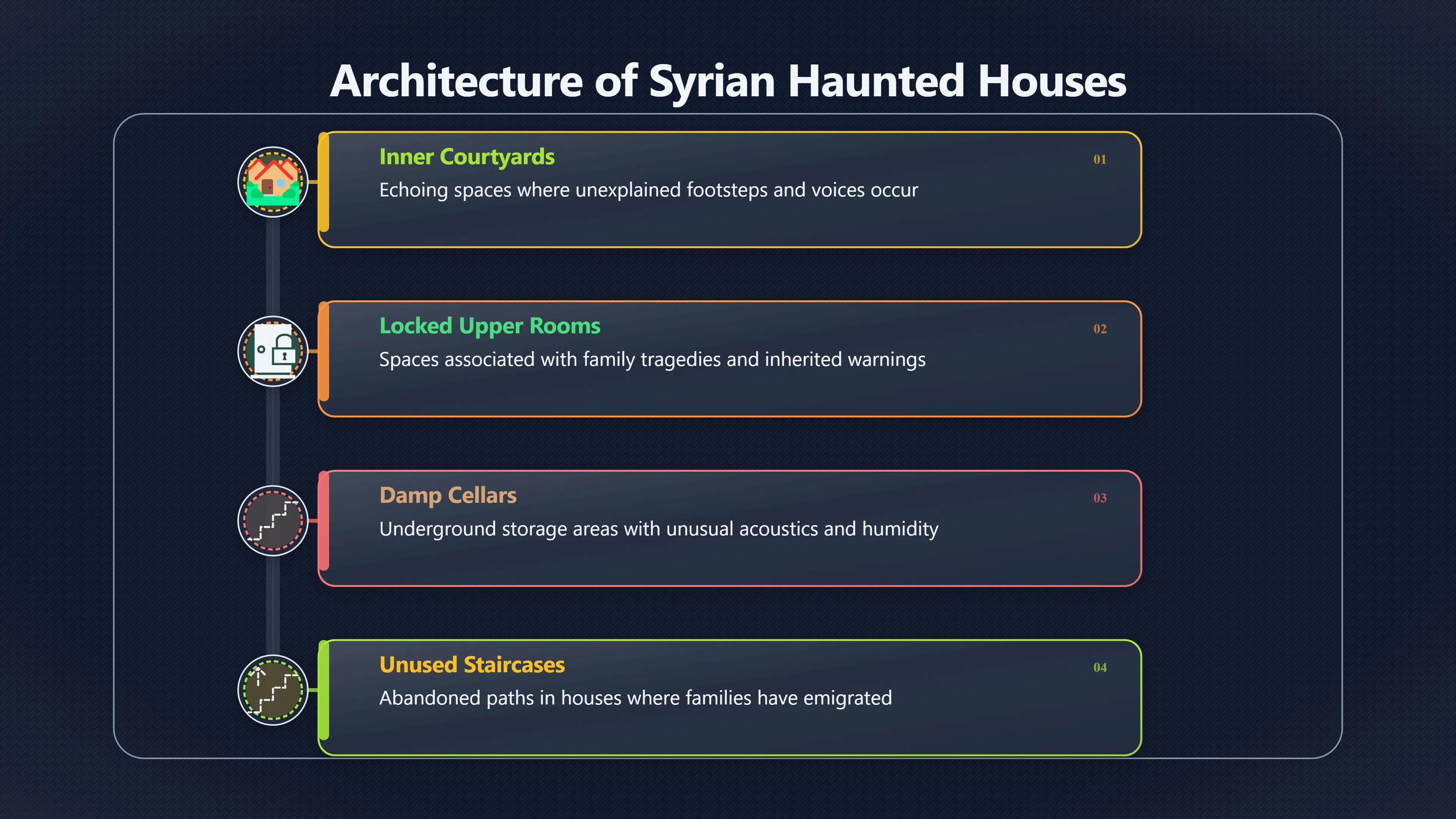
Certain parts of a traditional urban house appear repeatedly in local accounts:
- Inner courtyards, where unexplained footsteps or voices are said to echo after dark.
- Locked upper rooms, often associated with family tragedies or inherited warnings never to enter.
- Cellars and storage spaces, where darkness, humidity and unusual acoustics encourage fearful interpretations.
- Unused staircases, particularly in houses partly abandoned after families emigrated or moved elsewhere.
These locations are psychologically significant as well as architecturally distinctive. Old houses contain spaces that modern occupants rarely use, allowing stories to develop around rooms that remain physically present but socially forgotten.
Family memory reinforces this process. If an elderly relative recalls that “something happened” in one room decades earlier, later generations may inherit the warning without knowing the original event. Over time the explanation shifts from forgotten history to supernatural tradition.

The Damascus Abrash House legend
Perhaps the best-known modern example is the abandoned Abrash House in Damascus, located in the Jisr al-Abyad district. Over many years it accumulated stories claiming that it had been built on an old cemetery, that construction workers died under mysterious circumstances, or that an entire family disappeared after moving in.
The details vary depending on the storyteller, but the narrative follows a familiar pattern. The house remains empty, neighbours speculate about invisible occupants, and rumours grow because nobody lives there long enough to contradict them.
More recent journalistic investigations paint a much less dramatic picture. Members of the owning family have publicly rejected the stories, while nearby residents report that they have witnessed nothing extraordinary despite living beside the building for years. Investigations suggest that inheritance disputes, abandonment and the imposing appearance of a decaying mansion explain much of its eerie reputation.[ما وراء الطبيعة - PARANORMAL ARABIA]paranormalarabia.comما وراء الطبيعةPARANORMAL ARABIAAbrash Family House in Damascus: The Legend of a Haunted Place | Paranormal ArabiaSeptember 30, 2025…
This illustrates an important feature of Syrian haunted-house folklore: the legend often becomes more famous than any documented event that supposedly created it.
Jinn belief between folklore and social stress
Haunted-house traditions cannot be understood simply as ghost stories. In Syria, references to jinn frequently overlap with religious language, local custom and everyday attempts to explain distressing experiences.
Belief does not necessarily imply certainty that every strange event has a supernatural origin. Instead, it offers one possible framework alongside practical explanations. Families might consult respected religious figures for prayers while simultaneously repairing structural damage, seeking medical treatment or leaving an uncomfortable property.
Periods of instability also strengthen these narratives. During decades marked by migration, economic hardship and conflict, many historic homes became vacant. Empty buildings naturally attracted rumours, while abandoned neighbourhoods acquired reputations that blended genuine danger with supernatural speculation.
Modern Syrian writers have explored this connection directly, depicting haunted houses less as evidence of literal jinn than as reflections of fear, displacement and collective memory. Contemporary commentary likewise notes how stories about abandoned houses in Aleppo and Damascus spread through suggestion, neighbourhood gossip and inherited belief rather than documented paranormal events.[تيار المستقبل السوري]sfuturem.orgتيار المستقبل السوريJune 21, 2025…

Sceptical explanations and real-world risks
Many features associated with supposedly haunted houses have ordinary explanations.
Ageing masonry expands and contracts with temperature changes, producing knocks and creaks. Courtyards amplify echoes, while poor ventilation, damp conditions and inadequate lighting can make unfamiliar buildings feel oppressive. Sleep disruption, anxiety and expectation also influence how unusual sensations are interpreted.
There are practical dangers as well. Some abandoned houses in Syria have suffered structural damage through neglect, earthquake activity or warfare. Entering them carries genuine risks from unstable floors, collapsing ceilings or unexploded remnants of conflict, quite apart from any supernatural reputation.
Researchers who study belief in jinn generally argue that these traditions should be understood anthropologically rather than dismissed as mere superstition. They reveal how people organise uncertainty, interpret misfortune and negotiate tensions between religious ideas, inherited folklore and modern life. Ethnographic work on Syrian belief systems shows that stories of jinn often function as social explanations for experiences that communities find emotionally or culturally difficult to interpret.[Österreichischer Wissenschaftsfonds FWF]fwf.ac.atÖsterreichischer Wissenschaftsfonds FWFProjektdetailÖsterreichischer Wissenschaftsfonds FWFProjektdetail
Why the stories endure
The enduring appeal of Aleppo’s and Damascus’s haunted houses lies in their ambiguity. Unlike fictional haunted castles, these are recognisable family homes embedded within living cities. They invite competing interpretations without allowing any single explanation to dominate.
Believers may see reminders that the unseen world exists alongside ordinary life. Sceptics point to abandoned buildings, rumour, suggestion and architectural atmosphere. Historians recognise that many stories preserve fragments of forgotten family histories, property disputes or neighbourhood change.
That combination of tangible place and uncertain explanation gives Syrian jinn-house traditions their lasting place in the country’s strange folklore. They are less about proving the supernatural than about understanding how old houses become repositories of memory, anxiety and imagination, where every creaking staircase or locked room can accumulate another generation of stories.
Amazon book picks
Further Reading
Books and field guides related to Why Do Old Syrian Houses Become Haunted?. Use these as the next step if you want deeper reading beyond the article.

Legends of the fire spirits
Directly addresses folklore surrounding jinn and haunted places.
The Syrian Goddess
First published 1913. Subjects: Religion, Cults, Cultes, Traductions anglaises (vieil anglais), Littérature grecque.
Oxford History of the Ancient near East
First published 2020. Subjects: Africa, history.
eBay marketplace picks
Marketplace Samples
Live-tested eBay searches with available results related to this page.


Endnotes
1.
Source: paranormalarabia.com
Title: ما وراء الطبيعة
Link:https://www.paranormalarabia.com/en/articles/2025/09/abrash-family-house-in-damascus-the-legend-of-a-haunted-place/
Source snippet
PARANORMAL ARABIAAbrash Family House in Damascus: The Legend of a Haunted Place | Paranormal ArabiaSeptember 30, 2025...
Published: September 30, 2025
2.
Source: fwf.ac.at
Title: Österreichischer Wissenschaftsfonds FWFProjektdetail
Link:https://www.fwf.ac.at/forschungsradar/10.55776/D4098
3.
Source: tandfonline.com
Link:https://www.tandfonline.com/doi/full/10.1080/02757206.2013.878713
4.
Source: sfuturem.org
Link:https://sfuturem.org/en/2025/06/the-impact-of-paranormal-phenomena-on-individuals-and-groups-jinn/
Source snippet
تيار المستقبل السوريJune 21, 2025...
Published: June 21, 2025
Additional References
5.
Source: core.ac.uk
Link:https://core.ac.uk/outputs/30340151
6.
Source: youtube.com
Link:https://www.youtube.com/watch?v=8sQRnTW18CE
Source snippet
Jinn Are Nothing Like Genies...
7.
Source: youtube.com
Title: Every Jinn Explained in 13 Minutes
Link:https://www.youtube.com/watch?v=etnDayQAV5s
Source snippet
Jinn Explained: Types, Races And Powers...
8.
Source: youtube.com
Title: Jinn Explained: Types, Races And Powers
Link:https://www.youtube.com/watch?v=CVPe9VrwcCw
Source snippet
The Origin of JINN...
9.
Source: youtube.com
Title: Jinn Are Nothing Like Genies
Link:https://www.youtube.com/watch?v=hFQeAYFHx9I
Source snippet
Every Jinn Explained in 13 Minutes...
10.
Source: youtube.com
Title: The Origin of JINN
Link:https://www.youtube.com/watch?v=p4mc4ERe0Yw
Topic Tree