Within Weird Denmark
What Did Denmark's Hidden Beings Explain?
Nisse, trolls, elves and the mare show how Danish folklore gave shape to illness, bad luck, sleep terror and household order.
On this page
- Nisse, farms and household luck
- Trolls, elves and changeling fears
- The mare and sleep paralysis
Page outline Jump by section
Introduction
Denmark’s hidden beings were never just colourful characters in old stories. For centuries they offered practical explanations for everyday problems that people could not otherwise understand: livestock falling ill, food spoiling, children behaving unexpectedly, terrifying dreams, or the constant uncertainty of rural life. Rather than dividing the world neatly into “real” and “imaginary”, Danish folk belief treated invisible beings as part of the landscape and household, each associated with particular kinds of fortune or misfortune.
Today these creatures are usually understood as folklore rather than evidence of supernatural events. Yet they remain valuable because they reveal how earlier generations interpreted illness, accidents, social rules and psychological experiences long before modern medicine, neuroscience and veterinary science offered alternative explanations. Denmark’s extensive folklore collections preserve these traditions in remarkable detail, allowing historians to study not simply the stories themselves but the everyday concerns that gave them lasting power.[Wikipedia]WikipediaDanish folkloreDanish folklore
Why invisible beings made sense in everyday Denmark
Life on a traditional Danish farm depended on weather, healthy animals and close-knit communities. A failed harvest, a sick cow or an exhausted horse could threaten an entire household. When causes were uncertain, folklore supplied patterns that made misfortune understandable and, importantly, suggested ways to avoid it.
These beliefs also reinforced social expectations. Respect for the home, careful treatment of animals, proper childcare and good manners were presented not only as sensible behaviour but as protection against unseen neighbours. In this way, hidden beings functioned as moral regulators as much as supernatural explanations.
Rather than replacing observation, these traditions often grew from it. Farmers noticed horses occasionally became tangled in the night, people awoke unable to move after vivid dreams, and some children developed in unexpected ways. Folklore connected these experiences into narratives that communities could share and remember.[Wikipedia]WikipediaDanish folkloreDanish folklore
Nisse, farms and household luck
Among Denmark’s best-known hidden beings is the nisse, a small household spirit closely attached to individual farms. Unlike a wandering ghost or monster, the nisse belonged to a particular place, usually living in the barn, stable or loft. A well-treated nisse protected livestock, helped with chores and brought prosperity. An insulted one caused endless practical problems.
Stories rarely describe spectacular supernatural attacks. Instead, the nisse explained ordinary setbacks:
- Milk unexpectedly turning sour.
- Harnesses breaking without obvious reason.
- Animals becoming restless.
- Tools going missing.
- General bad luck around the farm.
These were exactly the kinds of frustrating events that farmers experienced regularly. Rather than seeing them as random, folklore framed them as the result of damaged relationships between humans and the spirit responsible for the household’s welfare.
The famous custom of leaving a bowl of porridge, ideally with a generous lump of butter, illustrates this practical relationship. The offering was less about worship than maintaining good relations with an unseen helper whose favour could influence daily success. Refusing the custom symbolised carelessness or disrespect, qualities already dangerous on a working farm.[Wikipedia]WikipediaNisse (folkloreNisse (folklore
The nisse therefore acted as an explanation for fortune itself. A thriving farm suggested harmony between people, animals and hidden forces. Persistent failure hinted that something in that balance had been disturbed.
Trolls, elves and changeling fears
Away from the farmyard, Danish folklore imagined trolls, elves and other hidden folk inhabiting hills, ancient burial mounds and lonely places. These beings explained dangers that seemed to emerge from the landscape itself.
Rather than encouraging exploration, many stories warned against disturbing particular places after dark, making unnecessary noise or behaving arrogantly near ancient earthworks. Such tales helped reinforce caution around unfamiliar terrain, steep hillsides or isolated countryside where genuine accidents could easily occur.
One of the most emotionally significant traditions involved changelings. According to many Danish legends, hidden beings could steal an unbaptised or vulnerable child and leave another creature in its place. These supposed replacements were often described as eating excessively, behaving strangely or failing to develop as expected. Danish tales collected during the nineteenth century preserve numerous versions of this belief.[Pitt Sites]sites.pitt.eduPitt SitesScandinavian Changeling LegendsThe aliens in these legends are not those from outer space, but rather underground people from o…
Modern historians and folklorists do not treat changeling stories as records of actual supernatural abductions. Instead, they are widely interpreted as attempts to explain conditions that families could not otherwise understand, including developmental disabilities, severe illness, neurological differences or profound changes following childhood disease. In societies with limited medical knowledge and high infant mortality, these stories offered an emotionally powerful framework for experiences that otherwise seemed inexplicable.[Wikipedia]WikipediaOpen source on wikipedia.org.
The folklore also reflects genuine parental anxiety. Childbirth was dangerous, infant survival uncertain, and sudden illness common. Hidden beings became a way of expressing fears that medicine could rarely answer.
The mare and sleep paralysis
Perhaps the clearest example of folklore explaining an ordinary human experience is the mare.
According to Danish tradition, the mare visited sleeping people during the night, sitting or riding upon their chest. Victims awoke unable to move, struggling to breathe and overwhelmed by terror. Horses were also believed to suffer the mare’s visits, explaining why an otherwise healthy animal might be found exhausted or covered in sweat by morning. Tangled hair in people or animals could likewise be attributed to the creature’s nocturnal activity.[Wikipedia]WikipediaMare (folkloreMare (folklore
The description matches remarkably well with what modern medicine recognises as sleep paralysis. During episodes of sleep paralysis, a person becomes briefly conscious while the body’s normal dream-related muscle paralysis persists. Many sufferers report an overwhelming sense of pressure on the chest, frightening hallucinations and the vivid feeling that another presence is in the room. Contemporary sleep research identifies these episodes as a recognised neurological phenomenon rather than evidence of external attack.[arXiv]arxiv.orgarXiv Sleep Paralysis: phenomenology, neurophysiology and treatmentSleep Paralysis: phenomenology, neurophysiology and treatmentApril 7, 2017…
The folklore did not invent the experience. Instead, it supplied an explanation that made terrifying episodes intelligible long before neuroscience understood rapid eye movement (REM) sleep.

What these stories tell us today
Viewed through a Fortean lens, Denmark’s hidden beings are most interesting not because they demonstrate supernatural activity but because they reveal recurring human strategies for explaining uncertainty.
Several consistent patterns emerge:
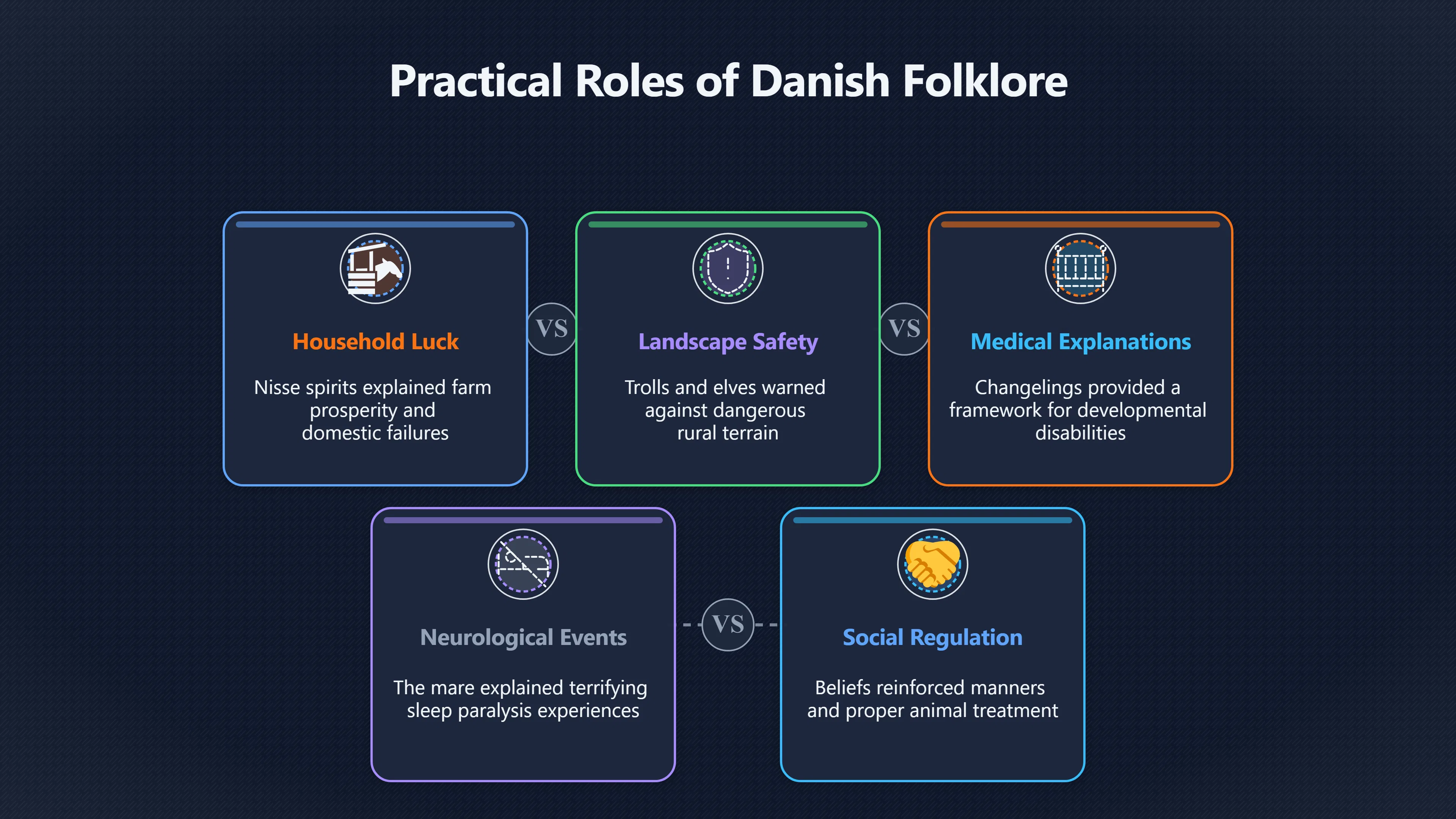
- Household spirits explained luck, prosperity and unexpected domestic failures.
- Hidden folk and changelings helped communities interpret childhood illness, disability and family tragedy.
- Trolls and elves attached danger to particular landscapes, encouraging caution and respect.
- The mare transformed a frightening neurological experience into a shared cultural story.
These explanations often survived because they worked socially. They gave communities common language for discussing fear, encouraged behaviour considered responsible and provided narratives that could be passed between generations.
Why hidden beings remain part of Denmark’s strange history
Modern Danes generally encounter the nisse as a cheerful Christmas figure rather than an unpredictable farm spirit, while trolls and elves have become familiar characters in literature, tourism and fantasy. Yet beneath these later adaptations lie older traditions rooted in everyday experience.
For anyone interested in Denmark’s strange history, these beings illustrate an important principle: many of the country’s most enduring supernatural traditions were never attempts to explain spectacular miracles. Instead, they addressed ordinary mysteries—the child who changed, the horse found exhausted, the inexplicable run of bad luck, or the terrifying inability to move after waking.
That practical role helps explain their longevity. Even after science replaced the supernatural explanations, the stories endured because they preserved something equally valuable: a record of how ordinary people once made sense of an uncertain world.[Wikipedia]WikipediaDanish folkloreDanish folklore
Amazon book picks
Further Reading
Books and field guides related to What Did Denmark's Hidden Beings Explain?. Use these as the next step if you want deeper reading beyond the article.

Scandinavian folk belief and legend
Directly addresses elves, trolls, household spirits and folk belief.


Fairies: A Guide to the Celtic Fair Folk
Useful comparative reading on hidden beings and folklore.
eBay marketplace picks
Marketplace Samples
Live-tested eBay searches with available results related to this page.
Endnotes
1.
Source: Wikipedia
Title: Danish folklore
Link:https://en.wikipedia.org/wiki/Danish_folklore
2.
Source: Wikipedia
Title: Nisse (folklore)
Link:https://en.wikipedia.org/wiki/Nisse_%28folklore%29
3.
Source: Wikipedia
Title: Mare (folklore)
Link:https://en.wikipedia.org/wiki/Mare_%28folklore%29
4.
Source: Wikipedia
Link:https://en.wikipedia.org/wiki/Changeling
5.
Source: sites.pitt.edu
Link:https://sites.pitt.edu/~dash/scanchange.html
Source snippet
Pitt SitesScandinavian Changeling LegendsThe aliens in these legends are not those from outer space, but rather underground people from o...
6.
Source: arxiv.org
Title: arXiv Sleep Paralysis: phenomenology, neurophysiology and treatment
Link:https://arxiv.org/abs/1704.02342
Source snippet
Sleep Paralysis: phenomenology, neurophysiology and treatmentApril 7, 2017...
Published: April 7, 2017
Additional References
7.
Source: youtube.com
Link:https://www.youtube.com/watch?v=vofsx285Ilc
Source snippet
Dr. Mathias Nordvig | Why the Psychologized Interpretation of Norse Mythology is Problematic...
8.
Source: youtube.com
Link:https://www.youtube.com/watch?v=r9W3cRQKWMQ
Source snippet
Valravn: The Monstrous Black Bird of Danish Folklore - Complete Documentary...
9.
Source: visitsweden.com
Title: mythological creatures
Link:https://visitsweden.com/what-to-do/culture-history-and-art/culture/mythological-creatures/
Source snippet
Spirits, trolls, elves and 'näcken' – discover Sweden's...9 May 2025 — Born out of Swedish folklore, a string of otherworldly creatures...
Published: May 2025
10.
Source: bitget.com
Link:https://www.bitget.com/academy/scandinavian-folklor
Source snippet
Scandinavian Folklore Creatures: Norse Mythology &...5 Mar 2026 — Supernatural creatures provided pre-scientific explanations for numero...
11.
Source: youtube.com
Link:https://www.youtube.com/watch?v=ZkfEqdR76WI
Source snippet
ashed children of Eden? Or just more wild Hulderfolk?...
12.
Source: facebook.com
Title: Vaesen Anniversary Edition
Link:https://www.facebook.com/johanegerkranspublic/posts/vaesen-anniversary-edition-spirits-and-monsters-of-scandinavian-folklore-for-all/1438881418039434/
Source snippet
The Vittra, underground folk who live parallel lives beneath the hills. Though...Read more...
13.
Source: facebook.com
Link:https://www.facebook.com/MetalTitansOfficial/posts/a-gorgeously-illustrated-book-in-english-about-the-scandinavian-folklore-a-defin/2623915540969316/
Source snippet
ive work for readers of all ages...
14.
Source: facebook.com
Link:https://www.facebook.com/groups/625436697499583/posts/24847341601549088/
Source snippet
Using Norwegian folklore in a fantasy novel set in the 1340sTo everyone who replied to my questions regarding the names, Tullebuk and Buk...
15.
Source: youtube.com
Title: Helhest Danish Folklore
Link:https://www.youtube.com/watch?v=jEUcZalB1hk
Source snippet
An Old Fashioned Christmas Eve | Norwegian Christmas Story 1843...
16.
Source: youtube.com
Title: Valravn: The Monstrous Black Bird of Danish Folklore
Link:https://www.youtube.com/watch?v=d0tZGla_2_Q
Source snippet
Helhest Danish Folklore...
Topic Tree