Within Marshall Weird
Why Do Bikini and Enewetak Feel Haunted?
The nuclear test legacy gave Bikini and Enewetak a strange afterlife of ghost fleets, radioactive ash and a sea-level concrete tomb.
On this page
- Mushroom clouds and displaced communities
- Ghost fleet, fallout and radioactive ash
- Runit Dome and the afterlife of testing
Page outline Jump by section
Introduction
Bikini and Enewetak Atolls occupy a unique place in the Marshall Islands’ strange history because their eerie reputation does not depend on ghost stories alone. The landscapes themselves were transformed by nuclear testing into places where documented history feels almost surreal: fleets of abandoned warships resting on lagoon floors, islands erased by explosions, white radioactive dust falling like snow across tropical atolls, and a huge concrete dome sealing radioactive waste beside the sea. These are real places shaped by extraordinary events, yet they have acquired the atmosphere of modern legends because the physical traces of the nuclear age remain so visible. Rather than proving anything supernatural, Bikini and Enewetak show how genuine historical trauma can produce landscapes that many visitors describe as haunted in the emotional rather than paranormal sense.[UNESCO World Heritage Centre]whc.unesco.orgUNESCO World Heritage CentreBikini Atoll Nuclear Test SiteAfter the displacement of the local inhabitants, 23 nuclear tests were carried…
Mushroom clouds and displaced communities
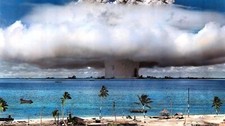
Between 1946 and 1958 the United States carried out 67 nuclear tests in the Marshall Islands. Twenty-three took place at Bikini Atoll, while the remainder were conducted at Enewetak. The islands were chosen because of their remoteness from the continental United States, but they were not empty. Marshallese communities were removed from ancestral homes with assurances that the relocations would be temporary. For many families, those promises were never fulfilled.[unesco.org]whc.unesco.orgUNESCO World Heritage CentreBikini Atoll Nuclear Test SiteAfter the displacement of the local inhabitants, 23 nuclear tests were carried…
This human displacement is central to why the atolls feel so uncanny today. They are not abandoned ruins from an ancient civilisation but inhabited cultural landscapes that were deliberately emptied for military experiments. Empty churches, former village sites and overgrown roads exist alongside blast craters and military remains, creating an unsettling contrast between ordinary island life and extraordinary destruction. UNESCO describes Bikini not simply as a testing ground but as a landscape symbolising both the birth of the nuclear age and the human consequences that followed.[UNESCO World Heritage Centre]whc.unesco.orgUNESCO World Heritage CentreBikini Atoll Nuclear Test SiteAfter the displacement of the local inhabitants, 23 nuclear tests were carried…
The atmosphere has encouraged ghostly interpretations in popular culture. Divers, photographers and journalists often describe Bikini as a “ghost atoll”, but this language is largely metaphorical. The feeling comes from silence, absence and historical memory rather than reports of consistent paranormal experiences.
Ghost fleet, fallout and radioactive ash
Perhaps the most striking image associated with Bikini is its so-called ghost fleet.
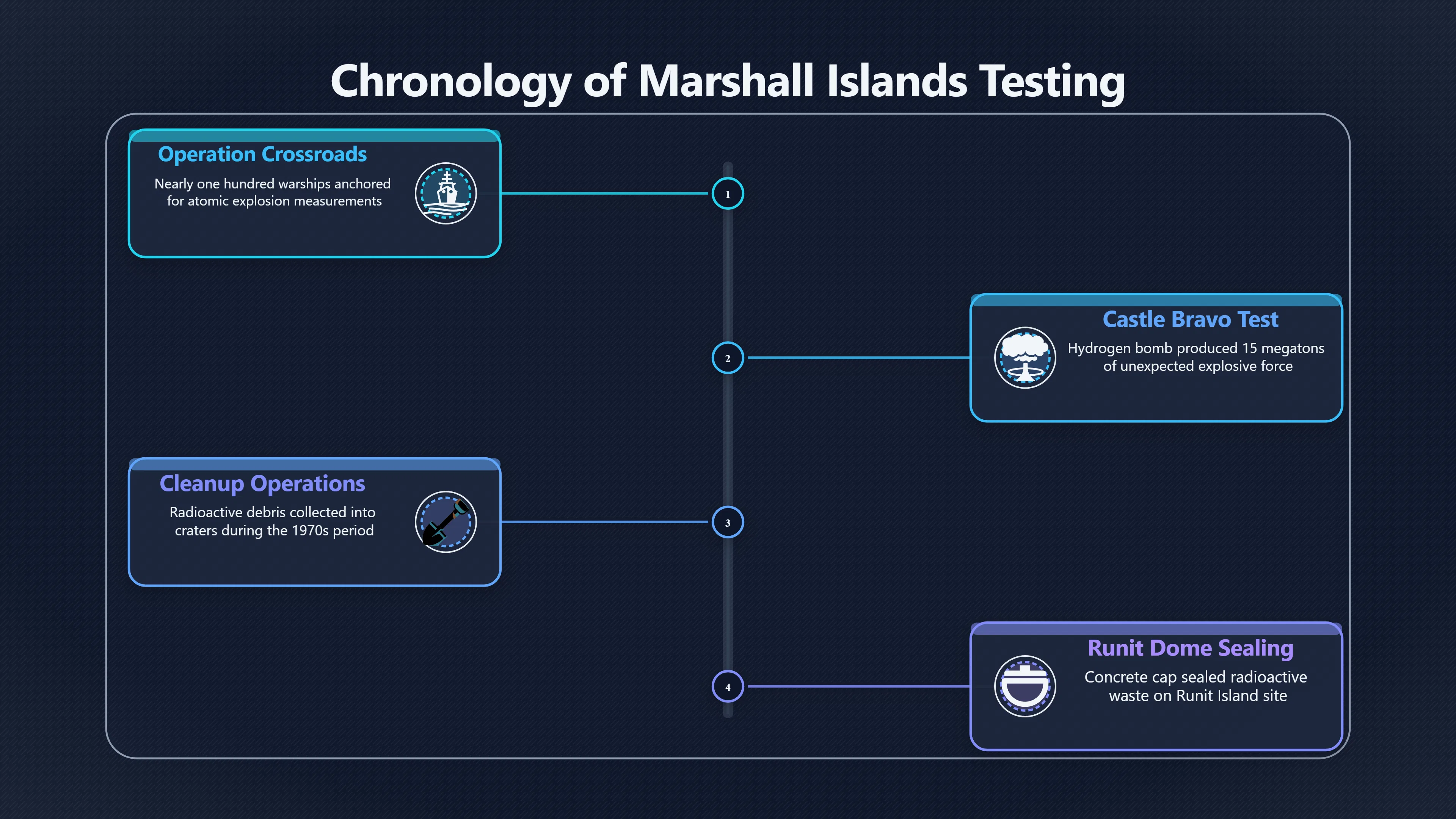
During Operation Crossroads in 1946, nearly one hundred surplus warships were anchored inside Bikini Lagoon so scientists could measure how atomic explosions affected naval vessels. Some ships sank immediately, while others became so contaminated by radiation that they were later scuttled because decontamination proved impossible. Today these battleships, aircraft carriers and submarines lie on the lagoon floor, making Bikini one of the world’s most famous wreck-diving locations.[wikipedia.org]WikipediaOperation CrossroadsOperation Crossroads
The wrecks themselves are entirely explainable, yet they contribute enormously to the atoll’s uncanny reputation. Unlike ordinary shipwrecks caused by storms or warfare, these vessels represent a scientific experiment in which an entire fleet was sacrificed to observe nuclear destruction. Resting in remarkably clear water beneath a lagoon once occupied by island communities, they resemble a submerged museum of the Cold War.
An even stranger image emerged during the Castle Bravo hydrogen bomb test on 1 March 1954. Scientists expected a much smaller explosion, but the device produced around 15 megatons—far exceeding predictions. Pulverised coral mixed with radioactive material drifted through the atmosphere before falling onto nearby islands as fine white particles. Witnesses described the material as resembling snow or ash, an astonishing sight in the tropical Pacific. Children reportedly played in it before anyone understood its danger.[nasa.gov]science.nasa.govNASA ScienceRevisiting Bikini AtollOn March 1, 1954, the U.S. Army detonated a thermonuclear bomb on Bikini Atoll in the Marshall Islands…
The fallout contaminated neighbouring atolls including Rongelap and Utirik. Many residents developed acute radiation sickness before being evacuated. Because the white fallout looked harmless, it has become one of the most haunting images associated with the Marshall Islands: a landscape transformed not by visible fire alone but by an invisible danger disguised as something almost beautiful.[Nuclear Museum]ahf.nuclearmuseum.orgNuclear MuseumMarshall Islands - Atomic Heritage FoundationBetween 1946 and 1958, the United States conducted 67 nuclear tests in the Mar…
This combination of invisible contamination and spectacular imagery explains why nuclear testing entered global folklore. Stories often emphasise glowing islands, poisoned reefs or permanently cursed landscapes. Scientific investigations present a more complex picture. Radiation varies greatly between locations, some areas have undergone extensive clean-up, and ecological recovery has occurred in surprising ways, even while significant contamination remains in soils and some local foods. The reality is neither simple apocalypse nor complete recovery.[wikipedia.org]WikipediaNuclear testing at Bikini AtollNuclear testing at Bikini Atoll

Runit Dome and the afterlife of testing
If Bikini represents the explosive beginning of the nuclear age, Enewetak’s Runit Dome symbolises its unfinished ending.
Following clean-up operations during the 1970s, radioactive debris from Enewetak was collected into a large crater on Runit Island and sealed beneath a concrete cap roughly 115 metres across. Locally it is often called “The Tomb”, a nickname that captures both its appearance and the uneasy symbolism attached to it.[Wikipedia]WikipediaRunit IslandRunit Island
The dome has become one of the world’s most recognisable nuclear landmarks because it appears simultaneously permanent and fragile. Built only slightly above sea level, it sits in an environment threatened by erosion, rising seas and increasingly severe storms. News reports frequently portray it as though it could suddenly release vast quantities of radioactive material into the Pacific.
The scientific assessment is more nuanced. Researchers and officials have noted legitimate concerns about ageing concrete and long-term environmental risks. However, they also point out that surrounding lagoon sediments already contain substantial radioactive contamination left by the original tests. In other words, the dome is not the sole source of contamination; it functions primarily as a containment structure within an environment already altered by nuclear explosions.[Wikipedia]WikipediaEnewetak AtollEnewetak Atoll
That distinction is often lost in dramatic retellings. As a result, the dome has acquired an almost mythical status in documentaries and online discussions, where it is sometimes described as a “cracking nuclear coffin” or an impending environmental catastrophe. The genuine engineering and environmental questions are serious enough without exaggeration, and the structure remains a powerful reminder that the legacy of atmospheric nuclear testing extends far beyond the explosions themselves.
Why these atolls remain part of Fortean history
Bikini and Enewetak illustrate an unusual category of Fortean landscape. Their power comes not from uncertain evidence but from documented events so extreme that they resemble science fiction.
Several factors reinforce this reputation:
- Entire communities were displaced from ancestral islands that remain culturally significant.
- Islands were physically erased or radically reshaped by explosions.
- Tropical skies produced towering mushroom clouds visible for extraordinary distances.
- Radioactive fallout appeared as harmless-looking white dust in places where snow does not exist.
- Dozens of warships still rest beneath the lagoon as an underwater “ghost fleet”.
- A massive concrete radioactive repository remains exposed on a low coral island.
Unlike classic haunted locations, the mystery here lies less in unexplained phenomena than in the psychological effect of confronting landscapes where ordinary expectations no longer apply. The silence of abandoned villages, submerged fleets and visible remnants of Cold War engineering encourage reflection on absence, memory and environmental change.
For the Marshall Islands, these atolls have become enduring symbols of how historical reality can produce places every bit as unsettling as folklore. Their strange reputation survives because visitors encounter tangible evidence of events that once seemed almost unimaginable, and because the consequences of those events continue to shape both the physical landscape and the cultural memory of the islands.[unesco.org]whc.unesco.orgUNESCO World Heritage CentreBikini Atoll Nuclear Test SiteAfter the displacement of the local inhabitants, 23 nuclear tests were carried…
Amazon book picks
Further Reading
Books and field guides related to Why Do Bikini and Enewetak Feel Haunted?. Use these as the next step if you want deeper reading beyond the article.
Command and Control
Provides essential context for nuclear testing and its consequences.

Atomic Accidents : A History of Nuclear Meltdowns and Disasters
First published 2014. Subjects: Disasters, Nuclear reactor accidents.
The Pacific
First published 1991. Subjects: Pacific ocean, description and travel, Social conditions, History.

Before the fallout
First published 1998. Subjects: Social aspects, Science, Moral and ethical aspects, Atomic bomb, History.
eBay marketplace picks
Marketplace Samples
Live-tested eBay searches with available results related to this page.

Endnotes
1.
Source: whc.unesco.org
Link:https://whc.unesco.org/en/list/1339/
Source snippet
UNESCO World Heritage CentreBikini Atoll Nuclear Test SiteAfter the displacement of the local inhabitants, 23 nuclear tests were carried...
2.
Source: Wikipedia
Title: Operation Crossroads
Link:https://en.wikipedia.org/wiki/Operation_Crossroads
3.
Source: science.nasa.gov
Link:https://science.nasa.gov/earth/earth-observatory/revisiting-bikini-atoll-83237/
Source snippet
NASA ScienceRevisiting Bikini AtollOn March 1, 1954, the U.S. Army detonated a thermonuclear bomb on Bikini Atoll in the Marshall Islands...
Published: March 1, 1954
4.
Source: Wikipedia
Title: Nuclear testing at Bikini Atoll
Link:https://en.wikipedia.org/wiki/Nuclear_testing_at_Bikini_Atoll
5.
Source: Wikipedia
Title: Runit Island
Link:https://en.wikipedia.org/wiki/Runit_Island
6.
Source: Wikipedia
Title: Enewetak Atoll
Link:https://en.wikipedia.org/wiki/Enewetak_Atoll
7.
Source: Wikipedia
Title: Bikini Atoll
Link:https://en.wikipedia.org/wiki/Bikini_Atoll
Source snippet
Bikini AtollAfter the Second World War, the atoll was chosen by the United States as a nuclear weapon testing site. The 167 people who...
8.
Source: history.com
Title: 7 Surprising Facts about Nuclear Bomb Tests at Bikini Atoll
Link:https://www.history.com/articles/nuclear-bomb-tests-bikini-atoll-facts
Source snippet
A target fleet of 95 ships was positioned in Bikini Atoll's lagoon, with laboratory animals—pigs, goats...Read more...
9.
Source: ahf.nuclearmuseum.org
Link:https://ahf.nuclearmuseum.org/ahf/location/marshall-islands/
Source snippet
Nuclear MuseumMarshall Islands - Atomic Heritage FoundationBetween 1946 and 1958, the United States conducted 67 nuclear tests in the Mar...
Additional References
10.
Source: thedirtydozenexpeditions.com
Link:https://thedirtydozenexpeditions.com/bikini-atoll-wrecks
Source snippet
Bikini Atoll WrecksNow, from the misery and destruction wrought by the nuclear tests, Bikini's nuclear ghost fleet has risen as the world...
11.
Source: sail-world.com
Link:https://www.sail-world.com/-73232/
Source snippet
Between 1946 and 1954, 67 nuclear test were carried out in the...Read more...
12.
Source: pubmed.ncbi.nlm.nih.gov
Link:https://pubmed.ncbi.nlm.nih.gov/9199216/
Source snippet
recollections and views of elders of Bikini Atollby J Niedenthal · 1997 · Cited by 67 — The people of Bikini Atoll were moved from their...
13.
Source: youtube.com
Title: Bikini Atoll: Into The Atomic Abyss
Link:https://www.youtube.com/watch?v=OTAQfg0M7H0
Source snippet
The documentary Bikini Atoll: The Atomic Ship Graveyard is highly relevant as it explores the underwater landscape of abandoned target ve...
14.
Source: bikiniatoll.info
Title: Enewetak Atoll History
Link:https://www.bikiniatoll.info/history-of-enewetak/
Source snippet
The first hydrogen bomb test, code-named Ivy Mike, occurred in late 1952 as part of Operation Ivy; it...Read more...
15.
Source: downwinders.com
Link:https://www.downwinders.com/2025/02/07/bikini-atoll-in-the-marshall-islands-nuclear-tests-and-their-impact/
Source snippet
Bikini Atoll in the Marshall Islands: Nuclear Tests and Their...Feb 7, 2025 — Located in the Pacific Ocean, its once-pristine islands be...
16.
Source: youtube.com
Link:https://www.youtube.com/watch?v=x_GbII6cmhs
Source snippet
Bikini Atoll: From Paradise to Nuclear Wasteland I SLICE...July, 1946. Bikini. It was the first of 23 nuclear tests the US government ma...
17.
Source: youtube.com
Title: Parts of the Marshall Islands just as radioactive as Chernobyl and Fukushima
Link:https://www.youtube.com/watch?v=PyhZcWy1Ero
Source snippet
The Cove - Australian Army...
18.
Source: youtube.com
Title: Sea Gypsies: The Plutonium Dome (Runit Dome Marshall Islands)
Link:https://www.youtube.com/watch?v=0kbw7fpG9dA
Source snippet
Bikini Atoll: The Atomic Ship Graveyard...
19.
Source: youtube.com
Title: The Forgotten Nuclear War
Link:https://www.youtube.com/watch?v=NjqoiT-RS4A
Source snippet
The Cove - Australian Army...
Topic Tree