Within Weird Bulgaria
What Did Bulgaria's Vampire Graves Really Show?
Iron rods, ploughshares and altered graves turn Bulgarian vampire belief into a physical record of social anxiety around the dead.
On this page
- Sozopol and the pierced medieval skeletons
- Perperikon, ploughshares and repeated burial patterns
- Belief, scapegoating and sceptical explanations
Page outline Jump by section
Introduction
Bulgaria’s so-called “vampire graves” are among the country’s most famous archaeological discoveries, but they are often misunderstood. Archaeologists have not uncovered evidence that medieval people were actually turning into vampires. What they have found is something arguably more revealing: physical traces of how communities tried to protect themselves from the feared return of certain dead individuals. Iron rods driven through chests, heavy stones placed on bodies, severed limbs and other unusual burial treatments provide rare archaeological evidence of beliefs that usually survive only in folklore.
These discoveries matter because they connect stories about vampires with excavated human remains rather than later literary fiction. They reveal how fear, religion, local custom and social judgement could shape the treatment of the dead, leaving a record that can still be studied centuries later. The graves also demonstrate the need for caution. While newspapers quickly dubbed them “vampire burials”, archaeologists generally interpret them as evidence of anti-vampire rituals—that is, preventive measures carried out by the living rather than proof of supernatural events.[World Archaeology]world-archaeology.comvampires slayers and false accusationsThere are two types of vampire in this world: the fictional variety – handsome, debonair, usually wears a silk…Read more…
What Did Bulgaria’s Vampire Graves Really Show?
The striking feature shared by Bulgaria’s best-known “vampire” burials is deliberate post-mortem intervention. These were not ordinary funerals. The bodies had been modified in ways intended to prevent the deceased from returning.
Across medieval Bulgaria, archaeologists have identified around one hundred burials displaying practices associated with anti-vampire belief, although the exact number varies as new discoveries are made and individual cases are reassessed. These include skeletons pinned with iron objects, weighed down with stones, buried with bricks placed in the mouth, or otherwise altered after death. Importantly, no single treatment defines a vampire burial. Instead, archaeologists recognise a family of practices linked by a common concern: preventing an unsettling dead person from troubling the living.[Oxbow Books]oxbowbooks.comthe archaeology of vampiresOxbow BooksThe Archaeology Of Vampires31 Oct 2016 — In Bulgaria, which is home to around 100 'known vampire' burials, skeletons have even…
Unlike the elegant aristocratic vampires of nineteenth-century fiction, the medieval fear was practical rather than romantic. The danger lay not in seductive immortality but in the possibility that a disturbed or morally suspect corpse might return to spread disease, misfortune or unrest.
Sozopol and the pierced medieval skeletons
The discovery that brought Bulgaria’s vampire burials to worldwide attention came in 2012 during excavations at the medieval church of St Nicholas in the Black Sea town of Sozopol.
Archaeologists uncovered two medieval skeletons that had been pierced through the chest with iron implements after burial. One of the men was thought by excavation director Professor Bozhidar Dimitrov to have been an influential local figure, possibly the medieval governor known from historical sources as Krivich, although this identification remains speculative rather than universally accepted. What attracted global attention was not his identity but the iron stake driven through the chest—a measure widely interpreted as an attempt to prevent the dead from rising.[Smithsonian Magazine]smithsonianmag.compirate vampire dug up in bulgaria 131708166In the Black Sea town of Sozopol, a 700-year-old skeleton was found with metal stakes where the man's heart…Read more…
Media reports naturally embraced the word “vampire”, helping turn the discovery into an international sensation. Tourist numbers increased dramatically, museum displays attracted large audiences and Sozopol quickly became associated with medieval vampire folklore. Yet archaeologists consistently framed the find as evidence for historical belief rather than supernatural reality. The skeleton demonstrates that some medieval communities considered certain individuals dangerous even after death and took physical steps to neutralise that perceived threat.[Time]time.comHigh-Stakes Tourism: Vampire Hunters Descend on Bulgaria31 Oct 2013 — Tourist visits to Sozopol's archaeological museum have tripled…
The Sozopol discoveries are especially valuable because they were excavated within a well-documented medieval cemetery rather than appearing as isolated curiosities. Their archaeological context allows researchers to compare them with ordinary burials from the same period and identify which practices were genuinely exceptional.
Perperikon, ploughshares and repeated burial patterns
The ancient hilltop settlement of Perperikon in southern Bulgaria produced another dramatic example in 2013, reinforcing the idea that Sozopol was not an isolated case.
Here archaeologists uncovered a thirteenth-century skeleton with the iron blade of a ploughshare driven through the left side of the chest. The lower part of the left leg had also been removed and placed beside the body. Excavation director Professor Nikolai Ovcharov described the burial as closely resembling the Sozopol example, arguing that both reflected the same protective ritual intended to prevent the deceased from returning.[Archaeology Magazine]archaeology.orgMagazine NewsArchaeology MagazineNews - Medieval “Vampire” Burial Unearthed in BulgariaOctober 10, 2014 — 10 Oct 2014 — SOFIA, BULGARIA—A thirteenth-c…
Subsequent excavations at Perperikon uncovered additional graves interpreted as possible anti-vampire burials, suggesting that such practices may have been repeated over generations rather than representing a single extraordinary event.[BNR News]bnrnews.bgarchaeologists discover a second vampire grave in the necropolis of perperikonThe skeleton discovered had a metal ploughshare driven into the left side of the body. At that time…Read more…
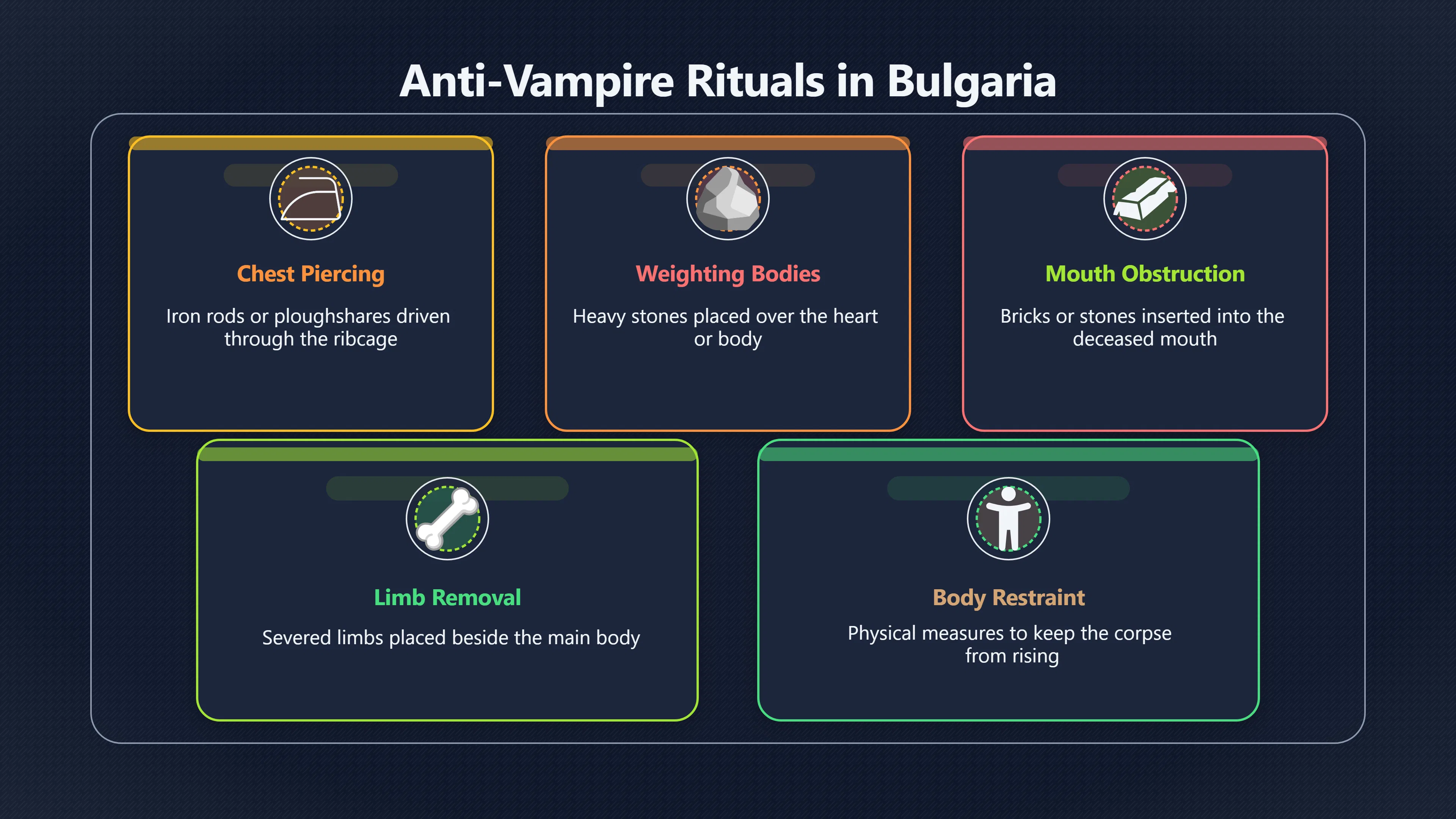
These finds are important because they reveal recurring patterns rather than random violence. Archaeologists have documented several methods that appear repeatedly across Bulgaria:
- Iron rods or ploughshares driven through the chest.
- Heavy stones placed over the body or heart.
- Limbs deliberately removed or repositioned.
- Bricks or stones inserted into the mouth.
- Bodies restrained or weighted within the grave.
Not every unusual burial automatically represents vampire belief. Some modifications may reflect punishment, judicial execution, epidemic response or other local customs. The significance lies in repeated combinations of practices that correspond closely with historical accounts of preventing the dangerous dead from returning.[Academia]academia.eduTime to Slay Vampire Burials?The Archaeological and…Excavations reveal at least 100 vampire-related burials in Bulgaria, often involving brutal treatments of the d…

Why were some people feared after death?
The archaeological evidence raises an obvious question: why were only certain individuals treated this way?
Historical folklore from the Balkans suggests that not everyone faced suspicion. Particular concern often surrounded people believed to have lived unusual or morally troubling lives, individuals accused of sorcery, social outsiders, those who died violently, or people whose deaths coincided with unexplained misfortune. In some traditions, an improperly conducted funeral or unusual physical appearance could also contribute to fears that the deceased might become dangerous after death.[Academia]academia.eduTime to Slay Vampire Burials?The Archaeological and…Excavations reveal at least 100 vampire-related burials in Bulgaria, often involving brutal treatments of the d…
From an archaeological perspective, however, identifying precisely why a specific individual received an anti-vampire burial is extremely difficult. Skeletons rarely preserve evidence of social reputation. Archaeologists therefore rely on combining physical evidence with folklore, historical documents and comparisons across multiple sites rather than assuming every treated skeleton belonged to a notorious “vampire”.
This uncertainty is important. A stake through the chest tells us that somebody feared the dead person. It does not tell us exactly why.
Belief, scapegoating and sceptical explanations
Modern researchers generally interpret Bulgaria’s vampire burials as evidence of social anxiety rather than encounters with supernatural beings.
Several overlapping explanations have been proposed.
Fear of disease. Before modern medicine, unexplained illness could devastate villages. Communities sometimes connected repeated deaths with the restless dead rather than invisible infection.
Managing social tension. Individuals viewed as troublesome, foreign, criminal or otherwise marginal could continue to attract suspicion after death. Extraordinary burial rites may have expressed collective fear or served as symbolic reassurance.
Religious and folkloric tradition. Medieval Christian practice existed alongside older local beliefs about spirits, improper death and dangerous corpses. Anti-vampire rituals may represent an accommodation between these overlapping worldviews rather than a contradiction between them.
Archaeological caution. Specialists also warn against labelling every deviant burial as a vampire grave. Similar practices appear elsewhere in Europe for reasons including execution, punishment or local funerary customs. The physical evidence must always be interpreted within its archaeological context rather than through folklore alone.[Academia]academia.eduTime to Slay Vampire Burials?The Archaeological and…Excavations reveal at least 100 vampire-related burials in Bulgaria, often involving brutal treatments of the d…
Why the graves still fascinate
Bulgaria’s vampire burials occupy an unusual place where archaeology, folklore and popular culture intersect. Unlike fictional vampires inspired by nineteenth-century literature and later cinema, these discoveries reveal what ordinary medieval communities actually did when confronted with fears about the dead.
The iron rods, ploughshares and altered skeletons are therefore valuable not because they prove vampires existed, but because they preserve a material record of belief. Fear left marks in the ground. Centuries later, those marks allow archaeologists to reconstruct how medieval people responded to uncertainty, illness, reputation and death.
That combination of dramatic imagery and careful archaeological evidence explains why Bulgaria’s vampire graves continue to attract worldwide attention. They remind us that folklore is not always confined to stories. Sometimes it survives as iron driven into bone, waiting beneath the soil for centuries until excavation reveals how seriously past communities took the possibility that the dead might not stay dead.[World Archaeology]world-archaeology.comvampires slayers and false accusationsThere are two types of vampire in this world: the fictional variety – handsome, debonair, usually wears a silk…Read more…

eBay marketplace picks
Marketplace Samples
Live-tested eBay searches with available results related to this page.
Endnotes
1.
Source: world-archaeology.com
Title: vampires slayers and false accusations
Link:https://www.world-archaeology.com/world/europe/bulgaria/vampires-slayers-and-false-accusations/
Source snippet
There are two types of vampire in this world: the fictional variety – handsome, debonair, usually wears a silk...Read more...
2.
Source: academia.edu
Title: Time to Slay Vampire Burials?
Link:https://www.academia.edu/8854480/Time_to_Slay_Vampire_Burials_The_Archaeological_and_Historical_Evidence_for_Vampires_in_Europe
Source snippet
The Archaeological and...Excavations reveal at least 100 vampire-related burials in Bulgaria, often involving brutal treatments of the d...
3.
Source: time.com
Link:https://time.com/archive/7148224/high-stakes-tourism-vampire-hunters-descend-on-bulgaria/
Source snippet
High-Stakes Tourism: Vampire Hunters Descend on Bulgaria31 Oct 2013 — Tourist visits to Sozopol's archaeological museum have tripled...
4.
Source: archaeology.org
Title: Magazine News
Link:https://archaeology.org/news/2014/10/10/141010-bulgaria-perperikon-vampire/
Source snippet
Archaeology MagazineNews - Medieval “Vampire” Burial Unearthed in BulgariaOctober 10, 2014 — 10 Oct 2014 — SOFIA, BULGARIA—A thirteenth-c...
Published: October 10, 2014
5.
Source: academia.edu
Title: Figure 1
Link:https://www.academia.edu/figures/2031038/figure-1-the-burial-from-sozopol-bulgaria-with-heavy
Source snippet
from Time to Slay Vampire Burials? TheThe burial from Sozopol, Bulgaria, Burial with stones around the throat. a feature of excavated ske...
6.
Source: oxbowbooks.com
Title: the archaeology of vampires
Link:https://www.oxbowbooks.com/blog/2016/10/31/the-archaeology-of-vampires/
Source snippet
Oxbow BooksThe Archaeology Of Vampires31 Oct 2016 — In Bulgaria, which is home to around 100 'known vampire' burials, skeletons have even...
7.
Source: smithsonianmag.com
Title: pirate vampire dug up in bulgaria 131708166
Link:https://www.smithsonianmag.com/smart-news/pirate-vampire-dug-up-in-bulgaria-131708166/
Source snippet
In the Black Sea town of Sozopol, a 700-year-old skeleton was found with metal stakes where the man's heart...Read more...
8.
Source: bnrnews.bg
Title: archaeologists discover a second vampire grave in the necropolis of perperikon
Link:https://bnrnews.bg/en/post/116698/archaeologists-discover-a-second-vampire-grave-in-the-necropolis-of-perperikon
Source snippet
The skeleton discovered had a metal ploughshare driven into the left side of the body. At that time...Read more...
9.
Source: smithsonianmag.com
Title: vampire grave bulgaria holds skeleton stake through its heart 180953004
Link:https://www.smithsonianmag.com/smart-news/vampire-grave-bulgaria-holds-skeleton-stake-through-its-heart-180953004/
Source snippet
"Vampire Grave" in Bulgaria Holds a Skeleton With a Stake...13 Oct 2014 — Archeologists in Bulgaria haved uncovered a 13th century stake...
Additional References
10.
Source: bntnews.bg
Link:https://bntnews.bg/news/bulgarian-archaeologists-uncover-39vampire-39-burial-at-perperikon-see-pics-1302978news.html
Source snippet
Bulgarian archaeologists uncover 'vampire' burial at...22 Oct 2024 — In 2013, a grave of a "vampire" was discovered at Perperikon, and t...
11.
Source: youtube.com
Link:https://www.youtube.com/watch?v=PI5t1iLUdgI
Source snippet
The Gruesome Truth About Vampire BurialsAcross Europe, archaeologists have uncovered mysterious graves — skeletons buried with stakes thr...
12.
Source: kathyreichs.com
Link:https://kathyreichs.com/vampire-grave-in-bulgaria-holds-a-skeleton-with-a-stake-through-its-heart/
Source snippet
An iron rod had been hammered through his chest “to keep the corpse from rising from the dead and...Read more...
13.
Source: sofiaglobe.com
Title: bulgarian archaeologists find twin of sozopol vampire at perperikon
Link:https://sofiaglobe.com/2013/09/02/bulgarian-archaeologists-find-twin-of-sozopol-vampire-at-perperikon/
Source snippet
The Sofia GlobeBulgarian archaeologists find 'twin' of Sozopol 'vampire' at...2 Sept 2013 — “I say that he is almost a 'twin' of the Soz...
14.
Source: apcz.umk.pl
Title: Of 574 skeletons, 299 indicate pathological lesions
Link:https://apcz.umk.pl/AHP/article/view/42193
Source snippet
multidisciplinary study of anti-vampire burials from early...by M Matczak · 2021 · Cited by 4 — The research allowed the identification...
15.
Source: researchgate.net
Title: Of 574 skeletons, 299 indicate pathological
Link:https://www.researchgate.net/publication/366231907_multidisciplinary_study_of_anti-vampire_burials_from_early_medieval_Culmen_Poland_were_the_diseased_and_disabled_regarded_as_vampires
Source snippet
multidisciplinary study of anti-vampire burials from early...15 Jun 2026 — The research allowed the identification of 13 antivampire gra...
16.
Source: novinite.com
Link:https://www.novinite.com/articles/163986/%27Vampire%27%2BBurial%2BUncovered%2BIn%2BPerperikon
Source snippet
'Vampire' Burial Uncovered In Perperikon10 Oct 2014 — Grave of a young man on whom was performed an anti-vampire ritual was uncovered at...
17.
Source: exutopia.com
Link:https://www.exutopia.com/exclusion-zone/bulgaria-sozopol-vampire/
Source snippet
Bulgaria's 'Sozopol Vampire' - Ex Utopia3 Feb 2016 — Most recently: the discovery of several vampire skeletons near the seaside town of S...
18.
Source: theweek.com
Title: unearthed bulgarian vampire skeletons
Link:https://theweek.com/articles/474918/unearthed-bulgarian-vampire-skeletons
Source snippet
Unearthed: Bulgarian 'vampire' skeletons8 Jan 2015 — Archaeologists in the Bulgarian Black Sea town of Sozopol unearthed two 800-year-old...
19.
Source: facebook.com
Link:https://www.facebook.com/groups/ancientcivilizations.st/posts/1343149973328374/
Source snippet
Medieval vampire burials in Sozopol, BulgariaThe "Vampire" burials of Sozopol, Bulgaria, date back to the medieval period, roughly betwee...
Topic Tree