Within Madagascar Weird
Was Madagascar's Man Eating Tree Ever Real?
The man-eating tree story shows how Victorian journalism turned Madagascar's real biodiversity into a fake botanical nightmare.
On this page
- The 1874 newspaper story
- Why the evidence collapses
- What the hoax reveals
Page outline Jump by section
Introduction
Was Madagascar’s man-eating tree ever real? The short answer is no. The famous story of a gigantic carnivorous tree that supposedly devoured human sacrifices is one of the best-known newspaper hoaxes of the Victorian era. Although presented as a genuine report from Madagascar in 1874, the tale collapses under even modest scrutiny: the supposed explorer cannot be verified, the named tribe appears to have been invented, no botanical evidence has ever emerged, and later investigations traced the story back to sensational journalism rather than field observation. Yet the hoax remains historically important because it shaped how generations of readers imagined Madagascar—as a place where even the plants were monstrous. Rather than revealing an unknown species, the legend reveals how colonial-era media transformed genuine biological wonder into exotic horror.[Royal Botanical Gardens]rbg.caRoyal Botanical GardensBotanicult Fiction: The Man-eating Tree of MadagascarJune 23, 2020 — 23 Jun 2020 — There Leche had encountered the…

The 1874 newspaper story
The legend first entered public view in April 1874 when the New York World published an article attributed to journalist Edmund Spencer. The report claimed that a German explorer named Karl Leche had written from Madagascar describing an extraordinary botanical discovery. According to the article, Leche encountered the supposedly isolated “Mkodo” people, who worshipped a gigantic carnivorous plant known as Crinoida Dajeeana.[Royal Botanical Gardens]rbg.caRoyal Botanical GardensBotanicult Fiction: The Man-eating Tree of MadagascarJune 23, 2020 — 23 Jun 2020 — There Leche had encountered the…
The account described the plant as resembling an enormous pineapple topped with long, muscular leaves and writhing tendrils. During an alleged ritual, a young woman was forced onto the tree and made to drink an intoxicating liquid before the leaves and vine-like appendages wrapped around her, crushed her and absorbed her remains. The lurid description was written in the style of an eyewitness adventure, blending botanical language with gothic horror to maximise its impact.[Wikipedia]WikipediaMan-eating plantMan-eating plant
Victorian newspapers eagerly reprinted the story across Britain, Australia and elsewhere. Because readers already knew that some plants could trap insects, the leap to a much larger carnivorous plant seemed astonishing rather than impossible. Madagascar’s reputation as a distant, little-known island added further credibility in the minds of many readers.[Royal Botanical Gardens]rbg.caRoyal Botanical GardensBotanicult Fiction: The Man-eating Tree of MadagascarJune 23, 2020 — 23 Jun 2020 — There Leche had encountered the…
Why the evidence collapses
The story begins to unravel almost immediately once its individual claims are examined.
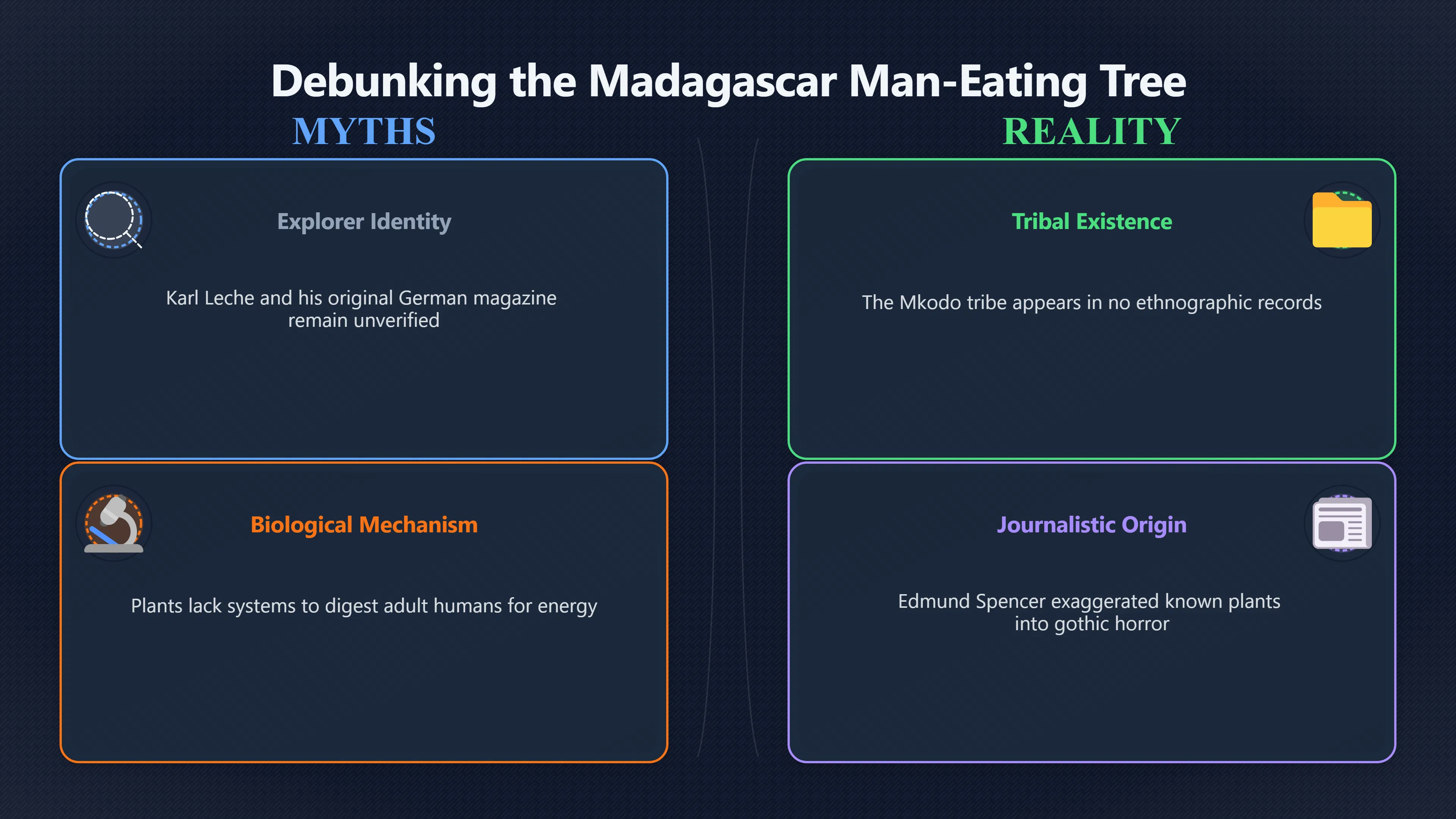
No reliable evidence has ever been found for Karl Leche as the explorer described in the article. Likewise, historians have been unable to identify the magazine that supposedly published his original account in Germany. The “Mkodo” tribe also appears nowhere in serious ethnographic studies of Madagascar, despite extensive missionary, linguistic and anthropological records from the nineteenth century.[Wikipedia]WikipediaMan-eating plantMan-eating plant
Botanically, the tale is equally implausible. Carnivorous plants certainly exist, but they capture insects and, in a few exceptional cases, small vertebrates such as frogs or rodents. There is no known biological mechanism by which a stationary plant could repeatedly capture, digest and sustain itself on adult humans. The enormous energy required would vastly exceed any benefit gained from such rare prey.[Wikipedia]WikipediaMan-eating plantMan-eating plant
By the late nineteenth century the story had effectively been exposed as fiction. Later publications identified Edmund Spencer as the author and explained that he had exaggerated the behaviour of known carnivorous plants into a sensational horror story. The revelation, however, never achieved the same circulation as the original article, allowing the legend to survive.[The Garden History Blog]thegardenhistory.blogdarwin and the man eating tree of madagascarKarl Leche, Dr. Omelius Friedlowski, the Mkodi tribe…Read more…
Why so many people believed it
The hoax appeared at precisely the right historical moment.
In the 1870s, public fascination with carnivorous plants was growing rapidly. Scientific research had recently demonstrated that species such as Venus flytraps and sundews genuinely captured animal prey, challenging older assumptions that plants were passive organisms. For readers unfamiliar with the limits of these discoveries, a giant flesh-eating plant seemed like a dramatic—but conceivable—extension of real science.[Wikipedia]WikipediaMan-eating plantMan-eating plant
At the same time, Madagascar occupied a special place in the European imagination. Much of the island remained poorly understood by Western audiences, while reports of unusual animals, unfamiliar landscapes and isolated communities encouraged publishers to market it as a land of marvels. The fabricated tree exploited exactly this appetite for exotic discoveries.[Royal Botanical Gardens]rbg.caRoyal Botanical GardensBotanicult Fiction: The Man-eating Tree of MadagascarJune 23, 2020 — 23 Jun 2020 — There Leche had encountered the…
The article also relied on colonial stereotypes. Its fictional tribe was portrayed as primitive and bloodthirsty, reinforcing prejudices that distant peoples practised bizarre rituals beyond the reach of civilisation. Modern historians have argued that these invented details helped the story spread because they matched expectations already held by many readers rather than challenging them.[Royal Botanical Gardens]rbg.caRoyal Botanical GardensBotanicult Fiction: The Man-eating Tree of MadagascarJune 23, 2020 — 23 Jun 2020 — There Leche had encountered the…
How the legend refused to die
Exposure did not end the story.
Travel books, magazines and newspapers repeatedly recycled the tale over the following decades, often omitting the doubts that had already emerged. One of the most influential revivals came in 1924 with Chase Salmon Osborn’s Madagascar: Land of the Man-Eating Tree. Although Osborn admitted he had never seen such a plant, the striking title ensured that the legend reached another generation of readers.[Encyclopedia]encyclopedia.pubMan-Eating Plant | Encyclopedia MDPINovember 17, 2022 — 17 Nov 2022 — The hoax was given further publicity by Madagascar: Lan…
The story even inspired reported attempts to organise expeditions in the early twentieth century to search for the mysterious plant. None found any evidence whatsoever, but each new search helped keep the legend alive by implying there might still be something waiting to be discovered in Madagascar’s forests.[Royal Botanical Gardens]rbg.caRoyal Botanical GardensBotanicult Fiction: The Man-eating Tree of MadagascarJune 23, 2020 — 23 Jun 2020 — There Leche had encountered the…
Meanwhile, the idea escaped into popular culture. Fictional man-eating plants became recurring features in adventure novels, pulp magazines, horror stories and eventually cinema. Although later fictional monsters were rarely placed in Madagascar specifically, the island’s imaginary tree helped establish the entire trope of giant carnivorous plants in modern fantasy and horror.[Wikipedia]WikipediaMan-eating plantMan-eating plant

What the hoax reveals about Madagascar’s strange-history record
The man-eating tree deserves a place in Madagascar’s catalogue of Fortean curiosities not because it points towards an undiscovered organism, but because it demonstrates how myths can be manufactured.
Unlike genuine Malagasy folklore, the legend did not emerge from local oral tradition. Instead, it originated in foreign journalism and reflected Western fears and fantasies far more than Malagasy beliefs. The island’s genuine biodiversity—home to lemurs, baobabs, strange reptiles and remarkable endemic plants—provided enough authenticity that an entirely fictional botanical horror seemed believable to distant audiences.[Royal Botanical Gardens]rbg.caRoyal Botanical GardensBotanicult Fiction: The Man-eating Tree of MadagascarJune 23, 2020 — 23 Jun 2020 — There Leche had encountered the…
The episode also serves as a reminder that nineteenth-century newspaper “discoveries” require careful scrutiny. During an era when communication was slow and verification difficult, colourful adventure stories could circulate globally before anyone had the opportunity to challenge them. Once embedded in popular imagination, they often proved remarkably resistant to correction.
For readers interested in Madagascar’s wider strange history, the man-eating tree is therefore best understood as a case study in media mythology. It illustrates how sensational reporting, colonial attitudes and genuine scientific curiosity combined to create one of the world’s most enduring botanical legends—even though the plant itself never existed.[rbg.ca]rbg.caRoyal Botanical GardensBotanicult Fiction: The Man-eating Tree of MadagascarJune 23, 2020 — 23 Jun 2020 — There Leche had encountered the…
Amazon book picks
Further Reading
Books and field guides related to Was Madagascar's Man-Eating Tree Ever Real?. Use these as the next step if you want deeper reading beyond the article.
Extraordinary Popular Delusions and the Madness of Crowds
Rating: 4.0/5 from 5 Google Books ratings
Explores how sensational stories and hoaxes spread.

The book of barely imagined beings
Shows that real biology can rival invented monsters.
eBay marketplace picks
Marketplace Samples
Live-tested eBay searches with available results related to this page.




Endnotes
1.
Source: Wikipedia
Title: Man-eating plant
Link:https://en.wikipedia.org/wiki/Man-eating_plant
2.
Source: encyclopedia.pub
Link:https://encyclopedia.pub/entry/35098
Source snippet
Man-Eating Plant | Encyclopedia MDPINovember 17, 2022 — 17 Nov 2022 — The hoax was given further publicity by Madagascar: Lan...
Published: November 17, 2022
3.
Source: hoaxes.org
Title: man eating tree of madagascar
Link:https://hoaxes.org/archive/permalink/man_eating_tree_of_madagascar
Source snippet
The Man-Eating Tree of Madagascar (1874)On April 28, 1874, the New York World ran an article announcing the discovery in Madagascar of a...
Published: April 28, 1874
4.
Source: rbg.ca
Link:https://www.rbg.ca/the-man-eating-tree-of-madagascar/
Source snippet
Royal Botanical GardensBotanicult Fiction: The Man-eating Tree of MadagascarJune 23, 2020 — 23 Jun 2020 — There Leche had encountered the...
Published: June 23, 2020
5.
Source: trove.nla.gov.au
Link:https://trove.nla.gov.au/newspaper/article/39810790
Source snippet
nla.gov.au27 Oct 1874 - THE MAN-EATING TREE OF MADAGASCAR.— Karl Leche.' We are not aware that the existence of this re-. markable tree h...
6.
Source: thegardenhistory.blog
Title: darwin and the man eating tree of madagascar
Link:https://thegardenhistory.blog/2024/01/06/darwin-and-the-man-eating-tree-of-madagascar/
Source snippet
Karl Leche, Dr. Omelius Friedlowski, the Mkodi tribe...Read more...
Additional References
7.
Source: sites.smith.edu
Title: man eating trees are a myth update trees dont eat women either
Link:https://sites.smith.edu/fys169-f19/2019/11/27/man-eating-trees-are-a-myth-update-trees-dont-eat-women-either/
Source snippet
smith.eduMan-Eating Trees are a Myth… Update27 Nov 2019 — The article included excerpts from a letter supposedly sent by Karl Leche that...
8.
Source: oriire.com
Title: the man eating tree of madagascar myth or fact
Link:https://oriire.com/article/the-man-eating-tree-of-madagascar-myth-or-fact
Source snippet
The Man-Eating Tree of Madagascar: Myth or Fact?27 May 2026 — The New York World published a story on April 28, 1874, claiming the discov...
Published: April 28, 1874
9.
Source: reddit.com
Link:https://www.reddit.com/r/botany/comments/1pthfth/the_crazy_true_story_of_the_madagascar_maneating/
Source snippet
ver really existed.” Illustration from “Plants That Kill...Read more...
10.
Source: cryptidz.fandom.com
Link:https://cryptidz.fandom.com/wiki/Madagascar_Tree
Source snippet
Cryptid WikiMadagascar Tree - Cryptid Wiki - FandomOn April 28, 1874, the New York World ran an article announcing the discovery in Madag...
Published: April 28, 1874
11.
Source: youtube.com
Title: The tree that eats people | Man Eating Tree
Link:https://www.youtube.com/watch?v=KRcmXSsJ19w
Source snippet
The Man Eating Tree of Madagascar The Man-Eating Tree of Madagascar Crypticc...
12.
Source: youtube.com
Title: The Crazy True Story of the Madagascar Man-Eating Tree
Link:https://www.youtube.com/watch?v=ENX3fDf3T20
Source snippet
Are There Lost Photos of Madagascar's Man-Eating Tree?...
13.
Source: youtube.com
Title: The Man-Eating Tree of Madagascar
Link:https://www.youtube.com/watch?v=WxBOO-KU9C8
Source snippet
The Crazy True Story of the Madagascar Man-Eating Tree...
14.
Source: youtube.com
Title: The Legend Of Man Eating Plants
Link:https://www.youtube.com/watch?v=G4-qBnDeybo
Source snippet
The tree that eats people | Man Eating Tree...
15.
Source: youtube.com
Title: Are There Lost Photos of Madagascar’s Man-Eating Tree?
Link:https://www.youtube.com/watch?v=iGylAh7veDk
Source snippet
The Legend Of Man Eating Plants...
Topic Tree