Where Albania Turns Weather Into Monsters
Albania’s strange-history record is not dominated by a single famous “monster” or world-renowned UFO case.
Page outline Jump by section
The storm monster hiding in plain sight
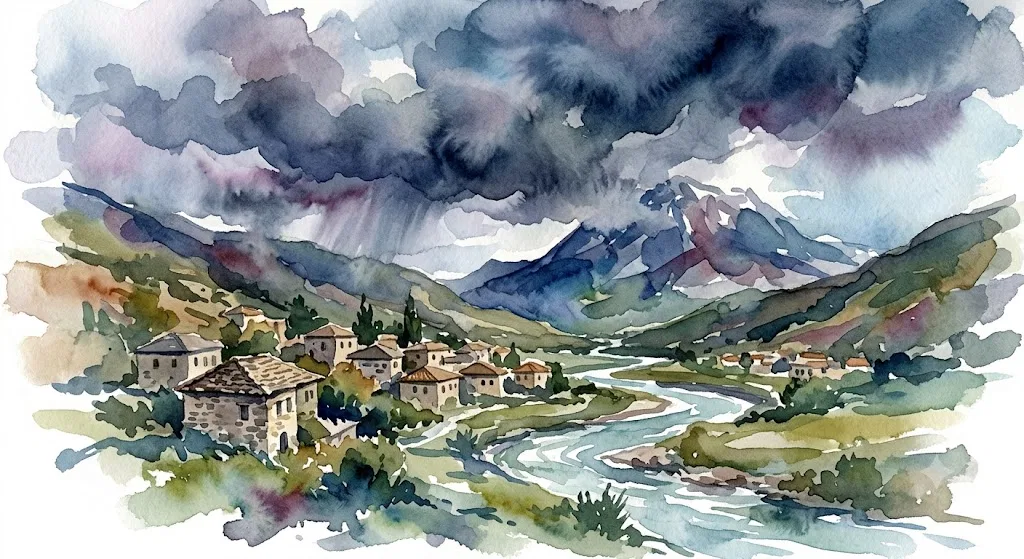
The most powerful Albanian “weird” tradition is not a newspaper oddity but a weather myth. In Albanian belief, the storm can become a supernatural drama between the heroic drangue and the destructive kulshedra, a huge female serpent or dragon associated with storms, drought, floods and disorder. Anthropologist Albert Doja describes the kulshedra as a storm demon, often imagined as a monstrous female being with multiple heads, fire, bad weather and a connection to springs, fountains and blocked waters. The drangue, by contrast, is the figure able to fight her, sometimes with thunderbolts, trees, boulders and even houses torn from their foundations.[UCL Discovery]discovery.ucl.ac.ukUCL Discovery Mythology and destinyUCL Discovery Mythology and destiny
This is classic Fortean territory because it sits between explanation and imagination. A thunderstorm is real; the story gives it intention, combat and personality. In some versions, the signs of the battle are not just clouds and thunder but specific landscapes: boulders in riverbeds, mountain passes, and rivers such as the Drin and Shkumbin become evidence-like scenery for mythic events. Doja records beliefs that placed such battles in northern mountain country and in central Albania near Elbasan, where the kulshedra had to be drowned so she could not return.[UCL Discovery]discovery.ucl.ac.ukUCL Discovery Mythology and destinyUCL Discovery Mythology and destiny
Sceptically, this is not evidence for a literal dragon. It is a richly local way of making sense of violent weather, drought, flood, and dangerous water. Believers and storytellers did not need a modern cryptid hiding in a lake; they had a cosmology in which nature itself could behave like a monstrous opponent. That is why the drangue and kulshedra matter more for Albania’s Forteana than a dozen vague “creature sighting” rumours: they explain how the strange was built into the country’s weather, rivers and mountains.
Witches, vampires and the anxiety of the household
Albanian vampire lore is less familiar internationally than the Serbian, Romanian or Greek strands that fed European vampire literature, but it belongs to the same Balkan world of revenants, witches and household danger. A useful starting point is the shtriga: usually described as a witch-like or vampiric figure associated with harm to children, illness and night-time attack. Edith Durham’s 1923 article “Of Magic, Witches and Vampires in the Balkans” is an important early English-language source for such beliefs, and later summaries of her work note that she recorded defensive practices against witches and vampires during her travels in Albania and neighbouring Balkan areas.[JSTOR]jstor.org121. Of Magic, Witches and Vampires in the Balkans121. Of Magic, Witches and Vampires in the Balkans
Durham’s importance should be handled carefully. She was a remarkable traveller and observer, but she was also writing from the assumptions of her time. Modern readers should not treat her accounts as neutral laboratory evidence of supernatural beings. They are better read as records of beliefs, anxieties and social explanations: why infants died, why livestock sickened, why an unpopular or marginal woman might be suspected, and how communities tried to protect themselves. Her broader reputation as an authority on early twentieth-century Albania is still noted by scholars of travel writing and anthropology, but her work also needs context rather than blind acceptance.[berose.fr]berose.frOpen source on berose.fr.
The weirdness here is intimate rather than spectacular. Albania’s witch-vampire material belongs to doorways, cradles, charms, church thresholds, spitting cures and household suspicion. It is Fortean because it turns ordinary misfortune into a hidden agency, but it is also human because it shows how communities coped with illness and uncertainty before modern medicine and public health could answer every loss.

The house snake that was not just a snake
One of the most distinctive Albanian folk beliefs is the protective household serpent. In Albanian tradition, figures such as the Ora and Vitore can be imagined in serpent form, tied to fate, domestic protection and family luck. Doja’s work on Albanian mythology records that beliefs in protective serpents, whether called Ora, Vitore or the “house snake”, were found across the Albanian cultural zone; he notes the belief that a snake should not be disturbed even in a baby’s cradle because it may be the protective spirit of the house and child.[UCL Discovery]discovery.ucl.ac.ukUCL Discovery Mythology and destinyUCL Discovery Mythology and destiny
This is a useful corrective to the lazy assumption that snakes in folklore are always evil. In Albanian domestic belief, the snake can be guardian, ancestor-sign, luck-bringer and warning system. That does not mean people literally lived comfortably with any reptile in the house; it means the animal occupied a charged symbolic place. A natural explanation can sit beside the folk one: snakes reduce rodents and may appear around warm, food-rich household spaces. The folklore turns that practical cohabitation into a moral rule: do not harm the creature that may be protecting the home.
The same serpent logic helps explain why Albanian dragon and storm myths feel so coherent. Serpents are not random monsters dropped into stories for colour. They run through ideas of ancestry, weather, water, danger, fertility and protection. Albania’s weird record is therefore less a cabinet of isolated oddities than a network of recurring images.
Sacred mountains and living legends
Mount Tomorr is one of Albania’s strongest examples of a landscape where myth, pilgrimage and national memory overlap. Albania’s official tourism site describes Tomorr not merely as a mountain but as a sacred place in Albanian cultural tradition, linked in folk myths to Baba Tomorri, a white-bearded giant who protects the surrounding lands. The same source notes its later association with religious traditions, including Bektashi pilgrimage to honour Abas Ali, especially around 20–25 August.[Faqja Zyrtare e Turizmit]akt.gov.alFaqja Zyrtare e Turizmit Tomorri National ParkFaqja Zyrtare e Turizmit Tomorri National Park
For Fortean readers, Tomorr is interesting because it shows how a “haunted” or “sacred” landscape can survive by changing vocabulary. A pre-Christian or folk sacred mountain can become linked with saints, Bektashi devotion, local oath-taking, national romanticism and tourism without losing its aura. The claim is not that a giant objectively lives on the peak. The point is that Tomorr has long been treated as more than scenery: a place where authority, protection, fear, blessing and identity gather.
This is also where Albania’s strange history avoids a simple sceptic-versus-believer split. A sceptic can reject the literal giant and still recognise the mountain’s cultural power. A pilgrim can understand the landscape through devotion rather than folklore. A visitor can enjoy the “living legend” language while seeing how sacred geography shapes real routes, festivals and memory.
The Blue Eye and the lure of natural mystery
The Blue Eye in southern Albania is not paranormal, but it is exactly the kind of natural feature that attracts mystery language. The official Albanian tourism site describes it as a famous natural monument near Muzinë, about 18 km from Saranda: a karst spring with crystal blue water emerging from more than 45 metres down, creating the optical effect of an eye.[Faqja Zyrtare e Turizmit]akt.gov.alFaqja Zyrtare e Turizmit Blue EyeFaqja Zyrtare e Turizmit Blue Eye
Its Fortean pull is easy to understand. A deep blue “pupil”, cold water rising from below, uncertain depth in popular retellings, and a protected natural setting all invite legend. Travel accounts often embroider the place with stories of dragons or giant serpents, but the best grounded explanation is geological: it is a powerful karst spring whose appearance is dramatic enough to feel designed. The mystery is not “what supernatural thing lives there?” but why certain natural places almost demand supernatural stories.
That distinction matters. Albania has enough genuine folklore that there is no need to overclaim every scenic spring as paranormal. The Blue Eye belongs in the country’s strange-history record because it shows the border between natural wonder and myth-making: the kind of place where the eye sees geology, tourism sees beauty, and folklore sees a watcher under the water.
UFOs and strange lights: thin files, persistent stories
Modern Albanian UFO material exists, but it is much thinner than the folklore record. A KOHA.net article gathers claims about Albanian sightings and rumours, including a reported luminous object over Cërrik, stories associated with Tomorr, and a much older anecdote attributed to Mihal Grameno’s memoirs about a shining object seen by fighters in the mountains. The same article also refers to later press fragments and local testimony, but much of this is second-hand, retrospective or filtered through books and journalism rather than official case files.[KOHA.net]koha.netUFOs in Albania under the surveillance of the State Security since the 60sUFOs in Albania under the surveillance of the State Security since the 60s
That does not make the stories worthless. It means they should be read as reports, not conclusions. Albania’s twentieth-century context matters: military secrecy, Cold War anxiety, isolation, rumours of foreign aircraft, and limited public access to information could all make lights in the sky seem more ominous. A “new type of aircraft” explanation, whether true or merely convenient, fits a state environment where calming the public may have mattered as much as identifying the object.[KOHA.net]koha.netUFOs in Albania under the surveillance of the State Security since the 60sUFOs in Albania under the surveillance of the State Security since the 60s
The strongest sceptical reading is that the Albanian UFO tradition is a mix of misidentified aircraft, military activity, bright astronomical objects, local rumour and the global UFO imagination entering Albanian media. The believer’s reading is that repeated reports across decades suggest something unresolved. The evidence-aware middle position is simpler: Albania has UFO stories, but not a well-documented national case on the level of classic international incidents with multiple independent records, instrument data and sustained investigation.
What is missing from Albania’s Fortean record
A good strange-history page should say what the evidence does not show. Albania does not currently have a robust, well-sourced equivalent of Loch Ness, the Cottingley fairies, the Enfield poltergeist or the best-documented twentieth-century UFO waves. Searches for Albanian “lake monsters”, animal rains and spectacular paranormal cases tend to produce weak, recycled or social-media-heavy material rather than strong archival trails. By contrast, the folklore material is comparatively deep, with named scholars, older travel records, oral-literature collections and living sacred landscapes.
That imbalance is revealing. Albania’s Forteana is strongest when it is read through folklore and cultural memory rather than as a hunt for hard evidence of monsters. Its strangeness belongs to storm dragons, household serpents, mountain guardians, witch-vampire anxieties, sacred peaks and modern rumours shaped by secrecy and media. The country’s weird record is therefore not poor; it is simply different from places whose fame rests on one marketable beast or one famous haunted house.
Why Albania’s strange stories still matter
Albania’s Fortean material matters because it preserves a way of seeing the world as alive with moral and spiritual forces. Storms are not just weather; they are battles. A snake is not just a snake; it may be the house’s luck. A mountain is not just stone; it may be a fatherly protector, a pilgrimage site and a national symbol. A spring is not just hydrology; it becomes an eye. A light in the sky is not just unidentified; it becomes a test of secrecy, fear and imagination.
The most honest reading keeps two ideas together. First, there is no need to present Albania’s dragons, witches, household spirits or UFOs as proven supernatural facts. Second, dismissing them as “just superstition” misses their value. These stories tell us how Albanians explained danger, protected children, honoured place, read the weather, remembered the dead, and negotiated uncertainty. That is the real Fortean richness of Albania: not a solved mystery, but a country where landscape, folklore and strange testimony keep speaking to one another.
Amazon book picks
Further Reading
Books and field guides related to Where Albania Turns Weather Into Monsters. Use these as the next step if you want deeper reading beyond the article.

The Dictionary of Albanian Religion, Mythology and Folk Culture
Covers the myths, monsters and sacred landscapes discussed.


eBay marketplace picks
Marketplace Samples
Live-tested eBay searches with available results related to this page.
Endnotes
1.
Source: archive.org
Link:https://archive.org/details/dictionaryofalba0000elsi
2.
Source: jstor.org
Title: 121. Of Magic, Witches and Vampires in the Balkans
Link:https://www.jstor.org/stable/2788569
3.
Source: berose.fr
Link:https://www.berose.fr/article2600.html
4.
Source: koha.net
Title: UFOs in Albania under the surveillance of the State Security since the 60s
Link:https://www.koha.net/en/lemsh/ufo-t-ne-shqiperi-nen-vezhgimin-e-sigurimit-te-shtetit-qe-ne-vitet-60
5.
Source: elsie.de
Title: Albanian Tales
Link:https://www.elsie.de/pdf/articles/A2008AlbFolktalesGreenwood.pdf
6.
Source: books.elsie.de
Link:https://books.elsie.de/2004-1986/b20.html
7.
Source: books.elsie.de
Link:https://books.elsie.de/b073_albanian-folktales-and-legends/
8.
Source: archive.org
Link:https://archive.org/details/afg4972.0001.001.umich.edu
9.
Source: jstor.org
Link:https://www.jstor.org/stable/i329648
10.
Source: jstor.org
Link:https://www.jstor.org/stable/41857304
11.
Source: jstor.org
Link:https://www.jstor.org/stable/10.2979/histmemo.25.1.77
12.
Source: koha.net
Title: zbulohet misteri i madh pse iliret mbanin gjarper shtepie
Link:https://www.koha.net/en/lemsh/zbulohet-misteri-i-madh-pse-iliret-mbanin-gjarper-shtepie
13.
Source: discovery.ucl.ac.uk
Title: UCL Discovery Mythology and destiny
Link:https://discovery.ucl.ac.uk/18364/1/18364.pdf
14.
Source: akt.gov.al
Title: Faqja Zyrtare e Turizmit Tomorri National Park
Link:https://akt.gov.al/en/natyre/parku-kombetar-i-tomorrit/
15.
Source: akt.gov.al
Title: Faqja Zyrtare e Turizmit Blue Eye
Link:https://akt.gov.al/en/monumente-natyrore/syri-i-kalter/
16.
Source: Wikipedia
Link:https://en.wikipedia.org/wiki/Kulshedra
17.
Source: Wikipedia
Link:https://en.wikipedia.org/wiki/Shtriga
18.
Source: Wikipedia
Link:https://en.wikipedia.org/wiki/Vampire
19.
Source: Wikipedia
Link:https://en.wikipedia.org/wiki/Tomorr
20.
Source: Wikipedia
Link:https://en.wikipedia.org/wiki/Drangue
21.
Source: Wikipedia
Link:https://en.wikipedia.org/wiki/Vitore
22.
Source: trove.nla.gov.au
Link:https://trove.nla.gov.au/newspaper/article/98235169
23.
Source: redalyc.org
Link:https://www.redalyc.org/journal/7038/703873534004/html/
24.
Source: oldeuropeanculture.blogspot.com
Title: house snake
Link:https://oldeuropeanculture.blogspot.com/2023/03/house-snake.html
25.
Source: edominations.com
Link:https://edominations.com/en/article/35151/Albania%20-%20Legend%20of%20Baba%20Tomor
26.
Source: markberepeterson.com
Link:https://markberepeterson.com/2021/04/24/shtriga/
Additional References
27.
Source: youtube.com
Link:https://www.youtube.com/watch?v=CLnBDDDXAsk
Source snippet
ALBANIAN MYTHOLOGY: ILLYRIAN GOD'S AND GODDESSES REACTION...
28.
Source: loc.gov
Link:https://www.loc.gov/everyday-mysteries/browse-all-questions/item/can-it-rain-frogs-fish-and-other-objects/
29.
Source: facebook.com
Link:https://www.facebook.com/saidu.sani.848/videos/witnessing-the-magic-of-yanar-dag-this-burning-mountain-in-azerbaijan-has-been-b/1433257458464442/
30.
Source: academia.edu
Link:https://www.academia.edu/110021769/Albanian_Myths_and_Custom_Law_in_Literature
31.
Source: researchgate.net
Link:https://www.researchgate.net/publication/357514572_Albanian_Myths_and_Custom_Law_in_Literature
32.
Source: researchgate.net
Link:https://www.researchgate.net/publication/379629919_Ball_lightning_and_unidentified_flying_objects_UFOs
33.
Source: researchgate.net
Link:https://www.researchgate.net/publication/387685474_Robert_Elsie_A_Dictionary_of_Albanian_Religion_Mythology_and_Folk_Culture_London_Hurst_2001_357_s_ISBN_1850655707
34.
Source: medium.com
Link:https://medium.com/%40tecumsehclark/a-bloodstained-journey-to-the-peak-of-mt-tomorr-e271aa523d8
35.
Source: openlibrary.org
Link:https://openlibrary.org/books/OL18021512M/A_dictionary_of_Albanian_religion_mythology_and_folk_culture
36.
Source: instagram.com
Link:https://www.instagram.com/reel/DU2NCJNEunr/?hl=en
Topic Tree
Follow this branch
Related pages 192
- Afghan Forteana
- Antigua Uncanny
- Bosnian Mysteries
- Botswana Weird
- Brazil Strange
- +187 more in sidebar