Within Uganda Weird
Who Built the Bigo Earthworks?
Bigo's huge earthworks make the Bachwezi traditions feel tangible, but archaeology and oral memory do not line up neatly.
On this page
- Bigo bya Mugyenyi as a real archaeological landscape
- Bachwezi rulers, spirits and sacred kingship
- Where legend, heritage and archaeology disagree
Page outline Jump by section
Introduction
Who built the vast earthworks at Bigo bya Mugyenyi, and why are they so often linked to the mysterious Bachwezi? The short answer is that nobody knows with certainty. The earthworks are unquestionably real: an enormous Late Iron Age complex of ditches, banks and enclosures in western Uganda. The Bachwezi are equally real as figures of oral tradition, remembered as powerful rulers who vanished rather than died and later became spirit ancestors. The mystery begins when those two stories meet. Archaeology can date the monument and reveal something about the society that built it, but it cannot confirm the supernatural elements of the Bachwezi legends. Oral tradition, meanwhile, preserves powerful memories of kingship and sacred authority but not a straightforward historical record. It is precisely this gap between physical evidence and remembered history that has made Bigo one of Uganda’s most enduring pieces of historical Forteana.[UNESCO World Heritage Centre]whc.unesco.orgkms series of archaeological earthworks dating to between the 14th and 16th centuries A.D. There is an outer trench system which…Read…

Bigo bya Mugyenyi as a real archaeological landscape
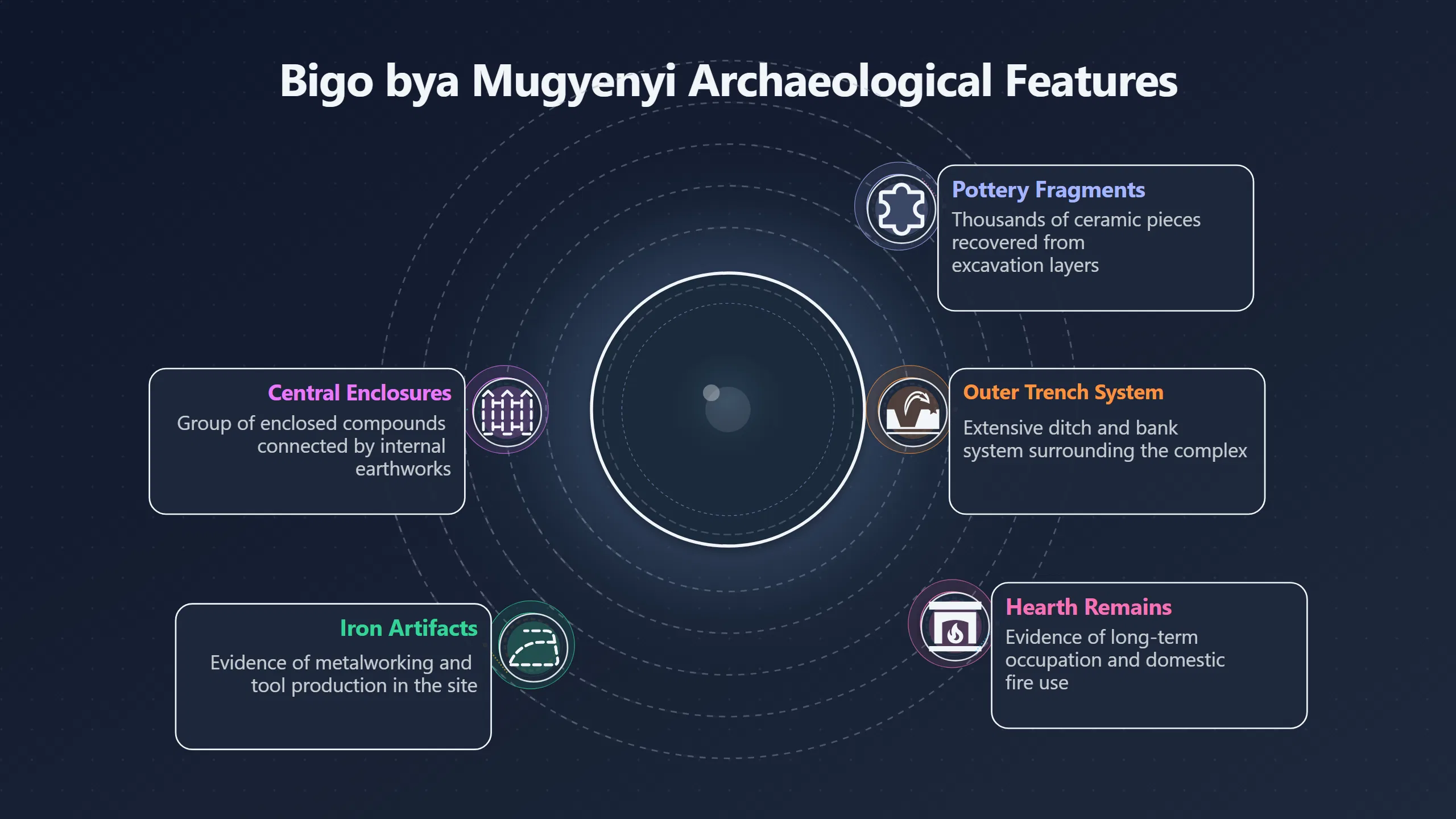
Bigo bya Mugyenyi lies along the Katonga River in western Uganda and is the country’s largest known ancient earthwork complex. Covering roughly ten square kilometres, it consists of an extensive outer ditch and bank system together with a central group of enclosed compounds connected by additional earthworks. Archaeological investigations have shown that these were substantial engineering projects requiring organised labour rather than isolated defensive trenches.[UNESCO World Heritage Centre]whc.unesco.orgkms series of archaeological earthworks dating to between the 14th and 16th centuries A.D. There is an outer trench system which…Read…
Excavations have recovered thousands of pottery fragments, iron objects, hearths and evidence of long-term occupation. Radiocarbon dating and associated archaeological evidence place the main construction broadly between the fourteenth and sixteenth centuries, although settlement in the wider region began earlier. The monument therefore belongs to a flourishing Late Iron Age society rather than to a mythical prehistoric civilisation.[Wikipedia]WikipediaBigo bya MugenyiBigo bya Mugenyi
Because of its importance, Bigo was added to Uganda’s UNESCO Tentative List as a site of exceptional archaeological value. UNESCO describes it as one of the country’s most significant ancient monuments and notes both its impressive scale and its close association with local traditions about the Bachwezi.[UNESCO World Heritage Centre]whc.unesco.orgkms series of archaeological earthworks dating to between the 14th and 16th centuries A.D. There is an outer trench system which…Read…
Why the Bachwezi became the obvious builders
Local traditions across Bunyoro, Tooro and neighbouring regions remember the Bachwezi as a short-lived dynasty that ruled the legendary kingdom of Kitara. Unlike ordinary kings, they are often described as possessing extraordinary abilities, unusual beauty and semi-divine status. They are credited with introducing cattle wealth, improving political organisation and bringing prosperity before mysteriously disappearing from the world.[Wikipedia]WikipediaEmpire of KitaraMarch 24, 2007 — Kitara (sometimes spelt as Kittara or Kitwara, also known as the Chwezi Empire) was an ancient legendary state that cove…
Their disappearance is one of the most distinctive features of the legend. Rather than dying in battle or being replaced by conquerors, many traditions describe the Bachwezi as simply withdrawing from human society. Some accounts say they vanished into the earth, others that they departed into another realm, while later belief often regarded them as continuing to exist as powerful ancestral spirits.
That transformation from remembered rulers into supernatural beings gives the stories their lasting Fortean appeal. The Bachwezi occupy a middle ground between history and mythology. They are not merely fictional characters, yet neither can historians demonstrate that every legendary ruler corresponds to an identifiable historical individual.
Sacred kingship and living spirit traditions
For many communities, the Bachwezi were never simply forgotten monarchs. They became connected with sacred places, mediums and shrines where people sought guidance, healing or protection.
In this tradition, particular rulers such as Ndahura and Wamara were remembered not only as kings but also as continuing spiritual presences. Spirit possession associated with Bachwezi figures became woven into regional religious practice long after the supposed dynasty had disappeared. These beliefs persisted alongside later kingdoms and continued through the colonial period, even as European administrators attempted to separate “history” from “legend”.[Cambridge University Press & Assessment]cambridge.orgCambridge University Press & AssessmentThe Antecedents of the Interlacustrine Kingdoms*by JEG Sutton · 1993 · Cited by 89 — The dating of…
This spiritual dimension explains why Bigo is more than an archaeological site. For many visitors it is also part of a sacred historical landscape. Ancient earthworks become physical reminders of stories in which the boundary between political authority, ancestral memory and the supernatural is deliberately blurred.

Where legend and archaeology disagree
The strongest evidence for the Bachwezi comes from oral tradition. The strongest evidence for Bigo comes from archaeology. They overlap, but they do not match neatly.
One difficulty is chronology. Archaeologists can date charcoal, pottery and occupation layers, but oral traditions compress generations into memorable narratives centred on famous rulers. As a result, it is impossible to state confidently that a particular ditch or enclosure was constructed under a named Bachwezi king.[Cambridge University Press & Assessment]cambridge.orgCambridge University Press & AssessmentThe Antecedents of the Interlacustrine Kingdoms*by JEG Sutton · 1993 · Cited by 89 — The dating of…
Another disagreement concerns the purpose of the earthworks.
Early colonial observers naturally interpreted the immense ditches as military fortifications. More recent archaeological work has questioned whether such extensive boundaries could ever have been effectively defended. Alternative interpretations include:
- marking political or ceremonial boundaries;
- protecting valuable cattle and crops;
- controlling movement and trade;
- expressing royal authority through monumental construction;
- combining practical, symbolic and ritual functions rather than serving a single purpose.[Wikipedia]WikipediaBigo bya MugenyiBigo bya Mugenyi
These changing interpretations illustrate an important lesson. Even when archaeologists agree about what survives in the ground, understanding why it was built remains much harder.
Why the vanished rulers still matter
The Bachwezi legends endure because they answer questions that archaeology alone cannot.
An enormous abandoned earthwork naturally invites stories about exceptional builders. Communities preserved memories of powerful rulers whose achievements seemed worthy of such monuments, while the mysterious disappearance of those rulers explained why no comparable kings remained. Over centuries, those memories acquired increasingly supernatural qualities.
For believers, the earthworks help confirm that the Bachwezi were extraordinary historical figures whose influence continued after death. For sceptics, the legends preserve genuine cultural memories that have accumulated mythical features through centuries of retelling. Neither position fully eliminates the mystery because the archaeological record confirms the existence of a sophisticated society without identifying every individual remembered in oral tradition.[UNESCO World Heritage Centre]whc.unesco.orgkms series of archaeological earthworks dating to between the 14th and 16th centuries A.D. There is an outer trench system which…Read…

Why Bigo remains one of Uganda’s great historical mysteries
Bigo bya Mugyenyi occupies a rare position where archaeology, folklore and living belief all point towards the same landscape while telling different stories about it.
The earthworks themselves are not mysterious in the sense of being inexplicable. They were built by skilled people using organised labour, and archaeologists continue to learn more about their date and function. The enduring mystery lies instead in their human story. Oral traditions remember vanished rulers who became spirit ancestors, while excavated pottery, iron tools and settlement evidence reveal an advanced but otherwise anonymous society.
That combination makes the Bachwezi tradition one of Uganda’s most compelling examples of historical Forteana. The strange element is not a monster lurking in the wilderness but a vanished dynasty whose memory has survived in earthworks, sacred landscapes and stories that refuse to fit comfortably into either conventional history or pure mythology.
Amazon book picks
Further Reading
Books and field guides related to Who Built the Bigo Earthworks?. Use these as the next step if you want deeper reading beyond the article.


African Civilizations
Strong background for ancient earthworks and early African states.

The scramble for Africa,
First published 1990. Subjects: History, Colonies, Colonization, Colonización, Kolonisatie.
eBay marketplace picks
Marketplace Samples
Live-tested eBay searches with available results related to this page.




Endnotes
1.
Source: whc.unesco.org
Link:https://whc.unesco.org/en/tentativelists/911/
Source snippet
kms series of archaeological earthworks dating to between the 14th and 16th centuries A.D. There is an outer trench system which...Read...
2.
Source: cambridge.org
Link:https://www.cambridge.org/core/journals/journal-of-african-history/article/antecedents-of-the-interlacustrine-kingdoms/8C87C2A9A023B30C90C3F213488E803A
Source snippet
Cambridge University Press & AssessmentThe Antecedents of the Interlacustrine Kingdoms*by JEG Sutton · 1993 · Cited by 89 — The dating of...
3.
Source: Wikipedia
Title: Bigo bya Mugenyi
Link:https://en.wikipedia.org/wiki/Bigo_bya_Mugenyi
4.
Source: Wikipedia
Title: Empire of Kitara
Link:https://en.wikipedia.org/wiki/Empire_of_Kitara
Source snippet
March 24, 2007 — Kitara (sometimes spelt as Kittara or Kitwara, also known as the Chwezi Empire) was an ancient legendary state that cove...
Published: March 24, 2007
5.
Source: unesco.org
Link:https://www.unesco.org/en
Source snippet
Building Peace through Education, Science and...UNESCO supports communities affected by conflict and natural disasters, ensurin...
6.
Source: whc.unesco.org
Link:https://whc.unesco.org/fr/etatsparties/ug
Source snippet
UNESCO Convention du patrimoine mondialBigo bya Mugyenyi (Archaeological Earthworks) · Ntusi (man-made mounds and Basin) · Nyero and othe...
7.
Source: researchgate.net
Link:https://www.researchgate.net/profile/Peter_Robertshaw/publication/274374580_The_age_and_function_of_the_ancient_earthworks_of_Western_Uganda/links/551c66d60cf2fe6cbf791736/The-age-and-function-of-the-ancient-earthworks-of-Western-Uganda.pdf
Source snippet
EARTHWORKSNotes on the Biggo bya Mugenyi: Some Ancient Earthworks. Page 8. THE. UGANDA. JOURNAL. THE JOURNAL OF. THE UGANDA SOCIETY. VOLU...
Additional References
8.
Source: facebook.com
Link:https://www.facebook.com/ancientoriginsweb/posts/discover-the-mysterious-legend-of-the-cwezi-a-group-of-demi-gods-who-ruled-ugand/963395899162274/
Source snippet
Ancient OriginsThe Bachwezi people, who are also known as the Ancient Cwezi or Chwezi, were a group of people who legends say ruled the E...
9.
Source: habariugandatours.com
Link:https://www.habariugandatours.com/archaeological-sites-uganda/
Source snippet
Archaeological Sites UgandaBigo Bya Mugyenyi site is a 10 square kilometres series of archaeological earthworks with an inner royal enclo...
10.
Source: kitararcc.com
Link:https://kitararcc.com/bigo-bya-mugenyi/
Source snippet
Bigo Bya MugenyiLocated in Mawogola county about 50 kilometers from Sembabule town center, Bigo Bya Mugenyi site is one of the exceptiona...
11.
Source: researchgate.net
Link:https://www.researchgate.net/publication/240349398_Archaeological_survey_ceramic_analysis_and_state_formation_in_western_Uganda
Source snippet
(PDF) Archaeological survey, ceramic analysis, and state...Early archaeological research on the Iron Age of Uganda focused upon earthwor...
12.
Source: facebook.com
Link:https://www.facebook.com/mugerwa.nsumba/posts/this-is-bigo-byamugenyi-site-found-in-ntuusi-ssembabule-this-place-used-to-be-th/3808856502769033/
Source snippet
This Is "BIGO BYAMUGENYI" Site Found In NtuusiBigo Bya Mugenyi is a late Iron Age site in Uganda, the capital of the Kitara or Chwezi Dyn...
13.
Source: youtube.com
Link:https://www.youtube.com/shorts/UUrYe6SVeRo
Source snippet
Bigo Bya Mugenyi: Uganda's Ancient Earthwork MysteryDiscover the secrets of Bigo Bya Mugenyi, a vast earthwork complex in Uganda. Who bui...
14.
Source: africarebirth.com
Title: uncovering the true story of the ancient bachwezi people of uganda
Link:https://www.africarebirth.com/uncovering-the-true-story-of-the-ancient-bachwezi-people-of-uganda/
Source snippet
Uncovering the True Story of the Ancient Bachwezi People...29 Nov 2024 — In this article, we will explore the story of the Bachwezi acco...
15.
Source: ugandasafaristours.com
Link:https://www.ugandasafaristours.com/uganda-travel-blog/bigo-byamugyenyi-sounds-sights-bachwezi.html
Source snippet
Bigo Byamugyenyi: Sounds and Sights Of Bachwezi in UgandaHistory has it that the Chwezi dynasty reigned at Bigobyamugyenyi between 1000 a...
16.
Source: primeugandasafaris.com
Link:https://www.primeugandasafaris.com/exploring-ntusi-and-bigo-bya-mugenyi-earthworks-in-uganda-uganda-safari-news/
Source snippet
o tradition, the earthworks were excavated to protect the Chwezi Empire from...
17.
Source: scribd.com
Link:https://www.scribd.com/document/933703715/chwezi
Source snippet
stablishing the foundations of the Kitara Empire and...Read more...
Topic Tree