Within Tonga
Why Were Tongan Landscapes Spirit Haunted?
Older Tongan supernatural records show a world where spirits, omens, illness and taboo shaped how danger was understood.
On this page
- Sacred restriction and supernatural force
- Omens, household danger and spirit caused illness
- How ethnographers preserved and distorted the record
Page outline Jump by section
Introduction
Older Tongan accounts of spirits are best understood as part of a complete moral and social system rather than a collection of ghost stories. Before Christianity became dominant in the nineteenth century, many Tongans believed that particular people, places, objects and actions possessed sacred power or dangerous potency. Misfortune, unexplained illness, unusual animal behaviour and breaches of social rules could all be interpreted through this framework. What modern readers might label “hauntings” were often understood instead as the consequences of violating sacred restrictions or disturbing relationships between the living, the dead and the spirit world. These traditions remain an important part of Tonga’s cultural history, but they are preserved largely through missionary accounts, ethnographic fieldwork and oral memory rather than eyewitness paranormal investigations.[eHRAF World Cultures]ehrafworldcultures.yale.edue HRAF World Cultures The Supernatural In TongaeHRAF World CulturesThe Supernatural In Tonga - eHRAF World Cultures…
Why were Tongan landscapes spirit-haunted?
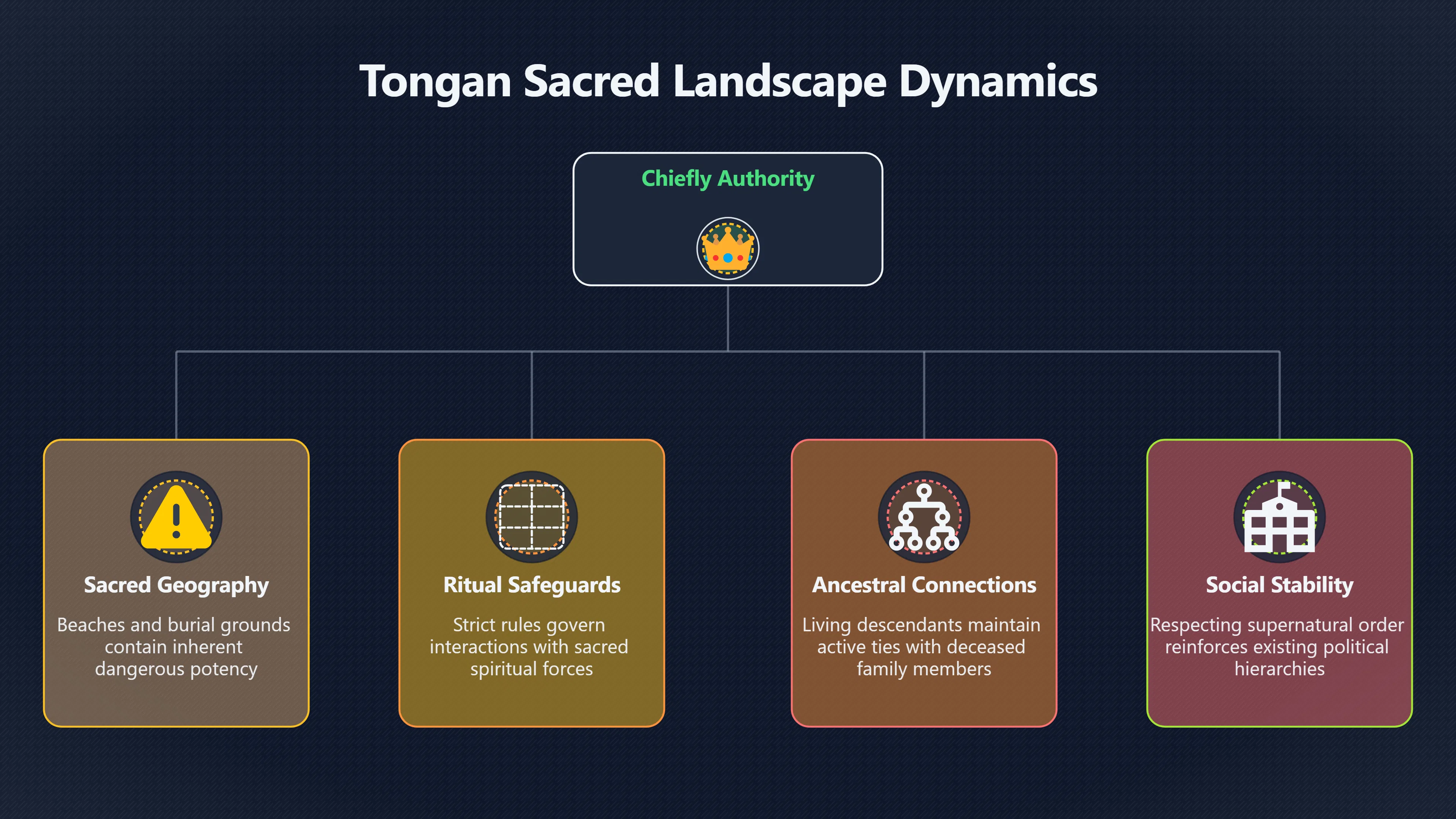
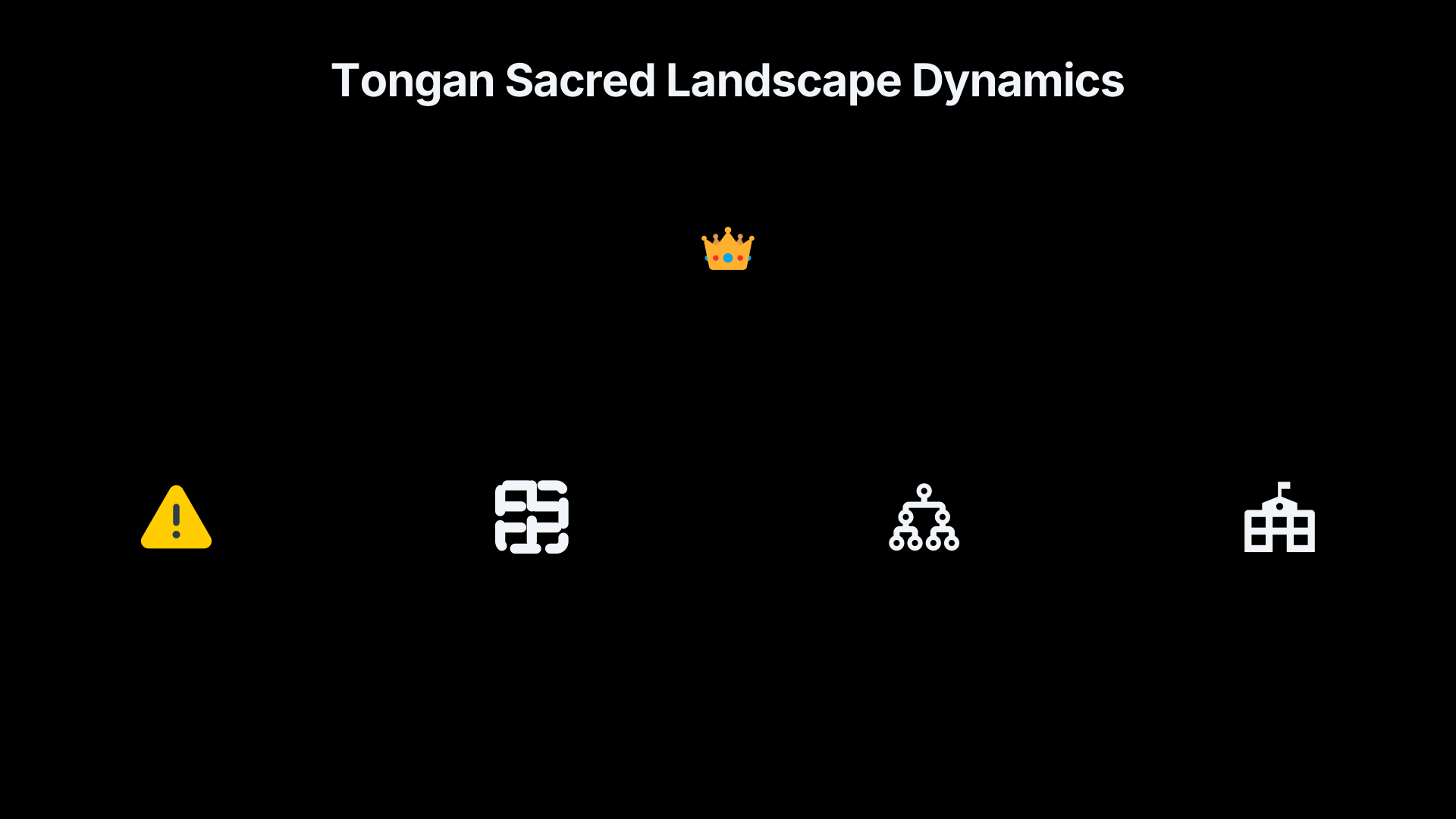
Traditional Tongan belief did not divide the world neatly into natural and supernatural realms. Sacred power was thought to be embedded within landscapes, chiefly authority, ancestral connections and everyday life. Certain beaches, burial grounds, trees, fishing places and chiefly sites were considered inherently dangerous because they stood within networks of sacred relationships rather than because they contained roaming ghosts.
The result was a mental map in which invisible dangers mattered as much as visible ones. A place might appear ordinary while still demanding careful behaviour because it belonged to an ancestral spirit, had been associated with a powerful chief, or was protected by religious restrictions. The danger lay less in meeting an apparition than in breaking rules that governed contact with sacred power.[eHRAF World Cultures]ehrafworldcultures.yale.edue HRAF World Cultures The Supernatural In TongaeHRAF World CulturesThe Supernatural In Tonga - eHRAF World Cultures…
Unlike modern paranormal traditions, these beliefs were woven into politics and everyday authority. Chiefs themselves were regarded as possessing exceptional sacred status linked to divine ancestry, meaning that respect for hierarchy was simultaneously respect for supernatural order. Sacred landscapes therefore reinforced both religion and social organisation.[eHRAF Archaeology]ehrafarchaeology.yale.edue HRAF Archaeology TonganeHRAF ArchaeologyTongan - Summary - eHRAF Archaeology…
Sacred restriction and supernatural force
Early ethnographer and Methodist missionary E. E. V. Collocott identified two concepts as especially important for understanding older Tongan religion: sacred restriction (often discussed under the Polynesian concept of taboo) and supernatural force or efficacy, commonly compared with the wider Polynesian idea of mana. Although his terminology reflects early twentieth-century anthropology, these concepts remain useful for explaining why apparently ordinary actions could carry extraordinary consequences.[eHRAF World Cultures]ehrafworldcultures.yale.edue HRAF World Cultures The Supernatural In TongaeHRAF World CulturesThe Supernatural In Tonga - eHRAF World Cultures…
Sacred restrictions applied across many areas of life:
- Certain people, particularly high-ranking chiefs, possessed exceptional sacred status.
- Birth, death and major ceremonies required careful observance of ritual rules.
- Particular foods, fishing grounds, tools or ceremonial objects could temporarily or permanently become forbidden.
- Entering protected places or handling restricted objects improperly risked illness, misfortune or spiritual retaliation.
From within this belief system, these restrictions were practical safeguards rather than arbitrary superstition. Violating them threatened both individual wellbeing and social stability because sacred force was understood to have real effects in the world.[eHRAF World Cultures]ehrafworldcultures.yale.edue HRAF World Cultures The Supernatural In TongaeHRAF World CulturesThe Supernatural In Tonga - eHRAF World Cultures…
Modern readers sometimes translate every sacred restriction as “taboo”, but this can be misleading. In Tongan belief the restrictions were not merely prohibitions. They expressed relationships between humans, ancestors, deities, chiefs and the land itself. Breaking them disturbed an existing sacred balance rather than simply breaking a rule.[eHRAF World Cultures]ehrafworldcultures.yale.edue HRAF World Cultures The Supernatural In TongaeHRAF World CulturesThe Supernatural In Tonga - eHRAF World Cultures…
Omens, household danger and spirit-caused illness
One striking feature of older Tongan belief is how ordinary domestic life could become part of the supernatural landscape. Collocott recorded traditions stating that evil spirits might accompany rubbish, together with creatures such as rats, lizards and kingfishers. To modern readers this resembles folklore about keeping a house spiritually clean, but within its original setting it reflected concerns about maintaining proper order against unseen dangers.[eHRAF World Cultures]ehrafworldcultures.yale.edue HRAF World Cultures The Supernatural In TongaeHRAF World CulturesThe Supernatural In Tonga - eHRAF World Cultures…
Illness also occupied a middle ground between physical and spiritual explanation. Some conditions were attributed to disturbed relationships with spirits or to breaches of sacred restrictions rather than infection or injury alone. Traditional healers employed massage, medicinal plants and ritual practices intended to restore both bodily and spiritual balance. Contemporary anthropological work shows that spirit explanations have continued to influence some Tongan understandings of sickness alongside modern medical care, particularly in discussions surrounding death, grief and unusual illness.[PubMed]pubmed.ncbi.nlm.nih.govA view from the other side: the place of spirits in the Tongan social field - PubMed…
Omens likewise formed part of everyday decision-making. Animals, dreams, unexpected events and unusual occurrences might be interpreted as warnings, indications of supernatural activity or signs requiring ritual attention. These interpretations were not isolated ghost stories but components of a broader worldview in which invisible agency could be inferred from visible events.[eHRAF World Cultures]ehrafworldcultures.yale.edue HRAF World Cultures The Supernatural In TongaeHRAF World CulturesThe Supernatural In Tonga - eHRAF World Cultures…
Spirits as social actors rather than horror villains
Modern ghost traditions often emphasise frightening encounters with wandering apparitions. Older Tongan traditions usually treated spirits differently.
Spirits were understood as active participants within family, community and landscape rather than random supernatural intruders. Ancestors might continue influencing descendants. Other supernatural beings could protect particular places, punish violations or communicate warnings. Encounters therefore carried moral and social significance instead of functioning primarily as tales of terror.[eHRAF World Cultures]ehrafworldcultures.yale.edue HRAF World Cultures Notes On Tongan ReligioneHRAF World CulturesNotes On Tongan Religion - eHRAF World Cultures…
This perspective also explains why many historical accounts focus less on describing the appearance of spirits than on explaining the circumstances under which they acted. A person’s behaviour—respecting sacred places, observing ritual obligations or honouring chiefly authority—was often more important than describing what the spirit supposedly looked like.

How ethnographers preserved—and distorted—the record
Almost everything known about pre-Christian Tongan supernatural belief comes through outsiders. Missionaries, colonial officials and visiting anthropologists recorded traditions after Christianity had already transformed much of Tongan religious life. Even Collocott acknowledged that much of what he described survived through older informants and historical memory rather than direct observation of traditional rituals.[eHRAF World Cultures]ehrafworldcultures.yale.edue HRAF World Cultures The Supernatural In TongaeHRAF World CulturesThe Supernatural In Tonga - eHRAF World Cultures…
That creates several challenges.
First, many writers interpreted Tongan concepts through Christian or European religious vocabulary, translating complex local ideas into familiar terms such as “devils”, “witchcraft” or “magic”. These translations sometimes flatten important distinctions within the original beliefs.
Second, ethnographers often focused on beliefs they considered unusual while giving less attention to the ordinary social context that made those beliefs meaningful. Sacred restrictions that structured everyday life could therefore appear more exotic than they actually were.
Finally, later researchers have questioned how accurately early observers understood the cultural logic behind the traditions they recorded. Contemporary anthropologists tend to read these accounts alongside oral history and broader Polynesian cultural patterns rather than accepting every description at face value.[nih.gov]pubmed.ncbi.nlm.nih.govA view from the other side: the place of spirits in the Tongan social field - PubMed…
Why these traditions matter in Tonga’s strange-history record
From a Fortean perspective, the value of these traditions lies less in proving supernatural events than in revealing how an entire society explained uncertainty. Sacred restrictions, spirit-caused illness, ominous landscapes and invisible forces formed a coherent interpretive system linking religion, politics, health and geography.
That makes Tonga distinctive within Pacific strange history. Instead of isolated tales of haunted houses or mysterious creatures, its older supernatural record presents an integrated map of invisible relationships. The uncanny emerged from violating sacred order rather than from random paranormal intrusion.
For modern readers, these accounts are most revealing when approached as carefully documented historical beliefs. They illuminate how Tongans understood danger, authority and landscape before modern scientific explanations became dominant, while also reminding us that ethnographic records preserve both invaluable cultural memory and the assumptions of those who wrote them.[yale.edu]ehrafworldcultures.yale.edue HRAF World Cultures The Supernatural In TongaeHRAF World CulturesThe Supernatural In Tonga - eHRAF World Cultures…
Amazon book picks
Further Reading
Books and field guides related to Why Were Tongan Landscapes Spirit-Haunted?. Use these as the next step if you want deeper reading beyond the article.

African religions & philosophy
Offers comparative frameworks for understanding sacred landscapes.

Vikings of the sunrise, by Peter H. Buck (Te Rangi Hiroa) ......
First published 1938. Subjects: Ethnology, Polynesians, World history, Australia, history.
eBay marketplace picks
Marketplace Samples
Live-tested eBay searches with available results related to this page.


Endnotes
1.
Source: ehrafworldcultures.yale.edu
Title: e HRAF World Cultures The Supernatural In Tonga
Link:https://ehrafworldcultures.yale.edu/cultures/ou09/documents/030
Source snippet
eHRAF World CulturesThe Supernatural In Tonga - eHRAF World Cultures...
2.
Source: ehrafworldcultures.yale.edu
Title: e HRAF World Cultures Notes On Tongan Religion
Link:https://ehrafworldcultures.yale.edu/cultures/ou09/documents/016
Source snippet
eHRAF World CulturesNotes On Tongan Religion - eHRAF World Cultures...
3.
Source: pubmed.ncbi.nlm.nih.gov
Link:https://pubmed.ncbi.nlm.nih.gov/12825783/
Source snippet
A view from the other side: the place of spirits in the Tongan social field - PubMed...
4.
Source: ehrafworldcultures.yale.edu
Title: e HRAF World Cultures Tongan Society
Link:https://ehrafworldcultures.yale.edu/cultures/ou09/documents/001
Source snippet
> ##### Abstract > > This is a general ethnographic introduction to Tongan soci...
5.
Source: ehrafarchaeology.yale.edu
Title: e HRAF Archaeology Tongan
Link:https://ehrafarchaeology.yale.edu/traditions/ou80/summary
Source snippet
eHRAF ArchaeologyTongan - Summary - eHRAF Archaeology...
6.
Source: hraf.yale.edu
Title: using ehraf to explore supernatural explanations for natural and social events
Link:https://hraf.yale.edu/using-ehraf-to-explore-supernatural-explanations-for-natural-and-social-events/
Source snippet
eHRAF to explore supernatural explanations for natural and social events | Human Relations Area FilesFebruary 13, 2024 — HUMAN RELATIONS...
Published: February 13, 2024
7.
Source: hraf.yale.edu
Title: hraf academic quarterly vol 2023 02
Link:https://hraf.yale.edu/hraf-academic-quarterly-vol-2023-02/
Source snippet
Developing codes using ethnographic data from eHRAF and the Standard Cross-Cultural Sample, Jackson, et al. com...
8.
Source: ehrafarchaeology.yale.edu
Link:https://ehrafarchaeology.yale.edu/subjects/776/description
Source snippet
Archaeology - eHRAF Archaeology776 SPIRITS AND GODS Broader Term: religious beliefs 26 Documentsdescriptiondocuments * * * SCOPE NOTE Con...
9.
Source: ehrafworldcultures.yale.edu
Title: > #####
Link:https://ehrafworldcultures.yale.edu/cultures/ou09/documents/048
Source snippet
Kin Groups - eHRAF World CulturesTONGAN KIN GROUPS: THE NOBLE AND THE COMMON VIEW JOURNAL OF THE POLYNESIAN SOCIETY • 83 • PUBLISHED IN 1...
10.
Source: ehrafworldcultures.yale.edu
Link:https://ehrafworldcultures.yale.edu/documents?q=author%3A%22Collocott%2C+E.+E.+V.+%28Ernest+Edgar+Vyvyan%29%22%5E2+OR+authors%3A%22Collocott%2C+E.+E.+V.+%28Ernest+Edgar+Vyvyan%29%22
Source snippet
World CultureseHRAF World Cultures * * * homeHomesearchSearchmanage_searchAdvanced Search * * * DOCUMENTS eHRAF is comprised of thousands...
11.
Source: ehrafworldcultures.yale.edu
Link:https://ehrafworldcultures.yale.edu/cultures/ou09/documents/081
Source snippet
I. RICHARDS • [LONDON] • PUBLISHED IN 1972 • PAGES: 205-237 BY: BOTT, ELIZABETH. > ##### Abstract > > In this study, Bo...
12.
Source: ehrafworldcultures.yale.edu
Title: E. V. (ERNEST EDGAR VYVYAN). > #####
Link:https://ehrafworldcultures.yale.edu/cultures/ou09/documents/017
Source snippet
yale.eduSickness, Ghosts And Medicine In Tonga - eHRAF World CulturesARTICLE SICKNESS, GHOSTS AND MEDICINE IN TONGA JOURNAL OF THE POLYNE...
Additional References
13.
Source: researchgate.net
Link:https://www.researchgate.net/publication/301699715_Bodies_Permeable_and_Divine_Tapu_Mana_and_the_Embodiment_of_Hegemony_in_Pre-Christian_Tonga
Source snippet
April 1, 2016 — Chapter PDF Available BODIES PERMEABLE AND DIVINE: TAPU, MANA AND THE EMBODIMENT OF HEGEMONY IN PRE‑CHRISTIAN TONGA * Apr...
Published: April 1, 2016
14.
Source: researchgate.net
Title: A View from the Other Side: The Place of Spirits in the Tongan Social Field
Link:https://www.researchgate.net/publication/10691259_A_View_from_the_Other_Side_The_Place_of_Spirits_in_the_Tongan_Social_Field
Source snippet
April 1, 2003 — A VIEW FROM THE OTHER SIDE: THE PLACE OF SPIRITS IN THE TONGAN SOCIAL FIELD * April 2003 * Culture Medicine and Psychiatr...
Published: April 1, 2003
15.
Source: researchgate.net
Title: I dene episodic tapu as a potentially fatal episode of metaphysica
Link:https://www.researchgate.net/publication/301699715_3_Bodies_Permeable_and_Divine_Tapu_Mana_and_the_Embodiment_of_Hegemony_in_Pre-Christian_Tonga
Source snippet
(PDF) Bodies Permeable and Divine: Tapu, Mana and the Embodiment of Hegemony in Pre‑Christian TongaApril 1, 2016 — distinction here betwe...
Published: April 1, 2016
16.
Source: jstor.org
Link:https://www.jstor.org/stable/j.ctvk3gmv5
Source snippet
PREFACE * Download * XML * * TIME, SPACE AND LANGUAGE * Download * XML * * BASIC THEMES * Downl...
17.
Source: youtube.com
Title: Tu’i Tonga Empire (Medieval Tonga Samoa Fiji Polynesia Austronesia)
Link:https://www.youtube.com/watch?v=nx-upmhD1EQ
Source snippet
Ancient Tonga and Its Traditional Beliefs with Tevita Ka'ili features an in-depth conversation exploring how pre-Christian spiritual fram...
18.
Source: natlib.govt.nz
Title: ‘Avanga: Tongan concepts of mental il
Link:https://natlib.govt.nz/records/20895091
Source snippet
Items | National Library of New Zealand | National Library of New ZealandJOURNAL 'AVANGA: TONGAN CONCEPTS OF MENTAL ILLNESS Add to favo...
19.
Source: tandfonline.com
Title: E. E. Collocott Wesleyan Colleg
Link:https://www.tandfonline.com/doi/abs/10.1080/0015587X.1919.9719102
Source snippet
A Tonoan Theogony.: Folklore: Vol 30, No 3February 1, 2012 — Image: Publication Cover Folklore Volume 30, 1919 - Issue 3 Journal homepage...
Published: February 1, 2012
20.
Source: publicanthropology.org
Title: american anthropologist 1921
Link:https://www.publicanthropology.org/american-anthropologist-1921/
Source snippet
An example is the tabu against anyone “to step over a fishing net whilst it was being made.” (p.429) Another example is the belief that h...
21.
Source: wikidata.org
Title: TH E SUPERNATURAL IN TONGA
Link:https://www.wikidata.org/wiki/Q137490021
Source snippet
THE SUPERNATURAL IN TONGA - WikidataOctober 12, 1921 — THE SUPERNATURAL IN TONGA (Q137490021) * Item * Discussion [Input] English * Read...
Published: October 12, 1921
22.
Source: youtube.com
Title: Megalithic Technology in Ancient Tonga: The Mysterious ‘Langi’ Pyramid Platforms
Link:https://www.youtube.com/watch?v=Fdi1dcT3ofE
Source snippet
PROHIBITIONS IGNORED - Po Fananga, Folk Tales Of Tonga - Voice John T. Kneubuhl...
Topic Tree