Within Tajikistan Weird
Why Iskanderkul Keeps Alexander's Horse Alive
Iskanderkul shows how a beautiful lake can turn conquest, grief and local memory into a story visitors keep retelling.
On this page
- The lake name and Alexander tradition
- Bucephalus, scepticism and tourist retellings
- Dragons, spirits and older landscape folklore
Page outline Jump by section
Introduction
Iskanderkul is one of Tajikistan’s best-known mountain lakes, but its lasting fascination comes from more than its dramatic scenery. The lake has become a meeting point between history, folklore and tourism, where stories about Alexander the Great blend with much older ideas about sacred landscapes and supernatural waters. Visitors arrive expecting spectacular views and often leave having heard tales of drowned horses, flooded kingdoms and mysterious spirits.
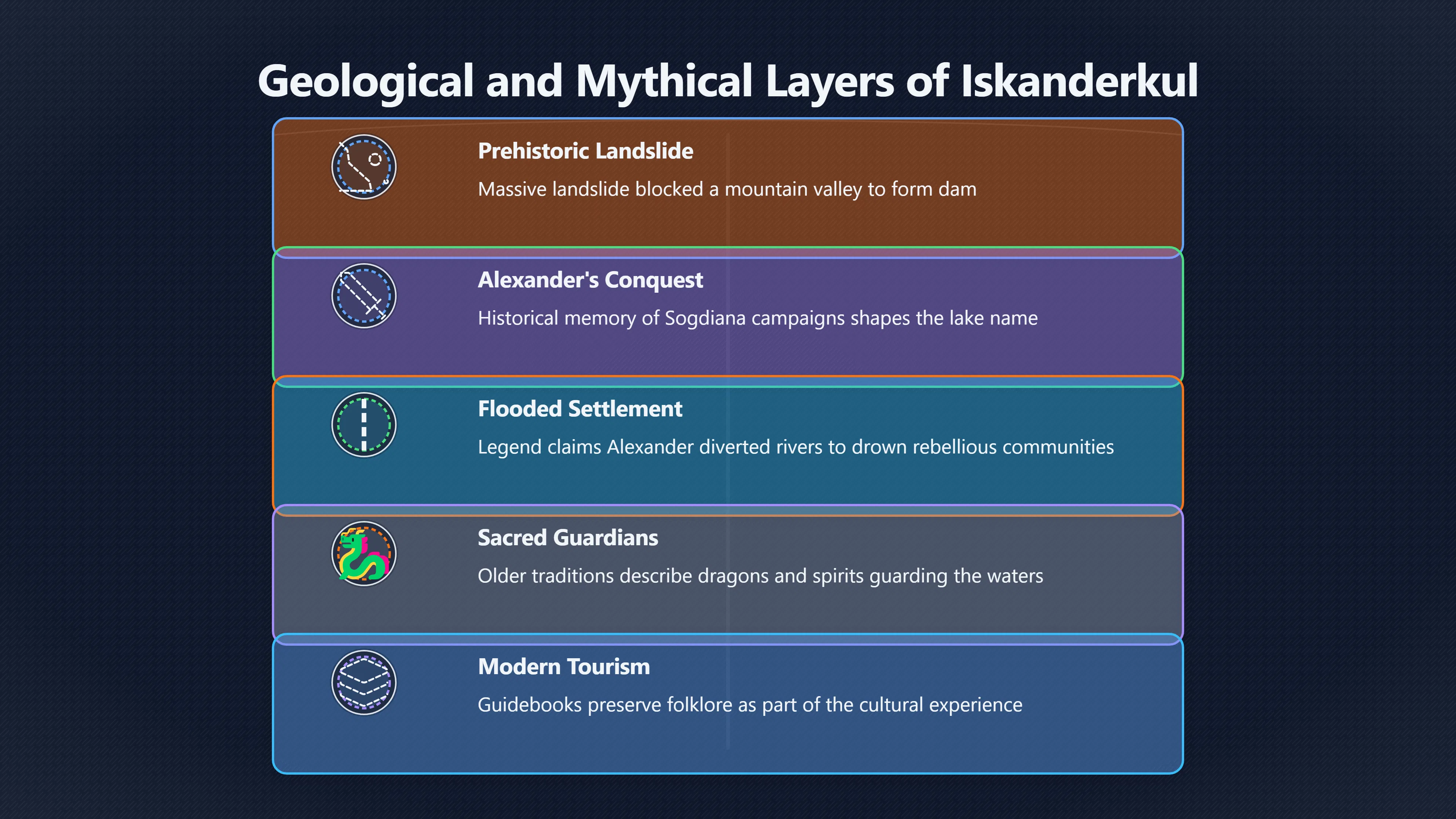
None of these stories can be confirmed as historical fact. Instead, they illustrate how a remarkable landscape has attracted successive layers of storytelling. The Alexander legends help explain the lake’s name, while older traditions about dangerous waters, mountain spirits and uncanny natural places give the site a deeper cultural resonance. For anyone interested in Tajikistan’s Fortean heritage, Iskanderkul shows how history and folklore reinforce one another without requiring either to be literally true.
Why the lake bears Alexander’s name
The name Iskanderkul literally means “Alexander’s Lake”. “Iskander” is the Persian form of Alexander, while “kul” is a Turkic word meaning lake. The name reflects the powerful legacy of Alexander the Great’s campaigns through Central Asia during the fourth century BC, although there is no firm historical evidence that he personally visited the lake itself.[MFA]mfa.tjIskanderkul lake | Embassy of the Republic of Tajikistan in the Federal Republic of GermanyNovember 12, 2021…
Alexander’s conquest of nearby Sogdiana became one of the defining historical episodes of the region. Over centuries, historical memory mixed with material from the medieval Alexander Romance, Persian literature and local oral traditions. Across Central Asia, striking mountains, fortresses and rivers became associated with Iskander, making Iskanderkul one of many landscapes claimed by later legend rather than contemporary history.[MFA]mfa.tjIskanderkul lake | Embassy of the Republic of Tajikistan in the Federal Republic of GermanyNovember 12, 2021…
This layering is typical of mountain folklore. An impressive natural landmark invites explanation, a famous historical figure supplies the narrative, and later generations continue reshaping the story to fit local identity.
Bucephalus, scepticism and tourist retellings
The best-known legend concerns Alexander’s famous horse, Bucephalus.
Several versions circulate today:
- Bucephalus drank the lake’s icy water, became fatally ill and died.
- The horse drowned while crossing the lake.
- After its death, the horse’s spirit continued to haunt the water.
- On moonlit nights, a white horse is said to emerge from the lake before vanishing again at dawn.[mfa.tj]mfa.tjIskanderkul lake | Embassy of the Republic of Tajikistan in the Federal Republic of GermanyNovember 12, 2021…
The ghostly horse is the most overtly Fortean element of the tradition. Unlike a simple historical legend, it transforms the lake into a liminal place where the past briefly becomes visible. The story survives largely through oral retellings, guidebooks and tourism literature rather than through older written chronicles. It is presented as local folklore rather than as a witnessed supernatural phenomenon.
From a historical perspective, the story is almost certainly symbolic. Ancient sources place Bucephalus’s death in India after the Battle of the Hydaspes, many hundreds of kilometres from modern Tajikistan. Historians therefore regard the Iskanderkul version as a later regional adaptation rather than an authentic account of Alexander’s campaign.[Wikipedia]WikipediaOpen source on wikipedia.org.
That historical weakness has done little to reduce the tale’s appeal. For many visitors, the image of Alexander’s faithful horse rising from an alpine lake is far more memorable than a discussion of ancient campaign routes.

Did Alexander create the lake?
A second major legend explains not merely the lake’s name but its very existence.
According to this tradition, mountain communities resisted Alexander’s advance. Unable to defeat them outright, he ordered a river to be blocked or diverted, flooding the rebellious settlement beneath rising water. The submerged community supposedly became Iskanderkul itself.[mfa.tj]mfa.tjIskanderkul lake | Embassy of the Republic of Tajikistan in the Federal Republic of GermanyNovember 12, 2021…
This narrative echoes flood myths found across many cultures. A powerful ruler reshapes nature, human pride is punished, and a dramatic landscape becomes both monument and warning.
Modern geology tells a different story. Iskanderkul is understood to have formed naturally when an enormous prehistoric landslide blocked a mountain valley, creating the lake behind a natural dam. The geological explanation accounts for the lake’s structure without invoking human engineering on an impossible scale.[Nature Tours]nature-tours.chNature Tours Die Legende vom Iskander Kul | Nature ToursNature ToursDie Legende vom Iskander Kul | Nature Tours - Natur Kultur TrekkingApril 27, 2021…
Rather than replacing the legend, the geological explanation simply creates two parallel ways of understanding the landscape: one through physical processes, the other through moral storytelling.
Dragons, spirits and an older sacred landscape
Alexander’s stories probably did not create Iskanderkul’s reputation for mystery; they attached themselves to a landscape that already felt exceptional.
Across Tajikistan’s mountains, lakes often occupy an ambiguous place in folklore. They provide life-giving water but also represent unpredictable natural forces. Sudden storms, cold depths, landslides and echoing cliffs encourage stories about unseen powers that inhabit or guard such places.
Local travel traditions and folklore collections occasionally mention dragons, water spirits or supernatural guardians associated with mountain lakes, including the wider Iskanderkul region, although these accounts are much less standardised than the Alexander cycle. In many versions, such beings function less as monsters than as expressions of the lake’s dangerous and sacred character.[Travel Land]trvlland.comTravel Land Myths and Legends of Tajikistan | Travel LandTravel Land Myths and Legends of Tajikistan | Travel Land
This reflects a broader pattern found throughout Central Asia. Rather than separating religion, folklore and geography, traditional communities often treated unusual natural places as spiritually charged. A beautiful lake could simultaneously be:
- a practical source of water;
- a place demanding respect;
- a setting for historical memory;[academic.oup.com]academic.oup.comHdt 6.117): A Medical History Critique and Reappraisal | Social History of Medicine | Oxford AcademicFebruary 17, 2025 — CONTEXTUALISING…
- and the home of supernatural forces.
The Alexander legends fit comfortably into this older framework because heroic conquerors and sacred landscapes often merge in oral tradition.

Why the legends endure
The enduring popularity of Iskanderkul’s stories owes much to the landscape itself. The lake lies more than 2,000 metres above sea level in the Fann Mountains, surrounded by steep peaks whose reflections create an atmosphere that readily invites imaginative interpretation. Even without folklore, it feels like the setting for epic stories.[Travel Tajikistan]traveltajikistan.tjTravel Tajikistan Iskandarkul/Iskandar Lake – Travel to TajikistanTravel Tajikistan Iskandarkul/Iskandar Lake – Travel to Tajikistan
Modern tourism has helped preserve rather than replace these traditions. Guidebooks, local guides and official tourism organisations routinely recount both the Bucephalus story and the tale of the flooded settlement. They are presented not as established history but as part of the cultural experience of visiting the lake.[traveltajikistan.tj]traveltajikistan.tjTravel Tajikistan Iskandarkul/Iskandar Lake – Travel to TajikistanTravel Tajikistan Iskandarkul/Iskandar Lake – Travel to Tajikistan
For Fortean readers, this makes Iskanderkul particularly interesting. It is not famous because of alleged paranormal sightings or unexplained phenomena in the modern sense. Instead, it demonstrates how an extraordinary landscape accumulates successive layers of myth, historical imagination and sacred tradition until the place itself seems inseparable from the stories told about it.
The result is one of Tajikistan’s richest examples of living landscape folklore: a mountain lake where Alexander’s shadow, the ghost of Bucephalus and older beliefs about enchanted waters continue to coexist in popular memory, even while geology and history offer more conventional explanations.
Amazon book picks
Further Reading
Books and field guides related to Why Iskanderkul Keeps Alexander's Horse Alive. Use these as the next step if you want deeper reading beyond the article.

The Silk Roads
Provides historical context for Alexander traditions and Central Asian landscapes.
Alexander the Great
Covers Alexander's Central Asian campaigns that inspired regional folklore.

Myths and Legends
Helps place sacred landscape and dragon traditions into a wider mythic context.

Lost Enlightenment Central Asias Golden Age From The Arab Con...
First published 2013. Subjects: History, Civilization, Asia, central, history.
eBay marketplace picks
Marketplace Samples
Live-tested eBay searches with available results related to this page.


Endnotes
1.
Source: mfa.tj
Link:https://mfa.tj/en/berlin/view/9098/iskanderkul-lake
Source snippet
Iskanderkul lake | Embassy of the Republic of Tajikistan in the Federal Republic of GermanyNovember 12, 2021...
Published: November 12, 2021
2.
Source: Wikipedia
Link:https://en.wikipedia.org/wiki/Iskanderkul
3.
Source: visitsilkroad.org
Title: Visit Silk Road Iskanderkul Lake
Link:https://visitsilkroad.org/destination/iskanderkul-lake/
Source snippet
Iskanderkul Lake - VisitSilkRoadISKANDERKUL LAKE * Sughd, Tajikistan * Nature, Eco-tourism Image: pin_tajikstan VISIT GUIDE TO ISKANDERKU...
4.
Source: orexca.com
Title: Orex CAIskander-Kul Lake: Rivers and lakes of the Tajikistan
Link:https://www.orexca.com/tajikistan/nature/rivers_lakes/iskanderkul.htm
5.
Source: nature-tours.ch
Title: Nature Tours Die Legende vom Iskander Kul | Nature Tours
Link:https://www.nature-tours.ch/news-stories/artikel/die-legende-vom-iskander-kul
Source snippet
Nature ToursDie Legende vom Iskander Kul | Nature Tours - Natur Kultur TrekkingApril 27, 2021...
Published: April 27, 2021
6.
Source: youtube.com
Title: MACEDONIAN in the mountains of Tajikistan: TRUTH OR MYTH?
Link:https://www.youtube.com/watch?v=TrPD-98KeLM
Source snippet
Tajikistan - Dushanbe, Khujand, Iskanderkul...
7.
Source: youtube.com
Link:https://www.youtube.com/watch?v=36k4JSxjwfQ
Source snippet
Lake Iskanderkul in the Fann Mountains of Tajikistan...
8.
Source: traveltajikistan.tj
Title: Travel Tajikistan Iskandarkul/Iskandar Lake – Travel to Tajikistan
Link:https://traveltajikistan.tj/en/iskandarkul-iskandar-lake/
9.
Source: trvlland.com
Title: Travel Land Myths and Legends of Tajikistan | Travel Land
Link:https://trvlland.com/tajikistan/myths-and-legends-of-tajikistan/
10.
Source: en.wiktionary.org
Link:https://en.wiktionary.org/wiki/Iskandar
Source snippet
Doublet of Alexander PROPER NOUN [edit] Iskandar (plural Iskandars) 1. A male given name from...
11.
Source: en.wiktionary.org
Link:https://en.wiktionary.org/wiki/Iskander
Source snippet
This surname is mostly found among Copts in Egypt. Doublet of Alexander PRONUNCIATION [edit] *...
12.
Source: academic.oup.com
Link:https://academic.oup.com/shm/article/38/3/513/8019627
Source snippet
(Hdt 6.117): A Medical History Critique and Reappraisal | Social History of Medicine | Oxford AcademicFebruary 17, 2025 — CONTEXTUALISING...
Published: February 17, 2025
13.
Source: nameorigin.info
Link:https://nameorigin.info/iskander.html
Source snippet
Origin, Meaning & History | NameOrigin.infoISKANDER /ɪsˈkændər/ is-KAN-dər Origin: Arabic/Persian (from Greek) Meaning: Defender of men...
Additional References
14.
Source: researchgate.net
Link:https://www.researchgate.net/publication/391119526_Later_Rumors_of_Mongol_Defeat_in_Europe_in_the_Mid-Thirteenth_Century_Batu%27s_Drowning_in_Austria_and_the_Saint_Ladislaus_Legend_in_Russia
Source snippet
RussiaApril 1, 2025 — Article PDF Available LATER RUMORS OF MONGOL DEFEAT IN EUROPE IN THE MID-THIRTEENTH CENTURY: BATU'S DROWNING IN AUS...
Published: April 1, 2025
15.
Source: tandfonline.com
Link:https://www.tandfonline.com/doi/abs/10.1080/04308778.2024.2322818
Source snippet
February 27, 2024 — Folk Life Journal of Ethnological Studies Volume 62, 2024 - Issue 1 Submit an article Journal homepage Open access 2...
Published: February 27, 2024
16.
Source: eurasia.travel
Link:https://eurasia.travel/tajikistan/nature/mountains/fann-mountains/iskanderkul-lake/
Source snippet
Iskanderkul Lake – Tours to Uzbekistan & Central Asia & CaucasusISKANDERKUL LAKE ISKANDERKUL LAKE Image: Iskanderkul Lake, Fann Mountains...
17.
Source: mustseespots.com
Link:https://www.mustseespots.com/tajikistan/articles/iskanderkul-lake-the-jewel-of-the-fann-mountains-travel-guide/
Source snippet
February 24, 2026 — Published on February 24, 2026 ISKANDERKUL LAKE: THE JEWEL OF THE FANN MOUNTAINS TRAVEL GUIDE Nestled high in the hea...
Published: February 24, 2026
18.
Source: tourstotajikistan.com
Link:https://tourstotajikistan.com/en/blog/lakes-of-tajikistan/iskanderkul-lake.html
Source snippet
Iskanderkul lake, Lakes of Tajikistan, It is interesting, Tours to TajikistanMay 19, 2014 — ISKANDERKUL LAKE Rubric: Lakes of Tajikistan...
Published: May 19, 2014
19.
Source: cambridge.org
Title: The Local Legend: A Product of Popular Culture | Rural History | Cambridge Core
Link:https://www.cambridge.org/core/journals/rural-history/article/abs/local-legend-a-product-of-popular-culture/C0EF8EA3B9D518462143F8C60BAFD031
Source snippet
January 22, 2009 — THE LOCAL LEGEND: A PRODUCT OF POPULAR CULTURE Published online by Cambridge University Press: 22 January 2009 Jacquel...
Published: January 22, 2009
20.
Source: cambridge.org
Title: The Local Legend: A Product of Popular Culture | Rural History | Cambridge Core
Link:https://www.cambridge.org/core/journals/rural-history/article/local-legend-a-product-of-popular-culture/C0EF8EA3B9D518462143F8C60BAFD031
Source snippet
January 22, 2009 — THE LOCAL LEGEND: A PRODUCT OF POPULAR CULTURE Published online by Cambridge University Press: 22 January 2009 Jacquel...
Published: January 22, 2009
21.
Source: nyfolklore.org
Title: “Evaluation of Petrifaction Legends in Turkey in Terms of Cultural Her
Link:https://nyfolklore.org/article/evaluation-of-petrifaction-legends-in-turkey-in-terms-of-cultural-heritage-and-tourism/
Source snippet
Evaluation of Petrifaction Legends in Turkey in Terms of Cultural Heritage and Tourism - New York FolkloreEVALUATION OF PETRIFACTION LEGE...
22.
Source: journalofnomads.com
Title: 5 Top Things To Do At Iskanderkul Lake In Tajikistan | Journal Of Nomads
Link:https://www.journalofnomads.com/iskanderkul-lake-tajikistan/
Source snippet
As Alexander the Great didn’t like to be challenged, he ordered to build a dam across the nearby river. He flooded the area and...
23.
Source: ancestry.com
Link:https://www.ancestry.com/first-name-meaning/iskandar?geo-lang=en-US
Source snippet
Iskandar: Meaning and Origin of First Name | Search Family History on Ancestry®.comMEANING OF THE FIRST NAME ISKANDAR ORIGIN Arabic/pers...
Topic Tree