Within Tuvalu Strange
Who Were Tuvalu's Spirit Ancestors and Sacred Guardians?
Ancestor spirits, ritual specialists, and revered objects formed a sacred system that survived in oral tradition after Christianity arrived.
On this page
- Ancestor worship and ritual
- Sacred objects and relics
- Missionary records and changing beliefs
Page outline Jump by section
Introduction
Before Christianity became the dominant religion in Tuvalu, the islands maintained a rich sacred tradition in which ancestor spirits, ritual specialists and revered objects were believed to influence everyday life. Unlike dramatic ghost stories or modern paranormal legends, these beliefs formed a practical religious system: ancestors protected families, sacred relics embodied spiritual power, and ritual experts mediated between the human and spirit worlds. Most of what is known today comes from nineteenth-century missionary accounts, oral histories recorded shortly afterwards, and later Tuvaluan historians who preserved memories of beliefs that were already fading. The evidence is fragmentary, but it provides a rare glimpse into a sacred landscape where spirits, places and objects were inseparable from fishing, farming, leadership and survival.[Wikipedia]WikipediaHistory of TuvaluHistory of Tuvalu
Who were Tuvalu’s spirit ancestors?
Early descriptions suggest that religious beliefs differed between islands rather than forming a single national religion. Nevertheless, ancestor reverence appears to have been widespread. The missionary Samuel James Whitmee, visiting the Ellice Islands (now Tuvalu) in 1870, remarked that the worship of ancestral spirits was common, although local practices varied considerably.[Wikipedia]WikipediaHistory of TuvaluHistory of Tuvalu
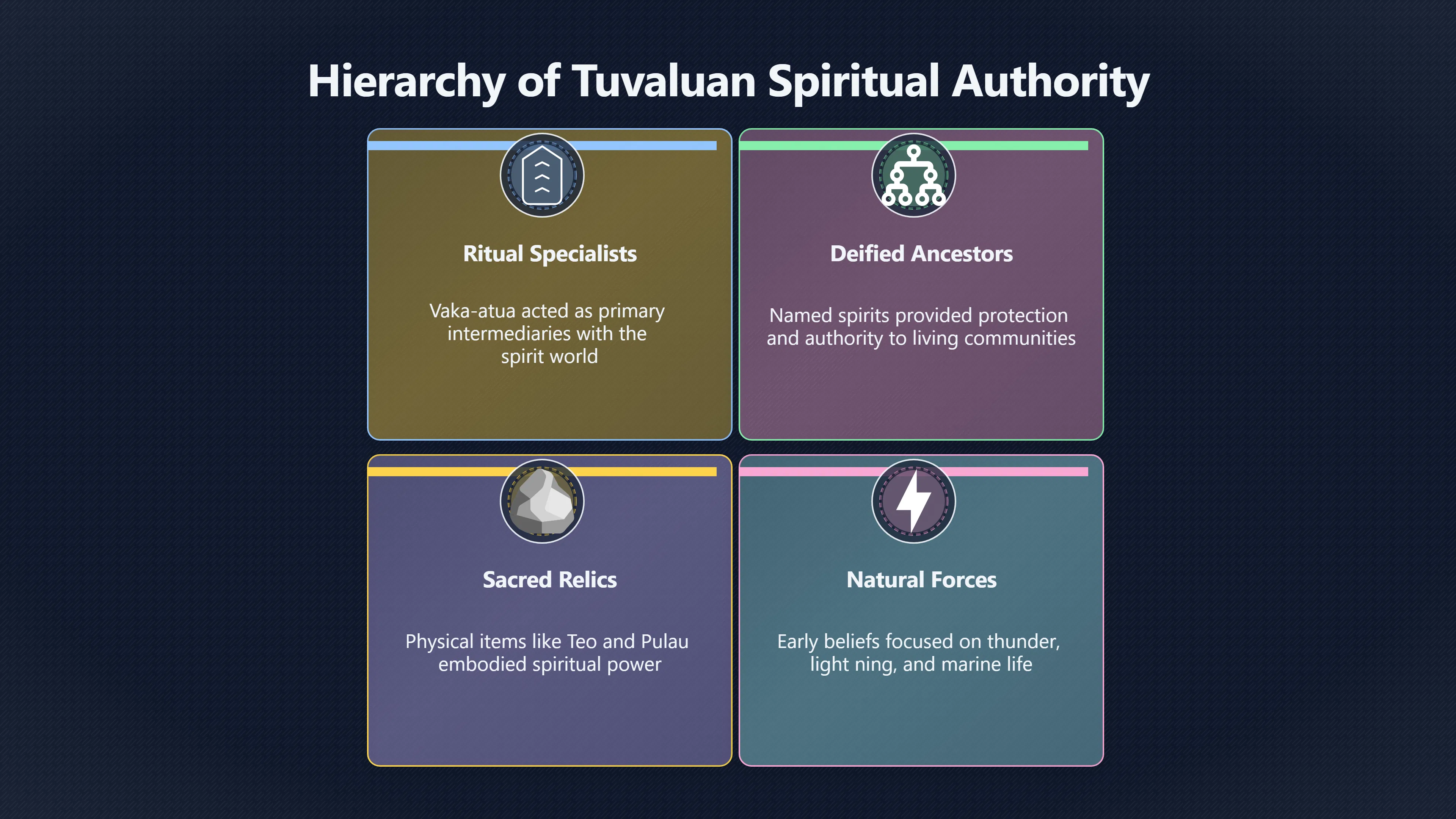
According to oral traditions later recorded by Professor W. J. Sollas during the Royal Society’s Funafuti Coral Reef Expedition in 1896, the religious system evolved over generations rather than remaining fixed. The oldest remembered beliefs focused on natural forces such as thunder, lightning, birds and fish. Later traditions increasingly centred on named spirits and deified ancestors whose continuing presence shaped community life. Eventually the greatest authority rested with ritual specialists who acted as intermediaries between ordinary people and these supernatural powers.[Wikipedia]WikipediaHistory of TuvaluHistory of Tuvalu
Rather than existing as distant gods, ancestor spirits were understood as continuing members of the community. Their favour was sought before important activities including fishing expeditions, crop cultivation and communal ceremonies. Success or failure could be interpreted as reflecting the state of relationships between the living and the unseen world. From a modern historical perspective, this resembles many Polynesian systems in which social order and spiritual order reinforced one another rather than existing separately.[Wikipedia]WikipediaHistory of TuvaluHistory of Tuvalu
How did ritual specialists connect people with the spirit world?
One of the most distinctive features of early Tuvaluan belief was the role of the vaka-atua, sometimes translated as spirit-masters or priests. These individuals did far more than lead ceremonies.
Accounts recorded from Funafuti describe them as:
- acting as intermediaries between humans and spirits;
- conducting rituals connected with sacred objects;
- providing healing and traditional medicine;
- overseeing ceremonies linked to fishing and agriculture;
- preserving knowledge about local ancestors and deities.
Because nearly all surviving descriptions were written after European contact, historians cannot reconstruct every aspect of their work. Even so, several independent sources agree that the vaka-atua occupied a position combining priest, healer and ritual expert. Their authority rested not simply on political power but on their supposed ability to communicate with unseen beings.[Wikipedia]WikipediaHistory of TuvaluHistory of Tuvalu
For readers interested in Fortean traditions, these figures are significant because they illustrate how the supernatural was woven into ordinary life rather than appearing only in exceptional ghost stories or miraculous events.
What were the sacred objects and relics?
Perhaps the most intriguing evidence concerns ritual objects believed to possess spiritual significance. These should not be understood as magical artefacts in the modern fantasy sense, but as sacred possessions whose power derived from ancestral or spiritual associations.
The red stone called Teo
One of the best-known relics mentioned in the Funafuti traditions is an unusual red stone known as Teo.
Very little physical information survives about the object itself. Instead, its importance lies in its ritual role. Teo is consistently described as a sacred object associated with ceremonies conducted by the vaka-atua. It appears to have functioned as a focus for communication with spiritual powers rather than as an object possessing independent magical abilities. No verified example has survived into modern museum collections, leaving historians uncertain whether it was eventually destroyed, hidden or simply lost.[Wikipedia]WikipediaHistory of TuvaluHistory of Tuvalu
Pulau, the ancestor’s ceremonial hat
Even more striking is the description of Pulau, a ceremonial hat woven from red, white and black pandanus leaves and decorated with white shells.
According to the oral history recorded by Sollas, the hat belonged to Firapu, an ancestor who had become deified after death. Rather than being valued merely as an heirloom, Pulau represented a continuing connection with the ancestor himself. Ceremonies involving the object linked living communities with the authority and protection of those who had gone before.[Wikipedia]WikipediaHistory of TuvaluHistory of Tuvalu
The emphasis on colour, shell decoration and association with a named ancestor fits broader Polynesian traditions in which prestige objects embodied genealogy, sacred authority and inherited status, although each island developed its own local forms.
Why were these relics important?
Modern readers sometimes expect sacred relics to produce miracles or spectacular supernatural events. The Tuvaluan evidence points instead towards something more integrated into daily existence.
Sacred objects were believed to matter because they:
- legitimised ritual authority;
- connected ceremonies with particular ancestors or spirits;
- protected important communal activities;
- reinforced traditional leadership;
- preserved collective memory across generations.
Their significance therefore lay as much in social cohesion as in supernatural belief. Whether or not modern observers accept the existence of ancestor spirits, these objects clearly carried immense symbolic authority within their communities.[Wikipedia]WikipediaHistory of TuvaluHistory of Tuvalu
What changed after Christianity arrived?
The London Missionary Society began establishing itself across the islands during the 1860s, largely through Samoan teachers before European missionaries became permanent residents. Christianity spread rapidly, and with it came profound changes in attitudes towards earlier religious practices.[UNESCO World Heritage Centre]whc.unesco.orgWorld Heritage Centre The Pacific atoll-island cultural landscape of TuvaluUNESCO World Heritage CentreThe Pacific atoll-island cultural landscape of Tuvalu - UNESCO World Heritage Centre…
One especially revealing detail comes from Erivara’s oral history as recorded by Sollas. He recalled that the ritual houses containing sacred objects were destroyed before formal missionary activity reached Funafuti. The account attributes much of this change to the trader Jack O’Brien, whose influence weakened the authority of the vaka-atua. Christianity then accelerated the abandonment of the older system.[Wikipedia]WikipediaHistory of TuvaluHistory of Tuvalu
This sequence reminds historians that religious change was not always a simple story of missionaries replacing traditional beliefs. Trade, personal relationships and local political decisions also reshaped island spirituality.
How reliable are the surviving accounts?
The evidence for Tuvalu’s sacred traditions deserves careful reading because almost every written source comes from outsiders or from oral testimony recorded after major cultural change had already begun.
Several factors strengthen their historical value:
- multiple writers independently noted widespread ancestor worship;
- Sollas recorded traditions directly from the Funafuti chief Erivara using an interpreter;
- later Tuvaluan historian Laumua Kofe preserved many of the same themes from local perspectives.
There are also important limitations.
The surviving descriptions focus heavily on Funafuti and cannot automatically be assumed to represent every island. Missionary observers often viewed indigenous religion through Christian assumptions, sometimes describing sacred objects as “fetishes”, a nineteenth-century term that reflected European ideas rather than local understandings. Finally, oral traditions naturally evolve over time, especially after dramatic religious transformation.[Wikipedia]WikipediaHistory of TuvaluHistory of Tuvalu
For these reasons, historians generally treat the accounts as valuable but incomplete windows onto an earlier sacred world rather than exact ethnographic records.
Why these traditions remain culturally important
Although Christianity transformed Tuvaluan religious life, memories of sacred ancestors, spiritually significant places and revered objects have not disappeared entirely. Modern cultural heritage initiatives emphasise that oral tradition remains central to Tuvaluan identity and that many culturally important landscapes long predate missionary settlement. Spiritually valued places, ancestral histories and traditional knowledge continue to shape how communities understand their islands, even where older ritual practices are no longer observed.[UNESCO World Heritage Centre]whc.unesco.orgWorld Heritage Centre The Pacific atoll-island cultural landscape of TuvaluUNESCO World Heritage CentreThe Pacific atoll-island cultural landscape of Tuvalu - UNESCO World Heritage Centre…
From a Fortean perspective, these traditions matter not because they provide evidence for supernatural phenomena, but because they preserve a worldview in which the boundary between the living, the dead and the landscape itself was far more permeable than modern Western assumptions allow. The red stone Teo, the ceremonial hat Pulau and the remembered work of the vaka-atua survive today chiefly through oral history and historical records, yet together they offer one of the clearest surviving glimpses into the sacred imagination of pre-Christian Tuvalu.
Amazon book picks
Further Reading
Books and field guides related to Who Were Tuvalu's Spirit Ancestors and Sacred Guardians?. Use these as the next step if you want deeper reading beyond the article.

Vaka Moana, Voyages of the Ancestors
First published 2007. Subjects: Polynesians, Navigation, Migrations, Discovery and exploration, Entdeckung.
eBay marketplace picks
Marketplace Samples
Live-tested eBay searches with available results related to this page.
Endnotes
1.
Source: Wikipedia
Title: History of Tuvalu
Link:https://en.wikipedia.org/wiki/History_of_Tuvalu
2.
Source: whc.unesco.org
Title: World Heritage Centre The Pacific atoll-island cultural landscape of Tuvalu
Link:https://whc.unesco.org/en/tentativelists/6707/
Source snippet
UNESCO World Heritage CentreThe Pacific atoll-island cultural landscape of Tuvalu - UNESCO World Heritage Centre...
3.
Source: Wikipedia
Link:https://en.wikipedia.org/wiki/Tuvalu
4.
Source: whc.unesco.org
Title: World Heritage Centre UNESCO World Heritage Centre
Link:https://whc.unesco.org/en/tentativelists/action%3Dlisttentative%26order%3Dstates%26state%3Dtv
Source snippet
World Heritage Centre - Tentative ListsJanuary 24, 2024 — TENTATIVE LISTS 1 Sites 1 States Parties 24/01/2024 Last Revision [Button: Expo...
Published: January 24, 2024
5.
Source: whc.unesco.org
Link:https://whc.unesco.org/en/news/2666
Source snippet
Pacific SIDS submit first Tentative Lists - UNESCO World Heritage CentreMarch 4, 2024 — TWO PACIFIC SIDS SUBMIT FIRST TENTATIVE LISTS Mon...
Published: March 4, 2024
7.
Source: whc.unesco.org
Link:https://whc.unesco.org/fr/listesindicatives/6707/
Source snippet
Pacific atoll-island cultural landscape of Tuvalu - UNESCO Centre du patrimoine mondialJanuary 24, 2024 — THE PACIFIC ATOLL-ISLAND CULTUR...
Published: January 24, 2024
8.
Source: whc.unesco.org
Link:https://whc.unesco.org/en/statesparties/tv/
Source snippet
UNESCO World Heritage ConventionMay 18, 2023 — IMAGE: TUVALU TUVALU 0 Property inscribed on the World Heritage List 0 Mandate to the Worl...
Published: May 18, 2023
9.
Source: ich.unesco.org
Link:https://ich.unesco.org/en/lists?text=oral+tradition
Source snippet
The Committee meets annually to evaluate nominations proposed by States Pa...
10.
Source: unesco.org
Link:https://www.unesco.org/en/countries/tv/conventions
Source snippet
Convention | UNESCOImage: Tuvalu Tuvalu UNESCO member since 1991 Asia and the Pacific CONVENTIONS RATIFIED BY TUVALU 3 ratified out of 43...
11.
Source: ich.unesco.org
Link:https://ich.unesco.org/en/RL/doina
Source snippet
The designations employed in the texts and documents presented by the submitting Sta...
12.
Source: unesco.org
Title: committee 2024
Link:https://www.unesco.org/en/intangible-cultural-heritage/committee-2024?hub=66489
Source snippet
Intangible Cultural Heritage Committee 2024 | UNESCOINTANGIBLE CULTURAL HERITAGE COMMITTEE 2024 The nineteenth session of the Intergovern...
13.
Source: encyclopedia.com
Title: Tuvalu | Encyclopedia.com
Link:https://www.encyclopedia.com/places/australia-and-oceania/pacific-islands-political-geography/tuvalu
Source snippet
Tuvalu is solidly Protestant with a Congregationalist flavor. Other sects and religions have few adherents. While some syncretic pre-Chri...
14.
Source: worldheritageexplorer.org
Link:https://www.worldheritageexplorer.org/countries/tuvalu.html
Source snippet
Tuvalu | World Heritage ExplorerIMAGE: FLAG OF TUVALU TUVALU * * * Tuvalu has been a State Party to the World Heritage Convention since 2023...
Additional References
15.
Source: searcharchives.bl.uk
Title: [Button: Show Hierarchy ] Hints for enabling arrow keys. Using Windows Narrator
Link:https://searcharchives.bl.uk/catalog/040-002840983
Source snippet
bl.ukEAP110/1/13/1/34 - British Library Archives and Manuscripts CatalogueJanuary 1, 1897 — This is an interim version of our Archives an...
Published: January 1, 1897
16.
Source: natlib.govt.nz
Link:https://natlib.govt.nz/guides/pacific-islands-family-history
Source snippet
TUVALU — FAMILY SEARCH PAGES Tuvalu genealogy page — Guide to Tuvalu ancestry, family history and g...
17.
Source: britannica11.org
Title: Encyclopædia Britannica, 11th Edition ANCESTOR-WORSHIP vol
Link:https://britannica11.org/article/01-0998-s5/ancestor-worship
Source snippet
1, pp. 945–947 · 3,152 words By Frederick Cornwallis Conybeare (F. C. C.) In: Religion and Theology › Comparative Religion and Folklore ›...
18.
Source: nature.com
Title: The Legendary History of Funafuti, Ellice Group1 | Nature
Link:https://www.nature.com/articles/055353a0
Source snippet
J. SOLLAS^{} Nature volume 55, pages 353–355 (1897) * 3251 Accesses * 4 Altmetric ABSTRACT THE fi...
19.
Source: worldheritagesite.org
Link:https://worldheritagesite.org/countries/tuvalu/
Source snippet
It has no inscribed sites yet, but its tentative list features a single cultural landsc...
20.
Source: nature.com
Title: Report on the Coral Reef at Funafuti | Nature
Link:https://www.nature.com/articles/055373b0
Source snippet
J. SOLLAS^{} Nature volume 55, pages 373–377 (1897) * 290 Accesses * 1 Citations ABSTRACT IN presenting, as desi...
21.
Source: amw.org.au
Title: funafuti edgeworth david 1897 expedition documents
Link:https://www.amw.org.au/register/listings/funafuti-edgeworth-david-1897-expedition-documents
Source snippet
Funafuti: The Edgeworth David 1897 Expedition Documents | Australian Memory of the WorldFUNAFUTI: THE EDGEWORTH DAVID 1897 EXPEDITION DOC...
22.
Source: journals.australian.museum
Title: museum General account of the Atoll of Funafuti
Link:https://journals.australian.museum/hedley-1896-aust-mus-mem-32-172/
Source snippet
I. General account - The Australian MuseumDecember 21, 1896 — GENERAL ACCOUNT OF THE ATOLL OF FUNAFUTI. I. GENERAL ACCOUNT * Author Charl...
Published: December 21, 1896
23.
Source: wikihandbk.com
Title: Английская Википедия:History of Tuvalu
Link:https://wikihandbk.com/wiki/%D0%90%D0%BD%D0%B3%D0%BB%D0%B8%D0%B9%D1%81%D0%BA%D0%B0%D1%8F_%D0%92%D0%B8%D0%BA%D0%B8%D0%BF%D0%B5%D0%B4%D0%B8%D1%8F%3AHistory_of_Tuvalu
Source snippet
/ Онлайн справочник - wikihandbk.comPRE-CHRISTIAN BELIEFS Laumua Kofe (1983) describes the objects of worship as varying from island to i...
24.
Source: maa.cam.ac.uk
Title: Their authority was legitimis
Link:https://maa.cam.ac.uk/Fiji-priests
Source snippet
Museum of Archaeology and AnthropologyMuseum of Archaeology and Anthropology PRIESTS In many areas of Fiji, chiefs and priests played e...
Topic Tree