Where Guinea's Weird History Gets Real
Guinea’s strange-history record is not rich in famous flying saucers, lake monsters or newspaper “rains of frogs”.
Page outline Jump by section
Guinea’s Forteana is mostly ritual, ecological and social
For readers expecting a catalogue of classic Fortean oddities, Guinea is a useful corrective. The country does not appear to have a well-documented, internationally famous UFO case or anomalous animal scare on the scale of better-known African cases. What it does have is a set of traditions and incidents where the ordinary categories of “art”, “animal”, “illness”, “forest” and “rumour” become unstable.
That matters because Forteana is not only about spectacular impossibilities. It is also about reports and beliefs that reveal how people handle uncertainty. In Guinea, the strongest examples tend to involve:
- Masked presences that are not merely costumes but public appearances of authority, fertility, danger, healing or ancestral force.
- Sacred groves and restricted forests where ecological protection overlaps with taboo, initiation and inherited law.
- Nimba’s uncanny natural history, including tool-using chimpanzees and the Mount Nimba viviparous toad, a real animal strange enough to sound invented.
- Ebola rumours and resistance, where a biological outbreak was interpreted through fear, mistrust, burial practice, foreign intervention and sometimes supernatural suspicion.[christies.com]christies.comOpen source on christies.com.
The Baga masks: spirits, power and misunderstood “idols”
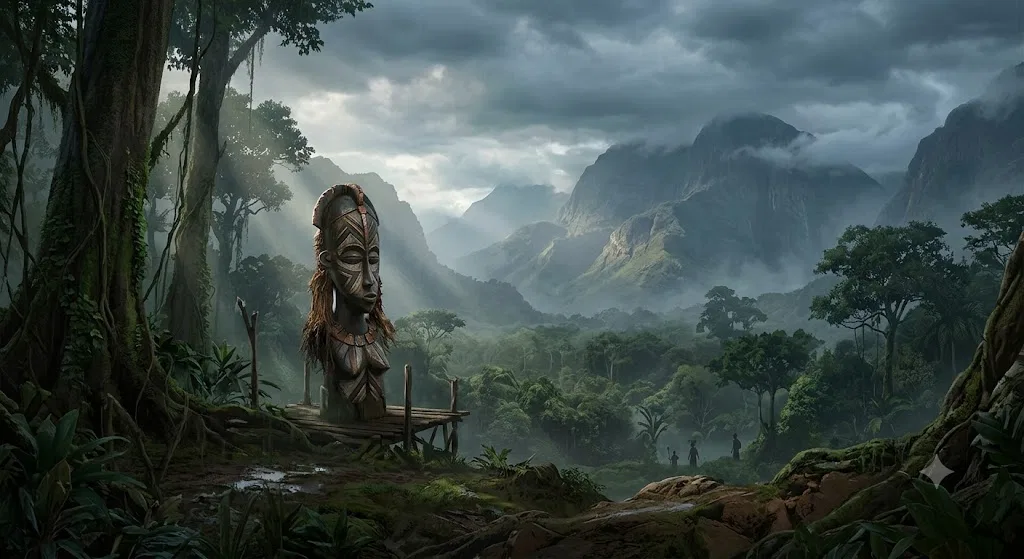
The Baga peoples of coastal Guinea produced some of West Africa’s most striking masquerade traditions. To outside collectors, missionaries and colonial observers, these works could look like “idols” or exotic curiosities. Within their own social worlds, they were more precise: objects activated through performance, linked to fertility, authority, ethics, initiation, lineage, fear, healing and renewal.
One famous example is the large shoulder mask often called Nimba or D’mba. Art-historical sources warn against oversimplifying it as a “goddess” or a literal supernatural being. Christie’s, drawing on the scholarship of Frederick Lamp, notes that “nimba” was a Susu term meaning “great spirit”, adopted partly through European contact, while the Baga term and interpretation are more specific. The mask appeared at important communal events such as marriages, births, wakes and agrarian rites; it represented an idealised mature woman associated with fertility, nurture, renewal and social aspiration rather than a simple monster or deity.[Christie's]christies.comOpen source on christies.com.
That is precisely what makes it Fortean in the grounded sense. A person looking only for “paranormal evidence” will miss the point. The strangeness lies in a public object that is simultaneously sculpture, dancer, social force, moral image and a presence that could reorganise the emotional life of a village. It is neither “just art” nor proof of a spirit world. It is a ritual technology for making invisible values visible.
The Baga serpent headdress known as a-Mantsho-ña-Tshol gives an even stronger case. The Metropolitan Museum of Art describes it as representing a spiritual force, roughly “master of medicine”, whose physical form could appear as a large aquatic serpent; among the Baga, the entity could also be associated with the rainbow, river sources, rain, beginnings, endings, life, death and lineage continuity. The Met also notes that access to such instruments of spiritual power was restricted and linked to male esoteric knowledge, secret associations and family lineages.[The Metropolitan Museum of Art]metmuseum.orgThe Metropolitan Museum of Art Baga artistThe Metropolitan Museum of Art Baga artist
For a weird-history page, the key point is not to exoticise this. The more interesting reading is that Guinea’s masquerade traditions blur boundaries that modern readers often separate too neatly: performance and belief, beauty and fear, entertainment and regulation, medicine and mystery. They are not “monster sightings”, but they are part of the country’s record of public encounters with the uncanny.
Sacred forests: where taboo becomes environmental force
Guinea’s sacred forests show another pattern common in West African Forteana: a place becomes strange not because it contains a single ghost story, but because access itself is controlled by inherited rules, ritual authority and fear of consequence. A 2021 study of sacred groves around the Niokolo-Badiar area in north-western Guinea describes sacredness related to nature conservation as known among Guinean communities in different ways, with Cognagui, Bassari and Badiaranke groups maintaining sacred forests tied to cultural values and practices. These spaces may be open only to certain people at certain times, even if they are protected all year.[E-depot]edepot.wur.nlOpen source on wur.nl.
That makes them easy to misread from outside. A sceptical outsider may see practical conservation wrapped in taboo; a believer may see the forest as protected because it belongs to powers that must not be offended. Both readings can coexist. The study explicitly frames cultural values and practices in terms of taboos, beliefs, totems, myths, rituals and sacredness, and argues that such frameworks can prevent unnecessary exploitation of forests.[E-depot]edepot.wur.nlOpen source on wur.nl.
For country-level Forteana, these groves matter because they make “haunted forest” thinking more complicated. The point is not necessarily that a specific ghost has been photographed or that a monster lurks in the trees. The point is that fear, reverence and ecological behaviour are bound together. A sacred forest can be a social boundary, a ritual archive and a conservation mechanism at once.
Mount Nimba: real animals stranger than many legends
Mount Nimba, on the borders of Guinea, Liberia and Côte d’Ivoire, is one of the strongest anchors for Guinea’s strange-but-grounded natural history. UNESCO describes the Mount Nimba Strict Nature Reserve as a mountain landscape with dense forest, grassy highland pastures and exceptionally rich flora and fauna, including endemic species such as the viviparous toad and chimpanzees that use stones as tools.[UNESCO World Heritage Centre]whc.unesco.orgWorld Heritage Centre Mount Nimba Strict Nature ReserveWorld Heritage Centre Mount Nimba Strict Nature Reserve
The viviparous toad is worth pausing over because it sounds like a folklore creature but is zoological fact. In broad terms, “viviparous” means giving birth to live young rather than laying eggs in the usual amphibian way. For a casual reader, that is exactly the kind of detail that can feel Fortean without being paranormal: a tiny mountain toad, restricted to a narrow landscape, with a reproductive strategy unusual enough to invite disbelief. UNESCO lists it alongside other exceptional species as part of the reserve’s outstanding ecological value.[UNESCO World Heritage Centre]whc.unesco.orgWorld Heritage Centre Mount Nimba Strict Nature ReserveWorld Heritage Centre Mount Nimba Strict Nature Reserve
The chimpanzees are stranger still in cultural terms. They are not cryptids, but their behaviour and status push them into the borderland between animal observation and uncanny kinship. UNESCO notes the use of stones as tools, while Reuters reported in 2024 that only seven chimpanzees remained in Guinea’s Bossou forest, near subsistence farming communities in the N’zérékoré region. Reuters also reported that chimpanzees are traditionally respected in Guinea and sometimes given gifts of food, a practice that can draw them towards human settlements.[UNESCO World Heritage Centre]whc.unesco.orgWorld Heritage Centre Mount Nimba Strict Nature ReserveWorld Heritage Centre Mount Nimba Strict Nature Reserve
That human–chimpanzee closeness has become darker in recent years. In September 2024, Reuters reported that residents near a chimpanzee research centre attacked the facility after a woman said a chimpanzee had taken and killed her infant; the centre said six chimpanzee attacks on humans had been recorded within the reserve since the start of that year. A local ecologist linked the increased danger to dwindling food supplies pushing animals out of protected areas more often.[Reuters]reuters.comResidents ransack Guinea chimpanzee centre after animal kills infant | ReutersResidents ransack Guinea chimpanzee centre after animal kills infant | Reuters
This is not a monster story in the cheap sense. It is more unsettling than that: an old relationship of respect and proximity under pressure from habitat loss, farming, research, hunger and mining concerns. Fortean readers may recognise the pattern. A creature once treated as special, almost kin-like, becomes a source of fear when ecological conditions change.
The “mysterious disease” that became Ebola
The most important modern strange episode associated with Guinea is not supernatural at all. It is the early West African Ebola outbreak, precisely because it began as an unexplained terror. WHO says a “mysterious” disease began silently spreading in a small village in Guinea on 26 December 2013 and was not identified as Ebola until 21 March 2014. Retrospective work identified the index case as an 18-month-old boy in Meliandou, in Guinea’s Forest Region, who developed fever, black stools and vomiting before dying two days later.[World Health Organization]who.intOrigins of the Ebola epidemic…
The weird-history significance is clear: for nearly three months, a lethal disease moved through social worlds that did not yet have a name for it. WHO notes that the exact source of the child’s infection was not identified, though contact with wild animals was likely; it also reports that forest loss around Meliandou may have brought bats and other potentially infected wildlife into closer contact with human settlement.[World Health Organization]who.intOrigins of the Ebola epidemic…
Once identified, the outbreak still generated uncertainty and fear. The CDC reported that on 21 March 2014 Guinea’s Ministry of Health described an illness with fever, severe diarrhoea, vomiting and a high case-fatality rate; laboratory testing then confirmed Ebola virus. Cases were initially reported in south-eastern Guinea and Conakry, then spread to Liberia and Sierra Leone. The CDC also identified community mistrust and resistance as major challenges to control.[CDC]cdc.govOpen source on cdc.gov.
For Forteana, this is a grim but important lesson. “Mysterious disease” reports often sit at the junction of biology and belief. The fact that Ebola was real does not make the rumours irrelevant. On the contrary, the rumours became part of how the event unfolded.

Rumours, burial teams and the fear of hidden harm
During the Ebola crisis, Guinea saw a dangerous collision between public health measures and local suspicion. Santé publique France summarised the problem plainly: anthropologists worked with medical personnel in Guinea to address mistrust rooted in rumours and lack of confidence in authorities, taking account of local social, historical, political and cultural contexts. In many cases, anthropologists acted as mediators.[Santé Publique France]santepubliquefrance.frOpen source on santepubliquefrance.fr.
The Social Science in Humanitarian Action Platform records that resistance to the Ebola response was more widespread and severe in Guinea than in Liberia and Sierra Leone, with sometimes violent incidents. Its evidence review set out to understand why educators, doctors and burial teams encountered resistance, including violent resistance, during response work.[Social Science in Action]socialscienceinaction.orgSocial Science in Action Ebola outbreak in GuineaSocial Science in Action Ebola outbreak in Guinea
The Red Cross described the same atmosphere in February 2015. It said volunteers in Guinea had been regularly attacked by scared communities because of fear and mistrust around Ebola, with an average of ten attacks per month since the previous July. The organisation also stressed that safe burials were essential to reducing transmission, and that rumours and misconceptions had to be addressed through radio, television, community consultation and work with religious leaders and families.[ICRC]icrc.orgOpen source on icrc.org.
This is where the case belongs in Guinea’s strange record. Rumour turned protective clothing, burial protocols and disinfection into signs of possible hidden harm. From a sceptical view, the explanation is social: fear, weak trust in institutions, unfamiliar disease, painful burial changes and poor communication. From within frightened communities, the same events could look like poisoning, sorcery, foreign plots or a disease invented by outsiders. The tragedy is that the “uncanny” interpretation had real consequences.
What is missing from Guinea’s weird archive
A careful Guinea page should also say what the evidence does not support. Live-source searching does not reveal a strong, well-documented national tradition of Guinean UFO cases, lake monsters, anomalous falls or classic newspaper oddities comparable to those found in some other country-level Forteana pages. There are scattered modern social-media-style claims and regional African motifs, but those are too weak to treat as serious Guinean cases without better primary reporting.
That absence is useful rather than disappointing. It prevents the page from becoming a padded list of recycled mysteries. Guinea’s strongest material is not “aliens over Conakry” or a dubious monster in a lake. It is the country’s better-attested record of masked presences, forest taboos, uncanny animals and rumour under crisis. Those subjects have firmer sources and deeper cultural meaning.[christies.com]christies.comOpen source on christies.com.
How to read Guinea’s strange record
The best way to approach Guinea’s Forteana is to keep three categories separate without stripping away the mystery.
First, there are ritual presences: masks, headdresses, protective figures and healing performances that are not reducible to props, but should not be presented as proof of supernatural beings either. The World Encyclopedia of Puppetry Arts, for example, describes Guinean protective and exorcistic figures used in family and healing contexts, including performances for misfortune, possession and child death.[World Encyclopedia of Puppetry Arts]wepa.unima.orgWorld Encyclopedia of Puppetry Arts Guinea | World Encyclopedia of Puppetry ArtsWorld Encyclopedia of Puppetry Arts Guinea | World Encyclopedia of Puppetry Arts
Second, there are ecological uncanny zones: Mount Nimba, Bossou and sacred groves where animals, forests and human communities have long-standing relationships shaped by taboo, respect, danger and scientific interest. These places generate stories because they are genuinely unusual landscapes, not because every claim attached to them is literally true.[unesco.org]whc.unesco.orgWorld Heritage Centre Mount Nimba Strict Nature ReserveWorld Heritage Centre Mount Nimba Strict Nature Reserve
Third, there are crisis rumours: the frightening interpretive fog that gathers around disease, death and official intervention. Ebola in Guinea shows how quickly a real biological event can acquire the texture of a supernatural or conspiratorial scare when people lack trust, clear information and culturally acceptable ways to handle the dead.[who.int]who.intWorld Health OrganizationOrigins of the Ebola epidemic…
Guinea’s weird history is therefore quieter than a monster catalogue but more revealing. Its strongest cases ask what happens when a community meets the unknown: through dance, taboo, animal kinship, grief, fear or science. The answer is rarely simple, and that is exactly why the material still has pull.

Amazon book picks
Further Reading
Books and field guides related to Where Guinea's Weird History Gets Real. Use these as the next step if you want deeper reading beyond the article.
African religions & philosophy
Excellent background for ritual, belief and folklore in West Africa.


eBay marketplace picks
Marketplace Samples
Live-tested eBay searches with available results related to this page.

Endnotes
1.
Source: whc.unesco.org
Title: World Heritage Centre Mount Nimba Strict Nature Reserve
Link:https://whc.unesco.org/en/list/155/
2.
Source: who.int
Title: World Health Organization
Link:https://www.who.int/news-room/spotlight/one-year-into-the-ebola-epidemic/origins-of-the-2014-ebola-epidemic
Source snippet
Origins of the Ebola epidemic...
3.
Source: icrc.org
Link:https://www.icrc.org/en/document/red-cross-red-crescent-denounces-continued-violence-against-volunteers-working-stop-spread
4.
Source: reuters.com
Title: Residents ransack Guinea chimpanzee centre after animal kills infant | Reuters
Link:https://www.reuters.com/world/africa/residents-ransack-guinea-chimpanzee-centre-after-animal-kills-infant-2024-09-21/
5.
Source: cdc.gov
Link:https://www.cdc.gov/mmwr/preview/mmwrhtml/mm6325a4.htm
6.
Source: who.int
Title: guinea the ebola virus shows its tenacity
Link:https://www.who.int/news-room/spotlight/one-year-into-the-ebola-epidemic/guinea-the-ebola-virus-shows-its-tenacity
7.
Source: who.int
Title: Factors that contributed to undetected spread CHAPTER 3
Link:https://www.who.int/news-room/spotlight/one-year-into-the-ebola-epidemic/factors-that-contributed-to-undetected-spread-of-the-ebola-virus-and-impeded-rapid-containment
8.
Source: who.int
Title: ebola outbreak 2014 2016 West Africa
Link:https://www.who.int/emergencies/situations/ebola-outbreak-2014-2016-West-Africa
9.
Source: cdc.gov
Link:https://www.cdc.gov/ebola/outbreaks/index.html
10.
Source: stacks.cdc.gov
Link:https://stacks.cdc.gov/view/cdc/35368
11.
Source: cdc.gov
Link:https://www.cdc.gov/mmwr/volumes/65/su/su6503a3.htm
12.
Source: archive.org
Link:https://archive.org/stream/GeophysicalAnomalies/Geophysical%20Anomalies_djvu.txt
13.
Source: ia903100.us.archive.org
Title: African Folklore An Encyclopedia
Link:https://ia903100.us.archive.org/30/items/africanfolkloreanencyclopedia/African%20Folklore%20-%20An%20Encyclopedia.pdf
14.
Source: metmuseum.org
Title: The Metropolitan Museum of Art Baga artist
Link:https://www.metmuseum.org/art/collection/search/312304
15.
Source: christies.com
Link:https://www.christies.com/en/lot/lot-5911763
16.
Source: edepot.wur.nl
Link:https://edepot.wur.nl/562289
17.
Source: socialscienceinaction.org
Title: Social Science in Action Ebola outbreak in Guinea
Link:https://www.socialscienceinaction.org/emergency/ebola-outbreak-in-guinea/
18.
Source: santepubliquefrance.fr
Link:https://www.santepubliquefrance.fr/en/maladie-a-virus-ebola/article/ebola-outbreak-guinea-anthropology-a-public-health-crisis
19.
Source: wepa.unima.org
Title: World Encyclopedia of Puppetry Arts Guinea | World Encyclopedia of Puppetry Arts
Link:https://wepa.unima.org/en/guinea/
20.
Source: un.org
Link:https://www.un.org/ungifts/nimba
21.
Source: ebolaresponse.un.org
Link:https://ebolaresponse.un.org/en/guinea
22.
Source: assets.publishing.service.gov.uk
Title: publishing.service.gov.uk Helpdesk Report: Ebola
Link:https://assets.publishing.service.gov.uk/media/57a08997ed915d622c0002c5/ebola-helpdesk-FOR-WEB1.pdf
23.
Source: etdh.resolvetosavelives.org
Link:https://etdh.resolvetosavelives.org/2022/ebola/
24.
Source: agentsoftransition.wordpress.com
Link:https://agentsoftransition.wordpress.com/baga/
25.
Source: slowly.fandom.com
Title: Mount Nimba Viviparous Toad
Link:https://slowly.fandom.com/wiki/Mount_Nimba_Viviparous_Toad
26.
Source: mahale.main.jp
Link:https://mahale.main.jp/PAN/1_1/bossou.html
Additional References
27.
Source: academia.edu
Link:https://www.academia.edu/71337593/UFOs_and_the_extraterrestrial_contact_movement_a_bibliography
28.
Source: facebook.com
Link:https://www.facebook.com/ethniesdeCI/posts/bamako-du-bambara-b%C3%A0mak%C9%94%CC%8C-qui-signifie-marigot-du-crocodile-a-%C3%A9t%C3%A9-fond%C3%A9e-%C3%A0-la-fi/1893106914044166/
29.
Source: adventuretoafrica.com
Link:https://www.adventuretoafrica.com/safari/ghana-benin-togo/15-days-guinea-conakry-liberia-sierra-leone-adventure-from-us5285-pp/
30.
Source: researchgate.net
Link:https://www.researchgate.net/publication/250221939_Assessment_of_the_distribution_and_conservation_status_of_the_viviparous_toad_Nimbaphrynoides_occidentalis_on_Monts_Nimba_Guinea
31.
Source: researchgate.net
Link:https://www.researchgate.net/publication/308393640_Cultural_valuation_and_biodiversity_conservation_in_the_Upper_Guinea_forest_West_Africa
32.
Source: facebook.com
Link:https://www.facebook.com/10NewsAU/posts/a-mysterious-white-plume-has-lit-up-the-night-sky-across-parts-of-australia-in-w/1434405662059321/
33.
Source: rexresearch1.com
Link:https://www.rexresearch1.com/Books/corlissanomaliesgeology.pdf
34.
Source: imj.org.il
Link:https://www.imj.org.il/sites/default/files/pdf/nimba-print-en.pdf
35.
Source: randafricanart.com
Link:https://www.randafricanart.com/Baga_Nimba.html
36.
Source: africartmarket.today
Link:https://africartmarket.today/en/artifacts/baga-guinea-african-carved-wood-nimba-large-female-shoulder-mask-352585/
Topic Tree
Follow this branch
Related pages 192
- Afghan Forteana
- Antigua Uncanny
- Bosnian Mysteries
- Botswana Weird
- Brazil Strange
- +187 more in sidebar