Within Sierra Leone Weird
Why Do Sierra Leone's Nomoli Figures Feel So Mysterious?
Sierra Leone's nomoli figures are old stone carvings whose lost origins made them perfect fuel for spirit traditions and fringe claims.
On this page
- What nomoli and pomdo figures are
- From buried objects to rice gods
- Ancient astronauts, sky stones and the evidence problem
Page outline Jump by section
Introduction
Sierra Leone’s nomoli stone figures are among West Africa’s most intriguing archaeological finds because they combine genuine historical uncertainty with centuries of folklore. These carved soapstone figures have been unearthed unexpectedly in fields, old settlements, riverbanks and mining areas, often long after the people who made them had disappeared from local memory. That gap between creation and rediscovery turned them into what many communities regarded as “found spirits” rather than simply ancient sculptures. Over time they accumulated stories about guardian powers, successful harvests, forgotten kingdoms and even extraterrestrial visitors. The evidence, however, points in a different direction: the figures are authentic archaeological objects whose original purpose remains partly uncertain, while the supernatural traditions grew from later communities trying to explain mysterious artefacts that appeared beneath the soil.[British Museum]britishmuseum.orgBritish Museumnomoli figure | British MuseumBritish Museumnomoli figure | British Museum
What are nomoli and pomdo figures?
Nomoli are carved stone figures found mainly in Sierra Leone, especially in the south and east, while closely related figures known as pomdo (or pomtan) occur among the Kissi people across the Sierra Leone–Guinea–Liberia borderlands. Most are carved from steatite (soapstone), although limestone and granite examples also exist. They typically depict seated or crouching human figures with unusually large heads, prominent facial features and carefully carved ornaments.[wikipedia.org]WikipediaNomoli figurineNomoli figurine
Although they are often discussed together, the two traditions are not identical.
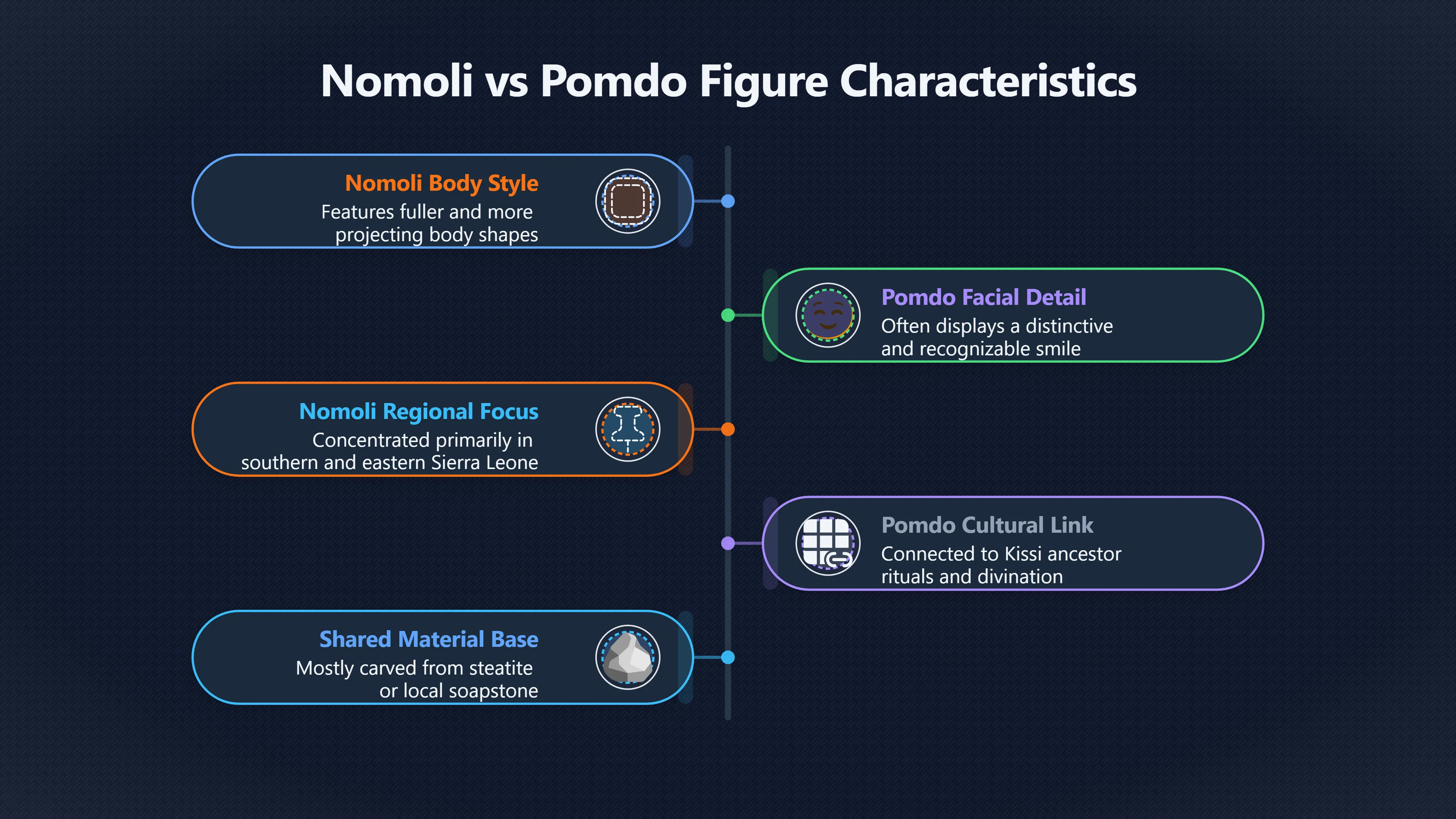
- Nomoli generally have fuller, more projecting bodies and are concentrated in Sierra Leone.
- Pomdo figures tend to be more cylindrical and, according to museum specialists, often display a distinctive smile. They remained connected with ancestor rituals and divination among the Kissi for longer than many Sierra Leonean nomoli.[British Museum]britishmuseum.orgBritish Museumfigure | British MuseumBritish Museumfigure | British Museum
Hundreds of examples now reside in museums and private collections, but many were originally discovered accidentally during farming, road building or mining. Unlike statues standing in temples or shrines, they usually appeared without obvious archaeological context, making them unusually mysterious to later generations.
Why were they called “found spirits”?
One of the most remarkable aspects of the nomoli tradition is that many communities no longer remembered who had carved them.
Museum research notes that the Mende name nomoli has commonly been interpreted as meaning “found spirits”, reflecting the belief that the figures emerged unexpectedly from the earth rather than belonging to any living tradition. Related traditions also describe them as remains of earlier peoples who occupied the land before present-day communities arrived.[sierraleoneheritage.org]sierraleoneheritage.orgSierra Leone Heritage NomoliSierra Leone Heritage Nomoli
Early European visitors recorded that local informants often believed the sculptures had been made by people or beings no longer living in the region. Some traditions attributed them to mysterious earlier inhabitants; others regarded them as products of supernatural beings because nobody knew how such carvings could have been created.[Wikipedia]WikipediaArt in Sierra LeoneArt in Sierra Leone
That combination of forgotten craftsmanship and dramatic rediscovery is exactly the sort of circumstance that repeatedly generates Fortean traditions around the world. Once the makers are forgotten, every fresh discovery becomes an invitation to speculation.
From buried objects to “rice gods”
Perhaps the best documented transformation is the way archaeological objects became active ritual objects.
Rather than leaving unearthed figures where they were found, many farming communities gave them new religious roles. Historical accounts describe nomoli being placed beside rice fields or inside temporary shrines where offerings were made in hopes of improving harvests. Some were ceremonially fed with cooked rice, while ritual whipping symbolically urged the figures to produce abundant crops. Others were consulted by diviners or kept as protective household spirits.[unisa.ac.za]ir.unisa.ac.zaIRTHE PLACE OF AFRICAN TRADITIONAL RELIGION IN INTERRELIGIOUSApril 21, 2026…
This secondary use is important because it does not necessarily reveal the figures’ original purpose.
Instead, archaeologists distinguish between:
- the original function, which remains uncertain;
- the later ritual use, which is historically well documented.
Modern readers sometimes blur these together, assuming the statues were always agricultural deities. The available evidence suggests something more complicated: forgotten artefacts were incorporated into later religious life because they already seemed ancient and powerful.
How old are they really?
Dating nomoli remains surprisingly difficult.
Most figures have been discovered outside controlled archaeological excavations, meaning there is often no associated pottery, charcoal or building remains that could be radiocarbon dated. Their age therefore has to be estimated through style, historical context and occasional archaeological evidence rather than precise laboratory dating.[sierraleoneheritage.org]sierraleoneheritage.orgSierra Leone Heritage NomoliSierra Leone Heritage Nomoli
Specialists generally agree on several cautious conclusions.
- They predate sustained European contact with Sierra Leone.(#endnote-1 “Endnote 1”)[sierraleoneheritage.org]sierraleoneheritage.orgSierra Leone Heritage NomoliSierra Leone Heritage Nomoli
- They were almost certainly produced by local West African craftsmen.
- Some stylistic features resemble sixteenth-century Afro-Portuguese ivory carvings, suggesting at least part of the tradition continued during that period.
- They may represent an artistic tradition that began considerably earlier, although exactly how much earlier remains unresolved.[British Museum]britishmuseum.orgBritish Museumnomoli figure | British MuseumBritish Museumnomoli figure | British Museum
Because precise dating remains elusive, the figures retain an aura of mystery without requiring extraordinary explanations.

What did they originally represent?
No surviving written records explain why nomoli were first carved, so archaeologists rely on comparisons with regional art and oral tradition.
Several interpretations receive serious scholarly consideration.
Ancestor figures. Their seated poses, dignified expressions and careful carving resemble commemorative sculpture elsewhere in West Africa.
Chiefs or elite leaders. Some researchers believe they portrayed important individuals whose authority continued after death.
Objects connected with ritual authority. Their careful placement and durable material suggest ceremonial rather than decorative purposes.
These ideas are not mutually exclusive. A sculpture could have represented an honoured ancestor who was also a former political leader. None of these interpretations requires assuming the statues were intended as supernatural beings in their own right.[britishmuseum.org]britishmuseum.orgBritish Museumnomoli figure | British MuseumBritish Museumnomoli figure | British Museum
Ancient astronauts, sky stones and the evidence problem
The mysterious circumstances surrounding nomoli have inevitably attracted fringe theories.
Popular books, documentaries and internet articles have claimed that the figures represent extraterrestrials, preserve memories of advanced lost civilisations or depict impossible technologies. Others argue that because they are found underground they must have fallen from the sky or been created by visitors from another world.
These claims have several recurring weaknesses.
First, they rely heavily on the fact that the figures’ original makers are unknown rather than producing positive evidence for extraordinary origins.
Second, they often exaggerate the uncertainty surrounding the sculptures’ age, assigning dates many thousands of years older than any archaeological evidence supports.
Third, features described as “alien” are usually ordinary artistic conventions, including enlarged heads, stylised eyes and symbolic body proportions that appear widely in African sculpture.
Perhaps most importantly, the figures themselves are carved from ordinary local stone using techniques entirely consistent with human craftsmanship. Museum specialists have long rejected suggestions that they were naturally formed objects or evidence of non-human technology. Even early twentieth-century researchers concluded that the sculptures were locally made African works rather than imports from some lost civilisation.[britishmuseum.org]britishmuseum.orgBritish Museumnomoli figure | British MuseumBritish Museumnomoli figure | British Museum
The real mystery is therefore historical rather than paranormal: which society created them, over what period, and why did knowledge of that tradition fade?

Why the mystery still endures
Nomoli continue to occupy a fascinating middle ground between archaeology and folklore.
For archaeologists, they are evidence of an artistic tradition that flourished before many written records for the region. Every newly documented example helps reconstruct Sierra Leone’s deeper cultural history.
For local tradition, they remain objects whose rediscovery carries symbolic power. Stories about guardian spirits, forgotten ancestors and miraculous harvests preserve memories of how communities interpreted ancient objects whose creators had vanished from living memory.
For Fortean enthusiasts, they offer a classic example of how genuine archaeological uncertainty can generate increasingly elaborate supernatural explanations. The buried statues are real. Their makers are still imperfectly understood. The legends grew afterwards.
That combination—authentic artefacts, missing historical context and centuries of evolving interpretation—is precisely what gives Sierra Leone’s nomoli figures their enduring reputation as one of the country’s most compelling found-spirit mysteries.
Amazon book picks
Further Reading
Books and field guides related to Why Do Sierra Leone's Nomoli Figures Feel So Mysterious?. Use these as the next step if you want deeper reading beyond the article.
Fingerprints of the gods
Represents speculative interpretations often compared with archaeological evidence.
eBay marketplace picks
Marketplace Samples
Live-tested eBay searches with available results related to this page.

Endnotes
1.
Source: sierraleoneheritage.org
Title: Sierra Leone Heritage Nomoli
Link:https://www.sierraleoneheritage.org/item/BM%3AAf.1909.220.1/nomoli
2.
Source: Wikipedia
Title: Nomoli figurine
Link:https://en.wikipedia.org/wiki/Nomoli_figurine
3.
Source: Wikipedia
Title: Art in Sierra Leone
Link:https://en.wikipedia.org/wiki/Art_in_Sierra_Leone
4.
Source: sierraleoneheritage.org
Title: Sierra Leone Heritage Nomoli1
Link:https://www.sierraleoneheritage.org/item/BM%3AAf.1948.39.4/nomoli
Source snippet
2. Image: Nomoli Image: Nomoli NOMOLI A stone figure, known as nomoli in Mende, carved out of steatite, or soapstone. The age of figures...
5.
Source: sierraleoneheritage.org
Title: Sierra Leone Heritage Nomoli1
Link:https://www.sierraleoneheritage.org/item/BM%3AAf.1906.525.34/nomoli
Source snippet
2. 3. 4. Image: Nomoli Image: Nomoli Image: Nomoli Image: Nomoli NOMOLI A stone figure, known as nomoli in Mende, carved out of steatite...
6.
Source: sierraleoneheritage.org
Title: Sierra Leone Heritage Nomoli1
Link:https://www.sierraleoneheritage.org/item/BM%3AAf.1906.525.5/nomoli
Source snippet
2. 3. 4. Image: Nomoli Image: Nomoli Image: Nomoli Image: Nomoli NOMOLI A stone figure, known as nomoli in Mende, carved out of steatite...
7.
Source: britishmuseum.org
Title: British Museumnomoli figure | British Museum
Link:https://www.britishmuseum.org/collection/object/E_Af1904
8.
Source: britishmuseum.org
Title: British Museumfigure | British Museum
Link:https://www.britishmuseum.org/collection/object/E_Af1970
9.
Source: ir.unisa.ac.za
Link:https://ir.unisa.ac.za/bitstream/handle/10500/2316/thesis.pdf?isAllowed=y&sequence=1
Source snippet
IRTHE PLACE OF AFRICAN TRADITIONAL RELIGION IN INTERRELIGIOUSApril 21, 2026...
Published: April 21, 2026
10.
Source: britishmuseum.org
Title: Production place Made
Link:https://www.britishmuseum.org/collection/object/E_Af1947
Source snippet
nomoli figure | British MuseumNOMOLI FIGURE Object Type nomoli figure Museum number Af1947,18.2 Description Register 1947: Stone seated f...
11.
Source: britishmuseum.org
Link:https://www.britishmuseum.org/collection/object/E_Af1979
Source snippet
nomoli figure | British MuseumNOMOLI FIGURE Object Type nomoli figure Museum number Af1979,01.5034 Description Small, carved stone figure...
12.
Source: britishmuseum.org
Link:https://www.britishmuseum.org/collection/object/E_Af1979
Source snippet
nomoli figure | British MuseumNOMOLI FIGURE Object Type nomoli figure Museum number Af1979,01.5143 Description Small, carved stone figure...
13.
Source: britishmuseum.org
Title: Production place Made in: Sierra Leone Findspot Found/Acquired
Link:https://www.britishmuseum.org/collection/object/E_Af1909
Source snippet
nomoli figure (?) | British MuseumNOMOLI FIGURE(?) Object Type nomoli figure (?) Museum number Af1909,0220.1 Description Figure of a seat...
14.
Source: britishmuseum.org
Title: Production ethnic group Made by: Sherbro (?) Production date
Link:https://www.britishmuseum.org/collection/object/E_Af1979
Source snippet
nomoli figure (head) | British MuseumNOMOLI FIGURE(HEAD) Object Type nomoli figure (head) Museum number Af1979,01.5037 Description Small...
15.
Source: britishmuseum.org
Link:https://www.britishmuseum.org/collection/object/E_Af1979-01-5033?selectedImageId=1614160263
Source snippet
nomoli figure | British MuseumNOMOLI FIGURE Object Type nomoli figure Museum number Af1979,01.5033 Description Small, carved stone figure...
Additional References
16.
Source: youtube.com
Title: 3 Ancient Mysteries YOU Never Knew Existed That Scientists CANNOT Explain
Link:https://www.youtube.com/watch?v=By_weB–EHk
Source snippet
Ancient Aliens: Reptile Sky Gods Descend to Earth (Season 18) | History...
17.
Source: youtube.com
Title: Divine Messages Hidden in the Stars | Ancient Aliens | History
Link:https://www.youtube.com/watch?v=krNl_HtZ6ag
Source snippet
3 Ancient Mysteries YOU Never Knew Existed That Scientists CANNOT Explain...
18.
Source: youtube.com
Title: Why Nomoli Figures Are Impossible?
Link:https://www.youtube.com/watch?v=4EP5MFcH7TQ
Source snippet
Divine Messages Hidden in the Stars | Ancient Aliens | History...
19.
Source: youtube.com
Title: Giants and Aliens, What’s the Story of the Enigmatic Nomoli Figures!
Link:https://www.youtube.com/watch?v=De6bKQ_aKr8
Source snippet
Why Nomoli Figures Are Impossible?...
20.
Source: youtube.com
Title: Ancient Aliens: Reptile Sky Gods Descend to Earth (Season 18) | History
Link:https://www.youtube.com/watch?v=dkpkHUlAt9Q
Topic Tree