Where Armenia's Weird History Meets the Mountains
Armenia’s strange-history record is not dominated by one famous monster or a single national ghost story. Its strongest Fortean material sits where deep folklore, mountain archaeology, Soviet-era space science and modern sky reports overlap.
Page outline Jump by section
Why Armenia’s Forteana Is More Archaeological Than Ghostly
Readers looking for haunted castles, poltergeist files or a tidy “Armenian Loch Ness Monster” will find the evidence thin. Armenia’s better-attested weird material is older and stranger: carved stones on high ground, dragon-serpent traditions, folk demons, visionary interpretations of ancient sites, and sky phenomena that sit between eyewitness wonder and scientific explanation.
That does not make the material dull. It makes it unusually grounded. In Armenia, the most interesting question is often not “did something supernatural happen?” but “why did this place invite supernatural, cosmic or mythic interpretation?” Mountains, storms, lakes and standing stones do much of the work. The same landscape that produced water-dragon stories also hosts archaeological monuments now being studied with mapping, geochemistry and heritage science. The same country associated in popular culture with ancient mysteries also housed Byurakan Observatory, where sober scientists discussed whether intelligent life elsewhere in the universe might be detectable.[nature.com]nature.comOpen source on nature.com.
This gives Armenia a distinctive Fortean profile: less séance-room melodrama, more “what happens when folklore, national heritage, astronomy and modern media all point at the sky?”
The Dragon Stones: Armenia’s Best Strange Case
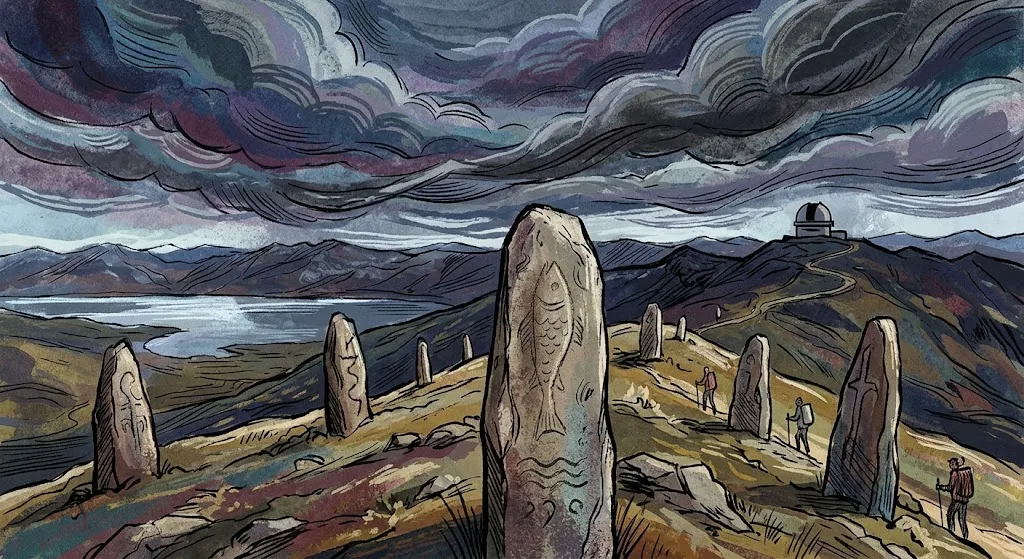
The most compelling Armenian entry in any country-level weird-history record is the group of prehistoric stone monuments often called vishap stones or “dragon stones”. These are not just tourist curiosities or internet folklore. UNESCO’s tentative-list page for “The Vishaps and the Cultural Landscape of Tirinkatar” describes the stones as among the earliest examples of figurative monumental art in the Caucasus, with Tirinkatar containing the largest known accumulation at one site. The listing presents the landscape as a long-used high-mountain ritual and settlement zone, shaped by seasonal movement, herding, irrigation and collective memory.[UNESCO World Heritage Centre]whc.unesco.orgOpen source on unesco.org.
The Fortean pull is obvious: large prehistoric stones, dragon imagery, high-altitude placement and water symbolism are exactly the ingredients that invite speculation. But the stronger story is archaeological rather than paranormal. A 2025 study in npj Heritage Science analysed 115 documented vishap stelae in Armenia and found support for the idea that they were linked to an ancient water cult, with many placed near springs, streams or prehistoric irrigation features. The authors also argue that their altitude and size patterns suggest deliberate, labour-intensive placement rather than random scattering.[Nature]nature.comOpen source on nature.com.
That matters because it gives the “dragon” story a material backbone. These stones are not proof that Armenians saw literal dragons. They show that dragon-like or fish-serpent imagery was tied to water, fertility, seasonal life and ritual order in a mountainous environment where water management could decide survival. Later legends of water dragons, lake dragons and storm dragons are easier to understand when set against that practical background.
The stones also show how a Fortean object can change category over time. To archaeologists, they are prehistoric monuments. To heritage bodies, they are culturally significant landscape markers. To folklorists, they resonate with dragon-serpent traditions. To modern mystery writers, they can become “ancient enigmas”. The most honest reading keeps all those layers visible without flattening the stones into either dry archaeology or supernatural bait.

Water Dragons, Storms and the Shape of Armenian Monsters
Armenian dragon lore is closely tied to water and weather. In popular summaries and older mythological accounts, the dragon-serpent figure is associated with lakes, rivers, mountains, clouds, floods and storms; some accounts make it destructive, while others treat it as a guardian or giver of abundance. The archaeological link between vishap stones and water sources strengthens the sense that Armenia’s dragons belong to the ecology of the highlands rather than to a simple “monster in a cave” template.[Wikipedia]WikipediaOpen source on wikipedia.org.
This is why Lake Sevan and mountain-water settings have such narrative pull, even when firm monster-sighting evidence is weak. Some modern travel and folklore retellings describe an old dragon connected with Lake Sevan, sometimes as a creature that ascends towards the sun, burns, and leaves black ash over the water. Such accounts are best treated as folklore and modern retelling, not as zoological evidence. Their value lies in showing how Armenian dragon imagery moves between lake, sky and storm.[Overland Armenia]overlandarmenia.comOpen source on overlandarmenia.com.
The same pattern appears in Christianised imagery. A 2021 study of dragon-serpent imagery in Armenian and South Caucasian medieval sculpture notes that the dragon-snake becomes a familiar symbol of the devil and underworld, appearing in reliefs of holy warriors slaying dragons from the sixth and seventh centuries onward. In other words, the old dragon did not disappear; it was reinterpreted. The creature that once helped explain water, storms and danger became part of Christian visual language about evil, victory and salvation.[Actual Art]publ.actual-art.orgOpen source on actual-art.org.
For Fortean readers, this is where Armenia becomes especially interesting. The dragon is not a cryptid in the modern sense, with footprints and blurry photographs. It is a long-lived explanatory figure, shifting from highland ritual to oral tradition to church sculpture to heritage tourism. It survived because it was useful: a memorable way to talk about water, risk, fertility, violence and divine order.
Zorats Karer: Ancient Observatory or Over-Loved Mystery?
Zorats Karer, also known internationally as Carahunge and often marketed as the “Armenian Stonehenge”, is the Armenian site most likely to appear in ancient-mystery writing. The site, near Sisian in southern Armenia, consists of standing stones, burial features and stones with holes. Popular claims have presented it as one of the world’s oldest observatories, sometimes with dates and certainties that go well beyond the evidence.
A more careful reading is more interesting. The Smithsonian’s travel coverage notes that the site’s name and interpretation have shifted: local tradition associated the stones with an “army of stones”, while later interpretations emphasised astronomical possibilities. The same article makes clear that the site is contested, with archaeology, local memory and national pride all shaping the way it is presented.[Smithsonian Magazine]smithsonianmag.comSmithsonian Magazine Unraveling the Mystery of the "Armenian StonehengeSmithsonian Magazine Unraveling the Mystery of the "Armenian Stonehenge
Recent reporting on surveys has also kept the site in the public eye. Archaeology Magazine reported that a survey identified 30 previously undocumented stones at Carahunge or Zorats Karer, describing the site as containing at least 223 stones with holes, burial cists and standing stones. That is enough to make it genuinely significant without needing to make it the oldest observatory on Earth.[Archaeology Magazine]archaeology.orgMagazine NewsMagazine News
The Fortean lesson is a familiar one: a mysterious stone site attracts a big claim; the big claim attracts tourism and speculation; specialists then have to separate plausible astronomical use from overconfident myth-making. Zorats Karer may well have had sky-related meanings or alignments, but “ancient observatory” is not the same as “prehistoric space-age science”. Its weirdness is not diminished by caution. The site is still a powerful example of how standing stones become screens for modern desire: for origins, for cosmic ancestry, for proof that the past knew more than we do.
Byurakan: Where “Aliens” Were a Serious Scientific Question
Armenia’s strongest connection to extraterrestrial life is not a crashed saucer story. It is Byurakan Astrophysical Observatory. Founded in 1946 by Viktor Ambartsumian, the observatory became a major Soviet scientific site, and its own history records conferences on extraterrestrial civilisations in 1964 and 1971.[aras.am]aras.amOpen source on aras.am.
The 1971 Byurakan meeting was especially important. The observatory’s page describes it as the First International Symposium on the Problem of Extraterrestrial Civilizations and Communication with Them, held from 6 to 11 September 1971 and organised jointly by Soviet and American scientific institutions. The participant list and framing place it firmly in the history of SETI: the search for extraterrestrial intelligence by scientific means, especially radio astronomy and communication theory.[Bao]bao.amOpen source on bao.am.
This is exactly the kind of case that gets blurred in popular memory. “Armenia hosted a conference about aliens” sounds like fringe material. In reality, it was part of Cold War science, involving astronomers and thinkers asking whether intelligent signals could be found and how humanity might recognise or interpret them. A contemporary New Yorker account described the meeting as sitting on the border between science and science fiction, but also as a serious gathering of experts discussing practical questions about detection methods, instruments and resources.[The New Yorker]newyorker.comletter from armenialetter from armenia
Byurakan therefore belongs on Armenia’s Fortean map for a very specific reason. It shows the respectable edge of the strange. The same theme that fuels UFO folklore — “are we alone?” — was being handled in Armenia by scientists, not contactees. That distinction matters. SETI is not evidence of visitors; it is evidence that the question of other minds in the universe became scientifically discussable.
The 2012 UFO That Was Probably a Missile
Modern Armenia has had UFO reports, but the best documented example is also one of the best explained. In June 2012, unusual lights were seen in Armenia and across a wider region. Radio Free Europe/Radio Liberty’s Armenian service reported that the Russian Defence Ministry had announced a Topol intercontinental ballistic missile test from Kapustin Yar at a time matching the sightings, and that this was suggested as the explanation for the “UFO” seen in Armenia and elsewhere.[«Ազատ Եվրոպա/Ազատություն» ռադիոկայան]azatutyun.amOpen source on azatutyun.am.
RFE/RL’s wider regional report reached the same conclusion: as images and videos spread, the apparent mystery increasingly looked like a missile event, with the Russian test providing the timing and mechanism. Such events can produce spectacular spirals, glowing trails and expanding clouds when fuel, exhaust or staging effects are illuminated high in the atmosphere.[RadioFreeEurope/RadioLiberty]rferl.orgOpen source on rferl.org.
Local scientific comment also pointed away from alien craft. Armenian reporting quoted Byurakan Observatory’s director Hayk Harutyunyan describing the observed objects as optical reflections associated with the Russian Topol test, not solid unknown craft.[Armenia News]news.amArmenia News Byurakan Observatory calls UFOs seen in Armenia 'opticalArmenia News Byurakan Observatory calls UFOs seen in Armenia 'optical
The case is useful because it shows how a convincing UFO wave can form without fakery or foolishness. Witnesses saw something genuinely unusual. Phones and cameras spread the images. The regional scale made it feel more important. But the best explanation was military aerospace activity, not visitation. Armenia’s 2012 UFO belongs in the weird-history record precisely because it demonstrates how the sky can be honestly strange and still be explicable.
Aragats: When the Mountain Really Does Glow With Particles
If Armenia has a modern “anomalous sky” story with hard scientific substance, it is not UFOs but thunderstorms over Mount Aragats. The Aragats high-altitude research station has been used for long-term cosmic-ray and atmospheric studies, and researchers there have documented thunderstorm ground enhancements: bursts of particles and gamma radiation detected at ground level during strong electrical storms.[arXiv]arxiv.orgOpen source on arxiv.org.
This sounds like Fortean theatre — a mountain under storms, invisible radiation, natural particle acceleration — but it is measured physics. A 2019 Scientific Reports paper describes cosmic rays as messengers for atmospheric and extra-atmospheric processes and explains that particle fluxes can carry information about atmospheric electricity. Later studies and datasets from Aragats describe extreme events, including large cosmic-ray increases linked to thunderstorms.[Nature]nature.comOpen source on nature.com.
The Fortean value is not that Aragats proves supernatural forces. It does almost the opposite. It shows that some apparently uncanny atmospheric effects are real, measurable and stranger than folklore would dare invent. Thunderclouds can act as natural accelerators. Ground detectors can record invisible bursts. Lightning can terminate or alter events. For readers of strange phenomena, Aragats is a reminder that “natural explanation” does not mean “boring explanation”.
It also adds a useful modern counterpoint to the dragon-storm material. Ancient stories linked dragons to storms, water and mountains because those were the forces people had to live with. Modern instruments on Aragats reveal a different invisible drama inside storms: charged particles, gamma rays and electric fields. The mythic dragon and the particle detector are not saying the same thing, but they are looking at the same kind of landscape with different tools.
Folk Spirits: Less Haunted House, More Dangerous Threshold
Armenian supernatural tradition also includes spirits, demons and uncanny beings, though the best-attested material is often part of wider Caucasian, Iranian and West Asian folklore rather than neat local ghost-tour material. The childbirth demon known as Al or Alk is one example. Encyclopaedia Iranica treats the figure as a folkloric being associated with puerperal fever and danger around childbirth, while more recent Caucasus-focused scholarship describes Al as a demon or demoness harmful to newborns and women in labour, with related forms across neighbouring regions.[Iranica Online]iranicaonline.orgIranica OnlineĀLIranica OnlineĀL
This is not “paranormal evidence” in the investigative sense. It is folk medicine, fear and social protection encoded as a being. Many cultures personified childbirth danger because the danger was real. Before modern obstetrics, infection, bleeding, infant death and postpartum illness needed explanation and ritual management. A demon at the threshold of birth made invisible risk memorable.
Other Armenian legendary beings show a similar concern with thresholds: life and death, mountain and home, water and land. Aralez figures, often described as dog-like beings able to revive fallen heroes by licking wounds, belong to heroic and mythic rather than ghost-hunting tradition. Folk-tale collections such as A. G. Seklemian’s The Golden Maiden and Other Folk Tales and Fairy Stories Told in Armenia also preserve a world of magical helpers, dangerous beings and impossible transformations, reflecting oral storytelling rather than case-file paranormal investigation.[Project Gutenberg]gutenberg.orgOpen source on gutenberg.org.
The result is a supernatural landscape that feels different from the Anglo-American haunted-house model. Armenian folklore is less preoccupied, at least in the accessible English record, with dead residents rattling chains in named buildings. It is more concerned with dangerous forces around birth, battle, water, storms, mountains and moral order.
Ancient Aliens, Petroglyphs and the Temptation to Overread
Armenia’s ancient sites and rock imagery also attract “paleocontact” interpretations: claims that petroglyphs, standing stones or mythic references preserve memories of alien visitors. This is not unusual. Around the world, ancient art becomes a favourite target for modern projection whenever figures look unfamiliar, stylised or hard to interpret.
There is even Armenian scholarship engaging with UFO urban legends as contemporary folklore. A paper summary from Vanadzor State University lists themes such as Orion, anomalous zones, Aragats, UFOs, aliens, memorates and paleocontact, and notes that petroglyphs and Zorats Karer can become sources of UFO interpretation as well as archaeological interest.[vsu.am]vsu.amOpen source on vsu.am.
The key point is not that these interpretations are well supported. It is that they are culturally revealing. Ancient-alien readings often say more about the present than the past: distrust of academic caution, hunger for cosmic origins, national pride in antiquity, and the internet’s habit of turning every ambiguous carving into an astronaut. In Armenia, the temptation is strengthened by real antiquity. The country has genuinely ancient monuments and a serious astronomical heritage, so the leap from “old stones and stars” to “lost space wisdom” can feel seductively short.
A grounded reading does not need that leap. Armenia’s ancient material is impressive without aliens. The vishap stones, Zorats Karer and highland petroglyphic traditions are more valuable when treated as human achievements: ritual, memory, observation, labour and imagination rooted in particular places.
What Still Feels Unresolved
Armenia’s Fortean record has unresolved edges, but they are not all the same kind of mystery. Some are evidential gaps: many local legends and newspaper oddities are hard to verify in accessible English sources, and some modern claims circulate mainly through tourism pages, social media or retellings. Some are interpretive disputes: Zorats Karer’s astronomical role, for instance, may involve real alignments without justifying the grandest claims. Some are scholarly questions: the exact social organisation behind the dragon-stone landscapes is still being investigated through archaeology and heritage science.[smithsonianmag.com]smithsonianmag.comSmithsonian Magazine Unraveling the Mystery of the "Armenian StonehengeSmithsonian Magazine Unraveling the Mystery of the "Armenian Stonehenge
The most important unresolved material is not “are there monsters in Lake Sevan?” or “did aliens visit Armenia?” The better questions are more human and more durable:
- Why did water-dragon symbolism become so important in Armenian highland landscapes?
- How did prehistoric ritual sites continue to gather new meanings across pagan, Christian, national and touristic contexts?
- Where is the line between plausible archaeoastronomy and modern mystery branding?
- How do modern Armenians inherit both serious space science and popular UFO folklore?
- What local stories remain under-documented because they were oral, regional or recorded in sources not widely translated?
These questions keep Armenia’s weird-history record alive without pretending that every rumour is a case.
Why Armenia Belongs on a Fortean Map
Armenia’s place in Forteana is not built on one spectacular anomaly. It is built on recurrence: dragons tied to water, stones placed in high landscapes, mountains watched by scientists, strange lights explained by missiles, and old fears preserved as spirits and demons. The country’s weird material has cultural pull because it sits at the border between the ancient and the modern. A visitor can move from prehistoric dragon stones to a Soviet observatory, from lake legends to particle bursts above Aragats, from folk demons to internet UFO theories, without leaving the same broad imaginative terrain.
The honest verdict is that Armenia offers little solid evidence for paranormal events in the strict sense. Its strongest cases are better understood as folklore, archaeology, atmospheric science, misidentified aerospace phenomena and modern myth-making. But that is not a disappointment. It is the point. Armenia shows how strange history often works: not as proof that the impossible happened, but as a record of how people read danger, wonder and meaning into stones, storms, skies and mountains.
Amazon book picks
Further Reading
Books and field guides related to Where Armenia's Weird History Meets the Mountains. Use these as the next step if you want deeper reading beyond the article.

Passport to Magonia: from folklore to flying saucers
Useful for readers exploring the UFO side of Armenia's strange history.
Mysteries of the Unexplained
Surveys the kinds of mysteries reflected in Armenia's traditions.
Armenia
First published 2019. Subjects: Armenia (republic), description and travel, Azerbaijan, description and travel.
eBay marketplace picks
Marketplace Samples
Live-tested eBay searches with available results related to this page.




Endnotes
1.
Source: whc.unesco.org
Link:https://whc.unesco.org/en/tentativelists/6702/
2.
Source: bao.am
Link:https://www.bao.am/meetings/meetings/ceti1971.php
3.
Source: nature.com
Link:https://www.nature.com/articles/s40494-025-01998-z
4.
Source: aras.am
Link:https://www.aras.am/BAO/history.html
5.
Source: whc.unesco.org
Title: World Heritage Centre Armenia
Link:https://whc.unesco.org/en/statesparties/am
6.
Source: Wikipedia
Link:https://en.wikipedia.org/wiki/Vishapakar
7.
Source: publ.actual-art.org
Link:https://publ.actual-art.org/aptha/en/article/view/10866
8.
Source: archaeology.org
Title: Magazine News
Link:https://archaeology.org/news/2020/08/10/200811-armenia-carahunge-survey/
9.
Source: arxiv.org
Link:https://arxiv.org/abs/2406.16163
10.
Source: nature.com
Link:https://www.nature.com/articles/s41598-019-42786-7
11.
Source: gutenberg.org
Link:https://www.gutenberg.org/files/46944/46944-h/46944-h.htm
12.
Source: vsu.am
Link:https://vsu.am/ufo-urban-legends-in-contemporary-armenian-folklore/
13.
Source: Wikipedia
Title: Armenian mythology
Link:https://en.wikipedia.org/wiki/Armenian_mythology
14.
Source: Wikipedia
Title: Rain of animals
Link:https://en.wikipedia.org/wiki/Rain_of_animals
15.
Source: Wikipedia
Title: Petrozavodsk phenomenon
Link:https://en.wikipedia.org/wiki/Petrozavodsk_phenomenon
16.
Source: Wikipedia
Title: Al (folklore)
Link:https://en.wikipedia.org/wiki/Al_%28folklore%29
17.
Source: Wikipedia
Title: Div (mythology)
Link:https://en.wikipedia.org/wiki/Div_%28mythology%29
18.
Source: Wikipedia
Link:https://en.wikipedia.org/wiki/First_Soviet-American_Conference_on_Communication_with_Extraterrestrial_Intelligence
19.
Source: Wikipedia
Title: Byurakan Conference
Link:https://en.wikipedia.org/wiki/Byurakan_Conference
20.
Source: Wikipedia
Title: List of World Heritage Sites in Armenia
Link:https://en.wikipedia.org/wiki/List_of_World_Heritage_Sites_in_Armenia
21.
Source: Wikipedia
Link:https://en.wikipedia.org/wiki/Carahunge
22.
Source: Wikipedia
Title: Christapor Mikaelian
Link:https://en.wikipedia.org/wiki/Christapor_Mikaelian
23.
Source: gutenberg.org
Link:https://www.gutenberg.org/ebooks/46944
24.
Source: gutenberg.org
Link:https://www.gutenberg.org/ebooks/subject/27345
25.
Source: gutenberg.org
Title: 38129 h
Link:https://www.gutenberg.org/files/38129/38129-h/38129-h.htm
26.
Source: gutenberg.org
Link:https://www.gutenberg.org/files/11461/11461-h/11461-h.htm
27.
Source: gutenberg.org
Link:https://www.gutenberg.org/files/54036/54036-h/54036-h.htm
28.
Source: carahunge.org
Link:https://carahunge.org/en/observatory/
29.
Source: arxiv.org
Link:https://arxiv.org/pdf/2508.11324
30.
Source: space.com
Title: 16076 spiraling ufo russian missile
Link:https://www.space.com/16076-spiraling-ufo-russian-missile.html?ms=Mhlink
31.
Source: archaeology.org
Title: researchers solve mystery of armenias dragon stones
Link:https://archaeology.org/news/2025/09/22/researchers-solve-mystery-of-armenias-dragon-stones/
32.
Source: azatutyun.am
Link:https://www.azatutyun.am/a/24608507.html
33.
Source: overlandarmenia.com
Link:https://overlandarmenia.com/en/vishaps-vishapaqars-in-the-mountains-of-armenia
34.
Source: smithsonianmag.com
Title: Smithsonian Magazine Unraveling the Mystery of the “Armenian Stonehenge”
Link:https://www.smithsonianmag.com/travel/unraveling-mystery-armenian-stonehenge-180964207/
35.
Source: newyorker.com
Title: letter from armenia
Link:https://www.newyorker.com/magazine/1971/11/06/letter-from-armenia
36.
Source: rferl.org
Link:https://www.rferl.org/a/transmission-ufo-missile-middle-east-russia/24607789.html
37.
Source: news.am
Title: Armenia News Byurakan Observatory calls UFOs seen in Armenia ‘optical
Link:https://news.am/en/news/109251
38.
Source: iranicaonline.org
Title: Iranica OnlineĀL
Link:https://www.iranicaonline.org/articles/al-folkloric-being-that-personifies-puerperal-fever/
39.
Source: barevarmenia.com
Link:https://barevarmenia.com/travelblog/vishaps/?srsltid=AfmBOoo8MKTuuimM2S9C6KdDxlPgKGYaU4jbGjwvnXfDsCMCC69l-GxJ
40.
Source: archaeologymag.com
Title: mystery of armenia s dragon stones solved
Link:https://archaeologymag.com/2025/09/mystery-of-armenia-s-dragon-stones-solved/
41.
Source: smithsonianmag.com
Title: strange rain why fish frogs and golf balls fall skies 180956527
Link:https://www.smithsonianmag.com/science-nature/strange-rain-why-fish-frogs-and-golf-balls-fall-skies-180956527/
42.
Source: news.am
Link:https://news.am/en/video/108757
43.
Source: mythslegendes.com
Title: Armenian Monsters
Link:https://mythslegendes.com/en/armenian-mythology/armenian-monsters/
44.
Source: oldeuropeanculture.blogspot.com
Title: vishap stones
Link:https://oldeuropeanculture.blogspot.com/2025/04/vishap-stones.html
Additional References
45.
Source: youtube.com
Title: Vishapakar: The Dragon Stones and Armenia’s Water-Driven Megaliths
Link:https://www.youtube.com/watch?v=Rko3euVWZcE
Source snippet
Zorats Karer.4500 Years Older Than Stonehenge.The Secret Hidden for 9000 Years...
46.
Source: loc.gov
Link:https://www.loc.gov/everyday-mysteries/browse-all-questions/item/can-it-rain-frogs-fish-and-other-objects/
47.
Source: cia.gov
Link:https://www.cia.gov/readingroom/document/0005517731
48.
Source: youtube.com
Title: The Vishapakar Stones: Armenia’s Strangest Megalithic Mystery
Link:https://www.youtube.com/watch?v=nKEPS7N0T9Y
Source snippet
The Mystery of the Mountaintop Fish Megaliths...
49.
Source: academia.edu
Link:https://www.academia.edu/41853983/The_History_of_Transnational_Armenian_Terrorism_in_the_Twentieth_Century_A_Historico_Criminological_Study
50.
Source: researchgate.net
Link:https://www.researchgate.net/publication/356379557_Dragons_under_Microscope_Determination_and_Identification_of_the_Geological_Sources_of_Vishap_Stone_Stelae_ARCHAEOLOGY_OF_ARMENIA_IN_REGIONAL_CONTEXT
51.
Source: researchgate.net
Link:https://www.researchgate.net/publication/381666889_Aragats_high_altitude_research_station_80_years_of_continuous_cosmic_ray_monitoring
52.
Source: reddit.com
Link:https://www.reddit.com/r/UFOs/comments/1o5ttgu/50100_unidentified_lights_over_ocean_off_the/
53.
Source: skepticalinquirer.org
Link:https://skepticalinquirer.org/newsletter/history-of-state-ufo-research-in-the-ussr/
54.
Source: brill.com
Link:https://brill.com/previewpdf/journals/ic/5/1/article-p149_18.xml?srsltid=AfmBOor7ghXjX2mhp-kqk0-v8X-BZry4qTcqiBaH8yGs-Uy92IfLQolJ
Topic Tree
Follow this branch
Related pages 192
- Afghan Forteana
- Antigua Uncanny
- Bosnian Mysteries
- Botswana Weird
- Brazil Strange
- +187 more in sidebar