Within Nicaragua Weird
Why Did Masaya Look Like Hell?
Masaya turns real lava, sulphur and crater glow into one of Central America's most memorable hell-mouth legends.
On this page
- The crater, glow and living geology
- Colonial fear, crosses and treasure stories
- Tourism, hazards and modern interpretation
Page outline Jump by section
Introduction
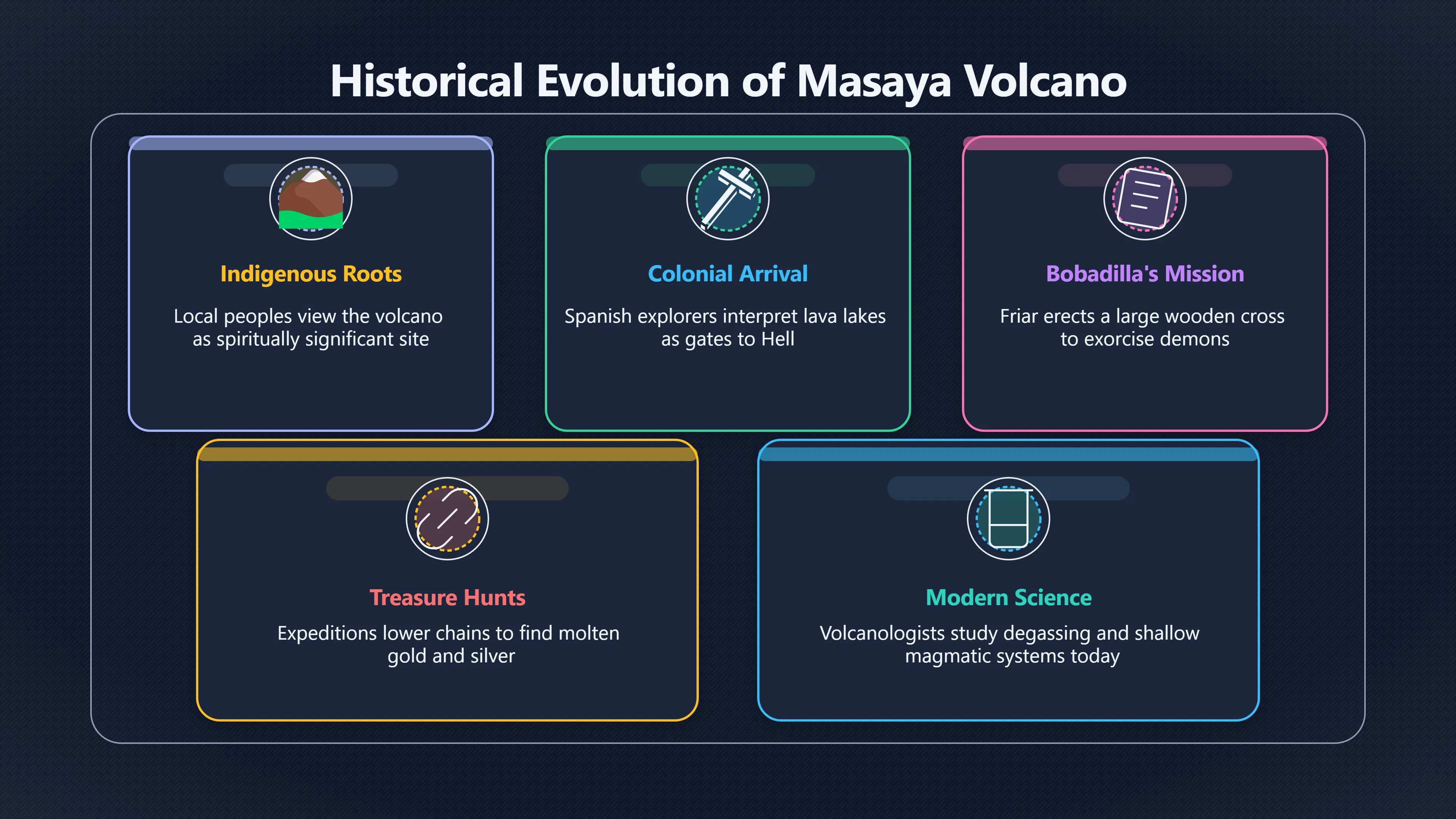
Masaya Volcano earned the nickname “the Mouth of Hell” because it combined something genuinely extraordinary with the religious imagination of the early Spanish colonial period. For centuries, visitors saw a crater that glowed with molten rock, belched sulphurous gases and seemed to roar from deep beneath the Earth. To people unfamiliar with active basaltic volcanoes, it looked less like a mountain than an entrance to the underworld. The resulting stories became some of Nicaragua’s most enduring pieces of strange history—not because they prove anything supernatural, but because they show how spectacular geology, Indigenous belief, colonial Christianity and later scientific investigation all shaped the same remarkable place. Modern volcanology explains why Masaya behaves as it does, yet the volcano remains one of Central America’s most evocative examples of how natural phenomena become powerful legends.[whoi.edu]whoi.eduWoods Hole Oceanographic InstitutionInto the 'Mouth of Hell' - Woods Hole…June 9, 2006 — 9 Jun 2006 — Unlike other volcanoes, Masaya v…
The crater, glow and living geology
Masaya lies around 20 kilometres south-east of Managua within a broad volcanic caldera that has been active for thousands of years. Today, activity is concentrated in Santiago Crater, where gas emissions, periodic lava lakes and incandescent glow have continued to attract both scientists and visitors. Unlike many volcanoes, Masaya often provides a direct view into an active volcanic conduit, allowing observers to see or detect magma surprisingly close to the surface.[Smithsonian Global Volcanism]volcano.si.eduSmithsonian Global VolcanismMasayaMasaya, the "Mouth of Hell", Nicaragua: volcanological interpretation of the myths, legends and anecdot…
What made the volcano seem uncanny to early observers was that its dramatic appearance was entirely real. At night, the crater could shine red. Thick sulphurous fumes escaped almost continuously, while deep rumbling noises echoed from below. Before geology explained magma chambers and volcanic gases, these sights and sounds naturally encouraged supernatural interpretations. The volcano did not merely erupt occasionally; it appeared to breathe.
Modern research has revealed why Masaya is unusually impressive. Scientists studying its emissions have found that many of its volcanic gases rise directly from magma with relatively little alteration by groundwater. This makes Masaya an important natural laboratory for understanding volcanic degassing while also helping explain why visitors encounter such intense sulphur smells and persistent gas plumes. The spectacular appearance that once inspired stories about Hell is therefore rooted in an unusually accessible volcanic system rather than mysterious forces.[Woods Hole Oceanographic Institution]whoi.eduWoods Hole Oceanographic InstitutionInto the 'Mouth of Hell' - Woods Hole…June 9, 2006 — 9 Jun 2006 — Unlike other volcanoes, Masaya v…
The volcano remains hazardous despite its popularity. Sulphur dioxide can reach levels dangerous to health, and changing volcanic conditions occasionally force restrictions on public access. The glowing crater that fascinates tourists is also a reminder that Masaya is an active volcano rather than simply a scenic landmark.[Smithsonian Global Volcanism]volcano.si.eduSmithsonian Global VolcanismMasayaMasaya, the "Mouth of Hell", Nicaragua: volcanological interpretation of the myths, legends and anecdot…
Why colonists believed they had found Hell
The phrase “Mouth of Hell” was not invented as colourful tourist advertising. It reflected genuine religious conviction among many Spanish colonists during the sixteenth century.
European ideas about volcanoes were still heavily influenced by medieval Christian thought. Classical volcanoes such as Vesuvius and Etna had long been associated with infernal fire, and theological writings often imagined volcanic openings as vents connected to Hell itself. When Spanish explorers encountered Masaya’s persistent lava lake—probably the first permanently active lava lake many Europeans had ever seen—they interpreted it through this familiar framework.[pages.mtu.edu]pages.mtu.eduMasaya, the “Mouth of Hell”, Nicaraguaby JG Viramonte · 2008 · Cited by 33 — Bobadilla climbing the volcano in 1529, where he erected a c…
Indigenous traditions surrounding Masaya were also reinterpreted through colonial eyes. Local peoples regarded the volcano as spiritually significant, and historical accounts describe offerings being made into the crater together with stories of supernatural beings associated with it. Rather than trying to understand these beliefs on their own terms, many Spanish writers concluded that Indigenous deities were manifestations of the Devil, reinforcing the belief that the volcano itself was infernal. Modern historians treat these colonial descriptions cautiously because they blend observation with religious prejudice and missionary agendas.[pages.mtu.edu]pages.mtu.eduMasaya, the “Mouth of Hell”, Nicaraguaby JG Viramonte · 2008 · Cited by 33 — Bobadilla climbing the volcano in 1529, where he erected a c…
Perhaps the best-known episode came in 1529, when the Mercedarian friar Francisco de Bobadilla climbed to the crater and erected a large wooden cross overlooking the abyss. According to the chronicles, the cross was intended to exorcise the Devil and symbolically seal the entrance to Hell. Variations of the “Bobadilla Cross” story remain part of Masaya’s identity today, and later replacements of the cross continue to stand as reminders of that dramatic encounter between religion and geology.[pages.mtu.edu]pages.mtu.eduMasaya, the “Mouth of Hell”, Nicaraguaby JG Viramonte · 2008 · Cited by 33 — Bobadilla climbing the volcano in 1529, where he erected a c…

Treasure beneath the flames
Hell was not the only explanation proposed for Masaya’s fiery depths.
Some early Spaniards believed the glowing material visible in the crater might conceal enormous quantities of molten gold or silver. The brightness of lava, seen from a distance and poorly understood, encouraged speculation that precious metals could be recovered from below.
Historical accounts describe remarkable attempts to test the idea. Expeditions lowered chains, baskets and equipment into the crater to collect samples despite the choking gases and intense heat. These dangerous ventures found volcanic rock rather than precious metal, but the stories survived because they combined greed, courage and apparent brushes with the infernal. Modern volcanologists regard these chronicles as valuable historical evidence, not because they reveal hidden treasure, but because their detailed observations help reconstruct the volcano’s behaviour during the colonial period.[pages.mtu.edu]pages.mtu.eduMasaya, the “Mouth of Hell”, Nicaraguaby JG Viramonte · 2008 · Cited by 33 — Bobadilla climbing the volcano in 1529, where he erected a c…
This blend of practical curiosity and supernatural expectation illustrates why Masaya occupies such a distinctive place in Nicaragua’s strange history. The same crater inspired both scientific observation and extravagant myth.
Why the legend endured after science arrived
Scientific understanding has transformed how Masaya is interpreted without making it any less remarkable.
Researchers now understand that the glowing crater, lava lakes, gas emissions and periodic eruptions result from a shallow magmatic system beneath the volcano. Geological studies have reconstructed repeated episodes of lava flows, explosive eruptions and changing crater structures over thousands of years. Rather than diminishing the old stories, this knowledge often makes them easier to understand. Sixteenth-century witnesses were describing real volcanic phenomena with the limited conceptual tools available to them.[Smithsonian Global Volcanism]volcano.si.eduSmithsonian Global VolcanismMasayaMasaya, the "Mouth of Hell", Nicaragua: volcanological interpretation of the myths, legends and anecdot…
The volcano has therefore become an unusual meeting point between folklore and science. Historians examine colonial chronicles for insights into early perceptions of the natural world, while volcanologists use many of the same accounts to identify past eruptions and changes in volcanic activity. A story that once served as religious warning now contributes to scientific reconstruction of Masaya’s history.[pages.mtu.edu]pages.mtu.eduMasaya, the “Mouth of Hell”, Nicaraguaby JG Viramonte · 2008 · Cited by 33 — Bobadilla climbing the volcano in 1529, where he erected a c…
Tourism, hazards and modern interpretation
Today Masaya National Park presents the volcano very differently from the fearful descriptions of colonial writers. Visitors often drive directly to viewpoints overlooking Santiago Crater, particularly after dark when volcanic glow is most visible if conditions permit. Interpretive displays explain both the geological processes and the historical stories, allowing the “Mouth of Hell” tradition to survive as cultural heritage rather than literal belief.[Woods Hole Oceanographic Institution]whoi.eduWoods Hole Oceanographic InstitutionInto the 'Mouth of Hell' - Woods Hole…June 9, 2006 — 9 Jun 2006 — Unlike other volcanoes, Masaya v…
The legend nevertheless retains its emotional power because the landscape still produces many of the sensations that inspired it. Visitors encounter sulphur fumes, hear volcanic rumbling, watch vapour rising from immense depths and, on favourable nights, glimpse incandescent magma below. The experience requires very little imagination to appreciate why sixteenth-century travellers reached for the strongest religious language they knew.
For Fortean readers, Masaya is especially valuable because it demonstrates how extraordinary natural settings generate extraordinary stories. There is no need to choose between geology and folklore. The volcano is simultaneously a scientifically important active volcanic system, a place of Indigenous cultural significance, a symbol of colonial religious history and one of Nicaragua’s most memorable examples of a landscape that genuinely looked, to generations of observers, like the entrance to another world.
Amazon book picks
Further Reading
Books and field guides related to Why Did Masaya Look Like Hell?. Use these as the next step if you want deeper reading beyond the article.

The volcano adventure guide
Provides practical volcano science context for visitors and enthusiasts.

The Book of Yōkai: Mysterious Creatures of Japanese Folklore
Useful comparative folklore reading for understanding how cultures transform fears and places into stories.

Underland: A Deep Time Journey
Captures the relationship between landscape, imagination and hidden worlds.
Krakatoa: The Day the World Exploded
Shows how volcanoes become cultural and historical events.
eBay marketplace picks
Marketplace Samples
Live-tested eBay searches with available results related to this page.

Endnotes
1.
Source: whoi.edu
Link:https://www.whoi.edu/oceanus/feature/into-the-mouth-of-hell/
Source snippet
Woods Hole Oceanographic InstitutionInto the 'Mouth of Hell' - Woods Hole...June 9, 2006 — 9 Jun 2006 — Unlike other volcanoes, Masaya v...
Published: June 9, 2006
2.
Source: pages.mtu.edu
Link:https://pages.mtu.edu/~raman/papers2/ViramonteMasayaJVGR08.pdf
Source snippet
Masaya, the “Mouth of Hell”, Nicaraguaby JG Viramonte · 2008 · Cited by 33 — Bobadilla climbing the volcano in 1529, where he erected a c...
3.
Source: volcano.si.edu
Link:https://volcano.si.edu/volcano.cfm?vn=344100
Source snippet
Smithsonian Global VolcanismMasayaMasaya, the "Mouth of Hell", Nicaragua: volcanological interpretation of the myths, legends and anecdot...
4.
Source: youtube.com
Link:https://www.youtube.com/watch?v=jCjC_INadBM
Source snippet
The Masaya Volcano: Inside the "Mouth of Hell"In the heart of Nicaragua, the Masaya volcano has been active for over 30000 years, creatin...
Additional References
5.
Source: academia.edu
Link:https://www.academia.edu/20991434/Masaya_the_Mouth_of_Hell_Nicaragua_Volcanological_interpretation_of_the_myths_legends_and_anecdotes
Source snippet
volcanic complex in Nicaragua, referred to as the 'Mouth of Hell,' through...Read more...
6.
Source: facebook.com
Link:https://www.facebook.com/NatGeoBooks/posts/the-masaya-volcanos-fiery-lava-lake-has-been-bubbling-for-centuries-in-nicaragua/999681128866575/
Source snippet
They planted a cross, "La Cruz de Bobadilla" (named after...Read more...
7.
Source: researchgate.net
Link:https://www.researchgate.net/publication/222416827_Masaya_the_Mouth_of_Hell_Nicaragua_Volcanological_interpretation_of_the_myths_legends_and_anecdotes
Source snippet
Masaya, the “Mouth of Hell”, Nicaragua: Volcanological...Nicaragua's conquest started only 30years after Christopher Columbu...
8.
Source: bigfive.com
Title: Big Five Infierno de Masaya, Nicaragua
Link:https://bigfive.com/infierno-de-masaya-nicaragua/
Source snippet
Infierno de Masaya, Nicaragua - Big Five Tours & ExpeditionsIn 1529, Mercedarian Fray Francisco de Bobadilla climbed the volcano, where h...
9.
Source: volcanocafe.org
Title: masaya volcano the mouth of hell
Link:https://www.volcanocafe.org/masaya-volcano-the-mouth-of-hell/
Source snippet
Masaya Volcano: the mouth of hell15 Feb 2017 — Volcan Masaya is one of Nicaragua's most active and unusual volcano which lies within the...
10.
Source: youtube.com
Title: Masaya Volcano, Nicaragua | Incredible molten lava lake in an active volcano
Link:https://www.youtube.com/watch?v=ZabJMWfx-yM
Source snippet
Volcanic Zipline into the Mouth of Hell...
11.
Source: youtube.com
Title: Volcanic Zipline into the Mouth of Hell
Link:https://www.youtube.com/watch?v=JJbjdeU3TVw
Source snippet
Ep. 27 - MASAYA volcano, NICARAGUA aka MOUTH OF HELL...
12.
Source: youtube.com
Title: Into Nicaragua’s Masaya Volcano | Explorer
Link:https://www.youtube.com/watch?v=90vUlxV3kjc
Source snippet
The Masaya Volcano: Inside the "Mouth of Hell"...
13.
Source: youtube.com
Title: Ep. 27
Link:https://www.youtube.com/watch?v=VxmehPFoa5g
Topic Tree