Within Brunei Weird
Why Does Brunei Have a Stone Ship?
Jong Batu turns a visible rock in the Brunei River into one of the country's strongest place-based legends.
On this page
- The Nakhoda Manis story
- The rock as folk evidence
- Curses, filial duty and river geography
Page outline Jump by section
Introduction
Jong Batu is one of Brunei’s best-known landmarks because it appears to offer physical proof of an impossible story. Rising from the Brunei River, the rocky outcrop resembles the bow of a ship emerging from the water. According to local tradition, it is exactly that: the petrified remains of the vessel of Nakhoda Manis, a wealthy trader who denied his own mother and was cursed for his ingratitude. Whether viewed as folklore, a moral lesson or a place-bound mystery, the legend has endured because visitors can point to a real object in the landscape and say, “There it is.” That combination of visible geography and supernatural explanation makes Jong Batu one of the strongest examples of Brunei’s place-based Fortean tradition.[Wikipedia]WikipediaJong BatuJong Batu

Why Does Brunei Have a Stone Ship?
Jong Batu is a rocky outcrop in the Brunei River, east of the royal residence, the Istana Nurul Iman. From certain angles it resembles the prow of a large vessel sinking beneath the river’s surface. The formation is around 20 metres long and can be reached by boat from Kampong Ayer in only a few minutes, making it a familiar sight on river tours rather than a remote curiosity.[Wikipedia]WikipediaJong BatuJong Batu
Unlike many supernatural legends that have no physical anchor, the Jong Batu story begins with a feature anyone can see. The rock is therefore treated in folklore as an explanation for an existing landmark rather than as evidence that a miracle occurred. This type of legend, sometimes called an origin legend or etiological tale, explains how a landscape feature supposedly came into being. The persistence of the rock gives the story a permanent stage.
The Nakhoda Manis Story
The central narrative varies in detail but follows a remarkably consistent structure.
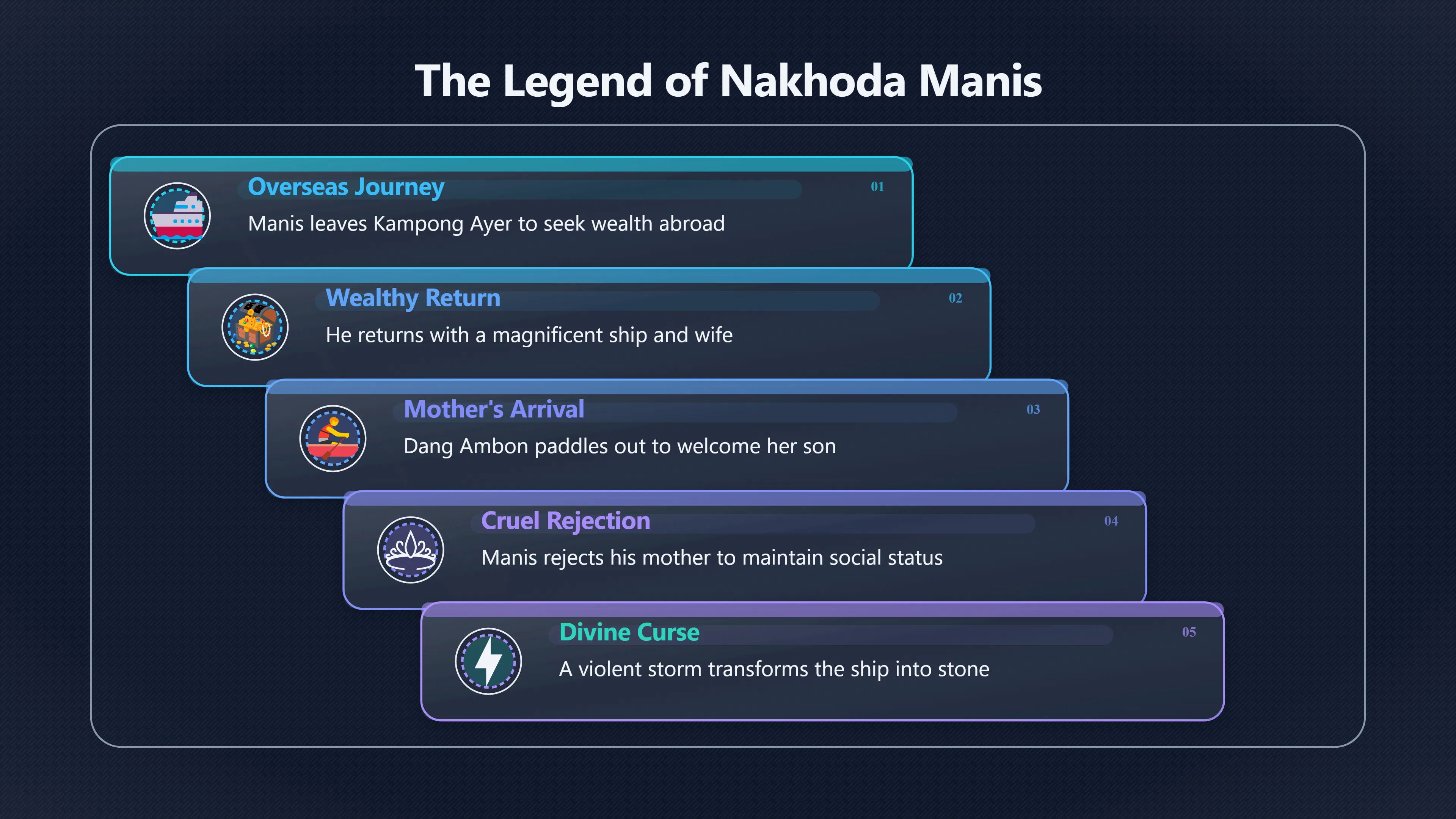
Nakhoda Manis, often simply called Manis before becoming a successful captain, leaves Kampong Ayer to seek wealth overseas. Some versions describe his family as prosperous before his departure, while others portray him as poor but ambitious. After years abroad he returns as a wealthy merchant, accompanied by an elegant wife and a magnificent ship.[Wikipedia]WikipediaJong BatuJong Batu
His ageing mother, usually named Dang Ambon or a similar variant depending on the retelling, paddles out in a small boat to welcome him home. She has waited for him for years and, in some versions, has given away her wealth in charity while praying for his safe return. Excited to embrace her son, she instead finds herself rejected.
The reason for the rejection differs slightly between tellings. In some versions, Manis himself is ashamed of her poverty. In others, his noble-born wife refuses to believe that such a poorly dressed woman could be related to her husband, and Manis chooses status over family loyalty. Either way, he orders that his mother be driven away from his ship.[Wikipedia]WikipediaJong BatuJong Batu
Heartbroken, the mother calls upon divine justice and curses her son. A violent storm suddenly develops, overturning the ship. When calm returns, the vessel has become a stone formation in the river: Jong Batu, literally “Stone Ship”. The captain, his crew and, in some versions, his wife are all transformed along with it.[Wikipedia]WikipediaJong BatuJong Batu
The Rock as Folk Evidence
For readers interested in Forteana, the fascinating aspect is not whether anyone believes a ship literally turned into stone. Instead, it is the way the landscape functions as “folk evidence”.
Because the rock resembles a partially submerged vessel, each generation can connect the visible formation with the traditional account. The legend therefore gains credibility through geography rather than through eyewitness testimony or historical documents.
This differs from many ghost stories, which rely entirely on reported experiences. Jong Batu’s continuing influence comes from three elements working together:
- a distinctive natural landmark;
- a memorable moral narrative;
- repeated local storytelling attached to a fixed location.
The result is a legend that survives not because new supernatural events are reported there, but because the rock continually invites explanation.
Curses, Filial Duty and River Geography
The supernatural element—a mother’s curse transforming an entire ship into stone—is inseparable from the story’s moral purpose.
Across Brunei and much of Southeast Asia, respect for parents is treated as a foundational social value. Nakhoda Manis embodies the opposite: prosperity achieved at the cost of forgetting one’s origins. His punishment is immediate, public and permanent.
The Brunei River is an especially fitting setting for such a tale. Historically it was the centre of trade, government and life in Kampong Ayer. Merchant vessels regularly travelled between Brunei and neighbouring ports, making the success of a seafaring trader entirely believable. Against this realistic backdrop, the supernatural transformation stands out all the more sharply. The extraordinary event interrupts an otherwise recognisable historical world.[Wikipedia]WikipediaBrunei RiverBrunei River
Part of a Wider Southeast Asian Family of Legends
Nakhoda Manis is not an isolated story. Folklorists have long recognised that it belongs to a widespread family of “ungrateful son” legends found across maritime Southeast Asia.
The closest parallels include:
- the Indonesian story of Malin Kundang from West Sumatra;(#endnote-4 “Endnote 4”)[Wikipedia]WikipediaMalin KundangMalin Kundang
- the Malaysian legend of Si Tanggang;
- related variants found elsewhere in the Malay world and the southern Philippines.
All involve a successful son who rejects his mother, receives a curse and is transformed into stone, usually alongside his ship. The similarities suggest centuries of cultural exchange through the trading networks that linked Brunei with neighbouring ports rather than independent invention of identical stories. Each region localises the narrative by attaching it to its own coastline or rock formation.[Wikipedia]WikipediaMalin KundangMalin Kundang
For Brunei, Jong Batu performs that localising role. The moral is shared across the region, but the landmark belongs specifically to the Brunei River.
History, Folklore and Modern Interpretation
There is no historical evidence that Nakhoda Manis was a documented individual whose vessel was destroyed by supernatural means. The story survives instead through oral tradition, educational materials, local histories and tourism.
Modern scholars generally interpret it as a classic example of a place legend: a narrative created or preserved to explain an unusual geographical feature while reinforcing important cultural values. More recent comparative studies continue to examine Nakhoda Manis alongside similar Southeast Asian traditions as an example of how shared folklore adapts to local landscapes while preserving the same moral structure.[ResearchGate]researchgate.netDespite their cultural specificity –…Read more…
Believers who recount the legend are rarely attempting to prove that rocks can literally form from ships. Rather, the story remains meaningful because it expresses ideas about gratitude, family obligation and the dangers of pride in a memorable way that is tied to a real place people can still visit.
Why Jong Batu Endures in Brunei’s Strange-History Tradition
Among Brunei’s many legends, Jong Batu occupies a distinctive position because it combines a visible landmark with an apparently supernatural explanation. It is therefore remembered both as a cultural treasure and as one of the country’s strongest examples of folklore anchored to the physical landscape.
For students of Forteana, it illustrates how extraordinary claims can become inseparable from geography. The rock itself is entirely real; the curse belongs to tradition. Their combination has allowed the story of Nakhoda Manis to endure for centuries, making Jong Batu not simply a curious rock in a river but one of Brunei’s defining examples of how landscape, morality and the supernatural imagination can become permanently intertwined.

Amazon book picks
Further Reading
Books and field guides related to Why Does Brunei Have a Stone Ship?. Use these as the next step if you want deeper reading beyond the article.



The Element Encyclopedia of Magical Creatures
Places supernatural transformation stories in wider tradition.
eBay marketplace picks
Marketplace Samples
Live-tested eBay searches with available results related to this page.



Endnotes
1.
Source: Wikipedia
Title: Jong Batu
Link:https://en.wikipedia.org/wiki/Jong_Batu
2.
Source: researchgate.net
Title: 388401828 Translation of Bruneian folk tales Nahkoda Manis
Link:https://www.researchgate.net/publication/388401828_Translation_of_Bruneian_folk_tales_Nahkoda_Manis
Source snippet
ResearchGate(PDF) Translation of Bruneian folk tales "Nahkoda Manis"31 Jan 2025 — In Brunei's geography, a large rock formation stands in...
3.
Source: Wikipedia
Title: Brunei River
Link:https://en.wikipedia.org/wiki/Brunei_River
4.
Source: Wikipedia
Title: Malin Kundang
Link:https://en.wikipedia.org/wiki/Malin_Kundang
5.
Source: researchgate.net
Link:https://www.researchgate.net/publication/394430623_The_Motif_of_Ungrateful_Son_in_Nusantara_Folklore_A_Proppian_Morphological_Analysis_of_Malin_Kundang_Si_Tanggang_and_Nokhoda_Manis
Source snippet
Despite their cultural specificity –...Read more...
Additional References
6.
Source: asianfolktales.unescoapceiu.org
Link:https://asianfolktales.unescoapceiu.org/folktales/read/pdf/Brunei_Darussalam/Nakhoda_Manis.pdf
Source snippet
nakhoda ManisJong Batu is a rock resembling a sinking ship found in the. Brunei River. • Used in Brunei Darussalam, Indonesia, and Malays...
7.
Source: youtube.com
Link:https://www.youtube.com/watch?v=7P-fHnjiPdc
8.
Source: youtube.com
Link:https://www.youtube.com/watch?v=8UiqxpCNCwE
9.
Source: youtube.com
Link:https://www.youtube.com/watch?v=D8RCn6ff4Go
10.
Source: youtube.com
Link:https://www.youtube.com/watch?v=KfWmO9uSe7A
11.
Source: youtube.com
Link:https://www.youtube.com/watch?v=LICiZE8_Be4
12.
Source: youtube.com
Link:https://www.youtube.com/watch?v=N_vOBK0OzYQ
13.
Source: youtube.com
Link:https://www.youtube.com/watch?v=PqkpgXq0HAM
14.
Source: youtube.com
Link:https://www.youtube.com/watch?v=T4mVR7Hotc8
Topic Tree