Within Kenya Strange
Was the Nandi Bear Ever a Real Animal?
The Nandi Bear turns night sightings, predator fear and colonial natural history into Kenya's most famous mystery-animal puzzle.

On this page
- What witnesses and writers claimed
- Hyenas, baboons and other likely suspects
- Why the legend still grips cryptozoology
Page outline Jump by section
Introduction
The Nandi Bear is Kenya’s best-known mystery animal, but the name hides a more complicated story than a simple search for an undiscovered beast. Reports from western Kenya, especially the Nandi Highlands, describe a powerful nocturnal predator with a sloping back, shaggy coat and fearsome reputation. Some witnesses compared it to a giant hyena, others to a bear, a baboon or something with no obvious modern equivalent. More than a century after the reports became famous, no specimen, skeleton or verified photograph has confirmed the existence of a distinct species. That absence of physical evidence has not ended the debate. Instead, the Nandi Bear has become an enduring case study in how folklore, colonial natural history, eyewitness testimony and modern cryptozoology overlap, making it one of the most intriguing entries in Kenya’s strange-animal tradition.[Wikipedia]WikipediaNandi bearNandi bear

What witnesses and writers claimed
Most classic Nandi Bear reports came from western Kenya during the late nineteenth and early twentieth centuries, a period when European administrators, settlers and naturalists were collecting local accounts of unfamiliar wildlife alongside their own observations. Rather than describing a single, consistent creature, witnesses produced a surprisingly varied collection of descriptions.
The recurring features included:
- A large, muscular body with especially heavy forequarters.
- A noticeably sloping back, higher at the shoulders than the hips.
- Shaggy reddish, brown or black fur.
- Mostly nocturnal habits.
- A reputation for attacking livestock and occasionally people.
- Unusual footprints that did not seem to match familiar animals.
Some stories added more dramatic details, claiming the creature scalped victims or fed on brains. Such accounts almost certainly reflect folklore as much as zoology, but they became inseparable from the legend as later writers repeated them. Different communities also used different names, including Kerit and Chemosit, although these terms have not always been used consistently and sometimes refer to overlapping traditions rather than a single animal.[Wikipedia]WikipediaNandi bearNandi bear
Colonial writers often treated these reports as genuine zoological puzzles. Early natural-history journals discussed unidentified tracks, alleged shootings and fleeting encounters. Charles W. Hobley even published a sketch of a supposed footprint in 1913, reflecting the serious curiosity that surrounded the reports before East Africa’s wildlife became thoroughly surveyed.[Wikipedia]WikipediaNandi bearNandi bear
Why the evidence never became convincing
The striking feature of the Nandi Bear record is not the number of stories but the lack of durable evidence behind them.
Over many decades, enthusiasts claimed that skins, bones or complete carcasses had been recovered, yet none can be traced today to authenticated museum collections. Likewise, while tracks were occasionally sketched or described, there are no widely accepted casts that demonstrate an unknown species. Reports of photographs likewise remain unverified or lost.[Cryptid Wiki]cryptidz.fandom.comCryptid Wiki Nandi BearCryptid WikiNandi Bear - Cryptid Wiki - FandomSome have suggested that the Nandi bear could be explained by spotted hyenas (Crocuta crocu…
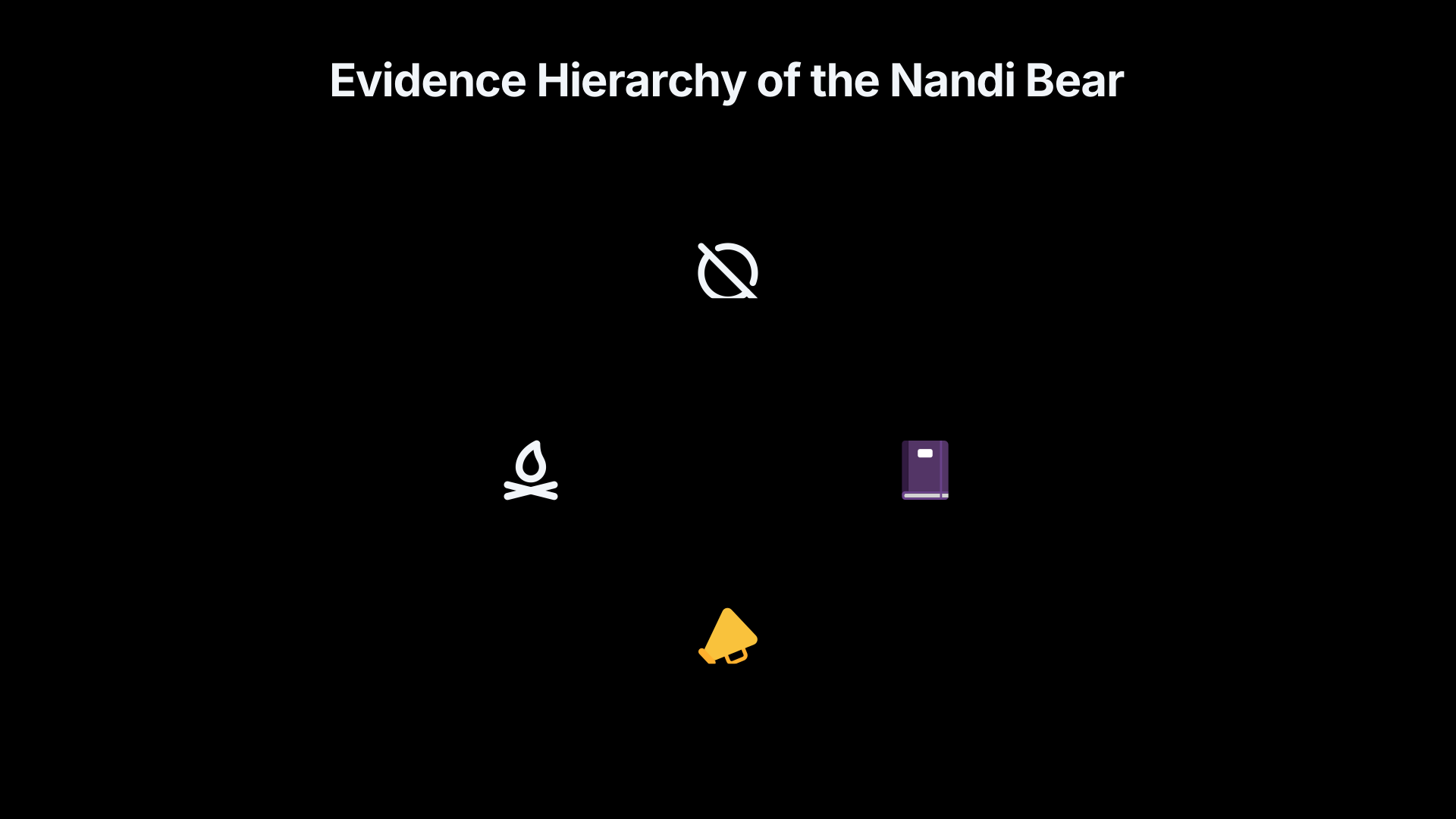
This leaves researchers with three main categories of evidence:
- Eyewitness testimony, often recorded long after the event.
- Colonial newspaper and journal reports, which frequently relied on second-hand accounts.
- Folklore, preserved through oral tradition but not intended as zoological documentation.
Each has historical value, but none can establish the existence of a previously unknown large mammal on its own.
Modern wildlife surveys also matter. Kenya’s large mammals are among the best-studied in Africa, thanks to decades of ecological research, conservation work and tourism. A breeding population of a large carnivore would be expected to leave repeated physical traces through camera traps, DNA, road casualties, carcasses or verified observations. No such evidence has emerged.[Wikipedia]WikipediaNandi bearNandi bear
Hyenas, baboons and other likely suspects
The sceptical explanation is not that every witness imagined the same thing, but that many different encounters gradually merged into one legendary animal.
Spotted hyenas
The most widely accepted explanation is the spotted hyena. Its powerful shoulders, sloping back, nocturnal behaviour and intimidating appearance already resemble many Nandi Bear descriptions. Poor light, fear and fleeting encounters could easily exaggerate its size or alter perceptions of its colour. Hyenas also occupy an unusual place in both African folklore and European imagination, making them natural candidates for frightening stories.[Wikipedia]WikipediaNandi bearNandi bear

Honey badgers
Some descriptions involve smaller, dark-coloured animals with exceptional aggression. Zoologists including George Gaylord Simpson argued that at least some reports fit unusually large honey badgers rather than an unknown predator. Their confidence, strength and nocturnal habits can produce surprisingly dramatic encounters.[Wikipedia]WikipediaNandi bearNandi bear
Baboons and primates
Certain witnesses described something more upright or almost ape-like. This led some researchers to suggest exceptionally large baboons or brief glimpses of primates seen in poor conditions. Because reports differ so dramatically, one explanation may account for some sightings while failing to explain others.[Wikipedia]WikipediaOn the Track of Unknown AnimalsOn the Track of Unknown Animals
Other proposals
Over the years, more speculative ideas have appeared, including:
- an unknown species of hyena;[thatsoundsterrific.com]thatsoundsterrific.comthe mystery of the nandi bearDec 13, 2024 — Some believe it could be a misidentified hyena, a bear species no longer native to Africa, or even a relic population of a…
- a surviving giant Ice Age hyena;
- a relic population of extinct chalicotheres, strange hoofed mammals with long forelimbs;
- a misplaced tradition based on gorillas transmitted through oral accounts into regions where gorillas do not occur.
These ideas attracted attention largely because some reports seemed unlike any familiar East African animal. However, none has gained scientific support because no physical evidence has been produced. The chalicothere hypothesis in particular lost credibility once researchers recognised that these extinct animals were herbivores rather than giant predators.[Wikipedia]WikipediaNandi bearNandi bear
Why the descriptions vary so much
One of the strongest arguments against the Nandi Bear representing a single undiscovered species is the remarkable inconsistency between reports.
Some descriptions suggest an animal taller than a hyena; others imply something scarcely larger than a honey badger. Coat colour ranges from reddish to black. Behaviour varies from shy scavenger to relentless hunter. Some accounts describe almost bear-like proportions, while others sound unmistakably primate-like.
Cryptozoologist Bernard Heuvelmans, despite taking mystery-animal reports seriously, eventually argued that the “Nandi Bear” probably represented several unrelated animals whose stories had become combined under one famous label. More recent writers have reached much the same conclusion from a sceptical perspective, suggesting that the legend became a convenient umbrella for many different unexplained encounters.[Wikipedia]WikipediaOn the Track of Unknown AnimalsOn the Track of Unknown Animals
Why the legend still grips cryptozoology
The Nandi Bear occupies an unusual position in cryptozoology because it emerged during a period when genuine zoological surprises were still being discovered in Africa. Species such as the okapi and giant forest hog entered scientific knowledge comparatively late, encouraging hopes that other large mammals might remain hidden.
That historical context explains why respected naturalists initially treated some reports with genuine curiosity rather than outright dismissal. The possibility of an overlooked species did not seem impossible in the early twentieth century, even if it appears much less plausible today.[Wikipedia]WikipediaNandi bearNandi bear
The legend also illustrates how colonial observers often recorded local traditions without fully understanding their cultural setting. A warning tale, a supernatural being, a dangerous predator and an unidentified animal could all become blended in written accounts that later readers interpreted as straightforward wildlife reports.
For cryptozoologists, the Nandi Bear remains a classic “what if?” case. For historians and folklorists, it demonstrates how stories evolve as they pass between oral tradition, newspapers and scientific debate.
What the mystery tells us today
The most evidence-based assessment is that there is no convincing proof that the Nandi Bear was ever a distinct species. More than a century of investigation has failed to produce verifiable physical evidence, while modern wildlife research has steadily reduced the likelihood that a large unknown carnivore survives unnoticed in western Kenya.[Wikipedia]WikipediaNandi bearNandi bear
Yet dismissing the legend as mere fantasy misses its real importance. The Nandi Bear captures a moment when East Africa’s wildlife was still imperfectly known, when colonial science eagerly collected local testimony, and when genuine predator encounters could grow into enduring folklore. Whether the original witnesses saw unusually large hyenas, aggressive honey badgers, baboons glimpsed in poor light or several different animals combined through repeated storytelling, the Nandi Bear remains Kenya’s most famous mystery-animal tradition precisely because it sits at the boundary between natural history and legend.


eBay marketplace picks
Marketplace Samples
Live-tested eBay searches with available results related to this page.




Endnotes
1.
Source: Wikipedia
Title: Nandi bear
Link:https://en.wikipedia.org/wiki/Nandi_bear
2.
Source: Wikipedia
Title: Kalenjin folklore
Link:https://en.wikipedia.org/wiki/Kalenjin_folklore
3.
Source: Wikipedia
Title: On the Track of Unknown Animals
Link:https://en.wikipedia.org/wiki/On_the_Track_of_Unknown_Animals
4.
Source: Wikipedia
Title: Spotted hyena
Link:https://en.wikipedia.org/wiki/Spotted_hyena
5.
Source: youtube.com
Title: Real World Monsters: The Nandi Bear
Link:https://www.youtube.com/watch?v=jefAuEpujGI
Source snippet
The Nandi Bear | The Fierce Beasts of Western Kenya...
6.
Source: youtube.com
Title: The Nandi Bear | The Fierce Beasts of Western Kenya
Link:https://www.youtube.com/watch?v=oFkNhw3W8uI
Source snippet
The Nandi Bear: Night Stalker of Africa...
7.
Source: cryptidz.fandom.com
Title: Cryptid Wiki Nandi Bear
Link:https://cryptidz.fandom.com/wiki/Nandi_Bear
Source snippet
Cryptid WikiNandi Bear - Cryptid Wiki - FandomSome have suggested that the Nandi bear could be explained by spotted hyenas (Crocuta crocu...
Additional References
8.
Source: academia.edu
Link:https://www.academia.edu/164830414/THE_KERIIT_OF_THE_KALENJIN_An_Inquiry_into_the_Nandi_Bear_Phenomenon
Source snippet
THE KERIIT OF THE KALENJIN: An Inquiry into the Nandi...Background: This paper presents an inquiry into the Keriit (also Keteet, Chemosi...
9.
Source: reddit.com
Title: Probability of the Nandi Bear (still) existing?
Link:https://www.reddit.com/r/Cryptozoology/comments/163z740/probability_of_the_nandi_bear_still_existing_and/
Source snippet
And what...Despite being one of Africa's most notable cryptids, the Nandi Bear hasn't had a reported sighting since 1998. Engineer Denni...
10.
Source: facebook.com
Link:https://www.facebook.com/johanegerkranspublic/posts/more-from-my-upcoming-book-cryptozoology-the-nandi-bear-is-a-bear-like-cryptid-f/1392992199295023/
Source snippet
n East Africa. It takes its name from the Nandi people who...Read more...
11.
Source: vocal.media
Title: The Terrifying Beast of Kenya | History
Link:https://vocal.media/history/the-terrifying-beast-of-kenya
Source snippet
Skeptics argue that the creature is merely a myth, its features cobbled together from encounters with known animals such as hy...
12.
Source: karlshuker.blogspot.com
Title: how nandi bear was conclusively
Link:https://karlshuker.blogspot.com/2021/04/how-nandi-bear-was-conclusively.html
Source snippet
HOW THE NANDI BEAR WAS CONCLUSIVELY...Apr 24, 2021 — It is evident that there is no single Nandi bear identity, that in reality this cry...
13.
Source: thatsoundsterrific.com
Title: the mystery of the nandi bear
Link:https://www.thatsoundsterrific.com/post/the-mystery-of-the-nandi-bear
Source snippet
Dec 13, 2024 — Some believe it could be a misidentified hyena, a bear species no longer native to Africa, or even a relic population of a...
14.
Source: blackbeastsandboogeymen.com
Title: monster monday the nandi bear
Link:https://blackbeastsandboogeymen.com/2026/03/30/monster-monday-the-nandi-bear/
Source snippet
Monster Monday: The Nandi BearMar 30, 2026 — Equally, the Nandi Bear may be an accumulation of misidentified encounters with hyenas seen...
15.
Source: arxiv.org
Link:https://arxiv.org/abs/1710.08880
16.
Source: youtube.com
Title: The Nandi Bear: Bear, Hyena or Baboon?
Link:https://www.youtube.com/watch?v=_jK3g5kYecc
Source snippet
The Terrifying Hyena Bear of Kenya - Nandi Bear...
17.
Source: youtube.com
Title: The Terrifying Hyena Bear of Kenya
Link:https://www.youtube.com/watch?v=9MwfPOFr67M
Source snippet
Real World Monsters: The Nandi Bear...
Topic Tree