Within Weird Belgium
How Did Belgium's Apparitions Become Pilgrimage Sites?
Belgium's approved Marian apparition sites show how children's testimony became chapel-building, pilgrimage and lasting sacred memory.
On this page
- The Beauraing visions and church recognition
- Banneux and the Virgin of the Poor
- Why some visions endure and others fade
Page outline Jump by section
Introduction
Belgium has many Catholic churches and shrines, but only two Marian apparition sites have received official recognition from the Catholic Church: Beauraing and Banneux. Both emerged within a few months of one another during the difficult early 1930s, when groups of children reported seeing the Virgin Mary. What began as local testimony quickly became the subject of church investigations, public debate and, eventually, international pilgrimage. For believers, these places are signs of divine intervention. For sceptics, they are examples of how sincere testimony, religious expectation and community memory can create enduring sacred landscapes. Either way, they are among Belgium’s most significant examples of how unusual claims move beyond eyewitness reports to become lasting features of the country’s cultural and spiritual history.[Wikipedia]WikipediaOur Lady of BeauraingOur Lady of Beauraing
How did Belgium’s apparitions become pilgrimage sites?
Unlike many visionary stories that remain local folklore, the reports from Beauraing and Banneux entered a formal process of ecclesiastical investigation. The Catholic Church neither accepted nor rejected the claims immediately. Instead, diocesan commissions interviewed witnesses, assessed the children’s consistency over time, examined reported healings and considered whether the messages matched Catholic teaching. The process lasted years rather than weeks, reflecting the Church’s traditional caution over supernatural claims.[Wikipedia]WikipediaOur Lady of BeauraingOur Lady of Beauraing
Recognition did not mean that Catholics were required to believe the apparitions had occurred. Instead, it meant that Church authorities judged them to be “worthy of belief” and suitable for public devotion. That distinction matters. Official approval opened the way for chapels, organised pilgrimages and liturgical celebrations without declaring the visions to be articles of faith. This measured approach helps explain why Beauraing and Banneux occupy an unusual place in Belgian Forteana: they are both extraordinary claims and carefully governed religious traditions rather than uncontrolled legends.[banneux-nd.be]banneux-nd.beBanneux Notre-DameRecognition of apparitionsLike my predecessors, I want to confirm this recognition: the apparitions and the message of…
The Beauraing visions and church recognition
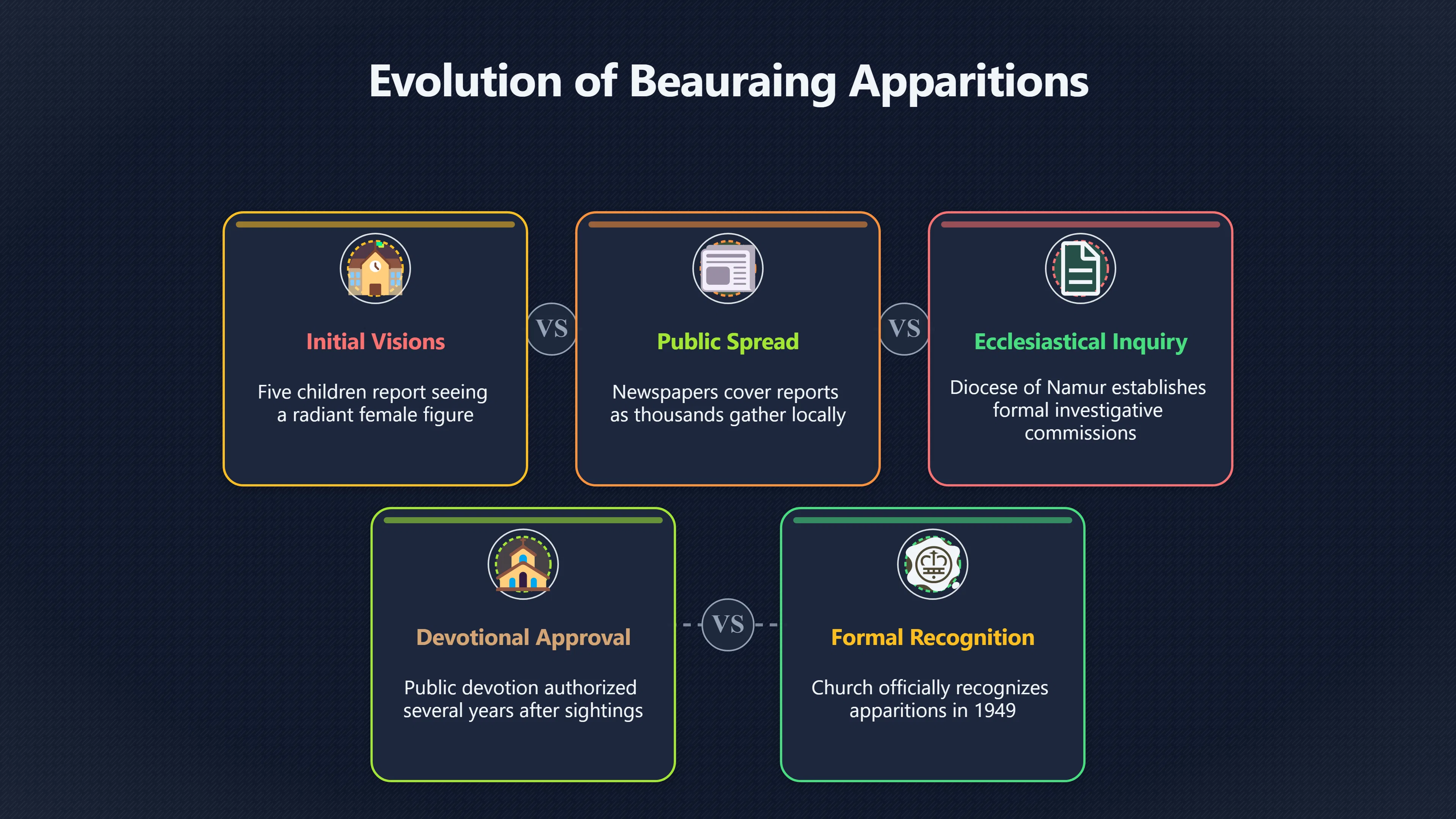
Between 29 November 1932 and 3 January 1933, five children from Beauraing reported seeing a radiant female figure on thirty-three occasions near a convent school. The witnesses ranged from nine to fifteen years old. According to their testimony, the figure identified herself with familiar Marian titles, encouraged prayer and sacrifice, and asked for a chapel to be built. During one of the later visions the children described a glowing golden heart visible on the figure’s chest, giving rise to the title “Virgin of the Golden Heart”.[Wikipedia]WikipediaOur Lady of BeauraingOur Lady of Beauraing
The reports spread rapidly through Belgium. Thousands gathered during the final days of the apparitions, hoping either to witness a miracle or simply to observe events for themselves. Newspapers covered the story extensively, while local clergy and Church authorities urged restraint until investigations could be completed. Public enthusiasm therefore developed alongside institutional scepticism rather than replacing it.[Wikipedia]WikipediaOur Lady of BeauraingOur Lady of Beauraing
The Diocese of Namur established commissions to investigate the claims. Public devotion was authorised in 1943, several years before the apparitions themselves received formal recognition in 1949. During the same period, reports of unexplained healings added to the shrine’s reputation, although individual cures remained subject to separate medical and ecclesiastical scrutiny. A chapel requested in the reported messages became the nucleus of a growing sanctuary, transforming the original location into a permanent destination for pilgrims.[Wikipedia]WikipediaOur Lady of BeauraingOur Lady of Beauraing
From a Fortean perspective, Beauraing illustrates an important pattern. The original mystery was not simply whether the children experienced something unusual, but how repeated testimony, large public gatherings, religious investigation and reported miracles combined to create a place whose significance survived long after the witnesses themselves had grown up.
Banneux and the Virgin of the Poor
Only days after the Beauraing visions ended, another Belgian child reported a different series of encounters. Between 15 January and 2 March 1933, eleven-year-old Mariette Béco said she saw a “Beautiful Lady” eight times in the village of Banneux, near Liège. Unlike Beauraing, where several children shared the experiences, Banneux centred on a single witness.[Wikipedia]WikipediaOur Lady of BanneuxOur Lady of Banneux
According to Mariette, the Lady described herself as the “Virgin of the Poor” and led her to a spring, saying it was intended “for all nations” and to bring relief to the sick. She also requested that a small chapel be built and repeatedly encouraged prayer. The emphasis on poverty, suffering and healing distinguished Banneux from many other Marian apparition traditions and helped shape the shrine’s later identity.[wikipedia.org]WikipediaOur Lady of BanneuxOur Lady of Banneux
Pilgrims soon began visiting the spring, collecting its water and reporting recoveries from illness. Although the Church approached such claims cautiously, the site steadily developed into a recognised pilgrimage centre. After several investigative commissions, the Bishop of Liège formally recognised the apparitions in 1949. Pope John Paul II later visited the sanctuary in 1985, further reinforcing its importance within modern Catholic pilgrimage.[Banneux Notre-Dame]banneux-nd.beBanneux Notre-DameRecognition of apparitionsLike my predecessors, I want to confirm this recognition: the apparitions and the message of…
The spring remains central to Banneux’s identity. For believers it symbolises healing and compassion rather than spectacle. Even visitors who do not accept miraculous explanations often remark that the physical landscape—the spring, chapel and processional routes—helps explain why the site continues to attract pilgrims decades after the original reports.
Why some visions endure and others fade
Europe has produced hundreds of reported Marian apparitions, but only a small proportion become internationally recognised pilgrimage destinations. Beauraing and Banneux demonstrate several factors that increase the chances of long-term survival.
First, both cases underwent prolonged institutional examination instead of relying solely on popular enthusiasm. Formal investigations, whatever one’s view of their conclusions, created an extensive documentary record that many local legends lack.[Wikipedia]WikipediaOur Lady of BeauraingOur Lady of Beauraing
Second, each location acquired a physical focus. Beauraing gained a sanctuary centred on the site where the children reported seeing the Virgin, while Banneux developed around the spring associated with Mariette Béco’s testimony. Pilgrimage depends not only on stories but also on places that people can visit, experience and return to.
Third, the reported messages were relatively simple. They emphasised prayer, compassion, conversion and hope rather than detailed prophecies or dramatic predictions. That simplicity allowed the shrines to remain relevant long after the political and economic crises of the 1930s had passed.[Banneux Notre-Dame]banneux-nd.beBanneux Notre-DameRecognition of apparitionsLike my predecessors, I want to confirm this recognition: the apparitions and the message of…

Belief, scepticism and Fortean interest
From a sceptical viewpoint, the Belgian apparitions can be interpreted through several familiar mechanisms. Children’s testimony may be influenced by expectation, suggestion or social reinforcement. Large crowds can amplify extraordinary claims, while reports of miraculous cures are difficult to evaluate because spontaneous remission, diagnostic uncertainty and selective reporting are all well-known challenges. Historians also note that Marian apparitions became particularly prominent in Catholic Europe during the nineteenth and twentieth centuries, creating cultural models that later visionaries might unconsciously follow.
Believers point to different features. They emphasise the consistency of the children’s accounts during repeated questioning, the absence of obvious material gain, the spiritual impact reported by pilgrims and the Church’s unusually cautious investigative process. For them, the decades-long scrutiny before recognition strengthens rather than weakens the credibility of the claims.[Wikipedia]WikipediaOur Lady of BeauraingOur Lady of Beauraing
For students of Forteana, the supernatural question is only part of the story. Beauraing and Banneux show how extraordinary experiences become embedded in national culture. Newspapers, clergy, investigators, pilgrims, architects and later generations all helped transform brief childhood testimonies into enduring sacred landscapes. Whether viewed as miracles, psychological experiences or remarkable episodes of collective belief, the two Belgian apparition sites demonstrate how unusual claims can reshape real places and leave a permanent mark on a country’s historical imagination.
Amazon book picks
Further Reading
Books and field guides related to How Did Belgium's Apparitions Become Pilgrimage Sites?. Use these as the next step if you want deeper reading beyond the article.

The World's Greatest UFO Mysteries
Fits readers exploring Belgium's wider strange history.
eBay marketplace picks
Marketplace Samples
Live-tested eBay searches with available results related to this page.



Endnotes
1.
Source: Wikipedia
Title: Our Lady of Beauraing
Link:https://en.wikipedia.org/wiki/Our_Lady_of_Beauraing
2.
Source: Wikipedia
Title: Our Lady of Banneux
Link:https://en.wikipedia.org/wiki/Our_Lady_of_Banneux
3.
Source: Wikipedia
Title: List of Marian apparitions
Link:https://en.wikipedia.org/wiki/List_of_Marian_apparitions
4.
Source: Wikipedia
Title: Sanctuaire Notre-Dame de Beauraing
Link:https://fr.wikipedia.org/wiki/Sanctuaire_Notre-Dame_de_Beauraing
5.
Source: theotokos.org.uk
Title: Virgin of the poor.” As the small crowd who had
Link:https://theotokos.org.uk/article-banneux-apparitions-january-1933/
Source snippet
Article: Banneux Apparitions January 1933 - Theotokos BooksBut despite initial skepticism, Banneux, like Beauraing, would also ultimately...
Published: January 1933
6.
Source: banneux-nd.be
Link:https://banneux-nd.be/en/recognition-of-apparitions/
Source snippet
Banneux Notre-DameRecognition of apparitionsLike my predecessors, I want to confirm this recognition: the apparitions and the message of...
7.
Source: hozana.org
Link:https://hozana.org/en/miracles-and-apparitions/marian-apparitions/banneux
Source snippet
Apparitions, History, Messages24 Apr 2026 — The apparitions of Our Lady of the Poor at Banneux were approved by the Catholic Church in 19...
Additional References
8.
Source: catholicculture.org
Link:https://www.catholicculture.org/culture/library/view.cfm?recnum=3195
Source snippet
Library: Beauraing and BanneuxThe cult of Our Lady of Banneux, Our Lady of the Poor, was authorized with the approval of the Holy See in...
9.
Source: facebook.com
Title: our lady of banneux belgium 1933 what you must know as a catholicin 1933 just da
Link:https://www.facebook.com/ProudlyCatholics/posts/our-lady-of-banneux-belgium-1933-what-you-must-know-as-a-catholicin-1933-just-da/1055882216656027/
Source snippet
Our Lady of Banneux (Belgium, 1933) — What You Must...The Shrine of the Virgin of the Poor includes the Sacred Spring, the Chapel of the...
10.
Source: facebook.com
Link:https://www.facebook.com/groups/belgiumtraveltips/posts/1752978652563676/
Source snippet
Marian Apparition... Taken@StNicolasChurchGhentBelgiumA MOMENT WITH MARY - JANUARY 17, 2019 The Shrine of Our Lady of Banneux, Belgium...
Published: January 17, 2019
11.
Source: catholicexchange.com
Title: marys message for belgium beauraing and banneux
Link:https://catholicexchange.com/marys-message-for-belgium-beauraing-and-banneux/
Source snippet
Mary's Message for Belgium: Beauraing and Banneux23 Mar 2016 — I had the opportunity to make a pilgrimage to the two great Marian shrines...
12.
Source: piercedhearts.org
Link:https://www.piercedhearts.org/hearts_jesus_mary/apparitions/our_lady_poor.html
Source snippet
g girl Mariette Beco January 15 - March 2, 1933, Belgium...
Published: March 2, 1933
13.
Source: youtube.com
Title: Our Lady of Banneux: The Blessed Virgin of the poor
Link:https://www.youtube.com/watch?v=sfUJYmrYTvA
Source snippet
8 Silent Apparitions: The Mystery of Our Lady of Banneux, Belgium...
14.
Source: youtube.com
Title: Our Lady of Banneux – Virgin of the Poor
Link:https://www.youtube.com/watch?v=RK6iP0XUNyc
Source snippet
Beauraing: The Missing Link! - Explaining the Faith...
15.
Source: youtube.com
Title: 8 Silent Apparitions: The Mystery of Our Lady of Banneux, Belgium
Link:https://www.youtube.com/watch?v=0w1Bn0zQkbI
Source snippet
Our Lady of Beauraing in Belgium...
16.
Source: youtube.com
Title: Beauraing: The Missing Link!
Link:https://www.youtube.com/watch?v=glSrY-4ISmY
Topic Tree