Within Azerbaijan
Why Azerbaijan's Mud Volcanoes Look Alien
Azerbaijan's mud volcanoes turn geology into spectacle, with bubbling cones, methane, eruptions and flames that look almost unreal.
On this page
- How mud volcanoes work
- Gobustan's bubbling landscape
- Eruptions, methane and fire
Page outline Jump by section
Introduction
Azerbaijan’s mud volcanoes are among the country’s most genuinely uncanny natural sights. Instead of red-hot lava, these volcanoes ooze cold grey mud, belch methane, rumble beneath the ground and, on rare occasions, burst into spectacular fireballs. The landscape can resemble a science-fiction film set, yet the explanation is firmly geological. Eastern Azerbaijan and the adjoining Caspian Sea contain the world’s greatest concentration of mud volcanoes, making the country a global laboratory for understanding how pressurised gases and sediments escape from deep underground. That combination of dramatic appearance and scientific explanation is exactly why the volcanoes occupy such an important place in Azerbaijan’s strange-history tradition: they look supernatural while remaining entirely natural.[Wikipedia]WikipediaMud volcanoes in AzerbaijanMud volcanoes in Azerbaijan

How mud volcanoes work
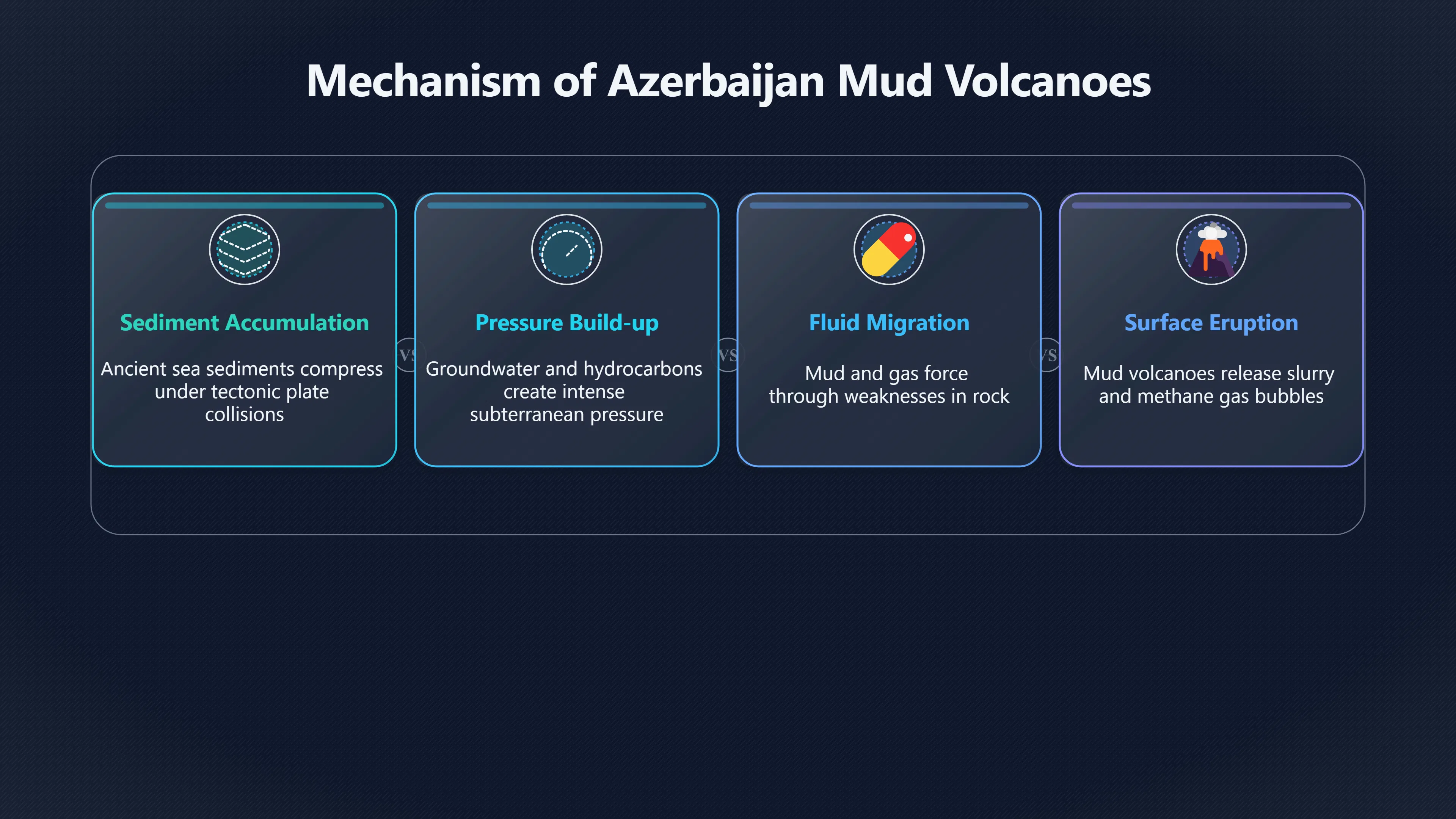
Despite their name, mud volcanoes are not true volcanic mountains. They are driven by pressure rather than molten rock.
Deep beneath eastern Azerbaijan lie enormous layers of clay-rich sediment mixed with groundwater and hydrocarbons. The South Caspian Basin has accumulated exceptionally thick sediments over millions of years, while tectonic forces continue to squeeze the region. As pressure builds, water, gas and soft mud find weaknesses in the rocks and force their way upwards. The result is a cone or crater that slowly releases slurry, gas bubbles and mineral-rich fluids instead of lava.[Wikipedia]WikipediaMud volcanoMud volcano
Methane is the key ingredient behind much of the spectacle. The escaping gas creates the constant bubbling that visitors see, and if it ignites during a large eruption it can produce dramatic flames rising hundreds of metres into the air. This is why Azerbaijan’s mud volcanoes often appear in lists of the world’s strangest geological phenomena even though geologists understand the basic mechanism well.[Wikipedia]WikipediaMud volcanoes in AzerbaijanMud volcanoes in Azerbaijan
Several features make these volcanoes especially unusual:
- They erupt cold mud rather than molten rock.
- Their activity ranges from gentle bubbling to violent explosive outbursts.
- Many emit methane continuously between eruptions.
- Large eruptions may be accompanied by underground rumbling, earth tremors and temporary fissures.
- Hundreds occur both on land and beneath the Caspian Sea.[Wikipedia]WikipediaMud volcanoes in AzerbaijanMud volcanoes in Azerbaijan
Why Azerbaijan has so many
Many countries possess a handful of mud volcanoes, but Azerbaijan has an extraordinary concentration because of its unique geological setting.
The eastern part of the country sits above one of the world’s richest hydrocarbon basins. Thick sediments from ancient seas have been compressed by the collision of tectonic plates, creating ideal conditions for pressurised mud and gas to escape. Estimates vary depending on how submarine volcanoes are counted, but Azerbaijan is generally recognised as containing roughly half of the world’s known mud volcanoes, with hundreds scattered across the Absheron Peninsula, Gobustan, the Shirvan Plain and the Caspian offshore zone.[Wikipedia]WikipediaMud volcanoes in AzerbaijanMud volcanoes in Azerbaijan
This close relationship with oil and gas has long shaped both science and folklore. Before modern geology explained the process, eruptions, flames and mysterious sounds naturally encouraged stories about restless earth spirits or hidden fires beneath the landscape. Today, petroleum geologists study the same features because active mud volcanoes often reveal information about deep hydrocarbon systems.[Wikipedia]WikipediaMud volcanoes in AzerbaijanMud volcanoes in Azerbaijan
Gobustan’s bubbling landscape
The best-known mud volcanoes lie around Gobustan, southwest of Baku, where the strange geology sits beside one of the world’s great collections of prehistoric rock art.
The contrast is remarkable. Visitors can walk among thousands of ancient petroglyphs before driving a short distance into a semi-desert dotted with grey cones that quietly burp bubbles of mud. The setting feels almost extraterrestrial: barren hills, cracked clay, circular vents and constant bubbling with little vegetation. UNESCO recognises Gobustan primarily for its archaeological importance, but the neighbouring mud volcano field adds another layer of fascination by showing that the landscape itself remains geologically active.[UNESCO World Heritage Centre]whc.unesco.orgUNESCO World Heritage CentreGobustan Rock Art Cultural LandscapeGobustan Rock Art Cultural Landscape covers three areas of a plateau of r…
Unlike dramatic volcanic eruptions seen elsewhere in the world, most Gobustan volcanoes spend their lives quietly gurgling. Thick mud slowly overflows crater rims before drying into cracked crusts, while methane escapes through pools that repeatedly inflate and burst. The sounds can be surprisingly loud in otherwise silent surroundings, helping explain why travellers have long described the area as eerie or otherworldly.[Sophie’s World Travel Inspiration]sophiesworld.netgobustan petroglyphs mud volcanoes azerbaijanAzerbaijan is home to more than half of the world's mud volcanoes and quite a few of them dot the landscape here in Gobustan…Read more…
For Fortean enthusiasts, Gobustan demonstrates an important pattern found throughout Azerbaijan: the landscape itself creates experiences that feel uncanny without requiring supernatural explanations.

Eruptions, methane and unexpected fire
Most mud volcanoes are peaceful, but Azerbaijan has repeatedly demonstrated that they can become surprisingly violent.
Historical records describe around 200 eruptions from roughly 50 volcanoes since the early nineteenth century. Some have produced explosions, loud detonations, ground cracking and towering flames when methane ignited. The Garasu volcano has reportedly generated flames approaching a kilometre in height during major events, while other volcanoes have repeatedly opened long fissures across the surrounding ground.[Wikipedia]WikipediaMud volcanoes in AzerbaijanMud volcanoes in Azerbaijan
One of the most dramatic modern examples occurred on 4 July 2021, when a submarine mud volcano erupted near Dashli Island in the Caspian Sea. A huge fireball rose above the water and was widely mistaken on social media for an explosion at an offshore oil platform. Investigations instead concluded that escaping natural gas from a mud volcano had ignited, creating a spectacular but short-lived blaze visible from Baku, around 70 kilometres away. No damage to nearby oil facilities was reported.[Wikipedia]WikipediaMud volcanoes in AzerbaijanMud volcanoes in Azerbaijan
Events like this illustrate why Azerbaijan’s geology so often generates mysterious reports. To someone unaware of the country’s mud volcanoes, a giant fire erupting from the sea looks almost impossible.
Why the landscape feels alien
Mud volcanoes are frequently described as “Martian”, and that comparison is not just poetic.
Planetary scientists have used Azerbaijan’s volcanoes as terrestrial analogues when studying mysterious mound-like landforms on Mars. The shapes, textures and vent structures resemble features that may have formed through ancient mud volcanism or fluid escape on the Red Planet. Studying Azerbaijan therefore helps researchers test ideas about how similar landscapes could have developed elsewhere in the Solar System.[Wikipedia]WikipediaMud volcanoes in AzerbaijanMud volcanoes in Azerbaijan
For visitors, the resemblance comes from the absence of familiar landmarks. The cones are often grey rather than green, the mud is cool rather than hot, and the landscape seems to bubble under its own power. The result is a setting that appears almost impossible despite being governed by ordinary geological processes.
Why mud volcanoes matter in Azerbaijan’s strange history
Few natural phenomena blur the line between science and wonder as effectively as Azerbaijan’s mud volcanoes.
They produce genuine spectacles—explosions, bubbling craters, flames, strange noises and even temporary changes to the landscape—that easily become legends when seen without geological knowledge. Yet they also remind us that the natural world is capable of extraordinary behaviour without invoking the supernatural.
That balance gives the volcanoes enduring cultural power. They support Azerbaijan’s identity as the “Land of Fire”, complement nearby natural gas flames such as Yanar Dag, enrich the atmosphere around Gobustan’s prehistoric monuments, and provide a striking example of how an entirely real geological process can inspire folklore, rumours and modern Fortean fascination alike.
Amazon book picks
Further Reading
Books and field guides related to Why Azerbaijan's Mud Volcanoes Look Alien. Use these as the next step if you want deeper reading beyond the article.

Lonely Planet Georgia, Armenia & Azerbaijan
Highlights Azerbaijan's mud volcanoes as key attractions.


Origins: How the Earth Made Us
Excellent introduction to geology shaping extraordinary landscapes.
Origins
First published 2019. Subjects: Human evolution, Human beings, origin, Human beings, Origin, Effect of environment on.
eBay marketplace picks
Marketplace Samples
Live-tested eBay searches with available results related to this page.



Endnotes
1.
Source: Wikipedia
Title: Mud volcanoes in Azerbaijan
Link:https://en.wikipedia.org/wiki/Mud_volcanoes_in_Azerbaijan
2.
Source: whc.unesco.org
Link:https://whc.unesco.org/en/list/1076/
Source snippet
UNESCO World Heritage CentreGobustan Rock Art Cultural LandscapeGobustan Rock Art Cultural Landscape covers three areas of a plateau of r...
3.
Source: Wikipedia
Title: Mud volcano
Link:https://en.wikipedia.org/wiki/Mud_volcano
4.
Source: Wikipedia
Title: Geology of Azerbaijan
Link:https://en.wikipedia.org/wiki/Geology_of_Azerbaijan
5.
Source: sophiesworld.net
Title: gobustan petroglyphs mud volcanoes azerbaijan
Link:https://www.sophiesworld.net/gobustan-petroglyphs-mud-volcanoes-azerbaijan/
Source snippet
Azerbaijan is home to more than half of the world's mud volcanoes and quite a few of them dot the landscape here in Gobustan...Read more...
Additional References
6.
Source: trekgo.in
Link:https://trekgo.in/blog/gobustan-national-park
Source snippet
Gobustan National Park: Mud Volcanoes & Travel GuidePlan your Gobustan National Park trip with UNESCO rock-art context, mud volcano highl...
7.
Source: getyourguide.com
Link:https://www.getyourguide.com/qobustan-qaradagku-l115617/gobustan-private-transfer-by-soviet-style-car-t1159772/
Source snippet
Gobustan UNESCO Site & Mud Volcanoes Day TripTravel back in time at Gobustan's UNESCO-listed petroglyphs and witness the unique mud volca...
8.
Source: nature.new7wonders.com
Link:https://nature.new7wonders.com/wonders/mud-volcanoes-azerbaijan/
Source snippet
New7Wonders of NatureGobustan mud volcanoesA hill and mountain site occupying the southeast end of the Greater Caucasus mountain ridge in...
9.
Source: youtube.com
Link:https://www.youtube.com/watch?v=ImXrwJvfFaU&list=PLAAXH74Eg1uxS6CpAoVYYTsVD1H8oahsn
Source snippet
► Egypt: [https://www.youtube.com/watch?v=QWHt5JRNueI&list=PLAAXH74Eg1uyPAMv1VSNHAznf3TEcsHkB](https://www.youtube.com/watch?v=QWHt5JRNueI&list=PLAAXH74Eg1uyPAMv1VSNHAznf3TEcsHkB) ► Malaysia Travel Guide: #://youtube.com/pla...
10.
Source: foxnomad.com
Title: a visual walk through the mud volcanoes of gobustan azerbaijan
Link:https://foxnomad.com/2012/06/12/a-visual-walk-through-the-mud-volcanoes-of-gobustan-azerbaijan/
Source snippet
A Visual Walk Through The Mud Volcanoes Of Gobustan...12 Jun 2012 — The mud volcanoes located in Gobustan National Park, about a 90 minu...
11.
Source: peek.com
Title: UNESC O Heritage Site Gobustan: Visit Ancient
Link:https://www.peek.com/qobustan-baku-azerbaijan/r0nw6g8/unesco-heritage-site-gobustan-visit-ancient-archaeological-monuments-and-mud-volcanoes/a0qygd3e
Source snippet
UNESCO Heritage Site Gobustan: Visit Ancient... - PeekExplore the ancient archaeological monuments and unique mud volcanoes at Gobustan...
12.
Source: youtube.com
Link:https://www.youtube.com/watch?v=cOE6iPqKwSk
Source snippet
More than meets the eye: A new way to see Gobustan's mud...Gobustan National Park in Azerbaijan is a UNESCO World Heritage site known fo...
13.
Source: youtube.com
Link:https://www.youtube.com/watch?v=QWHt5JRNueI&list=PLAAXH74Eg1uyPAMv1VSNHAznf3TEcsHkB
Source snippet
► Malaysia Travel Guide: #://youtube.com/playlist?list=PLAAXH74Eg1uwM5k_3UMLrMDsh6AF5eS49...
14.
Source: facebook.com
Link:https://www.facebook.com/YeniSafakEnglish/videos/gobustan-state-reserve-in-azerbaijan-a-unesco-world-heritage-site-features-over-/1039059921435484/
Source snippet
total. Revered for both their cultural and geological...
15.
Source: guidedazerbaijan.com
Link:https://guidedazerbaijan.com/page/gobustan-unesco-world-heritage-site
Source snippet
Volcanoes, offering a unique blend of cultural and...
Topic Tree