Within Iran Uncanny
Why Iranian Monsters Still Feel Powerful
Iranian monster and spirit traditions show how dragons, jinn and healing winds turn fear, illness and disorder into memorable stories.
On this page
- Dragons and cosmic disorder
- Jinn in modern fear stories
- Spirit winds, illness and healing
Page outline Jump by section
Introduction
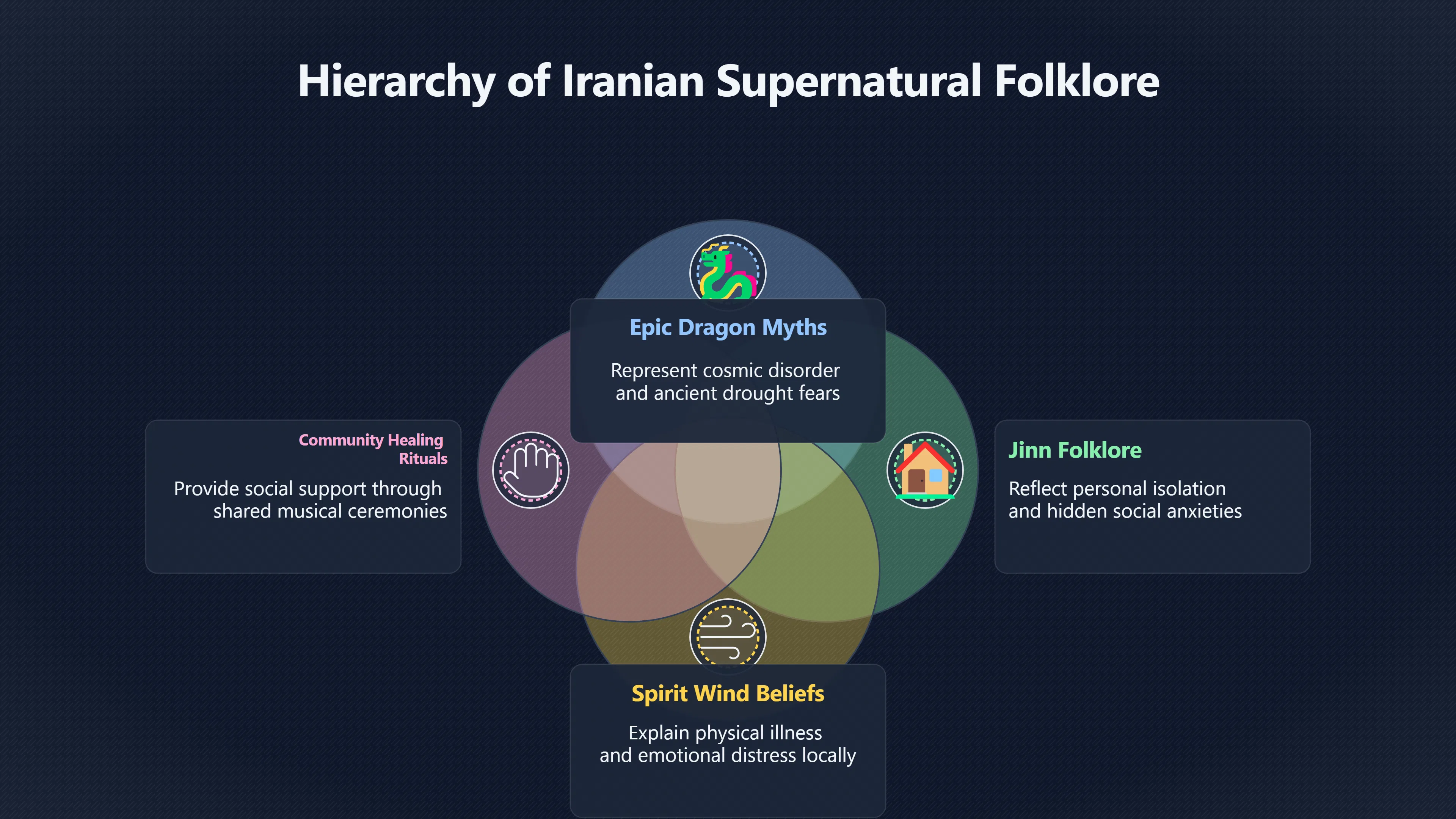
Iranian folklore is full of dragons, jinn and mysterious winds, but these are not simply collections of supernatural monsters. They are ways of explaining danger, illness, tyranny and disorder through memorable stories that have evolved over many centuries. Ancient dragon myths express fears about drought and cosmic chaos. Jinn stories reflect anxieties about abandoned places, loneliness and unseen forces. Along the Persian Gulf coast, traditions of harmful and healing spirit winds provide cultural explanations for physical and emotional distress while supporting elaborate community healing rituals. Together these traditions give modern Iranian ghost stories and strange reports much of their emotional weight, even when listeners do not literally believe in the supernatural. Rather than treating them as evidence of paranormal beings, historians and folklorists view them as an important record of how Iranian communities have interpreted misfortune, landscape and the unseen.[Iranica Online]iranicaonline.orgIranica OnlineIRAN iv. MYTHS AND LEGENDSThe texts give a mixture of pictures of Aži Dahāka as mythical dragon and legendary wicked monarc…
Why Iranian monsters still feel powerful
Unlike many European monster traditions, Iranian folklore often links supernatural beings to questions of moral order rather than random terror. Dangerous creatures usually represent imbalance in nature or society. Heroes do not merely kill monsters for adventure; they restore justice, release trapped waters, defeat oppression or overcome destructive impulses.
This moral dimension helps explain why these figures remain culturally influential. Dragons appear in literature, political metaphors and modern fantasy. Jinn continue to feature in contemporary horror stories and local legends. Spirit winds still survive in healing traditions in parts of southern Iran despite the growth of modern medicine. The supernatural therefore occupies a space between religion, folklore, psychology and social memory rather than existing as an isolated body of ghost stories.[Iranica Online]iranicaonline.orgIranica OnlineIRAN iv. MYTHS AND LEGENDSThe texts give a mixture of pictures of Aži Dahāka as mythical dragon and legendary wicked monarc…
Dragons and cosmic disorder
Ancient Iranian dragons were rarely treasure-hoarding beasts in the medieval European sense. Instead they were vast serpentine creatures associated with drought, destructive natural forces and cosmic disorder.
The best-known example is Aži Dahāka, later transformed into the legendary tyrant Zahhāk in Persian epic literature. Early Iranian religious texts present Aži Dahāka as a monstrous dragon-like being aligned with destructive powers. Later works, especially the Shahnameh, reshape him into an evil ruler whose snake-covered shoulders symbolise both supernatural corruption and political oppression. This blending of monster and king allowed later generations to read the story as both myth and political allegory.[Iranica Online]iranicaonline.orgIranica OnlineIRAN iv. MYTHS AND LEGENDSThe texts give a mixture of pictures of Aži Dahāka as mythical dragon and legendary wicked monarc…
The wider dragon tradition is equally revealing. Encyclopaedia Iranica notes that dragons in Iranian mythology were closely connected with drought because they were imagined as imprisoning or withholding the world’s life-giving waters. Heroes who defeated them restored rivers and rainfall, turning dragon-slaying into a symbolic victory over famine and chaos rather than simply over an animal.[Iranica Online]iranicaonline.orgIranica Online AŽDAHĀ iIn Old and Middle IranianAt the time of the Indo-Iranian unity, the Indo-Iranians must have imagined dragons restraining the heavenly wat…
Persian literature expanded these ideas dramatically. Dragons became gigantic serpent-like beings inhabiting mountains, deserts, rivers and even the sky. Heroes such as Rostam, Esfandiar and Bahram Gur all confront dragons, but the monsters often represent internal courage as much as external danger. Medieval writers also connected dragons with eclipses, violent storms and other unsettling natural phenomena, reinforcing their role as embodiments of disorder.[Iranica Online]iranicaonline.orgIranica OnlineAŽDAHĀ ii. In Persian literatureSymbolism of the dragon-slaying. The dragon in Iranian mythology is a destructive demoniaca…
For Fortean readers, these dragons matter less as reports of unknown animals than as examples of how extraordinary landscapes and dangerous weather became attached to memorable supernatural narratives.
Jinn in modern fear stories
Jinn occupy a different place in Iranian folklore from dragons. Rather than ancient cosmic monsters, they are usually imagined as unseen intelligent beings inhabiting lonely places, ruined buildings, deserts or isolated stretches of countryside.
Stories about encounters often follow familiar patterns. Travellers hear unexplained voices, become disoriented after sunset or experience sudden terror in abandoned places. Such tales rarely produce physical evidence and vary widely between regions, suggesting they function more as oral tradition than eyewitness history.
Modern Iranian horror fiction frequently draws upon these beliefs because jinn can represent hidden fears more effectively than visible monsters. Literary scholars have argued that supernatural figures in Iranian fiction often reflect social anxieties, historical trauma or personal isolation rather than serving purely as religious beings. The ambiguity is part of their enduring appeal: believers may regard some encounters as genuine spiritual experiences, while sceptics interpret them as folklore, sleep paralysis, fear, suggestion or psychological stress.[Iranica Online]iranicaonline.orgIranica OnlineIRAN iv. MYTHS AND LEGENDSThe texts give a mixture of pictures of Aži Dahāka as mythical dragon and legendary wicked monarc…
This ambiguity also explains why many contemporary jinn stories remain remarkably resistant to verification. Unlike UFO sightings or alleged monster encounters, they usually depend upon individual testimony shaped by local expectations and inherited storytelling traditions.
Spirit winds, illness and healing
Perhaps the most distinctive element of Iranian supernatural folklore is the belief in harmful spirit winds found along parts of the Persian Gulf coast, especially in southern Iran.
Here illness is sometimes explained through invisible winds carrying spiritual forces. Rather than imagining possession by a conventional ghost, local traditions describe certain winds as entering the body and producing physical symptoms, emotional distress or unusual behaviour. These beliefs form part of the broader zār tradition, which links Iran with neighbouring regions around the Arabian Peninsula and East Africa through centuries of maritime contact.[Wikipedia]WikipediaOpen source on wikipedia.org.
Wind as both illness and identity
The spirit wind tradition is striking because it does not simply divide people into believers and sceptics. Those thought to be affected often become members of ritual communities rather than social outcasts.
Ethnographic studies describe ceremonies involving music, rhythm, incense and communal participation intended to identify, negotiate with or calm the possessing wind. Individuals who recover may continue participating throughout their lives because the relationship with the spirit is understood as ongoing rather than permanently cured. The rituals therefore provide social support alongside spiritual healing.[Wikipedia]WikipediaOpen source on wikipedia.org.
Researchers increasingly interpret these ceremonies through several overlapping lenses:
- as traditional systems for explaining illnesses without obvious physical causes;
- as community-based responses to trauma, grief and psychological distress;
- as cultural practices shaped by centuries of contact between southern Iran, East Africa and the western Indian Ocean;
- as living folklore that continues alongside biomedical healthcare rather than necessarily replacing it.[Wikipedia]WikipediaOpen source on wikipedia.org.
For Fortean history, these traditions are especially valuable because they show how experiences regarded elsewhere as spirit possession can instead be understood through the imagery of invisible winds.
Between belief and explanation
Modern scholarship generally avoids asking whether dragons, jinn or spirit winds are objectively real supernatural entities. Instead it examines why these traditions proved so durable.
Several factors help explain their survival:
- Landscape: Mountains, deserts and isolated coastlines naturally encourage stories about unseen dangers.
- Natural hazards: Drought, disease and unpredictable weather acquired memorable symbolic forms through dragons and harmful winds.
- Religion and morality: Supernatural beings reinforced lessons about justice, pride, compassion and proper behaviour.
- Community memory: Oral storytelling preserved local experiences long after their original historical circumstances disappeared.
- Psychological meaning: Many experiences attributed to spirits can also be understood through stress, grief, suggestion, sleep disorders or culturally shaped interpretations of illness.[Iranica Online]iranicaonline.orgIranica OnlineIRAN iv. MYTHS AND LEGENDSThe texts give a mixture of pictures of Aži Dahāka as mythical dragon and legendary wicked monarc…
None of these explanations completely replaces the others. Believers may accept spiritual causes while recognising emotional suffering; sceptics may reject literal spirits while acknowledging the healing value of communal ritual.
Why these traditions remain part of Iran’s strange history
Iran’s dragons, jinn and spirit winds endure because they occupy different layers of the country’s cultural imagination. Dragons belong primarily to epic myth and symbolise cosmic threats. Jinn inhabit the uncertain boundary between folklore, religion and everyday fear. Spirit winds remain embedded in living ritual practices that address illness and social distress.
Together they demonstrate that Iranian Forteana is not simply a catalogue of monsters. It is a record of how generations have interpreted unexplained experiences, dangerous landscapes and human suffering through stories that continue to influence literature, horror, ritual and popular imagination long after their original contexts have changed.
Amazon book picks
Further Reading
Books and field guides related to Why Iranian Monsters Still Feel Powerful. Use these as the next step if you want deeper reading beyond the article.


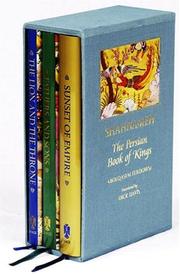
Shahnameh: The Persian Book of Kings
Primary literary source for dragons, heroes and mythic creatures.
eBay marketplace picks
Marketplace Samples
Live-tested eBay searches with available results related to this page.

Endnotes
1.
Source: Wikipedia
Link:https://en.wikipedia.org/wiki/Persian_mythology
Source snippet
Persian mythologyZahhak (Avestan: Aži Dahāka) was guarded by two vipers which grew out from... He is the first and most frequently i...
2.
Source: Wikipedia
Link:https://en.wikipedia.org/wiki/Z%C4%81r
3.
Source: Wikipedia
Link:https://en.wikipedia.org/wiki/Zahhak
Source snippet
ZahhakDespite the negative aspect of Aži Dahāka in mythology, dragons have been used on some banners of war throughout the history of...
4.
Source: iranicaonline.org
Link:https://www.iranicaonline.org/articles/iran-iv-myths-and-legends/
Source snippet
Iranica OnlineIRAN iv. MYTHS AND LEGENDSThe texts give a mixture of pictures of Aži Dahāka as mythical dragon and legendary wicked monarc...
5.
Source: iranicaonline.org
Title: Iranica Online AŽDAHĀ i
Link:https://www.iranicaonline.org/articles/azdaha/azdaha-i-in-old-and-middle-iranian/
Source snippet
In Old and Middle IranianAt the time of the Indo-Iranian unity, the Indo-Iranians must have imagined dragons restraining the heavenly wat...
6.
Source: iranicaonline.org
Link:https://www.iranicaonline.org/articles/azdaha/azdaha-ii-in-persian-literature/
Source snippet
Iranica OnlineAŽDAHĀ ii. In Persian literatureSymbolism of the dragon-slaying. The dragon in Iranian mythology is a destructive demoniaca...
Additional References
7.
Source: hunara.org
Link:https://www.hunara.org/article_173300_b91b5e39ad5ce8db748799851e45a8b8.pdf
Source snippet
Dragons, the Avestan saošiiant, and Possible Connections...by M Saadi-nejad · 2023 · Cited by 2 — The origins of the Dragon-slaying myth...
8.
Source: dokumen.pub
Title: lexikon der gtter und dmonen 9783520463036 3520463032
Link:https://dokumen.pub/lexikon-der-gtter-und-dmonen-9783520463036-3520463032.html
Source snippet
Lexikon der Götter und Dämonen 9783520463036...Mit 2200 Artikeln, die Zugang zur Welt der Götter und Göttinnen, Dämonen und Geister ver...
9.
Source: facebook.com
Title: Why was Ozar’s Father called Akhriman?
Link:https://www.facebook.com/groups/discovery.bookshop/posts/7947746828578160/
Source snippet
Perhaps only...Ahriman or Angra Mainyu is the ancient Persian spirit or demon of darkness. A God associated with the Yatuk Dinoih, the a...
10.
Source: youtube.com
Title: Persian / Iranian Dragons and Monsters of Myth
Link:https://www.youtube.com/watch?v=pCILGFekVFI
Source snippet
Ancient Persia's Most Powerful Animals Revealed...
11.
Source: youtube.com
Title: Every Jinn Explained in 13 Minutes
Link:https://www.youtube.com/watch?v=etnDayQAV5s
Source snippet
Exorcism Ritual of Zar and Noban in Bandar-e Lengeh...
12.
Source: youtube.com
Title: Exorcism Ritual of Zar and Noban in Bandar-e Lengeh
Link:https://www.youtube.com/watch?v=h84VU5HQvyc
Source snippet
The Messed Up Origins of Genies (Jinn)...
13.
Source: youtube.com
Title: Ancient Persia’s Most Powerful Animals Revealed!
Link:https://www.youtube.com/watch?v=yQBKgWKxCNE
Source snippet
Every Jinn Explained in 13 Minutes...
14.
Source: youtube.com
Title: The Messed Up Origins of Genies (Jinn)
Link:https://www.youtube.com/watch?v=piB-Jg-yw3c
Topic Tree