Within Nauru
Where Did Nauru Place Its Dead?
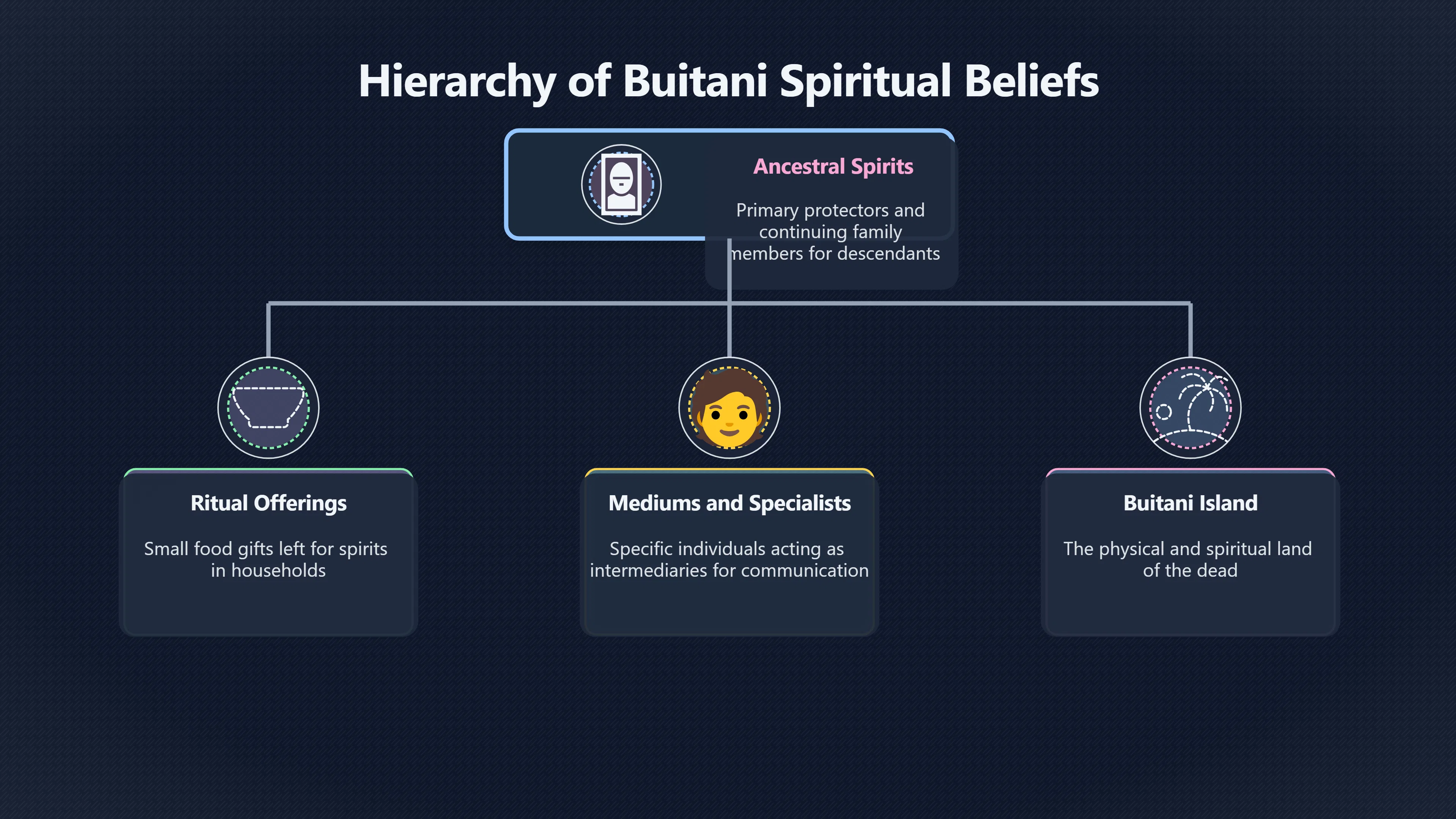
Nauru's ghostly record is strongest where family ancestors, offerings, mediums and Buitani made the dead socially present.
On this page
- Buitani as spirit land
- Ancestors, offerings and household presence
- What colonial era summaries can and cannot prove
Page outline Jump by section
Introduction
Among Nauru’s traditional beliefs, the idea of Buitani stands out as the island’s closest equivalent to a spirit world. Rather than a frightening realm of ghosts, Buitani was remembered as the destination of the dead, where ancestors continued an existence that closely resembled life on Nauru itself. Early ethnographers and colonial-era observers recorded a belief that the spirits of deceased relatives remained socially important: they could protect families, receive offerings and, through selected intermediaries, continue to influence the living. These accounts are fragmentary and filtered through outsiders’ perspectives, but together they provide one of the clearest windows into Nauru’s indigenous understanding of death, memory and the continuing presence of ancestors.[Wikipedia]WikipediaOpen source on wikipedia.org.
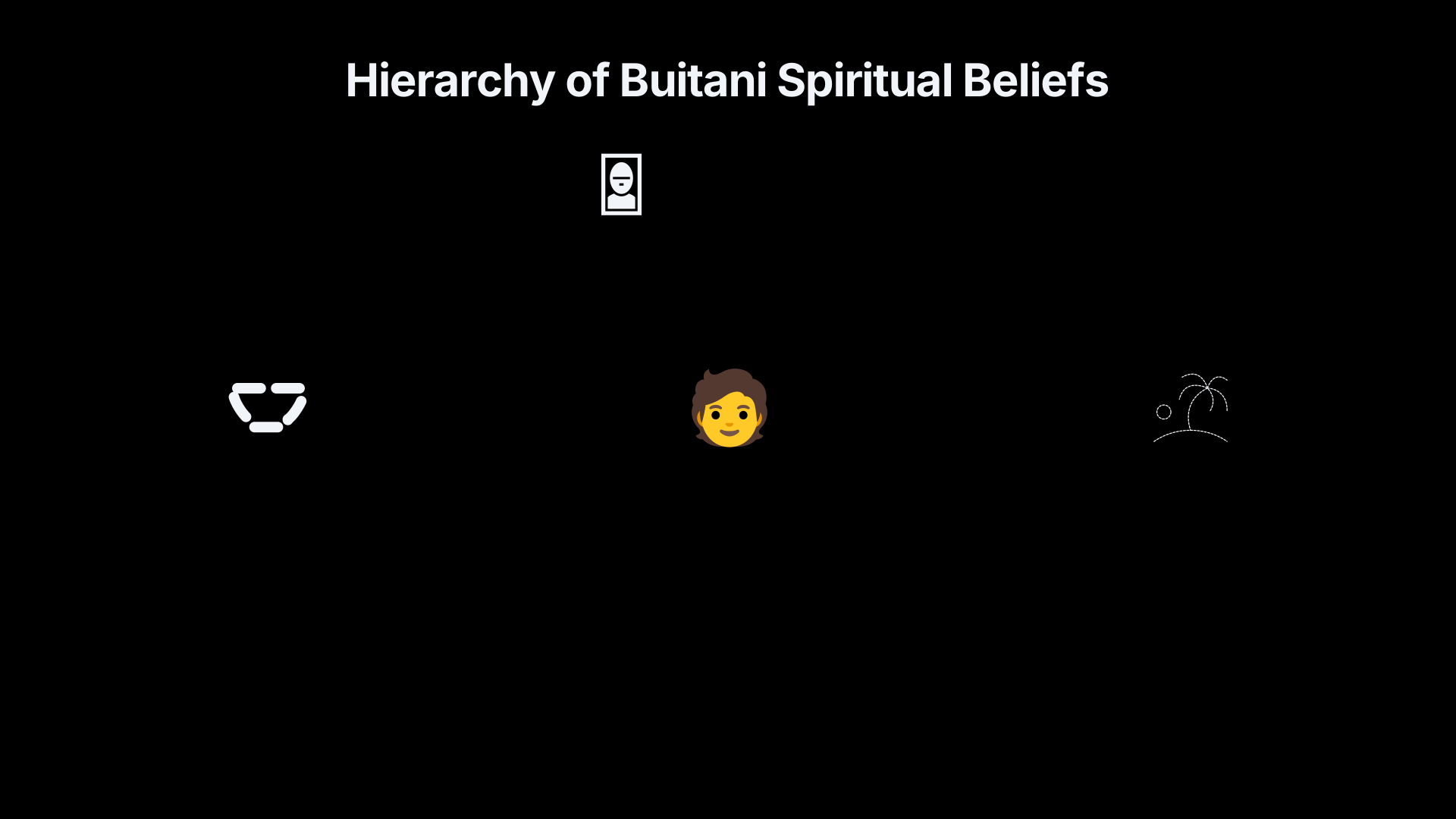
For anyone interested in Nauru’s strange folklore, the significance lies not in claims of hauntings or spectacular supernatural encounters. Instead, the island’s “ghostly” tradition is rooted in everyday relationships between families and their dead. Ancestor spirits were woven into domestic life, making Buitani one of the most important pieces of evidence for understanding Nauru’s distinctive spiritual landscape.
Where Did Nauru Place Its Dead?
Early descriptions of Nauruan religion describe Buitani as the land of the dead. It was imagined as another island rather than an abstract heaven or underworld. According to accounts collected before indigenous religious practice had largely disappeared under missionary influence, life in Buitani continued much as it had on earth. The dead remained recognisably themselves, preserving the continuity between generations rather than entering an entirely different existence.[Wikipedia]WikipediaOpen source on wikipedia.org.
This idea distinguishes Nauruan belief from many Western images of ghosts. The dead were not primarily wandering apparitions. Their proper place was Buitani, yet they remained connected to their descendants. The relationship between living families and deceased ancestors therefore continued after death instead of ending with burial.
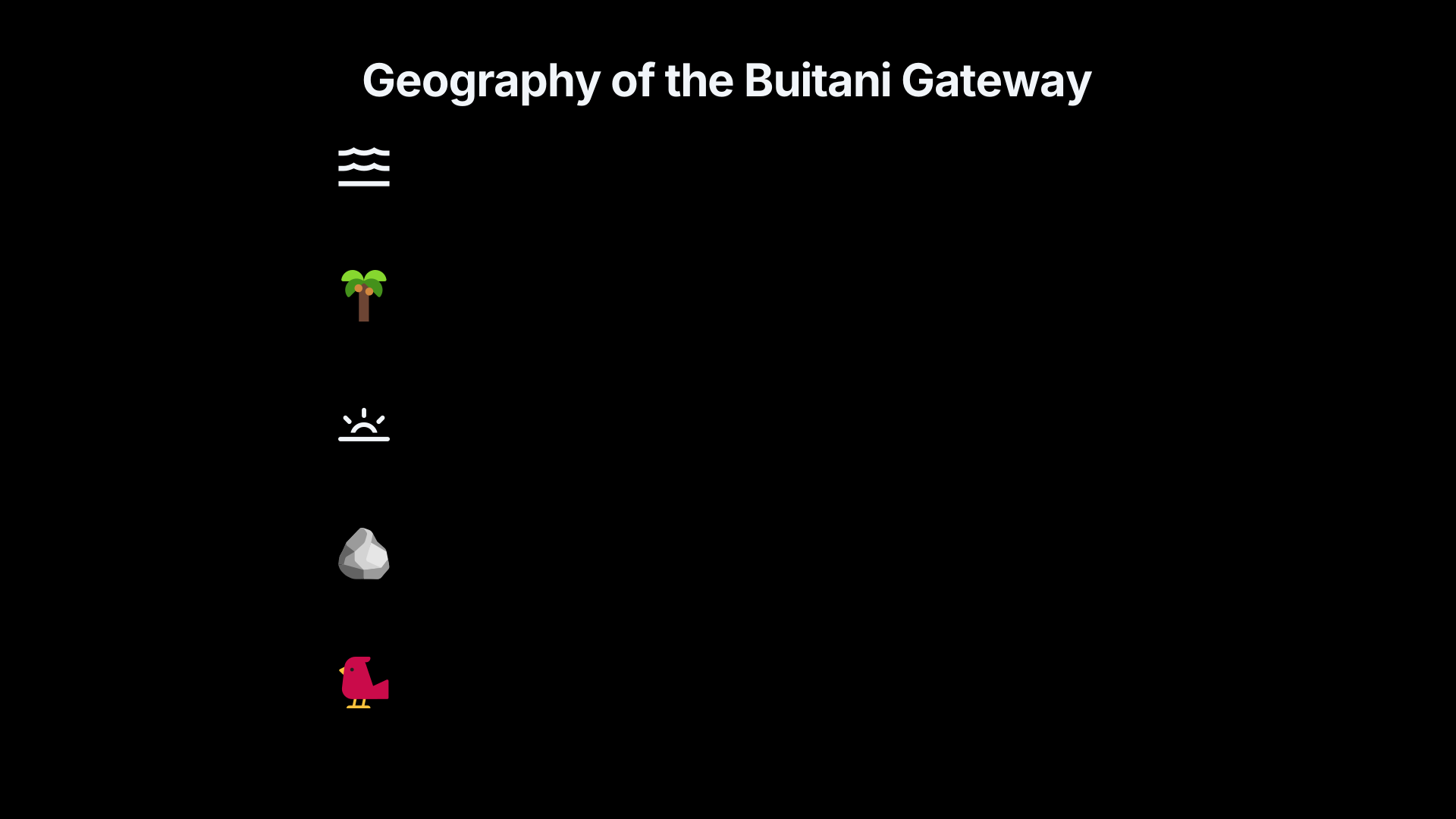
Some traditions also located a physical entrance to Buitani near Anibare on Nauru’s eastern coast. A large banana tree was said to mark this gateway, giving the invisible spirit world a geographical anchor within the island’s landscape. Such places were remembered with respect rather than as tourist curiosities, illustrating how myth and geography could become intertwined.[Wikipedia]WikipediaOpen source on wikipedia.org.
Ancestors, Offerings and Household Presence
The most striking feature of early descriptions is how ordinary ancestor relationships appear to have been.
Colonial-era ethnographers recorded that:
- families regarded particular ancestral spirits as protectors;
- households regularly left small food offerings for these spirits;
- spirits unable to remain in Buitani might dwell temporarily in rocks, bushes or the sea;
- ancestors were treated as continuing members of the family rather than distant supernatural beings.[Wikipedia]WikipediaOpen source on wikipedia.org.
These practices suggest a religion centred on kinship rather than fear. Daily offerings acknowledged the continuing obligations between generations. Instead of dramatic séances or public miracles, communication with the dead was embedded in domestic routine.
Some accounts also mention ritual specialists or mediums who were believed capable of communicating with ancestral spirits. The surviving evidence is sparse, and later writers rarely describe these practices in detail, but it indicates that certain individuals acted as intermediaries between ordinary people and the unseen world. Because nearly all surviving descriptions were written after prolonged contact with Europeans, it is difficult to reconstruct precisely how these roles functioned before Christianisation.
The Frigate Bird and the Journey Between Worlds
One of the most distinctive elements of Nauruan belief concerns the frigate bird.
According to early ethnographic summaries, the frigate bird was regarded as the bodily vessel or messenger of ancestral spirits. Rather than being worshipped simply as an animal, it symbolised the connection between the living community and Buitani. Annual ceremonies reportedly involved capturing a frigate bird, treating it with exceptional care and releasing or honouring it as part of ritual observances.[Wikipedia]WikipediaOpen source on wikipedia.org.
For a modern reader this may seem unusual, but the symbolism fits Nauru’s maritime culture. Frigate birds spend much of their lives soaring above the ocean and rarely land on water, making them striking creatures whose apparent freedom between sea and sky naturally lent itself to spiritual interpretation.
The bird therefore functioned less as a mysterious creature in its own right than as a visible reminder that the boundary between the human community and its ancestors remained permeable.
What Colonial-Era Summaries Can and Cannot Prove
Nearly everything known about Buitani comes from a remarkably small body of ethnographic work, especially research undertaken during the early twentieth century when indigenous religious traditions had already been profoundly affected by missionary activity and colonial administration. Researchers such as Camilla H. Wedgwood recorded beliefs that elderly Nauruans still remembered, but these accounts inevitably represent traditions already undergoing change.[Wikipedia]WikipediaOpen source on wikipedia.org.
That creates several important limitations.
First, many practices had already declined by the time they were documented. Researchers often relied on recollections rather than direct observation of long-established ceremonies.
Second, colonial observers interpreted Nauruan religion through European concepts such as “ancestor worship”, “spirits” and “ghosts”. Those labels may not perfectly reflect indigenous understandings.
Third, later retellings sometimes compress or simplify the surviving evidence, making Buitani appear as a fully systematised afterlife when the original ethnographic record is often more nuanced and incomplete.
None of this means the traditions were invented. Rather, it reminds readers that surviving evidence is both valuable and partial.

Why Buitani Matters in Nauru’s Strange History
Nauru has relatively few documented ghost stories in the modern sense. Its strongest contribution to Pacific Forteana instead lies in a worldview where the dead remained active participants in community life.
Buitani illustrates several themes that recur across the island’s traditional beliefs:
- the boundary between the living and the dead was considered permeable rather than absolute;
- particular places in the landscape could possess spiritual importance;
- animals, especially the frigate bird, acted as links between visible and invisible worlds;
- family relationships extended beyond death through offerings, remembrance and ritual.
For readers interested in unusual folklore rather than sensational paranormal claims, Buitani is significant precisely because it reflects a coherent indigenous understanding of ancestry. The surviving record does not provide evidence for literal ghosts or supernatural events. Instead, it preserves a rare glimpse of how generations of Nauruans understood death as a continuation of social life, with ancestors remaining present through memory, ritual and the enduring idea of a spirit island lying just beyond the visible world.
Amazon book picks
Further Reading
Books and field guides related to Where Did Nauru Place Its Dead?. Use these as the next step if you want deeper reading beyond the article.

The hero with a thousand faces
Provides interpretive tools for ancestor and spirit traditions.

The Penguin book of the undead
Explores historical beliefs about the dead across cultures.
eBay marketplace picks
Marketplace Samples
Live-tested eBay searches with available results related to this page.



Endnotes
1.
Source: Wikipedia
Link:https://de.wikipedia.org/wiki/Buitani
2.
Source: youtube.com
Title: Nareau: The Micronesian Spider God Who Wove the Universe
Link:https://www.youtube.com/watch?v=_UT2O9ITPOM
Source snippet
Nauru - Culture And Traditions...
3.
Source: youtube.com
Link:https://www.youtube.com/watch?v=24jH2LBk80g
Source snippet
History of Nauru...
Additional References
4.
Source: books.ftp.sh
Title: sh Encyclopedia of Food and Culture, Volume 3.pdf
Link:https://books.ftp.sh/eBooks/Other/Encyclopedia/Encyclopedia%20of%20Food%20and%20Culture%2C%20Volume%203.pdf
Source snippet
land is linked to the health and future of the people. It is a holistic and philosophical approach to agriculture, which has as its goals...
5.
Source: raw.githubusercontent.com
Title: Wordlist 550000 frequency weighted (BNC).txt
Link:https://raw.githubusercontent.com/ManiacDC/TypingAid/master/Wordlists/Wordlist%20550000%20frequency%20weighted%20%28BNC%29.txt
Source snippet
land white type range church industry during Street management although cause table death fall evidence free stop century morning trade c...
6.
Source: youtube.com
Title: Nauru History in 3 Minutes
Link:https://www.youtube.com/watch?v=PhPcfGcz-5U
Source snippet
Nauru Travel: The Pacific's Least-Visited Island Nation...
7.
Source: link.springer.com
Link:https://link.springer.com/content/pdf/10.1057/9781137569622.pdf
Source snippet
To this day, when the earth trembles, the Lemba know that it is Mwali.Read more...
8.
Source: youtube.com
Title: Nauru Travel: The Pacific’s Least-Visited Island Nation
Link:https://www.youtube.com/watch?v=2ZBmY5BOjaw
9.
Source: youtube.com
Title: History of Nauru
Link:https://www.youtube.com/watch?v=4P-RvlYGP3U
Source snippet
Nauru History in 3 Minutes...
Topic Tree