Why Estonia Turns Landscape Into Legend
Estonia’s strange-history record is not dominated by one world-famous monster or a single “classic” UFO case.
Page outline Jump by section
Introduction
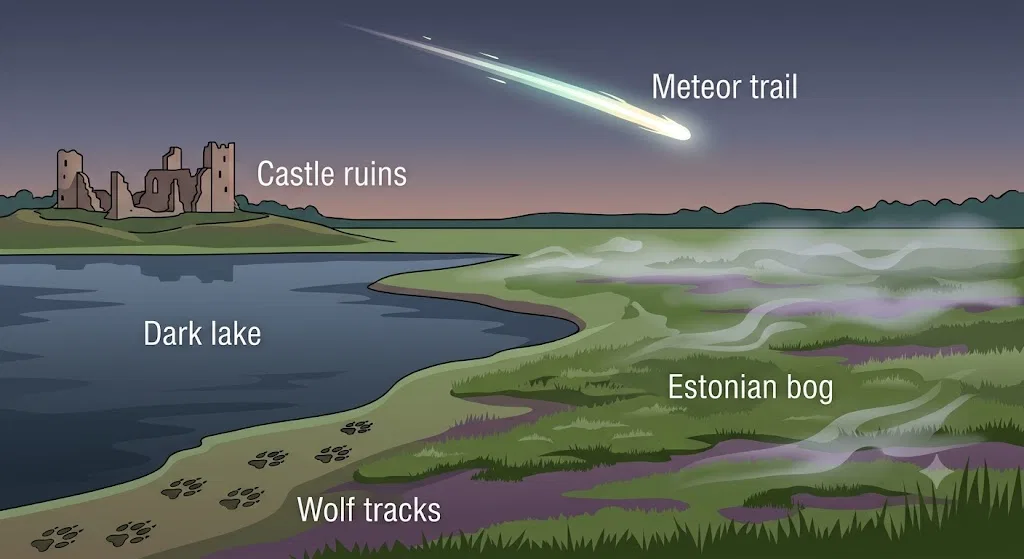
The strongest pattern is this: Estonia often turns real landscape features into uncanny engines. A crater becomes a sacred lake. A castle chapel window becomes a recurring apparition. A city reservoir becomes a flood prophecy. Bogs produce lights, ghostly eyes and hidden treasure stories. Modern sky scares, meanwhile, are usually pulled back down to earth by astronomy, cameras and aircraft explanations — but they still show how quickly an unusual light can become a mystery report.[visithaapsalu.com]visithaapsalu.comVisit HaapsaluHaapsalu Castle - Visit Haapsalu…
Estonia’s weird record begins with places, not monsters
The first thing to know about Estonian Forteana is that much of it is place-based. Rather than a parade of isolated marvels, the material clusters around recognisable settings: Saaremaa, Tallinn, Haapsalu, Lake Ülemiste, bogs, marshes, village lakes, old town houses and church towers. This matters because the strangeness usually does not float free of context. It is tied to how people explained danger, property, death, water, weather, sacred ground and social order.
The Estonian Folklore Archives and related folklore projects preserve a large body of material in which natural sites are not passive scenery. In older belief, landforms and waters could have guardians or otherworldly inhabitants, while bogs and marshes gathered stories of will-o’-the-wisps, ghost eyes, sunken treasure and dangerous boundary places. The Natural History Anthology hosted by Estonian folklore scholars lists traditions such as “Will-o’-the-wisp in Võlla marsh”, “Ghost eyes”, “A fortune sunk in the bog” and “One of the wolf cubs is a werewolf”, which is a neat miniature of the Estonian pattern: landscape, animal lore and the supernatural sit side by side.[Folklore]folklore.eeOther folklore | Natural history anthologyOther folklore | Natural history anthology
This makes Estonia a good case study in “grounded weirdness”. Many traditions are not best read as claims that a modern investigator could simply confirm or disprove. They are cultural maps. A dangerous lake is given an owner. A bog light becomes a warning. A wolf story explains fear of the forest, envy, witchcraft or social suspicion. A ghostly castle window turns architecture and moonlight into an annual ritual.
Kaali: the meteorite crater that made science look like myth
The most spectacular Estonian strange site is also one of the most scientifically secure: the Kaali crater field on Saaremaa. Kaali is not a rumour of a fallen star; it is a confirmed impact site. Research on the crater’s age has placed its formation shortly after roughly 1530–1450 BCE, making it a rare example of a major Holocene impact in a region where people may already have been present. A review of the physical and social effects of the impact calls the Kaali crater field “an excellent case study area for past human-meteorite interactions” and notes that Estonia has had several Holocene crater-forming impacts and registered meteorite falls.[Wiley Online Library]onlinelibrary.wiley.comOpen source on wiley.com.
For Fortean readers, Kaali is fascinating because it reverses the usual evidential problem. Here the extraordinary physical event is real; the uncertainty lies in how far its memory travelled into myth. Some older and more speculative interpretations have connected Kaali with Baltic and Finnic fire-from-the-sky motifs, catastrophe memories and sacred-lake traditions. Those links should be treated cautiously: folklore can preserve environmental memory, but it can also reshape, relocate and reinvent it. Still, Kaali gives Estonia something many countries only pretend to have — a genuine ancient sky event dramatic enough to invite mythic interpretation.
The crater also helps explain why Estonian sky stories have a different texture from purely modern UFO lore. In a country with a famous impact crater, a bright bolide is not merely a light in the sky; it belongs to a landscape where falling celestial bodies have left visible wounds. That does not make every light mysterious. It does make the boundary between scientific awe and legendary imagination especially thin.
Sky mysteries: from bolides to “UFOs” with ordinary causes
Modern Estonia still produces unusual sky reports, but the best recent examples show how quickly mystery can be narrowed by better observation. In February 2026, ERR reported that a “burning object” filmed near Koeru in central Estonia had been interpreted by the witness as possibly resembling a rocket or falling debris. The report’s likely explanation was much less exotic: aircraft contrails seen in particular lighting conditions. The story is a textbook Fortean moment because it shows the full chain — witness uncertainty, dramatic comparison, emergency call, media framing and a plausible atmospheric explanation.[ERR]news.err.eeUFO' filmed over central Estonian skies likely airplane contrails | News | ERRUFO' filmed over central Estonian skies likely airplane contrails | News | ERR
A month later, a bright object over Tartu and southern Estonia was captured not just by phone cameras but by the AllSky7 meteor camera network. ERR reported that the object appeared at about 5.45 a.m., left a glowing trail, and was recorded by Estonia’s first AllSky7 node in Tartu, part of a wider network designed to detect and film meteors. The observer managing the camera explained that with more stations, triangulation with Latvia could help calculate a body’s orbit and possible landing area.[ERR]news.err.eeOpen source on err.ee.
Another ERR report from January 2026 described an extra-bright bolide seen over Estonia and Latvia. Astronomer Tõnis Eenmäe of the University of Tartu Observatory described it as a very bright meteor, bright enough to light trees white, with witnesses reporting a visible tail lasting several seconds. That is the sober explanation — but it is also exactly the kind of event that, before cameras and meteor databases, could become a tale of heavenly fire, warning lights or uncanny visitation.[ERR]news.err.eeExtra-bright bolide meteor seen over Estonia, Latvia | News | ERRExtra-bright bolide meteor seen over Estonia, Latvia | News | ERR
The wider European context reinforces the point. The European Space Agency reported a March 2026 fireball over Europe that glowed for about six seconds, left a visible trail, broke into pieces and was recorded by meteor cameras, phones and other cameras. ESA assessed the object as up to a few metres in diameter and noted that such objects strike Earth from once every few weeks to once every few years. The lesson for Estonia is not “nothing strange happens”; it is that some very strange-looking things are part of a knowable sky.[European Space Agency]esa.intEuropean Space Agency ESAEuropean Space Agency ESA
Water spirits, lake warnings and the logic of dangerous places
Estonian water lore is one of the richest areas for country-level Forteana because it sits between environmental caution and supernatural imagination. In older belief, bodies of water had protectors or inhabitants — water mothers, water fathers, water spirits and water fairies. The Estonian Natural History Anthology explains that water could be imagined as an otherworld or a route to one, and that water spirits might appear as human- or fish-shaped beings with their own farms beneath the water.[Folklore]folklore.eeWater | Natural history anthologyWater | Natural history anthology
This is not quite the same as a modern lake-monster tradition. Estonia does not need a Nessie equivalent to have uncanny water lore. The strangeness lies in the moral and social role of the beings. The older water guardian was not necessarily evil; it regulated behaviour towards fishing, lakes and the sea. Later influences helped darken the figure into the dangerous water creature who might appear as a woman in white, a man or an animal, often a horse.[Folklore]folklore.eeWater | Natural history anthologyWater | Natural history anthology
Lake Ülemiste gives this water logic a civic form. The legend says an old man from the lake asks whether Tallinn is finished; if anyone says yes, he will flood the city. Ülemiste City’s own public artwork page summarises the folk tale and interprets it as a symbol of Tallinn as a city that must remain unfinished and continually developing. That is a remarkably elegant urban legend: it turns municipal growth into flood prevention.[Ülemiste City]ulemistecity.eeOpen source on ulemistecity.ee.
For a Fortean reading, the key point is that these stories are not random ghost tales with water attached. They encode the danger of drowning, the unpredictability of lakes, the importance of respectful conduct and the anxiety that built places remain vulnerable to natural forces. The supernatural figure gives a face to a risk everyone already understood.
Werewolves: Estonia’s strongest monster tradition
If Estonia has a serious monster tradition, it is the werewolf. The material is not a single cryptid case but a deep historical and folkloric corpus. Merili Metsvahi’s chapter “Estonian Werewolf History” notes that a 1550 reprint of Sebastian Münster’s Cosmographia introduced western learned readers to the idea that Livonia was a land of werewolves, based on information from a scholar who had visited the eastern Baltic coast in the 1540s. The chapter places Estonian werewolf belief within witchcraft, confession, learned demonology and local narrative traditions rather than treating it as evidence for literal shape-shifting.[Springer Link]link.springer.comLink Estonian Werewolf History | Springer Nature LinkLink Estonian Werewolf History | Springer Nature Link
Estonian werewolf lore is especially interesting because it is not just a Halloween-style monster. It crosses into witch trials, social accusation, gender, animal fear and folk healing. A separate study of “The Woman as Wolf” identifies that tale type as one of the most popular folk tales in the Estonian Folklore Archives, appearing both as fairy tale and legend, with most versions written down in the first part of the twentieth century.[UTLib OJS]ojs.utlib.eeOJSSOME INTERPRETATIONS OF A VERY ESTONIAN FOLKOJSSOME INTERPRETATIONS OF A VERY ESTONIAN FOLK
That distinction between fairy tale and legend matters. A fairy tale can be openly marvellous; a legend often behaves as if it might have happened to someone, somewhere nearby. Werewolf stories are therefore Fortean in a precise sense: they live in the uneasy zone between entertainment, testimony, fear and social belief. Sceptically, they can be read as stories about wolves, marginal people, witchcraft accusations or the pressures of rural life. Believers, historically, treated them as accounts of real transformation, bewitchment or spirit activity. The archive preserves the tension without requiring modern readers to accept the literal wolf-change.
Kratt: the Estonian servant-demon with a modern afterlife
The kratt is one of Estonia’s most memorable supernatural figures: a made thing, often assembled from household objects, animated through a bargain and forced to bring wealth or goods to its owner. It is not merely a monster; it is a story about greed, labour, property and moral debt. In folklore, a kratt is useful because it steals or carries treasure, but dangerous because such bargains come with consequences.
Recent scholarship has kept the figure alive in a surprisingly concrete way. A 2022 article in the Journal of Ethnology and Folkloristics notes that kratt folklore is rich and recorded across Estonia, while only one actual material example is known; it also discusses a 1928 newspaper reference to folklorist Matthias Johann Eisen’s account of a woman from Raadi Manor who allegedly made a kratt to bring her a husband.[Folklore]folklore.eeDownload for the ReaderDownload for the Reader
The kratt’s modern life is just as revealing as its old one. Estonia has used the figure as a metaphor in discussions of artificial intelligence, especially around responsibility for autonomous systems. That leap from demon-servant to algorithm is not a gimmick; it works because the old story already asks a modern question: who is responsible when a tool made to serve human desire behaves badly?
As Forteana, the kratt is less about whether anyone ever owned a supernatural stick-and-straw servant and more about how a society imagines agency. The thing is made by humans, animated by a bargain, used for profit and feared when it exceeds control. That is old folklore with remarkably current teeth.
Ghosts that became civic theatre
Estonia’s ghost traditions are strongest where architecture and performance keep them visible. The White Lady of Haapsalu is the best example. Haapsalu Castle’s own visitor information says the cathedral was probably built in 1279 and is known for one of Estonia’s most famous ghosts, who appears in the baptismal chapel window on full moons in August. The same source gives a cautious explanation: the figure is probably a mirage of light designed by the chapel builders at the turn of the fifteenth and sixteenth centuries, while folklore explains it as the apparition of a woman walled into the castle.[Visit Haapsalu]visithaapsalu.comHaapsalu Castle - Visit Haapsalu…
That combination is perfect Fortean material. The phenomenon has a physical setting, a recurring time, a plausible optical explanation, a tragic legend and a public ritual life. The legend was first written down in the nineteenth century by Carl Russwurm, and since 1979 an open-air performance of “The White Lady” has been staged in the castle courtyard during the full moon. In other words, the ghost is not just “believed” or “debunked”; it is performed, visited and renewed.[Visit Haapsalu]visithaapsalu.comHaapsalu Castle - Visit Haapsalu…
Tallinn’s ghost stories operate in a more urban register. Visit Tallinn’s guide to ghost stories includes Rataskaevu 16, where a devilish wedding supposedly took place behind a fake window, and St Olaf’s Church, whose legendary builder falls from the tower with a snake and a toad emerging from his mouth. The same guide notes the church’s height and its repeated lightning damage, showing how architectural risk and supernatural explanation become entwined.[Visit Tallinn]visittallinn.eeVisit Tallinn Top 8 ghost stories of TallinnVisit Tallinn Top 8 ghost stories of Tallinn
These stories should not be flattened into tourist nonsense. Tourism certainly packages them, but the packaging works because the stories are attached to real streets, towers and windows. The ghosts give old buildings a second life as narrative machines.
Prophecy scares and the White Ship
Estonian weird history is not all creatures and apparitions. One of its most culturally powerful strange motifs is the White Ship: a promised vessel of deliverance associated with the nineteenth-century religious figure Juhan Leinberg, known as Prophet Maltsvet. The Estonian Painters Association summarises the tradition as a belief, around 1860, that a white ship would come and take believers to a better land. It also notes that the image later became a strong Estonian cultural symbol for hoped-for deliverance that may never arrive.[Eesti Kunstnike Liit]eaa.eeOpen source on eaa.ee.
The historical picture is more complicated than the neat legend. Literary scholarship in Keel ja Kirjandus cautions that the familiar construction of Maltsevism owes much to later writing, especially Eduard Vilde’s novel, and that the White Ship image was probably not simply invented by Maltsvet or his assistant prophet Miina Renning. The article suggests it may have emerged from an anonymous follower’s imagination or even from newspaper mockery circulating from June 1861, before being fixed in public memory by literature.[Keel ja Kirjandus]keeljakirjandus.eeKeel ja Kirjandus Vilde as the constructor of MaltsevismKeel ja Kirjandus Vilde as the constructor of Maltsevism
That uncertainty makes the story more interesting, not less. The White Ship is a case where failed prophecy, satire, migration hope, religious longing and national symbolism fused. In Fortean terms, it belongs beside prophecy scares and visionary movements elsewhere: the marvellous promise fails in literal terms, but succeeds culturally by becoming a durable symbol.
Why Estonian Forteana feels different
Estonian Forteana has a quieter tone than the better-known strange traditions of larger countries. There are fewer globally famous “cases”, fewer internationally branded monsters and fewer headline-making paranormal investigations. But the material is unusually good at showing how the strange enters everyday life through place.
Several patterns stand out.
The landscape is active. Lakes ask questions, bogs hide lights and treasure, waters have guardians, and stones or craters carry memory. The supernatural is often a way of giving agency to dangerous or meaningful places.[Folklore]folklore.eeWater | Natural history anthologyWater | Natural history anthology
The sky is both mythic and measurable. Kaali gives Estonia a real ancient sky catastrophe, while modern bolides and “UFO” reports show how cameras, astronomy networks and contrail explanations now discipline the same sense of wonder.[springer.com]link.springer.comOpen source on springer.com.
The monsters are social. Werewolves and kratts are not just beasts. They express anxieties about witchcraft, greed, labour, envy, responsibility and hidden power. Their importance lies less in zoology than in what they reveal about human communities.[springer.com]link.springer.comLink Estonian Werewolf History | Springer Nature LinkLink Estonian Werewolf History | Springer Nature Link
Ghosts become public culture. Haapsalu’s White Lady and Tallinn’s old-town legends survive because they are attached to repeatable experiences: a window at a certain moonlit season, a walking route, a tower, a walled-up room, a festival or performance.[Visit Haapsalu]visithaapsalu.comHaapsalu Castle - Visit Haapsalu…
The result is a country-level weird history that rewards a grounded reading. Estonia’s strange reports are rarely strongest when treated as literal proof of supernatural events. They are strongest when read as layered records: of real impacts, dangerous waters, old fears, religious hopes, architectural illusions, misidentified lights and stories that keep finding new uses.

eBay marketplace picks
Marketplace Samples
Live-tested eBay searches with available results related to this page.

Endnotes
1.
Source: visithaapsalu.com
Title: Visit Haapsalu
Link:https://www.visithaapsalu.com/en/estonian-swedes/haapsalu-linnus/
Source snippet
Haapsalu Castle - Visit Haapsalu...
2.
Source: folklore.ee
Title: Water | Natural history anthology
Link:https://folklore.ee/loodus/en/veed
3.
Source: news.err.ee
Title: ‘UFO’ filmed over central Estonian skies likely airplane contrails | News | ERR
Link:https://news.err.ee/1609951076/ufo-filmed-over-central-estonian-skies-likely-airplane-contrails
4.
Source: folklore.ee
Title: Other folklore | Natural history anthology
Link:https://folklore.ee/loodus/en/zanrid/other-folklore
5.
Source: folklore.ee
Title: Land | Natural history anthology
Link:https://folklore.ee/loodus/en/maa
6.
Source: onlinelibrary.wiley.com
Link:https://onlinelibrary.wiley.com/doi/full/10.1111/maps.12616
7.
Source: link.springer.com
Link:https://link.springer.com/chapter/10.1007/978-3-540-32711
8.
Source: news.err.ee
Link:https://news.err.ee/1609976409/bright-object-passing-over-south-estonia-s-skies-picked-up-by-volunteer-camera-network
9.
Source: news.err.ee
Title: Extra-bright bolide meteor seen over Estonia, Latvia | News | ERR
Link:https://news.err.ee/1609911673/extra-bright-bolide-meteor-seen-over-estonia-latvia
10.
Source: esa.int
Title: European Space Agency ESA
Link:https://www.esa.int/Space_Safety/Planetary_Defence/ESA_analysing_fireball_over_Europe_on_8_March_2026
11.
Source: link.springer.com
Title: Link Estonian Werewolf History | Springer Nature Link
Link:https://link.springer.com/content/pdf/10.1007/978-1-137-52634
12.
Source: ojs.utlib.ee
Title: OJSSOME INTERPRETATIONS OF A VERY ESTONIAN FOLK
Link:https://ojs.utlib.ee/index.php/JEF/article/download/22636/17175/31031
13.
Source: folklore.ee
Title: Download for the Reader
Link:https://www.folklore.ee/folklore/sites/default/files/2025-07/fl_ejf_88x.pdf
14.
Source: folklore.ee
Link:https://folklore.ee/loodus/maa/ussid
15.
Source: folklore.ee
Link:https://www.folklore.ee/tagused/nr66/hiiemae_usund.pdf
16.
Source: folklore.ee
Link:https://www.folklore.ee/folklore/vol23/echoes.pdf
17.
Source: folklore.ee
Link:https://www.folklore.ee/folklore/sites/default/files/2025-07/fl_ejf_77x.pdf
18.
Source: folklore.ee
Title: CURREN T STUDIES
Link:https://folklore.ee/sator/wp-content/uploads/2021/11/sator22.pdf
19.
Source: folklore.ee
Link:https://www.folklore.ee/era/uudis/_index.html
20.
Source: folklore.ee
Link:https://www.folklore.ee/tagused/sites/default/files/2025-10/mt72x.pdf
21.
Source: en.folklore.ee
Link:https://en.folklore.ee/rl/fo/research/
22.
Source: folklore.ee
Link:https://folklore.ee/folklore/sites/default/files/2026-04/Folklore98_web.pdf
23.
Source: folklore.ee
Link:https://www.folklore.ee/folklore/vol26/lintrop.pdf
24.
Source: folklore.ee
Link:https://folklore.ee/loodus/en/zanrid/other-folk-story
25.
Source: folklore.ee
Link:https://folklore.ee/loodus/en/loodusjoud
26.
Source: folklore.ee
Link:https://www.folklore.ee/rl/pubte/ee/cf/cf/19.html
27.
Source: folklore.ee
Link:https://www.folklore.ee/balkan_baltic_yearbook/YBBS/article/view/127/156
28.
Source: folklore.ee
Link:https://www.folklore.ee/rl/pubte/ee/usund/ingl/konakov.html
29.
Source: folklore.ee
Link:https://www.folklore.ee/balkan_baltic_yearbook/YBBS/article/download/127/156/458
30.
Source: folklore.ee
Link:https://www.folklore.ee/rl/pubte/ee/bif/bif2/mare.html
31.
Source: folklore.ee
Title: field notes
Link:https://www.folklore.ee/folklore/vol65/berton-reilly.pdf
32.
Source: folklore.ee
Link:https://www.folklore.ee/rl/fo/konve/leedu06/
33.
Source: folklore.ee
Link:https://www.folklore.ee/folklore/vol44/koiva.pdf
34.
Source: news.err.ee
Title: what exciting celestial phenomena are in store for 2026
Link:https://news.err.ee/1609911445/what-exciting-celestial-phenomena-are-in-store-for-2026
35.
Source: news.err.ee
Title: russian military inspectors complete legitimate airspace mission over estonia
Link:https://news.err.ee/110905/russian-military-inspectors-complete-legitimate-airspace-mission-over-estonia
36.
Source: news.err.ee
Title: watch the skies meteor shower season s first events peak tuesday night
Link:https://news.err.ee/1610002024/watch-the-skies-meteor-shower-season-s-first-events-peak-tuesday-night
37.
Source: eesti.pl
Title: myths and legends in tallinn 1336
Link:https://www.eesti.pl/myths-and-legends-in-tallinn-1336.html
38.
Source: ojs.utlib.ee
Link:https://ojs.utlib.ee/index.php/JEF/article/view/22636/17175
39.
Source: esa.int
Link:https://www.esa.int/ESA_Multimedia/Videos/2026/03/Fireball_over_Europe_8_March_2026
40.
Source: earth.com
Title: lost fortress uncovered beneath estonian hill
Link:https://www.earth.com/news/lost-fortress-uncovered-beneath-estonian-hill/
41.
Source: forums.forteana.org
Link:https://forums.forteana.org/index.php?attachments%2Fmetsvahi-merili-2022-estonian-and-livonian-werewolf-lore-and-the-forests-place-in-it-chan-pdf.79474%2F=
42.
Source: archive.org
Title: Fortean Times 02.2021 djvu.txt
Link:https://archive.org/stream/fortean-times-08.2021/Fortean%20Times%2002.2021_djvu.txt
43.
Source: ulemistecity.ee
Link:https://www.ulemistecity.ee/en/art-work/the-old-man-of-ulemiste/
44.
Source: visittallinn.ee
Title: Visit Tallinn Top 8 ghost stories of Tallinn
Link:https://www.visittallinn.ee/eng/visitor/ideas-tips/tips-and-guides/ghost-stories-of-tallinn
45.
Source: eaa.ee
Link:https://www.eaa.ee/en/white-ship-estonian-painters-association
46.
Source: keeljakirjandus.ee
Title: Keel ja Kirjandus Vilde as the constructor of Maltsevism
Link:https://www.keeljakirjandus.ee/en/archives/25135
47.
Source: Wikipedia
Link:https://en.wikipedia.org/wiki/Kratt
48.
Source: Wikipedia
Title: Kaali crater
Link:https://en.wikipedia.org/wiki/Kaali_crater
49.
Source: Wikipedia
Title: Estonian folklore
Link:https://en.wikipedia.org/wiki/Estonian_folklore
50.
Source: Wikipedia
Title: Haapsalu Castle
Link:https://en.wikipedia.org/wiki/Haapsalu_Castle
51.
Source: Wikipedia
Title: Estonian Folklore Archives
Link:https://en.wikipedia.org/wiki/Estonian_Folklore_Archives
52.
Source: Wikipedia
Title: Juhan Leinberg
Link:https://en.wikipedia.org/wiki/Juhan_Leinberg
53.
Source: Wikipedia
Title: The White Ship
Link:https://en.wikipedia.org/wiki/The_White_Ship
54.
Source: visittallinn.ee
Link:https://visittallinn.ee/eng/visitor/see-do/things-to-do/tours/785/ghosts-and-legends-tour-in-tallinns-old-town
55.
Source: folklore.usc.edu
Title: the valge laev the white ship of estonia
Link:https://folklore.usc.edu/the-valge-laev-the-white-ship-of-estonia/
56.
Source: folklore-bestiary.vercel.app
Link:https://folklore-bestiary.vercel.app/en/creatures/ee-n-kk
57.
Source: augustibluus.ee
Link:https://augustibluus.ee/en/speakers/
58.
Source: europeisnotdead.com
Link:https://europeisnotdead.com/estonia-the-old-man-from-the-lake-ulemiste/
59.
Source: wildandheritage.com
Link:https://www.wildandheritage.com/haapsalu
60.
Source: balther.net
Title: the estonian folklore archives
Link:https://www.balther.net/memory-institutions/estonia/archives/the-estonian-folklore-archives/
61.
Source: kids.kiddle.co
Title: Lake Ülemiste
Link:https://kids.kiddle.co/Lake_%C3%9Clemiste
Additional References
62.
Source: loc.gov
Link:https://www.loc.gov/everyday-mysteries/browse-all-questions/item/can-it-rain-frogs-fish-and-other-objects/
63.
Source: youtube.com
Title: Haapsalu Episcopal Castle and the White Lady Ghost
Link:https://www.youtube.com/watch?v=5qW5h8c4hgg
Source snippet
Kodukäija and Külmking: Spirits from Estonian Folklore...
64.
Source: instagram.com
Link:https://www.instagram.com/p/DHeHtvysDR3/?hl=en
65.
Source: facebook.com
Link:https://www.facebook.com/groups/2485751181/posts/10161366717891182/
66.
Source: facebook.com
Link:https://www.facebook.com/visitnorway/posts/n%C3%B8kken-aka-the-water-sprite-is-one-of-the-most-mysterious-and-elusive-norwegian-/812472687985353/
67.
Source: researchgate.net
Link:https://www.researchgate.net/publication/384905339_A_Detailed_Phenomenology_of_Poltergeist_Events
68.
Source: academia.edu
Link:https://www.academia.edu/143054076/Forest_Spirits_and_Their_Functions_in_the_Traditions_of_Estonians_Estonian_Russians_and_Belarusians
69.
Source: academia.edu
Link:https://www.academia.edu/37934272/Historical_Profiles_in_Poltergeist_Research
70.
Source: academia.edu
Link:https://www.academia.edu/12870685/NORWAY_IN_UFO_PHOTOGRAPHS_THE_FIRST_CATALOGUE
71.
Source: researchgate.net
Link:https://www.researchgate.net/publication/284726717_What_Is_This_Mystical_Bogeyman_or_Ghost_Called_Sharing_Nightmare_Experiences_on_Internet_Forums
Topic Tree
Follow this branch
Related pages 192
- Afghan Forteana
- Antigua Uncanny
- Bosnian Mysteries
- Botswana Weird
- Brazil Strange
- +187 more in sidebar