Where Nicaragua's Weird Stories Meet Real Places
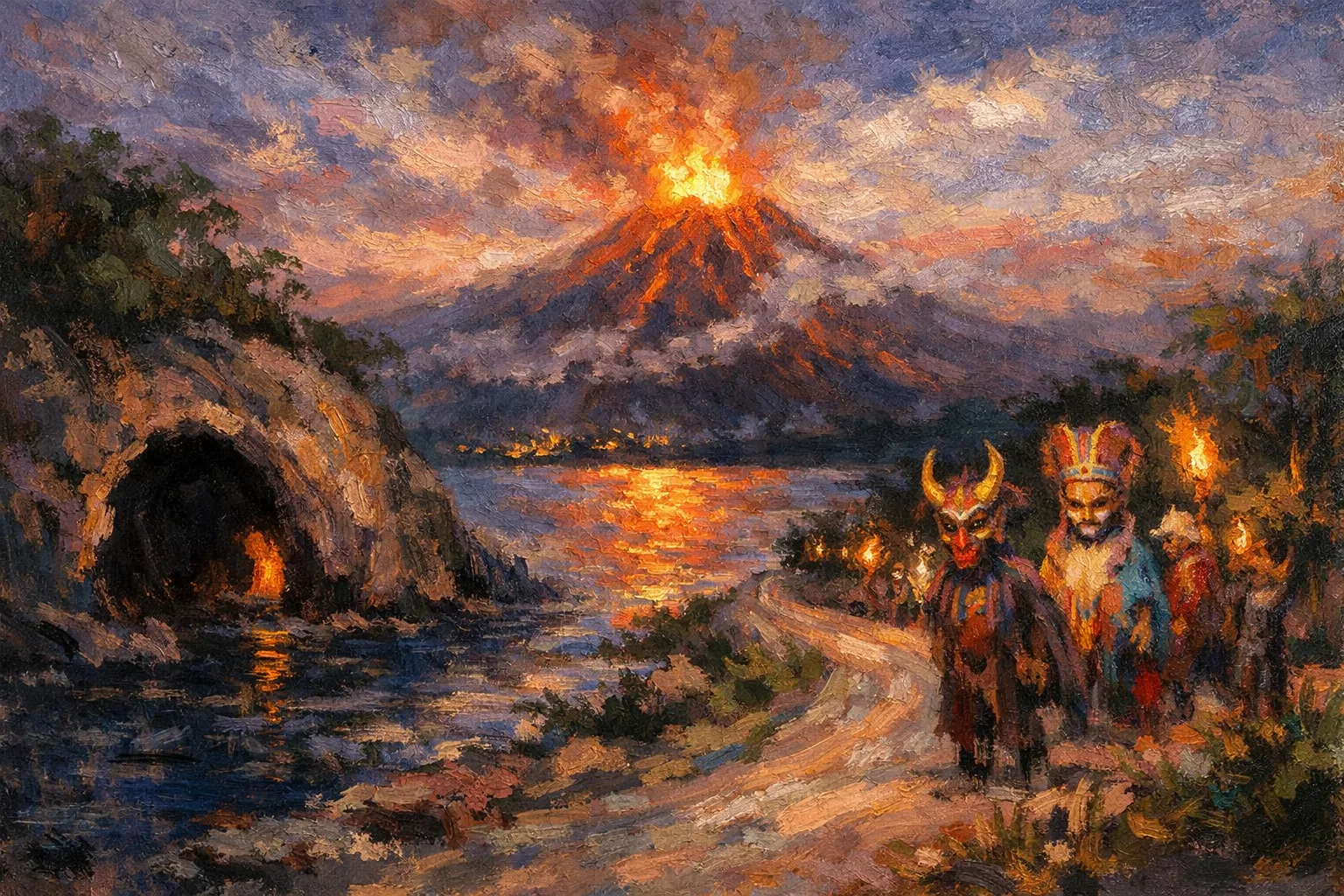
Nicaragua’s strangest material is not best understood as a tidy catalogue of “paranormal cases”. It is a country where volcanoes glow at night, a freshwater lake once produced perfectly real shark legends, colonial tales turn caves and roads into moral traps, and masked festivals deliberately bring old frights into the street.
Page outline Jump by section
Why Nicaragua’s weird history begins with landscape
Nicaragua is often described as a land of lakes and volcanoes, and that is not just tourist poetry. Its Pacific side is lined with active volcanic systems, while Lake Nicaragua and Lake Managua dominate the western lowlands. This geography matters because many of the country’s “strange” stories start with real sensory drama: sulphur fumes, crater glow, tremors, ash, unfamiliar animals, caves, lake crossings and dangerous night roads. The uncanny is not imported into the landscape; it grows out of it.[Smithsonian Global Volcanism]volcano.si.eduOpen source on si.edu.
That makes Nicaragua a useful country for reading Fortean material carefully. A story may be mythic in shape but attached to a real place. A monster may be legendary but inspired by a real animal. A “hell mouth” may be theology, colonial imagination and volcanology all at once. The question is rarely “did the supernatural happen?” A better question is: what did the report make visible about the place, and why did people keep telling it?
Masaya: the volcano that looked like hell
Masaya is Nicaragua’s most important Fortean site because its strangeness has a long documentary tail. The volcano is a broad caldera about 20 kilometres south-east of Managua, and the Smithsonian Global Volcanism Program records Santiago crater as the currently most active part, with a small lava lake and continuing gas-and-steam emissions during the recent eruption period that began in 2015.[Smithsonian Global Volcanism]volcano.si.eduOpen source on si.edu.
The older weird history is even richer. Spanish colonial observers saw Masaya’s fire, sulphur and glow through a religious lens, calling it the “Mouth of Hell”. A volcanological study of Masaya’s legends notes that early chroniclers treated the volcano as both infernal evidence and, in some cases, a possible source of molten treasure. The site’s Christianising symbolism is still visible in accounts of the cross associated with friar Francisco de Bobadilla, planted near the crater to exorcise the devil.[CATA]visitcentroamerica.comCATAMasaya Volcano National ParkCATAMasaya Volcano National Park
What makes Masaya more than a picturesque legend is that the “impossible” element has a physical engine. Visitors really can see glow from lava when conditions allow; gases really do rise from the crater; the volcano really has posed health and hazard questions. Woods Hole Oceanographic Institution has described Masaya’s gases as unusually direct emissions from underlying magma rather than gases filtered through groundwater, which helps explain why the place feels so immediate and theatrical.[Woods Hole Oceanographic Institution]whoi.eduWoods Hole Oceanographic Institution Into the 'Mouth of HellWoods Hole Oceanographic Institution Into the 'Mouth of Hell
For believers, Masaya could be read as a doorway between worlds. For sceptics, it is a lesson in how dramatic geology becomes religious theatre. For a Fortean reader, it is both: a real natural furnace that colonial fear, Indigenous memory, greed, ritual and later tourism turned into one of Central America’s great uncanny landscapes.
Lake Nicaragua: the “monster” that was a shark
Lake Nicaragua’s best strange-animal story is unusual because the startling part is true. The lake is freshwater, yet it has long been associated with sharks, sawfish and tarpon. Early accounts treated the shark as a special freshwater form, sometimes called the Lake Nicaragua shark, but later work showed it was the bull shark, a marine species capable of tolerating freshwater.[Wikipedia]WikipediaLake NicaraguaLake Nicaragua
The important scientific correction came from research on shark movement. Thomas B. Thorson’s work argued that the sharks were not trapped relics in the lake: evidence included their presence along the San Juan River, observations around rapids, and tagging results showing movement between the lake system and the sea.[DigitalCommons]digitalcommons.unl.eduOpen source on unl.edu.
This is exactly the sort of case where folklore and science do not cancel each other out. A freshwater shark sounds like a lake monster story because it violates ordinary expectations. Then biology explains the violation without making it dull. Bull sharks are among the few sharks able to survive in freshwater for extended periods, and the San Juan River gives the lake a route to the Caribbean.[Rancho Santana]ranchosantana.comRancho Santana Finding the Sharks of Lake NicaraguaRancho Santana Finding the Sharks of Lake Nicaragua
The modern twist is conservation rather than mystery. Older claims about a lake full of sharks can make the animal sound abundant and permanent, but reports of decline and fishing pressure have made the shark’s status a cautionary part of the story. The Fortean lesson is sharp: sometimes the “monster” is real, and the mystery is whether humans will leave enough of it to remain more than a rumour.
Water tigers and the Caribbean coast
Nicaragua’s Caribbean side has a different strange-animal tradition. Among Miskito and Mayangna or Sumu material, one recurring creature is the so-called water tiger, described in ethnographic sources as a manatee-like animal with glossy otter-like hair, a mane and webbed feet. The Smithsonian repository identifies Eduard Conzemius’s 1932 Ethnographical Survey of the Miskito and Sumu Indians of Honduras and Nicaragua as a major source for these traditions, and later reproductions of the text preserve the water-tiger description.[Smithsonian Research Online]repository.si.eduOpen source on si.edu.
This creature sits awkwardly between folklore, cryptozoology and animal misidentification. The description points partly towards known aquatic mammals, especially manatees, but the mane, colour varieties and tiger-like framing belong to a mythic animal vocabulary. That does not make the tradition “fake”; it means it is doing more than field zoology. It records how riverine and coastal communities classify danger, animal behaviour and the uncanny power of water.
The context matters. The Miskito and Mayangna peoples are central Indigenous groups in Nicaragua’s Caribbean regions, and their territories, rivers and forests have long shaped subsistence, travel and storytelling. Modern rights organisations describe continuing conflict over Indigenous territories, reminding readers that these traditions are not detached curiosities from a vanished world; they belong to living communities under real pressure.[Cejil]cejil.orgOpen source on cejil.org.
La Mocuana: betrayal, caves and colonial memory
La Mocuana is one of Nicaragua’s most recognisable legends. In the commonly told version, she is an Indigenous woman, often the daughter of a chief, who falls in love with a Spaniard. He deceives her, takes hidden treasure, and leaves her trapped in a cave. She escapes, but the betrayal transforms her into a wandering, vengeful or sorrowful figure associated with hills, rivers, caves and men who follow her at night.[Visita Nicaragua]visitanicaragua.comVisita Nicaragua5 Nicaraguan myths and legendsVisita Nicaragua5 Nicaraguan myths and legends
The story’s staying power comes from its double structure. On the surface, it is a ghostly warning: a beautiful woman lures a young man, reveals a terrifying face, and leaves him shaken or lost. Underneath, it is a colonial trauma story about extraction, sexual betrayal and hidden wealth. That gives it more weight than a simple “scary lady in white” tale.[Visita Nicaragua]visitanicaragua.comVisita Nicaragua5 Nicaraguan myths and legendsVisita Nicaragua5 Nicaraguan myths and legends
La Mocuana also shows how Nicaraguan folklore attaches fear to specific terrain. Caves are not just backdrops; they are places where treasure, secrecy, imprisonment and madness can be imagined together. The result is a story that can be told as a ghost encounter, a moral warning, a colonial allegory or a local place-legend depending on the teller.
Road ghosts, dog spirits and the social uses of fear
Several famous Nicaraguan and Central American legends work as night-road warnings. El Cadejo is usually described as a supernatural dog, with white and black forms often interpreted as protective and dangerous. La Cegua appears as a seductive or frightening female figure who punishes drunken, unfaithful or reckless men. La Llorona, the weeping woman, also circulates in Nicaragua as part of the wider Latin American ghost tradition.[wikipedia.org]WikipediaCulture of NicaraguaCulture of Nicaragua
These stories are easy to flatten into “monsters”, but they are more interesting as social technology. They regulate behaviour: do not walk home drunk; do not betray your spouse; do not trust every night-time invitation; do not mistake desire for safety. The supernatural gives the warning teeth. A lecture about alcohol and fidelity is forgettable; a horse-skulled woman or huge black dog on a dark road is not.
There is also a comic edge. In many retellings, the victim is not an innocent hero but a foolish man who has ignored ordinary caution. That mixture of fright and mockery is typical of durable folklore. The story scares the listener, but it also lets the community laugh at bad behaviour.

When the monsters march: Masaya’s Agüizotes
Nicaragua does not keep its old frights only in whispered stories. In Masaya, the Night of the Agüizotes turns them into public performance. Official tourism material describes it as a carnival of myths and legends in which people of all ages dress as characters from ancestral scary tales, with the event taking place in the city of Masaya shortly before the Torovenado de Monimbó.[Visita Nicaragua]visitanicaragua.comOpen source on visitanicaragua.com.
The National Tourism Map describes the procession as beginning around the María Magdalena church in Monimbó and moving through central neighbourhoods, with costumes alluding to Nicaraguan myths and legends. Other local accounts identify figures such as La Mocuana, El Cadejo, La Llorona and the headless priest among the recurring characters.[Mapa Nacional de Turismo]mapanicaragua.comMapa Nacional de Turismo Religious Festivities of MasayaMapa Nacional de Turismo Religious Festivities of Masaya
This matters because it changes how we read the legends. They are not merely old rural beliefs slowly fading away. They are performed, crafted, masked, lit by candles, photographed, watched by children and renewed as civic culture. The frightening figure becomes a costume; the costume becomes heritage; heritage becomes an annual night when the city plays with fear rather than simply submitting to it.
León’s Museum of Traditions and Legends: folklore beside political memory
León’s Museum of Traditions and Legends gives Nicaragua’s weird history a particularly unsettling frame. Travel and tourism sources describe the museum as presenting figures from Nicaraguan myth and legend through large models or puppet-like displays, but the building itself was formerly a prison associated with the Somoza period.[GetYourGuide]getyourguide.comOpen source on getyourguide.com.
That pairing can feel jarring, but it is revealing. A museum visitor encounters La Mocuana, El Cadejo and other legendary beings in a place also tied to imprisonment and torture. The result is not a clean separation between imaginary fear and historical fear. Nicaragua’s public memory places folklore, punishment, politics and spectacle in the same building.[baconismagic.ca]baconismagic.caLeon's Museum of Legends and MythsLeon's Museum of Legends and Myths
For Fortean purposes, this is important. Ghosts and monsters often survive because they help people talk indirectly about danger, guilt and power. In León, the literal architecture makes that connection hard to miss.
Strange skies: UFOs, meteors and misread lights
Nicaragua has occasional modern UFO-style reports, especially of lights or shapes in the sky, but the publicly available evidence is usually thin: social-media videos, short news items, personal testimony and little independent documentation. A 2020 Nicaraguan report, for example, recounted a journalist’s claimed triangular-object sighting in Juigalpa in 2012, but the account remains testimony rather than a verifiable case file.[100noticias.tv]100noticias.tvPeriodista de La Nación observó un ovni triangular y negroPeriodista de La Nación observó un ovni triangular y negro
A stronger way to handle such reports is to ask what else was in the sky. Nicaragua’s volcanoes produce glow, ash, gas plumes and dramatic night photography. NASA’s Earth Observatory has documented Momotombo’s eruption plume and lava in 2016, while EarthSky published a photograph of zodiacal light over Momotombo — the faint triangular glow sometimes called “false dawn”. Both are good reminders that unusual lights need not be paranormal to be memorable.[NASA Science]science.nasa.govScience Eruption at MomotomboScience Eruption at Momotombo
This does not mean every witness is foolish. People report the sky using the vocabulary available to them. “UFO” often means “I do not know what I saw” rather than “alien spacecraft”. In Nicaragua, as elsewhere, the most responsible reading keeps the uncertainty but lowers the temperature: some lights may be aircraft, meteors, satellites, camera artefacts, volcanic glow, atmospheric optics or genuine unknowns lacking enough data.
Anomalous falls: why Nicaragua has fewer famous cases than its neighbours
Classic Forteana loves odd falls: fish, frogs, stones, ash, coloured rain, strange substances dropping from the sky. Nicaragua does not appear to have a famous, well-documented “rain of fish” tradition comparable to Yoro in neighbouring Honduras, and that absence is worth saying plainly rather than padding the record. General scientific explainers note that animal falls have been reported for centuries, while the Library of Congress cautions that it does not literally “rain” animals in the normal water-cycle sense; strong winds, tornadoes or waterspouts are the usual proposed mechanisms when cases are credible.[The Library of Congress]loc.govOpen source on loc.gov.
Nicaragua’s closest equivalent is probably not fish from the sky but volcanic fallout. Ash from eruptions is a real falling substance, and in a country with active volcanoes it can transform daylight, soil, roofs, crops and health conditions. The Smithsonian records frequent activity at volcanoes such as Telica and San Cristóbal, while Wired’s 2016 report on Nicaraguan volcanic unrest described ash plumes, lava glow and public concern about whether several volcanoes were connected.[Smithsonian Global Volcanism]volcano.si.eduOpen source on si.edu.
The sceptical payoff is useful: Nicaragua’s sky weirdness is less about miraculous animal rains and more about living under a volcanic arc. The strange fall is not a Fortean exception but a geological fact.
How to read Nicaragua’s Forteana without spoiling it
The best Nicaraguan strange material rewards a middle path. Treat every legend as literal fact and the stories become credulous. Treat every legend as “just superstition” and they become flat. The richer reading asks what kind of evidence each case has.
A practical sorting helps:
- Well-supported natural strangeness: Masaya’s lava lake, volcanic gases, ash, Momotombo’s eruptions and Lake Nicaragua’s bull sharks are real phenomena with scientific documentation. Their weirdness lies in how extraordinary nature can look before it is explained.[Smithsonian Global Volcanism]volcano.si.eduOpen source on si.edu.
- Folklore with strong cultural presence: La Mocuana, El Cadejo, La Cegua and La Llorona are not proven apparitions, but they are deeply present in Nicaraguan storytelling, tourism, festivals and museums.[Visita Nicaragua]visitanicaragua.comVisita Nicaragua5 Nicaraguan myths and legendsVisita Nicaragua5 Nicaraguan myths and legends
- Ethnographic mystery animals: The water tiger belongs to recorded Miskito and Mayangna/Sumu tradition, but its zoological status is uncertain and should not be inflated into a confirmed unknown species.[Smithsonian Research Online]repository.si.eduOpen source on si.edu.
- Weak modern anomalies: UFO-style reports and haunted-house anecdotes can be culturally interesting, but without multiple independent records, physical evidence or clear dates and locations, they should remain testimony rather than headline claims.[100noticias.tv]100noticias.tvPeriodista de La Nación observó un ovni triangular y negroPeriodista de La Nación observó un ovni triangular y negro
That approach leaves the wonder intact. Nicaragua’s Forteana is not a pile of solved and unsolved curios. It is a set of stories about how people live with fiery mountains, dark roads, dangerous waters, colonial memory, Indigenous traditions, Catholic imagery, public festivals and the stubborn human habit of turning fear into narrative.
The lasting pull of Nicaragua’s strange record
Nicaragua’s weird-history record lasts because it is unusually place-bound. Masaya does not need invented demons; it has a glowing crater. Lake Nicaragua does not need a fake monster; it had real bull sharks. La Mocuana does not need a laboratory case file; she carries betrayal, caves and conquest in one portable story. The Agüizotes do not preserve folklore in silence; they put masks on it and send it through the streets.[researchgate.net]researchgate.netOpen source on researchgate.net.
The country’s Forteana is therefore most convincing when read as a layered record rather than a paranormal proof sheet. Some claims are natural wonders misunderstood at first glance. Some are moral tales sharpened by fear. Some are Indigenous and local traditions that deserve careful handling. Some are modern rumours with little evidence but clear social life. Together, they make Nicaragua a country where the strange is not separate from history and landscape, but one of the ways people have learned to describe them.
Amazon book picks
Further Reading
Books and field guides related to Where Nicaragua's Weird Stories Meet Real Places. Use these as the next step if you want deeper reading beyond the article.
The Encyclopedia of Monsters: A Guide to Creatures from Aroun...
Provides a wider folklore and creature context that fits Nicaragua's mix of legends, landscapes and strange history.

The Atlas of Monsters: Mythical Creatures from Around the World
Connects global creature traditions with the page's unusual-history theme.

The Book of Yōkai: Mysterious Creatures of Japanese Folklore
Useful comparative folklore reading for understanding how cultures transform fears and places into stories.
The Mythology Book: Big Ideas Simply Explained
Offers broad myth and legend background relevant to regional stories.
eBay marketplace picks
Marketplace Samples
Live-tested eBay searches with available results related to this page.


Endnotes
1.
Source: visitcentroamerica.com
Title: CATAMasaya Volcano National Park
Link:https://www.visitcentroamerica.com/en/visit/masaya-national-park/
2.
Source: researchgate.net
Link:https://www.researchgate.net/publication/222416827_Masaya_the_Mouth_of_Hell_Nicaragua_Volcanological_interpretation_of_the_myths_legends_and_anecdotes
3.
Source: Wikipedia
Title: Lake Nicaragua
Link:https://en.wikipedia.org/wiki/Lake_Nicaragua
4.
Source: cejil.org
Link:https://cejil.org/en/case/miskito-indigenous-communities/
5.
Source: Wikipedia
Link:https://es.wikipedia.org/wiki/Mocuana
6.
Source: Wikipedia
Title: Culture of Nicaragua
Link:https://en.wikipedia.org/wiki/Culture_of_Nicaragua
7.
Source: folklore.usc.edu
Title: la cegua
Link:https://folklore.usc.edu/la-cegua/
8.
Source: getyourguide.com
Link:https://www.getyourguide.com/en-gb/museum-of-traditions-and-legends-leon-l218791/
9.
Source: baconismagic.ca
Title: Leon’s Museum of Legends and Myths
Link:https://www.baconismagic.ca/nicaragua/leons-museum-of-legends-and-myths/
10.
Source: Wikipedia
Title: Museum of Traditions and Legends
Link:https://en.wikipedia.org/wiki/Museum_of_Traditions_and_Legends
11.
Source: 100noticias.tv
Title: Periodista de La Nación observó un ovni triangular y negro
Link:https://100noticias.tv/curiosidades/100816-ovnis-en-nicaragua/
12.
Source: science.nasa.gov
Title: Science Eruption at Momotombo
Link:https://science.nasa.gov/earth/earth-observatory/eruption-at-momotombo-87623/
13.
Source: earthsky.org
Title: zodiacal light over momotombo volcano
Link:https://earthsky.org/todays-image/zodiacal-light-over-momotombo-volcano/
14.
Source: wired.com
Link:https://www.wired.com/2016/02/volcanoes-nicaragua-sure-cranky-year
15.
Source: Wikipedia
Title: Rain of animals
Link:https://en.wikipedia.org/wiki/Rain_of_animals
16.
Source: Wikipedia
Title: Miskito people
Link:https://en.wikipedia.org/wiki/Miskito_people
17.
Source: time.com
Title: animals have actually rained from the sky
Link:https://time.com/28894/animals-have-actually-rained-from-the-sky/
18.
Source: researchgate.net
Link:https://www.researchgate.net/publication/355824768_Nicaraguan_volcanic_monitoring_program_of_the_Instituto_Nicaraguense_de_Estudios_Territoriales
19.
Source: science.nasa.gov
Title: the smoking terror 144334
Link:https://science.nasa.gov/earth/earth-observatory/the-smoking-terror-144334/
20.
Source: visitanicaragua.com
Title: Visita Nicaragua5 Nicaraguan myths and legends
Link:https://www.visitanicaragua.com/en/5-Nicaraguan-myths-and-legends/
21.
Source: visitanicaragua.com
Link:https://www.visitanicaragua.com/en/night-of-aguizotes-in-nicaragua/
22.
Source: volcano.si.edu
Link:https://volcano.si.edu/volcano.cfm?vn=344100
23.
Source: volcano.si.edu
Link:https://volcano.si.edu/volcanolist_countries.cfm?country=Nicaragua
24.
Source: whoi.edu
Title: Woods Hole Oceanographic Institution Into the ‘Mouth of Hell’
Link:https://www.whoi.edu/oceanus/feature/into-the-mouth-of-hell/
25.
Source: volcano.si.edu
Link:https://volcano.si.edu/showreport.cfm?doi=10.5479%2Fsi.GVP.BGVN202403-344100
26.
Source: digitalcommons.unl.edu
Link:https://digitalcommons.unl.edu/ichthynicar/38/
27.
Source: digitalcommons.unl.edu
Link:https://digitalcommons.unl.edu/ichthynicar/37/
28.
Source: ranchosantana.com
Title: Rancho Santana Finding the Sharks of Lake Nicaragua
Link:https://ranchosantana.com/blog/sharks-of-lake-nicaragua/
29.
Source: repository.si.edu
Link:https://repository.si.edu/handle/10088/15412
30.
Source: mapanicaragua.com
Title: Mapa Nacional de Turismo Religious Festivities of Masaya
Link:https://mapanicaragua.com/en/religious-festivities-of-masaya/
31.
Source: mapanicaragua.com
Title: Mapa Nacional de Turismo Masaya Culture
Link:https://mapanicaragua.com/en/masaya-culture/
32.
Source: loc.gov
Link:https://www.loc.gov/everyday-mysteries/browse-all-questions/item/can-it-rain-frogs-fish-and-other-objects/
33.
Source: volcano.si.edu
Link:https://volcano.si.edu/volcano.cfm?vn=344040
34.
Source: volcano.si.edu
Link:https://volcano.si.edu/showreport.cfm?doi=10.5479%2Fsi.GVP.BGVN202202-344020
35.
Source: stillwoods.blogspot.com
Title: la mocuana
Link:https://stillwoods.blogspot.com/2008/07/la-mocuana.html
36.
Source: cryptidarchives.fandom.com
Title: Lake monster
Link:https://cryptidarchives.fandom.com/wiki/Lake_monster
37.
Source: tripadvisor.com
Title: Mouth of Hell
Link:https://www.tripadvisor.com/ShowUserReviews-g551472-d646709-r748546904-Masaya_Volcano_National_Park_2025-Masaya_Masaya_Department.html
38.
Source: tripadvisor.com
Link:https://www.tripadvisor.com/Attraction_Review-g424970-d10023265-Reviews-Momotombo-Leon_Leon_Department.html
39.
Source: digitalcommons.unl.edu
Link:https://digitalcommons.unl.edu/cgi/viewcontent.cgi?article=1036&context=ichthynicar&httpsredir=1&referer=
40.
Source: volcano.si.edu
Link:https://volcano.si.edu/volcano.cfm?vn=344090
41.
Source: volcano.si.edu
Link:https://volcano.si.edu/showreport.cfm?gvpvar=GVP.WVAR20260212-344100
42.
Source: volcano.si.edu
Link:https://volcano.si.edu/showreport.cfm?doi=10.5479%2Fsi.GVP.BGVN202303-344100
43.
Source: volcano.si.edu
Title: volcanolist regions.cfm
Link:https://volcano.si.edu/volcanolist_regions.cfm?RegionGroup=Middle+America-Caribbean+Volcanic+Regions
44.
Source: volcano.si.edu
Link:https://volcano.si.edu/showreport.cfm?doi=10.5479%2Fsi.GVP.BGVN202408-344100
45.
Source: volcano.si.edu
Link:https://volcano.si.edu/showreport.cfm?doi=10.5479%2Fsi.GVP.BGVN202006-344100
46.
Source: visitanicaragua.com
Link:https://visitanicaragua.com/en/art-dario-legends-museums-leon/
47.
Source: catalog.hathitrust.org
Link:https://catalog.hathitrust.org/Record/002496987
48.
Source: abcnews.com
Link:https://abcnews.com/GMA/Travel/extraordinary-earth-nicaraguas-masaya-volcano-helps-cool-planet/story?id=69326112
49.
Source: x.com
Link:https://x.com/janinekrippner/status/1233440729139044352
50.
Source: vianica.com
Link:https://vianica.com/go/specials/9-nicaragua-volcanoes
Additional References
51.
Source: youtube.com
Title: Witch Villages in Nicaragua: The True Origin
Link:https://www.youtube.com/watch?v=NLpxO9gmuI4
Source snippet
Exploring the Museum of Myths and Legends of León, Nicaragua | La 21...
52.
Source: facebook.com
Link:https://www.facebook.com/NCNoticiasNic/videos/nicaragua-ovni-en-nicaragua-la-noche-del-martes-2-de-diciembre-algo-extra%C3%B1o-y-br/1518290782727231/
53.
Source: midlifenomads.com
Link:https://www.midlifenomads.com/p/experience-masaya-volcano
54.
Source: scribd.com
Link:https://www.scribd.com/document/957737628/Origin-of-the-Aguizotes
55.
Source: reddit.com
Link:https://www.reddit.com/r/Cryptozoology/comments/1rwxd2i/an_alleged_freshwater_seahorse_caught_alive_in/
56.
Source: facebook.com
Link:https://www.facebook.com/13abc/posts/animal-rain-happens-when-small-water-animals-like-fish-frogs-and-crabs-are-swept/10159511629081897/
57.
Source: facebook.com
Link:https://www.facebook.com/groups/939437669481329/posts/25841180428880375/
58.
Source: facebook.com
Link:https://www.facebook.com/RicWTSP/posts/can-fish-really-fall-from-the-sky-actually-yes-but-its-rare-of-course-the-fish-d/1041286680695506/
59.
Source: facebook.com
Link:https://www.facebook.com/PADI/posts/did-you-know-bull-sharks-can-survive-in-both-salt-and-freshwater-these-adaptable/1088142660018635/
60.
Source: instagram.com
Link:https://www.instagram.com/reel/DRrs9P7jABb/?hl=en
Topic Tree
Follow this branch
Related pages 192
- Afghan Forteana
- Antigua Uncanny
- Bosnian Mysteries
- Botswana Weird
- Brazil Strange
- +187 more in sidebar