Within UK Strange
Why Nessie Still Survives The Evidence
Nessie shows how eyewitness reports, tourism, science and expectation can keep a monster story alive without proving one.
On this page
- The modern Loch Ness story
- What sightings and e DNA can show
- Why the ritual of looking endures
Page outline Jump by section
Introduction
Loch Ness is Britain’s most famous monster story not because it has produced the strongest evidence for an unknown animal, but because it has become the country’s clearest example of how eyewitness testimony, media attention, tourism, folklore and scientific investigation can coexist without resolving the central question. Nearly a century after the modern legend began, thousands of reported sightings, repeated searches, sonar surveys, photographs and genetic studies have failed to produce convincing proof that a large unknown creature lives in the loch. Yet the story remains remarkably resilient because it is about more than zoology. It has become Britain’s enduring test case for what counts as evidence when extraordinary claims meet ordinary human perception.

The modern Loch Ness story
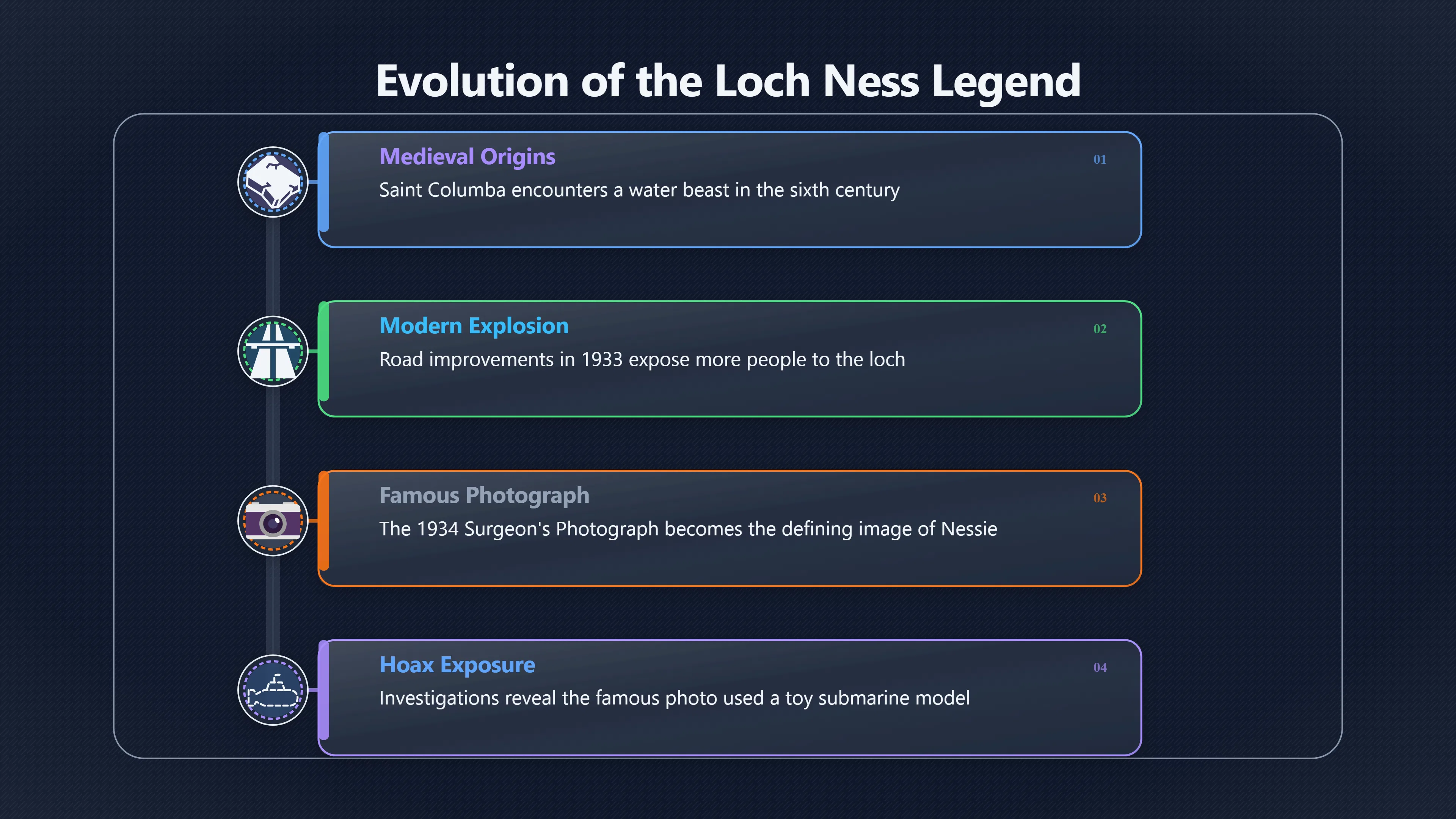
Although medieval traditions mention strange events around Loch Ness, including the well-known story of Saint Columba encountering a “water beast” in the sixth century, the modern Nessie phenomenon began in 1933. Improvements to the road running alongside the loch exposed more people to its waters, while newspapers eagerly published reports of an enormous creature seen swimming or crossing the surface. Within months, Loch Ness had become an international sensation.[National Geographic]nationalgeographic.comNational GeographicIs there any truth behind the legend of the Loch Ness Monster? | National GeographicOctober 24, 2024…
What followed established a pattern that still shapes the mystery today. Witnesses described different animals rather than one consistent creature. Some reported a long neck, others several humps, a large eel-like body, or a dark object moving unusually through the water. The descriptions often reflected popular expectations of prehistoric reptiles, especially after the public fascination with dinosaurs during the early twentieth century. Researchers have noted that cultural expectations can influence how ambiguous sights are interpreted.[Science Focus]sciencefocus.comScience Focus How do we know that the Loch Ness Monster doesn't exist?Science FocusHow do we know that the Loch Ness Monster doesn't exist? - BBC Science Focus MagazineNovember 25, 2020…
The famous 1934 “Surgeon’s Photograph” appeared to offer decisive proof. For decades it became the defining image of Nessie, showing what seemed to be a graceful neck emerging from the loch. However, investigations eventually established that the picture had been staged using a small model mounted on a toy submarine. Rather than settling the mystery, the exposure of the hoax highlighted a recurring feature of the Loch Ness story: dramatic evidence has often proved weaker than first advertised.[National Geographic]nationalgeographic.comNational GeographicIs there any truth behind the legend of the Loch Ness Monster? | National GeographicOctober 24, 2024…
Why the evidence has never become convincing
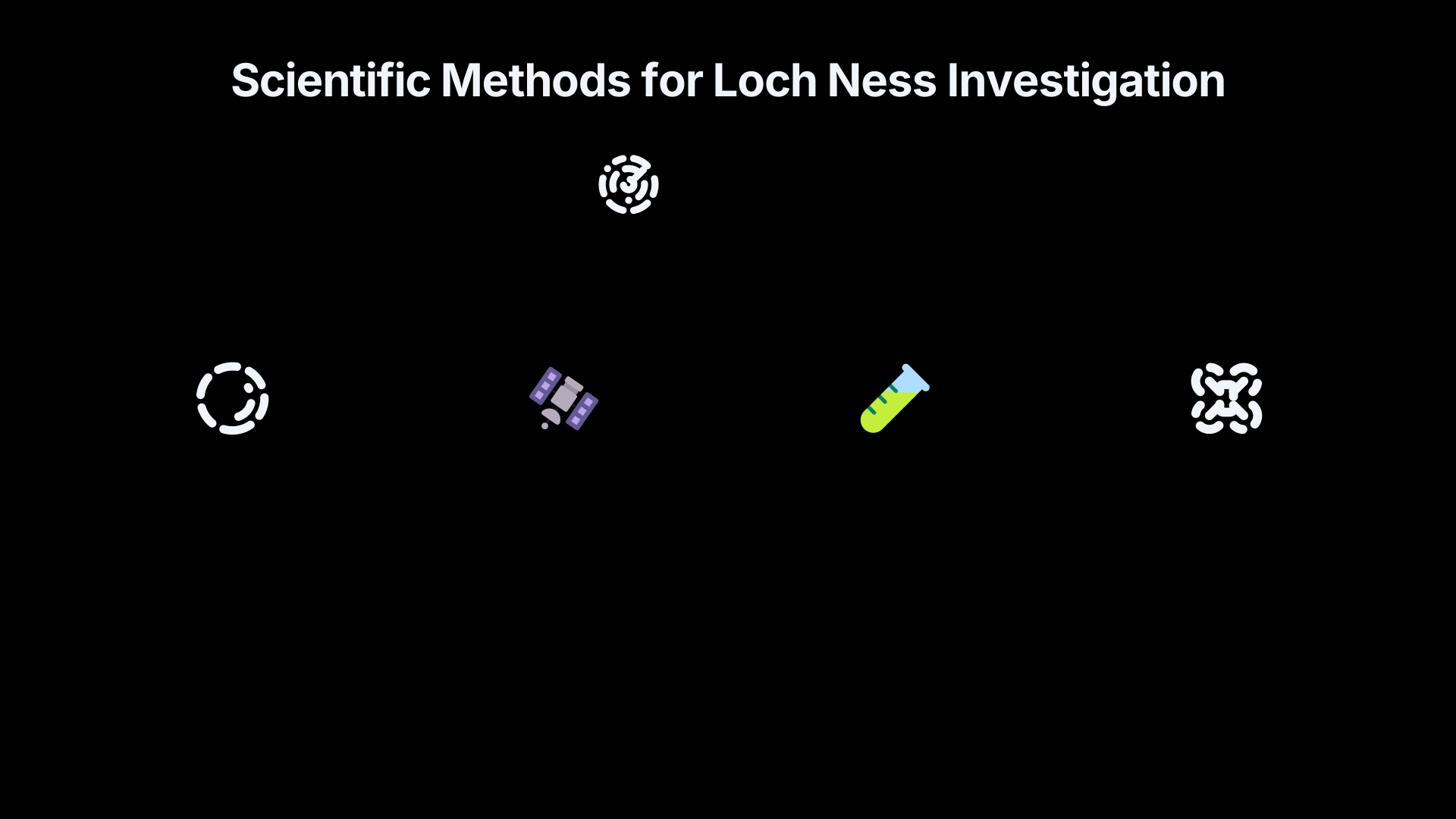
Loch Ness has probably been examined more thoroughly than any other location associated with an alleged mystery animal. The methods have evolved with technology, but the central problem has remained the same.
Researchers have employed:
- Extensive eyewitness catalogues.
- Underwater photography.
- Sonar surveys.
- Submersibles and remotely operated cameras.
- Satellite imagery.
- Environmental DNA (eDNA) sampling.
Each new technique has generated moments of excitement but no independently verified evidence of an unknown large species. Sonar occasionally detects large underwater objects, yet sonar records shape rather than identity. Fish shoals, underwater terrain, debris, or instrument artefacts can all produce unusual returns. Without physical confirmation, such readings remain ambiguous.[ScienceAlert]sciencealert.comOpen source on sciencealert.com.
Photographs face similar difficulties. Most are distant, blurry or taken under poor conditions. Water reflections, boat wakes, swimming deer, floating logs and optical distortions can all resemble something extraordinary, particularly when observers already expect to see a monster. The strongest historical photographs have either remained inconclusive or have later been exposed as hoaxes.[National Geographic]nationalgeographic.comNational GeographicIs there any truth behind the legend of the Loch Ness Monster? | National GeographicOctober 24, 2024…
This illustrates Britain’s wider “monster evidence problem”: witnesses may sincerely report remarkable experiences, but evidence strong enough to persuade zoologists requires clear, repeatable and independently verifiable data rather than isolated anecdotes.
What sightings and eDNA can show
The most significant scientific investigation in recent years came through environmental DNA analysis. Environmental DNA, or eDNA, examines genetic material naturally shed by living organisms into water through skin cells, mucus, scales and waste. Instead of searching directly for an animal, researchers search for its genetic traces.
In 2018, an international team led by geneticist Neil Gemmell collected around 250 water samples from throughout Loch Ness. The results were revealing.
The study found:
- no evidence for surviving plesiosaurs;
- no DNA suggesting giant reptiles;
- no indication of large sharks or similarly exotic animals;
- abundant DNA from ordinary European eels.
The researchers did not claim that giant eels exist in the loch. Instead, they suggested that ordinary eels could explain at least some reports if occasionally seen under unusual circumstances. The study also demonstrated an important point about evidence. eDNA cannot prove that no unknown animal has ever entered the loch, but it strongly constrains what is likely to be living there continuously. A large breeding population of unknown vertebrates would normally be expected to leave detectable genetic traces.[Science Focus]sciencefocus.comScience FocusLoch Ness Monster DNA study reveals ‘plausible’ explanation for sightings - BBC Science Focus MagazineSeptember 5, 2019…
For many scientists, the eDNA work shifted the debate away from prehistoric monsters and towards understanding why people continue to report unusual observations in an environment that naturally produces visual ambiguity.
Why people still report Nessie
The persistence of sightings does not necessarily imply the persistence of an unknown species.
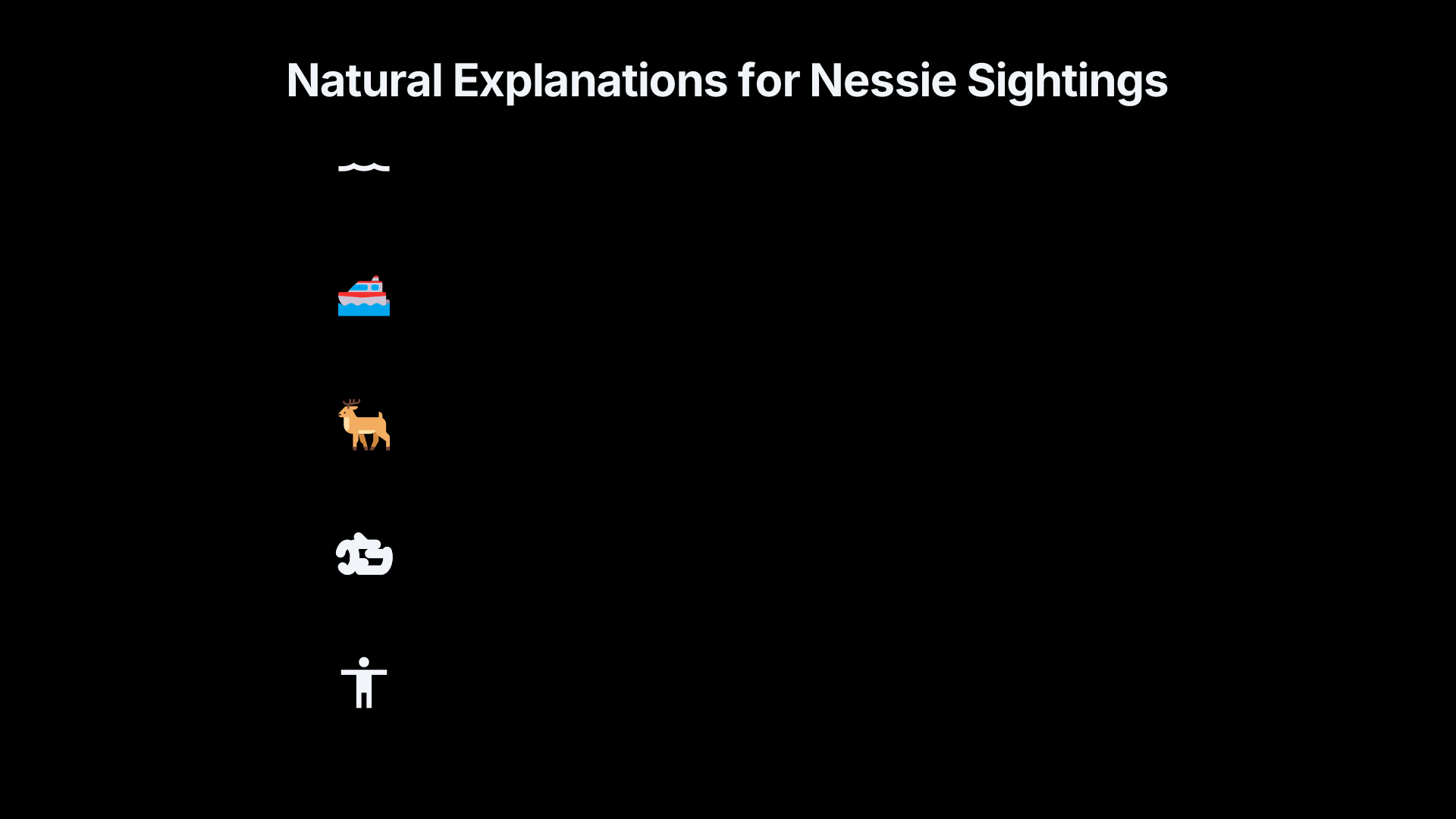
Several well-supported mechanisms can generate convincing experiences:
- Changing water conditions. Wind, standing waves and intersecting wakes can create moving humps that appear surprisingly animal-like.
- Boat wakes. Loch Ness forms part of the Caledonian Canal, and interacting wakes may produce long sequences of rolling waves that resemble multiple humps.
- Known wildlife. Deer, otters, seals, large fish and birds can all appear unfamiliar at distance.
- Floating timber. Waterlogged logs sometimes rise unexpectedly after trapped gases increase buoyancy.
- Expectation. Once people know they are looking for Nessie, ambiguous observations are more likely to be interpreted within that narrative.[sciencefocus.com]sciencefocus.comScience Focus How do we know that the Loch Ness Monster doesn't exist?Science FocusHow do we know that the Loch Ness Monster doesn't exist? - BBC Science Focus MagazineNovember 25, 2020…
These explanations do not imply dishonesty. Psychological research consistently shows that memory and perception are constructive rather than photographic. Honest witnesses can confidently describe extraordinary events while sincerely misinterpreting unusual but ordinary phenomena.
Why the ritual of looking endures
Perhaps the most remarkable feature of Loch Ness is not the monster but the continuing search.
Every year visitors watch the water from castle ruins, tour boats and roadside viewpoints. New photographs appear, webcams remain active, organised searches continue, and the official sightings register records reports using published criteria rather than accepting every claim automatically. Even relatively quiet years generate fresh discussion because the possibility itself has become part of the attraction.[The Sun]thesun.co.ukThe Official Loch Ness Monster Sightings Register recorded five sightings in total, including two sonar detections. Skipper Shaun Sloggie…
This endurance reflects several overlapping cultural functions.
First, Nessie provides a mystery that welcomes participation. Anyone standing beside the loch can imagine being the person who finally sees something extraordinary.
Second, the story offers a rare balance between scepticism and wonder. Scientific investigations are celebrated rather than treated as enemies of the legend. New sonar equipment, drones or genetic sampling become part of the ongoing narrative regardless of whether they find a monster.
Third, the legend has become economically and culturally valuable. Nessie is woven into Highland tourism, local identity, books, films, museum exhibitions and international popular culture. Even people who doubt the monster often enjoy the experience of searching for it.
What Loch Ness tells us about Britain’s monster evidence problem
Loch Ness demonstrates that the survival of a monster legend does not require proof of a monster. Instead, it requires an ongoing supply of ambiguous observations, memorable stories and enough uncertainty to prevent complete closure.
The strongest scientific evidence accumulated over decades points away from a large unknown animal inhabiting the loch. Hoaxes have been uncovered, famous photographs have collapsed under scrutiny, sonar has remained inconclusive, and environmental DNA has found no sign of an undiscovered giant vertebrate.[livescience.com]livescience.comLive Science Loch Ness Contains No 'Monster'’ DNA, Say Scientists | Live ScienceLive Science Loch Ness Contains No 'Monster'’ DNA, Say Scientists | Live Science
Yet the legend survives because it performs a different role from scientific evidence. It invites people to think about perception, uncertainty and the boundary between folklore and investigation. In that sense, Nessie has become Britain’s defining example of how a mystery can remain culturally alive long after the strongest available evidence has pointed towards ordinary explanations rather than an extraordinary creature.


eBay marketplace picks
Marketplace Samples
Live-tested eBay searches with available results related to this page.



Endnotes
1.
Source: nationalgeographic.com
Link:https://www.nationalgeographic.com/history/article/loch-ness-monster-legend
Source snippet
National GeographicIs there any truth behind the legend of the Loch Ness Monster? | National GeographicOctober 24, 2024...
Published: October 24, 2024
2.
Source: nature.com
Title: The Loch Ness “Mystery” | Nature
Link:https://www.nature.com/articles/133056a0
Source snippet
January 13, 1934 — * News *...
Published: January 13, 1934
3.
Source: sciencefocus.com
Title: Science Focus How do we know that the Loch Ness Monster doesn’t exist?
Link:https://www.sciencefocus.com/nature/how-do-we-know-that-the-loch-ness-monster-doesnt-exist
Source snippet
Science FocusHow do we know that the Loch Ness Monster doesn't exist? - BBC Science Focus MagazineNovember 25, 2020...
Published: November 25, 2020
4.
Source: sciencealert.com
Link:https://www.sciencealert.com/loch-ness-monster
5.
Source: livescience.com
Title: Live Science Loch Ness Contains No ‘Monster’’ DNA, Say Scientists | Live Science
Link:https://www.livescience.com/loch-ness-monster-dna-study.html
6.
Source: sciencefocus.com
Link:https://www.sciencefocus.com/news/loch-ness-monster-dna-study-reveals-plausible-explanation-for-sightings
Source snippet
Science FocusLoch Ness Monster DNA study reveals ‘plausible’ explanation for sightings - BBC Science Focus MagazineSeptember 5, 2019...
Published: September 5, 2019
7.
Source: thesun.co.uk
Link:https://www.thesun.co.uk/news/32300052/loch-ness-monster-sightings-tumble/
Source snippet
The Official Loch Ness Monster Sightings Register recorded five sightings in total, including two sonar detections. Skipper Shaun Sloggie...
8.
Source: sciencefocus.com
Title: Now, by seeking out monster DNA from the loch’s waters, scientis
Link:https://www.sciencefocus.com/nature/loch-ness-monster-how-edna-helps-us-discover-what-lurks-beneath
Source snippet
Loch Ness Monster: how eDNA helps us discover what lurks beneath - BBC Science Focus MagazineSeptember 5, 2019 — LOCH NESS MONSTER: HOW E...
Published: September 5, 2019
9.
Source: nature.com
Title: The Loch Ness Monster | Nature
Link:https://www.nature.com/articles/134765a0
Source snippet
November 17, 1934 — * News *...
Published: November 17, 1934
Additional References
10.
Source: mcgill.ca
Link:https://www.mcgill.ca/oss/article/critical-thinking/umpteenth-resurrection-loch-ness-monster
Source snippet
The Umpteenth Resurrection of the Loch Ness Monster | Office for Science and Society - McGill UniversityAugust 17, 2022 — Extraordinary m...
Published: August 17, 2022
11.
Source: researchgate.net
Title: (PDF) The case for the Loch Ness ‘‘Monster’’: The scientific evidence
Link:https://www.researchgate.net/publication/228706861The_case_for_the_Loch_Ness%27%27Monster%27%27_The_scientific_evidence
Source snippet
June 1, 2002 — Article PDF Available THE CASE FOR THE LOCH NESS ''MONSTER'': THE SCIENTIFIC EVIDENCE * June 2002 * Journal of Scientific...
Published: June 1, 2002
12.
Source: factually.co
Title: Is there really a monster in loch ness?
Link:https://factually.co/fact-checks/science/loch-ness-monster-evidence-explained-4358fd
Source snippet
Researched on January 19, 2026 Science Loch Ness Monster Existence Loch Ness Monster Existence Loch Ness Encyclopedia Britannica Encyclop...
Published: January 19, 2026
13.
Source: youtube.com
Link:https://www.youtube.com/watch?v=9y4SVIVPQBY
Source snippet
The Loch Ness DNA Test Results That Terrified Scientists...
14.
Source: youtube.com
Title: After 90 Years, The Loch Ness Monster Debate Is Over
Link:https://www.youtube.com/watch?v=9cZ8SQBnYDk
Source snippet
The Loch Ness Monster Explained: Saints, Hoaxes, DNA Tests, and Why Nessie Endures...
15.
Source: youtube.com
Title: The Loch Ness DNA Test Results That Terrified Scientists!
Link:https://www.youtube.com/watch?v=CcOEijIqiAM
Source snippet
Scientists Just Solved the Loch Ness Monster Mystery...
16.
Source: youtube.com
Title: Scientists Finally Explain The Loch Ness Monster
Link:https://www.youtube.com/watch?v=sKZ3dgJXIGQ
Source snippet
After 90 Years, The Loch Ness Monster Debate Is Over...
17.
Source: youtube.com
Title: Scientists Just Solved the Loch Ness Monster Mystery
Link:https://www.youtube.com/watch?v=gT-MrvDIaEU
Topic Tree