Within Slovenia Strange
Were Slovenia's Baby Dragons Ever Dragons?
The olm shows how a real cave animal became one of Slovenia's most memorable dragon stories.
On this page
- The animal behind the legend
- Valvasor, villagers and underground dragons
- Why science made the story stranger
Page outline Jump by section
Introduction
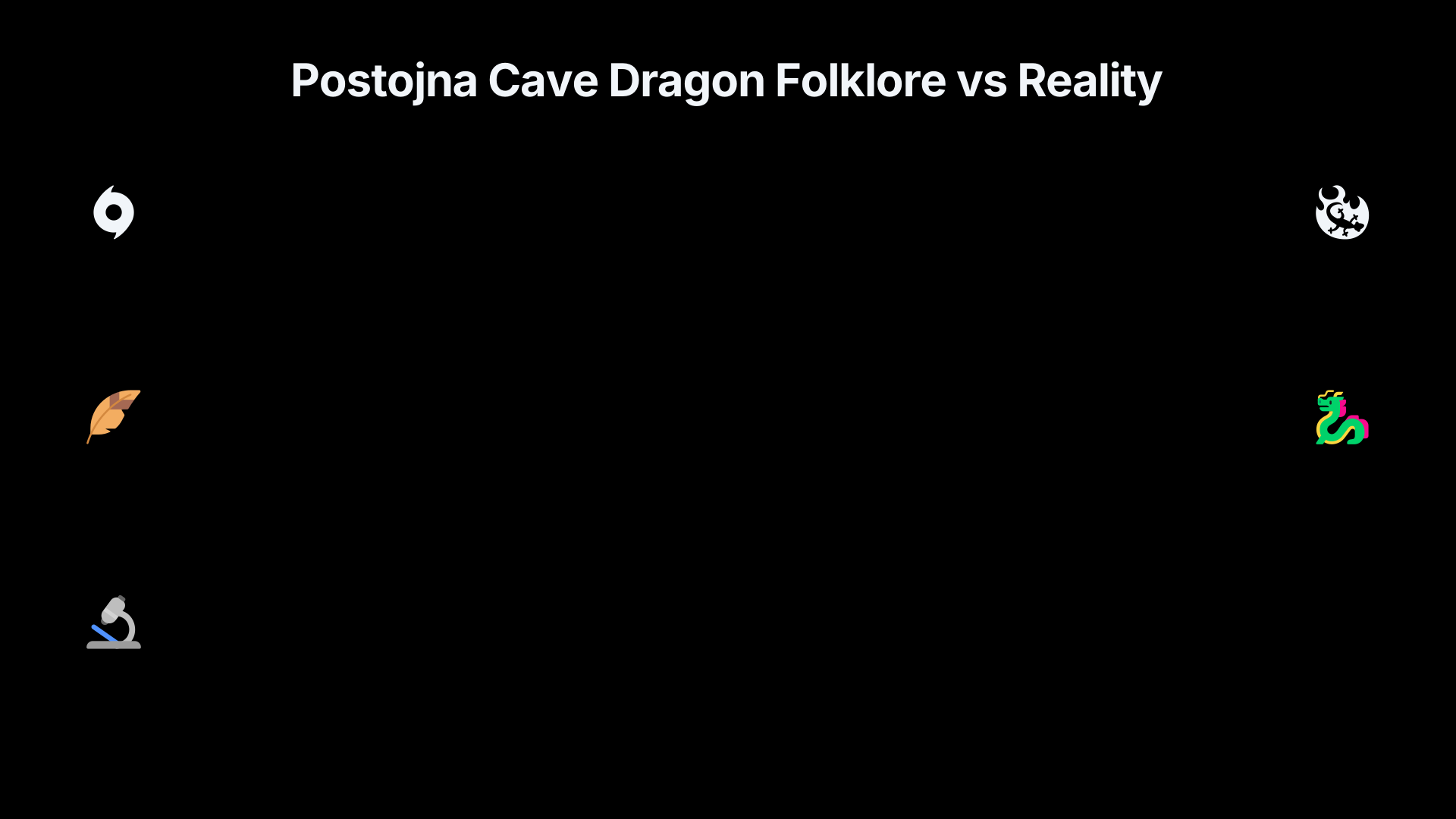
The legend of Slovenia’s “baby dragons” is unusual because it grew from a real animal rather than an imaginary monster. For centuries, people living around Postojna Cave occasionally saw strange, pale creatures washed out of underground waterways after heavy rain. With no knowledge of cave biology, many concluded that these eerie animals must be the young of dragons hidden deep beneath the karst landscape. Today we know the creatures are olms (Proteus anguinus), one of the world’s most remarkable cave amphibians, yet the scientific explanation has made the story no less fascinating. Instead, the tale has become one of Europe’s best examples of folklore and natural history reinforcing one another, showing how an extraordinary animal inspired a dragon tradition that survived into the modern age.
The animal behind the legend
The olm is so unlike familiar wildlife that the old interpretation is easy to understand. It is a permanently aquatic salamander found only in the underground waters of the Dinaric karst, with Slovenia forming the centre of its range. Unlike most amphibians, it spends its entire life in darkness beneath the surface.
Several features made the animal seem supernatural to early observers:
- Its skin is pale pink or almost translucent because it lives without sunlight.
- It has feathery external gills that resemble ornamental horns or frills.
- Its body is long and serpentine, somewhere between an eel, a lizard and a worm.
- Adults generally reach about 25–30 centimetres, making them among Europe’s largest cave-dwelling vertebrates.
- They appear only rarely because they normally remain hidden in underground rivers and pools.[Postojna Cave Park]postojnska-jama.euPostojna Cave ParkBaby Dragons' Secret StoriesWhat are baby dragons? Find out more about the biggest cave animal Proteus anguinus which l…
When exceptional rainfall flooded the cave systems, some olms were washed into springs where local people could see them for the first time. Without any understanding of subterranean ecosystems, the idea that they were offspring of enormous dragons living beneath the mountains seemed more reasonable than imagining an unseen network of flooded caves containing an entirely unknown species.
The dragon explanation therefore grew directly from genuine observations rather than pure invention.
Valvasor, villagers and underground dragons
The earliest well-known written account comes from the polymath Janez Vajkard Valvasor in his 1689 work The Glory of the Duchy of Carniola. Valvasor described how unusual creatures emerged after heavy rain and reported the local belief that they were the offspring of dragons living beneath the earth. Importantly, he was recording an existing folk tradition rather than claiming he had discovered dragons himself.[Wikipedia]WikipediaOpen source on wikipedia.org.
The landscape itself encouraged such beliefs. The karst around Postojna seemed mysterious even to careful observers:
- rivers vanished into limestone;
- water reappeared kilometres away;
- caves stretched beyond the limits of exploration;
- floods emerged unexpectedly from underground.
If a pale, snake-like animal suddenly appeared from one of these hidden waterways, connecting it with an unseen dragon was a natural piece of storytelling.
The dragon legend also reflected a broader European habit of explaining fossils, giant bones and unexplained natural phenomena through dragons or other mythical creatures. In Slovenia, however, the supposed evidence remained alive. Instead of discovering an old skeleton, people encountered living “proof” after storms.

Why science made the story stranger
The eventual scientific explanation did not make the olm seem ordinary. Instead, researchers found an animal that was extraordinary in entirely different ways.
In 1768, the physician and naturalist Josephus Nicolaus Laurenti formally described the species and gave it the scientific name Proteus anguinus. Earlier, Giovanni Antonio Scopoli had obtained living specimens for scientific study. Rather than revealing a disappointing “mere salamander”, science uncovered an animal uniquely adapted to underground life.[Postojna Cave Park]postojnska-jama.euPostojna Cave ParkBaby Dragons' Secret StoriesWhat are baby dragons? Find out more about the biggest cave animal Proteus anguinus which l…
Researchers gradually discovered that olms:
- spend their entire lives underwater;
- have eyes that become covered by skin as they mature;
- rely on highly developed senses other than vision;
- can survive extremely long periods without food because cave ecosystems are so nutrient-poor;
- are exceptionally long-lived compared with most amphibians.[Postojna Cave Park]postojnska-jama.euPostojna Cave ParkBaby Dragons' Secret StoriesWhat are baby dragons? Find out more about the biggest cave animal Proteus anguinus which l…
In other words, the creature proved to be almost as astonishing as the folklore suggested—just astonishing in biological rather than mythical terms.
Modern research has also transformed Postojna Cave into one of the world’s best-known centres for studying cave life. A widely publicised breeding event in 2016, when visitors watched eggs hatch in the cave’s vivarium, provided scientists with an unusually rare opportunity to observe olm development while simultaneously reviving international fascination with the “baby dragon” nickname.[Postojna Cave Park]postojnska-jama.euPostojna Cave ParkThe Birth of Baby DragonsThe baby dragon embryos are happily 'dancing' inside their egg jelly coats. At 2.5 months old…
Why the legend still matters
Unlike many dragon stories, the Postojna legend has never completely disappeared because visitors can still meet the animal that inspired it.
Tourism has embraced the nickname “baby dragons”, but modern interpretation carefully explains that the legend belongs to folklore while the animal itself is a genuine biological marvel. Rather than replacing one story with another, guides typically present both together: first the centuries-old belief in underground dragons, then the scientific discoveries that revealed the truth.[I feel Slovenia]slovenia.infoI feel SloveniaMeet "baby dragons" in Postojna CaveBelieving that there was a fearsome dragon living inside Postojna Cave, people thought…
This approach has helped make the olm one of Slovenia’s strongest natural symbols. The creature represents:
- the hidden complexity of the country’s karst landscape;
- the meeting point between folklore and scientific discovery;
- the importance of conserving fragile underground ecosystems;
- the way genuine natural mysteries can inspire enduring legends.[Environment]environment.ec.europa.euEnvironment Postojna Cave – Baby dragon guardiansPostojna Cave – Baby dragon guardians - EU EnvironmentThe blind cave salamander, or olm (Proteus anguinus) – which was mistake…
A rare case where myth and evidence meet
The Postojna “baby dragons” remain one of the finest examples of a Fortean story rooted in observable reality. No evidence has ever supported the existence of dragons beneath Slovenia, yet neither was the legend built from nothing. Villagers really did encounter bizarre animals emerging from hidden caves, and those animals genuinely looked unlike anything known on the surface.
The modern explanation therefore does not diminish the old tale. Instead, it reveals how folklore often develops: people observe something extraordinary, interpret it through the beliefs available to them, and pass the story on until science eventually provides a different answer. In the case of the olm, that answer proved almost as remarkable as the dragon legend itself.




eBay marketplace picks
Marketplace Samples
Live-tested eBay searches with available results related to this page.


Endnotes
1.
Source: Wikipedia
Link:https://en.wikipedia.org/wiki/Olm
2.
Source: slovenia.si
Link:https://slovenia.si/this-is-slovenia/olm-offspring-on-display-at-postojna-cave
Source snippet
Olm offspring on display at Postojna CaveThe Postojna Cave is planning to put on display almost two dozen olm offspring that hatched thre...
3.
Source: slovenia.info
Link:https://www.slovenia.info/en/stories/meet-baby-dragons-in-postojna-cave
Source snippet
I feel SloveniaMeet "baby dragons" in Postojna CaveBelieving that there was a fearsome dragon living inside Postojna Cave, people thought...
4.
Source: slovenia.info
Title: 38258 baby dragons celebrate their 10th birthday
Link:https://www.slovenia.info/en/press-centre/news-of-the-tourism-press-agency/38258-baby-dragons-celebrate-their-10th-birthday
Source snippet
Baby Dragons Celebrate Their 10th Birthday27 May 2026 — Fascinating Facts About the Olm. The first olm was discovered in the Black Cave s...
Published: May 2026
5.
Source: caves.org
Title: Ivo Lučić
Link:https://caves.org/wp-content/uploads/Publications/JCKS/v83/83_2_57.pdf
Source snippet
An underworld tailored to tourists: A dragon, a...by I Lučić · 2021 — Particular interest was raised by the hatching of olm in the Posto...
6.
Source: postojnska-jama.eu
Link:https://www.postojnska-jama.eu/en/wonderland-stories/baby-dragons-secret-stories/
Source snippet
Postojna Cave ParkBaby Dragons' Secret StoriesWhat are baby dragons? Find out more about the biggest cave animal Proteus anguinus which l...
7.
Source: postojnska-jama.eu
Link:https://www.postojnska-jama.eu/en/wonderland-stories/the-birth-of-baby-dragons/
Source snippet
Postojna Cave ParkThe Birth of Baby DragonsThe baby dragon embryos are happily 'dancing' inside their egg jelly coats. At 2.5 months old...
8.
Source: environment.ec.europa.eu
Title: Environment Postojna Cave – Baby dragon guardians
Link:https://environment.ec.europa.eu/topics/nature-and-biodiversity/natura-2000-award/meet-natura-2000-heroes/postojna-cave-baby-dragon-guardians_en
Source snippet
Postojna Cave – Baby dragon guardians - EU EnvironmentThe blind cave salamander, or olm (Proteus anguinus) – which was mistake...
9.
Source: postojnska-jama.eu
Link:https://www.postojnska-jama.eu/en/tickets/postojnacavebabydragons/
Source snippet
Postojna cave baby dragonsAn exciting cave train ride, a VIP meeting with the world's most famous baby olms and the interactive EXPO kars...
10.
Source: postojnska-jama.eu
Title: Vivarium » Postojna Cave Park
Link:https://www.postojnska-jama.eu/en/attractions-in-the-park/vivarium/
Source snippet
Explore baby dragons, mysterious animal from Postojna Cave in Vivarium. Perfect destination for school excursions...
Additional References
11.
Source: postojnsko.si
Link:https://postojnsko.si/en/human-fish-olm/
12.
Source: facebook.com
Link:https://www.facebook.com/Postojnacavepark/posts/ten-years-ago-something-incredible-happened-in-postojna-cave-slovenia-for-the-fi/1340651058088395/
Source snippet
Postojnska jama Cave-Grotte-HöhleIn a Rare Event, Slovenian Cave Welcomes "Baby Dragons": The Mysterious Olm. A female olm, or cave salam...
13.
Source: instagram.com
Link:https://www.instagram.com/p/DRMjlFqAaX-/
Source snippet
the famous “baby dragon” of Postojna CaveDid you know Slovenia's Postojna Cave is home to "baby dragons"? Uncover fascinating Proteus ang...
14.
Source: newyorker.com
Title: whats behind slovenias love affair with a salamander
Link:https://www.newyorker.com/tech/annals-of-technology/whats-behind-slovenias-love-affair-with-a-salamander
Source snippet
What's Behind Slovenia's Love Affair with a Salamander?Apr 25, 2016 — Meehan Crist reports on the female olm that laid eggs recently in P...
15.
Source: facebook.com
Title: Meet the baby dragons from Postojna Cave, Slovenia!
Link:https://www.facebook.com/Postojnacavepark/posts/meet-the-baby-dragons-from-postojna-cave-sloveniathis-mysterious-creature-can-li/1146087960878040/
Source snippet
a Rare Event, Slovenian Cave Welcomes "Baby Dragons": The Mysterious Olm. A female olm, or cave salamander, has laid 55 eggs i...
16.
Source: booking.com
Link:https://www.booking.com/city/si/postojna-obcina-ajdovscina.sr.html
Source snippet
ije cene i ponude za hotele na destinaciji Postojna.Read more...
17.
Source: bybio.wordpress.com
Title: baby dragons in postojna cave slovenia
Link:https://bybio.wordpress.com/2022/10/18/baby-dragons-in-postojna-cave-slovenia/
Source snippet
dragons in Postojna cave, Slovenia - Back Yard Biology18 Oct 2022 — The largest and most remarkable cave dweller in Postojna cave is the...
18.
Source: tanya.guide
Title: proteus anguinus facts postojna cave
Link:https://tanya.guide/proteus-anguinus-facts-postojna-cave/
Source snippet
Proteus Anguinus Facts: Slovenia's Baby Dragons in 202615 May 2026 — guide, visiting Postojna Cave in 2026 offers a rare chance to witnes...
Published: May 2026
19.
Source: sciencewanders.com
Title: Discovering baby dragons in Postojna
Link:https://www.sciencewanders.com/discovering-baby-dragons-in-postojna/
Source snippet
Photo credit: Postojnska Jama. Olms were believed to be baby dragons when first discovered in 1689.... Each olm...Read more...
20.
Source: facebook.com
Title: as adults, they’re blind
Link:https://www.facebook.com/Postojnacavepark/posts/-meet-the-real-cave-dragonlong-ago-locals-believed-it-was-a-dragons-baby-but-tod/1282737260546442/
Source snippet
✨Its translucent skin acts like a...🐉 Meet the real cave dragon! Long ago, locals believed it was a dragon’s baby, but today we know it...
Topic Tree