Within Peru Mysteries
When A Meteorite Struck Peru's Altiplano
The Carancas meteorite turned a real 2007 space impact into a worldwide mystery shaped by science, rumours and local beliefs.
On this page
- The 2007 impact and eyewitness reports
- Scientific investigation of the crater
- Rumours, beliefs and lasting mystery
Page outline Jump by section
Introduction
On 15 September 2007, a piece of rock from space struck the Peruvian Altiplano near the village of Carancas, close to Lake Titicaca, creating one of the best documented modern meteorite mysteries in South America. The event was real: a meteorite produced a crater, fragments were recovered, and scientists identified the object as an ordinary stony meteorite. What made Carancas unusual was everything that followed — reports of strange fumes, villagers becoming ill after visiting the site, rumours of contamination, and speculation that turned a scientific event into a modern mystery.[LARO]laro.lanl.govLAROAnalysis of a crater-forming meteorite impact in PeruLos Alamos National LaboratorySeptember 16, 2008…
Carancas remains fascinating because it sits at the meeting point of astronomy, geology, human reaction and local interpretation. The evidence eventually showed that a meteorite impact occurred, but the unusual circumstances surrounding it created questions that were not immediately easy to answer. The case became a reminder that even a genuine scientific event can pass through a period of uncertainty before the facts catch up with the rumours.[LARO]laro.lanl.govLAROAnalysis of a crater-forming meteorite impact in PeruLos Alamos National LaboratorySeptember 16, 2008…
The 2007 impact and eyewitness reports
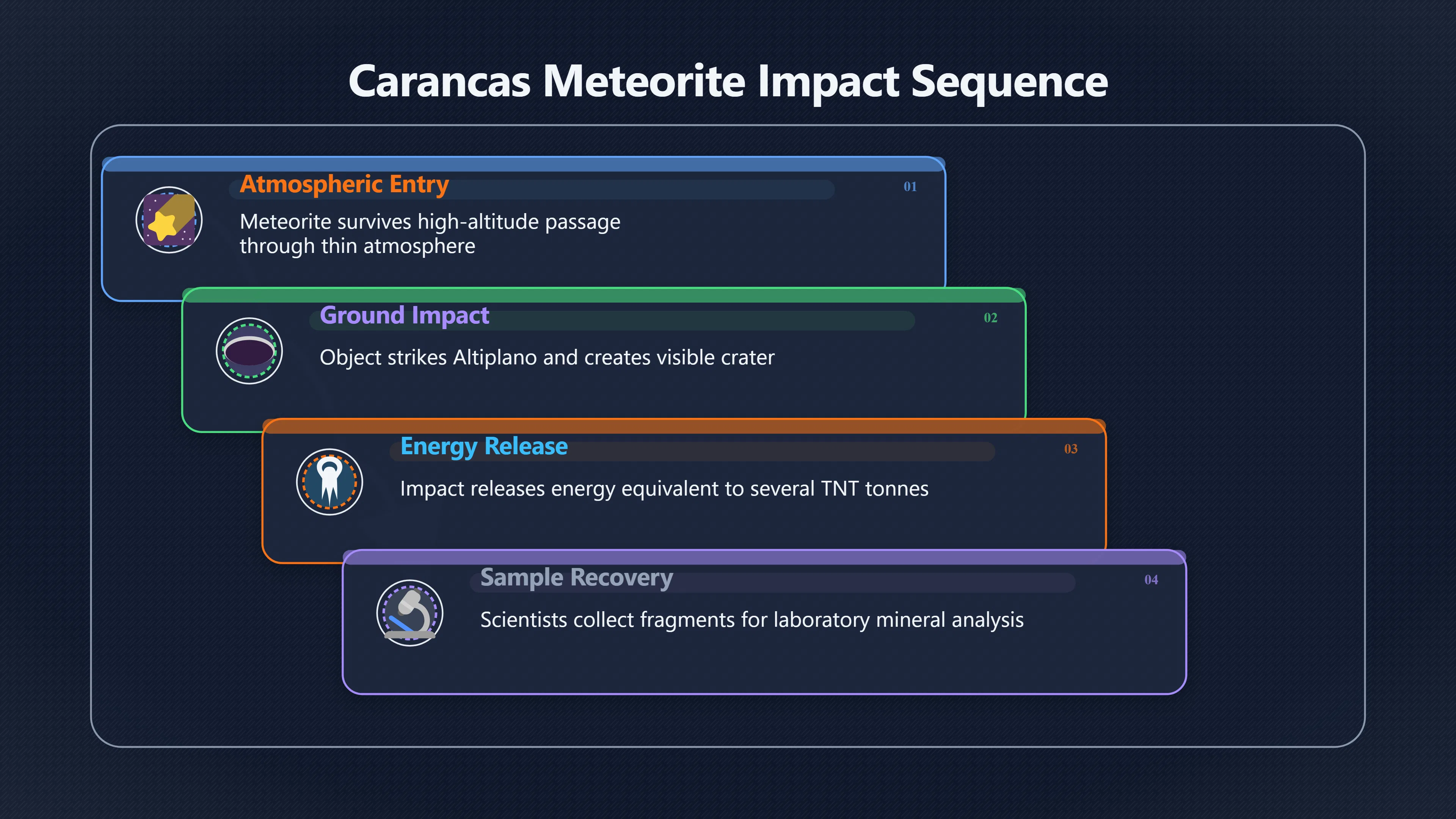
The Carancas meteorite fell in the Puno region of southern Peru, near the Bolivian border and Lake Titicaca. Witnesses described a bright fireball crossing the sky before a powerful impact shook the area. The explosion was initially confusing to local residents, with some reports describing fears of an aircraft crash or another human-made disaster. Instead, the source was a fragment of an asteroid entering Earth’s atmosphere and striking the ground.[The Guardian]theguardian.comOpen source on theguardian.com.
The impact created a crater roughly 13.5 metres across. For a meteorite fall, this was an extraordinary feature: most small stony meteorites break apart high in the atmosphere or land without excavating a visible crater. The scientific investigation of Carancas found that the impact released energy of about 10¹⁰ joules, equivalent to a few tonnes of TNT, based on seismic and infrasound measurements.[LARO]laro.lanl.govLAROAnalysis of a crater-forming meteorite impact in PeruLos Alamos National LaboratorySeptember 16, 2008…
The location helped make the event especially memorable. Carancas lies on the high Altiplano, more than 3,800 metres above sea level, where the thin atmosphere changes how incoming objects behave. Researchers suggested that the altitude and the meteorite’s trajectory contributed to its unusual survival through the atmosphere. Instead of breaking apart completely, the object remained sufficiently intact to strike the ground and form a crater.[LARO]laro.lanl.govLAROAnalysis of a crater-forming meteorite impact in PeruLos Alamos National LaboratorySeptember 16, 2008…
Why the impact seemed impossible to some observers
Early reactions were shaped by the fact that the event did not match ordinary expectations of a meteorite fall. Many people imagine shooting stars as brief flashes that disappear in the sky, not rocks capable of leaving holes in the Earth. At Carancas, witnesses saw a fireball, heard a major explosion and then found a physical scar in the landscape.
The unusual combination of a surviving meteorite, a fresh crater and reports of illness created a chain of uncertainty. The first question was not simply “what fell?” but also “what happened afterwards?” That second question gave Carancas its lasting reputation as a mystery.[The Guardian]theguardian.comOpen source on theguardian.com.
Scientific investigation of the crater
The investigation gradually replaced speculation with a clearer picture. Samples recovered from the site showed that the Carancas object was an ordinary chondrite, specifically an H4-5 type meteorite. Ordinary chondrites are among the most common meteorites found on Earth, but Carancas was unusual because this otherwise familiar type of space rock produced such a visible impact feature.[Buseck Center for Meteorite Studies]meteorites.asu.eduBuseck Center for Meteorite StudiesCarancas – Buseck Center for Meteorite StudiesSeptember 13, 2016…
Researchers used several lines of evidence to reconstruct what happened. Eyewitness accounts, atmospheric recordings, seismic signals and infrasound data were combined to estimate the meteorite’s path and energy. The scientific study published in the Journal of Geophysical Research concluded that the fireball travelled along a measurable trajectory and that the crater was consistent with a genuine meteorite impact.[LARO]laro.lanl.govLAROAnalysis of a crater-forming meteorite impact in PeruLos Alamos National LaboratorySeptember 16, 2008…
Laboratory studies added further detail. Analysis of recovered fragments identified minerals such as olivine and pyroxene, confirming the meteorite’s stony composition. Later work examined its magnetic properties and microscopic structure, reinforcing the classification of Carancas as an H4-5 ordinary chondrite rather than an unknown material.[Cambridge University Press & Assessment]cambridge.orgCambridge University Press & AssessmentMicrostructural investigation of the Carancas meteorite | International Journal of Astrobiology |…
The crater itself became scientifically important because impacts of this size are uncommon. Carancas provided researchers with a rare opportunity to study how a relatively small rocky object could survive atmospheric entry and create a measurable surface feature. It challenged some assumptions about how much protection Earth’s atmosphere normally provides against smaller incoming bodies.[LARO]laro.lanl.govLAROAnalysis of a crater-forming meteorite impact in PeruLos Alamos National LaboratorySeptember 16, 2008…
The illness reports and the mystery that followed
The strangest part of the Carancas story was not the meteorite itself but the reports of illness among people who visited the crater. Soon after the impact, some villagers complained of headaches, nausea, vomiting and other symptoms. Reports of unusual smells and gases coming from the crater added to fears that the fallen object might be dangerous.[The Guardian]theguardian.comOpen source on theguardian.com.
The rumours spread quickly because the situation combined several alarming details: an object from space, a smoking crater, strange odours and people becoming sick nearby. Some interpretations suggested contamination from the meteorite itself, while others connected the event with spiritual or supernatural concerns. The uncertainty was understandable in the immediate aftermath of an extraordinary event, but later investigations looked for more ordinary explanations.[WIRED]wired.comVarious explanations arose ranging from superstitions to reports of illnesses and toxic contamination. The rare event attracted global in…
Scientists generally moved away from the idea that the meteorite was poisonous. A leading explanation was that the impact disturbed material in the ground, possibly releasing gases from local mineral-rich water sources. The surrounding region contains naturally occurring arsenic compounds, and researchers proposed that heated groundwater or vapours may have contributed to the reported symptoms. The available evidence did not support the idea that the meteorite itself carried a mysterious toxin.[Wikipedia]Wikipedia2007 Carancas impact event2007 Carancas impact event
The illness episode shows how a real physical event can become surrounded by secondary mysteries. The crater was real, but the interpretation of what it meant changed over time: from disaster rumours, to fears of alien contamination, to a geological explanation involving the local environment.[WIRED]wired.comVarious explanations arose ranging from superstitions to reports of illnesses and toxic contamination. The rare event attracted global in…
Rumours, beliefs and lasting mystery
Carancas became a modern Peruvian mystery because it contained two different stories at once. One was the scientific story: a meteorite arrived from space, left fragments behind and created a measurable crater. The other was the human story: people confronted something unexpected in a landscape already rich with cultural meaning and uncertainty.[Buseck Center for Meteorite Studies]meteorites.asu.eduBuseck Center for Meteorite StudiesCarancas – Buseck Center for Meteorite StudiesSeptember 13, 2016…
The event also attracted worldwide attention from meteorite collectors and researchers. Because crater-forming meteorite falls are rare, fragments from Carancas became scientifically valuable. The scramble to study and recover material added another layer of drama, with outsiders arriving in a remote community suddenly placed at the centre of international interest.[WIRED]wired.comVarious explanations arose ranging from superstitions to reports of illnesses and toxic contamination. The rare event attracted global in…
From a Fortean perspective, Carancas is unusual precisely because it does not require a supernatural explanation to be strange. A rock from space really did fall into Peru, and for a short time the evidence was incomplete enough that many different stories competed to explain it. The mystery came from the gap between the event itself and human attempts to understand it.
Today, Carancas is remembered as one of Peru’s clearest examples of how science and mystery can overlap. The final explanation is not that something unknown fell from the sky, but that a known phenomenon created an extraordinary combination of rarity, fear, rumours and unanswered questions before investigation revealed the more grounded story.[LARO]laro.lanl.govLAROAnalysis of a crater-forming meteorite impact in PeruLos Alamos National LaboratorySeptember 16, 2008…
Amazon book picks
Further Reading
Books and field guides related to When A Meteorite Struck Peru's Altiplano. Use these as the next step if you want deeper reading beyond the article.
The Cambridge Encyclopedia of Meteorites
Explains meteorite impacts, identification, and the science behind events like Carancas.
The book of the cosmos
Places cosmic events within a wider history of human understanding.
Meteorites
Contains several previously unpublished accounts of meteorite recoveries in Australia and provides deatails on many Australian contributi...
eBay marketplace picks
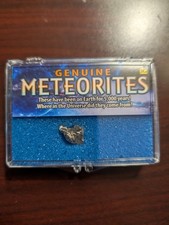
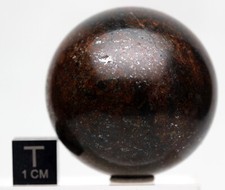
Marketplace Samples
Live-tested eBay searches with available results related to this page.
Endnotes
1.
Source: laro.lanl.gov
Title: LAROAnalysis of a crater-forming meteorite impact in Peru
Link:https://laro.lanl.gov/esploro/outputs/journalArticle/Analysis-of-a-crater-forming-meteorite-impact/9916364505003761
Source snippet
Los Alamos National LaboratorySeptember 16, 2008...
Published: September 16, 2008
2.
Source: wired.com
Link:https://www.wired.com/story/scramble-claim-worlds-most-coveted-meteorite
Source snippet
Various explanations arose ranging from superstitions to reports of illnesses and toxic contamination. The rare event attracted global in...
3.
Source: cambridge.org
Link:https://www.cambridge.org/core/journals/international-journal-of-astrobiology/article/abs/microstructural-investigation-of-the-carancas-meteorite/B4FB1AE312FEB6E1F521AE162E51C889
Source snippet
Cambridge University Press & AssessmentMicrostructural investigation of the Carancas meteorite | International Journal of Astrobiology |...
4.
Source: Wikipedia
Title: 2007 Carancas impact event
Link:https://en.wikipedia.org/wiki/2007_Carancas_impact_event
5.
Source: cambridge.org
Title: Three craters ha
Link:https://www.cambridge.org/core/product/76520AF13BA96C5E62E999A12CF2BC09/core-reader
Source snippet
Introduction - Ordinary ChondritesFebruary 24, 2026 — Most terrestrial impact craters with accompanying meteorites are associated with ir...
Published: February 24, 2026
7.
Source: cambridge.org
Title: Di Gregorio * Published online by Cambridge University Press: 11
Link:https://www.cambridge.org/core/journals/international-journal-of-astrobiology/volume/44B66681F664D185BB2558CD3860D24E
Source snippet
International Journal of Astrobiology: Volume 10 - | Cambridge CoreOctober 1, 2011 — [Input] * ### Microstructural investigation of the C...
Published: October 1, 2011
8.
Source: cambridge.org
Title: Di Gregor
Link:https://www.cambridge.org/core/services/aop-cambridge-core/content/view/B4FB1AE312FEB6E1F521AE162E51C889/S147355041000039Xa.pdf/microstructural-investigation-of-the-carancas-meteorite.pdf
Source snippet
Microstructural investigation of the Carancas meteorite | International Journal of Astrobiology | Cambridge CoreNovember 11, 2010 — MICRO...
Published: November 11, 2010
9.
Source: astronomy.com
Title: A Peruvian mystery
Link:https://www.astronomy.com/science/a-peruvian-mystery/
Source snippet
May 18, 2023 — Carancas. The 49-foot-wide (15m) Carancas crater in Peru surprised scientists because it formed from the impact of a fragi...
Published: May 18, 2023
10.
Source: theguardian.com
Link:https://www.theguardian.com/world/2007/sep/18/spaceexploration.science
11.
Source: meteorites.asu.edu
Link:https://meteorites.asu.edu/meteorites/carancas
Source snippet
Buseck Center for Meteorite StudiesCarancas – Buseck Center for Meteorite StudiesSeptember 13, 2016...
Published: September 13, 2016
12.
Source: ri.conicet.gov.ar
Link:https://ri.conicet.gov.ar/handle/11336/4921
13.
Source: theguardian.com
Title: Meteorites, ‘plagues’ and bad omens | Environment | The Guardian
Link:https://www.theguardian.com/environment/2007/sep/20/g2.peru
Source snippet
September 20, 2007 — This article is more than 18 years old METEORITES, 'PLAGUES' AND BAD OMENS This article is more than 18 years old Pa...
Published: September 20, 2007
14.
Source: passc.net
Link:https://www.passc.net/EarthImpactDatabase/New%20website_05-2018/Carancas.html
Source snippet
Planetary and Space Science CentreThe Carancas event on September 15, 2007: Meteorite fall, impact conditions and crater characteristics...
Published: September 15, 2007
Additional References
15.
Source: researchgate.net
Link:https://www.researchgate.net/publication/273471501_Magnetic_susceptibility_magnetization_magnetic_moment_and_characterization_of_Carancas_meteorite
Source snippet
(PDF) Magnetic susceptibility, magnetization, magnetic moment and characterization of Carancas meteoriteArticle PDF Available MAGNETIC SU...
16.
Source: researchgate.net
Link:https://www.researchgate.net/publication/230261749_The_Carancas_meteorite_impact_crater_Peru_Geologic_surveying_and_modeling_of_crater_formation_and_atmospheric_passage
Source snippet
January 1, 2010 — Article PDF Available THE CARANCAS METEORITE IMPACT CRATER, PERU: GEOLOGIC SURVEYING AND MODELING OF CRATER FORMATION A...
Published: January 1, 2010
17.
Source: researchgate.net
Link:https://www.researchgate.net/publication/282808559_The_Carancas_meteorite_impact_event_on_September_15_2007_Peru_the_impact_risk_on_Earth_is_underestimated
Source snippet
The Carancas meteorite impact event on September 15...15 Sept 2007 — The Carancas meteorite impact event on September 15, 2007, Peru: th...
Published: September 15, 2007
18.
Source: meteorite-recon.com
Link:https://www.meteorite-recon.com/home/meteorite-documentaries/carancas-meteorite
Source snippet
Carancas MeteoriteImpact crater of the Carancas Meteorite several weeks after the fall. The crater walls have partly collapsed and the bo...
19.
Source: docslib.org
Link:https://docslib.org/doc/3897868/magnetic-susceptibility-magnetization-magnetic-moment-and-characterization-of-carancas-meteorite
Source snippet
MAGNETIC SUSCEPTIBILITY, MAGNETIZATION, MAGNETIC MOMENT AND CHARACTERIZATION OF CARANCAS METEORITE Total Page:16 File Type:pdf, Si...
20.
Source: abc.net.au
Title: Peru ‘meteorite’ strike leaves 200 sick › News in Science (ABC Science)
Link:https://www.abc.net.au/science/articles/2007/09/19/2037489.htm?site=perth&topic=health
Source snippet
September 19, 2007 — News in Science › Space and Astronomy PERU 'METEORITE' STRIKE LEAVES 200 SICK Wednesday, 19 September 2007 ABC/AFP *...
Published: September 19, 2007
21.
Source: blogs.nature.com
Link:https://blogs.nature.com/blog/mystery_illness_follows_meteor_1/
Source snippet
illness follows meteor | nature.com blogsSeptember 19, 2007 — MYSTERY ILLNESS FOLLOWS METEOR Posted on 19 Sep 2007 by Hundreds of people...
Published: September 19, 2007
22.
Source: nasa.gov
Title: Did a Meteorite Cause a Crater in Nicaragua?
Link:https://www.nasa.gov/blogs/watch-the-skies/2014/09/08/did-a-meteorite-cause-a-crater-in-nicaragua/
Source snippet
September 8, 2014 — WATCH THE SKIES Image NASA September 8, 2014 8:10PM CATEGORIES Marshall Space Flight Center DID A METEORITE CAUSE...
Published: September 8, 2014
23.
Source: en.wikinews.org
Link:https://en.wikinews.org/wiki/Meteorite_blamed_for_mysterious_illness_in_Peru
Source snippet
blamed for mysterious illness in Peru - Wikinews, the free news sourceSeptember 20, 2007 — METEORITE BLAMED FOR MYSTERIOUS ILLNESS IN PER...
Published: September 20, 2007
24.
Source: agupubs.onlinelibrary.wiley.com
Title: Exposure to arsenic may have acute or chronic manifesta
Link:https://agupubs.onlinelibrary.wiley.com/doi/full/10.1029/2024GH001213
Source snippet
Health Impacts, Treatments, and Countermeasures of Martian Dust on Future Human Space Exploration - Wang - 2025 - GeoHealth - Wiley Onlin...
Topic Tree