Zimbabwe's Strangest Stories, Sceptically Told
Zimbabwe’s strongest Fortean material is not a neat cabinet of monsters and flying saucers. It is a layered record of strange claims at the meeting point of landscape, colonial history, schoolyard testimony, sacred water, oral tradition, journalism and modern scepticism.
Page outline Jump by section
Introduction
What makes Zimbabwe especially interesting is that its “weird history” is rarely just weird. A claimed mermaid at a dam is also a story about labour, water infrastructure and belief. A river monster at Kariba is also a memory of displacement. A sacred cave is also an ecological archive. Even the famous UFO case sits between testimony, media contagion, psychology, Cold War skywatching and children’s moral imagination. The result is a country-level Forteana that rewards curiosity, but punishes easy answers.
The Ariel School UFO case: Zimbabwe’s most famous modern anomaly
On 16 September 1994, pupils at Ariel School near Ruwa, east of Harare, reported seeing one or more strange objects and beings during morning break. The core version, repeated in later journalism and UFO literature, is that about 60 children, mostly aged between six and twelve, said a silver craft had come down beyond the school boundary and that small figures appeared nearby. Some children later described a silent or telepathic environmental message, often remembered as a warning about pollution or technological harm.[Wikipedia]WikipediaAriel School UFO incidentAriel School UFO incident
The case became unusually durable because it had three things many UFO stories lack: multiple child witnesses, rapid media attention and follow-up interviews by named investigators. BBC correspondent Tim Leach visited the school soon afterwards; Cynthia Hind, a prominent UFO researcher in southern Africa, also interviewed children and collected drawings; and Harvard psychiatrist John Mack later travelled to Zimbabwe to speak with witnesses. Mack was already controversial for his work with people reporting alien abduction experiences, and the Ariel case became one of the most widely cited examples in that field.[wikipedia.org]WikipediaAriel School UFO incidentAriel School UFO incident
For believers, Ariel’s force lies in the children’s apparent sincerity, the emotional effect of the encounter and the broad consistency of the drawings and statements. For sceptics, the case has obvious vulnerabilities: the witnesses were children, adult questioning may have shaped memory, the sighting occurred in a period of wider UFO excitement in Zimbabwe, and not every child present claimed to have seen the same thing. A medical review of mass hysteria episodes in African schools specifically cites the Zimbabwe case as one that many dismissed as mass hysteria, while also noting the unusual consistency with which the children were said to have repeated their accounts.[PMC]pmc.ncbi.nlm.nih.govOpen source on nih.gov.
The most grounded reading is not “aliens landed” or “nothing happened”. Something socially powerful happened at Ariel School. Whether the original stimulus was an aerial object, a misinterpreted event, imaginative contagion, a rumour cycle, a staged or misunderstood visual trigger, or an experience still not adequately explained, the case entered Zimbabwe’s strange-history record because it left persistent witnesses, artefacts in the form of drawings and interviews, and a moral message that now feels oddly modern: children saying the visitors were worried about what humans were doing to the Earth.
Sky phenomena, rumours and the problem of good evidence
Zimbabwe’s UFO material did not begin and end at Ariel. Reports around the same period included wider sightings of unusual lights across southern Africa, and later accounts have occasionally tied Zimbabwe to unidentified aerial phenomena in official or quasi-official contexts. One 2026 release of U.S. UAP-related documents, reported by major newspapers and listed on a U.S. government release page, included a July 2008 Harare airport account involving a disc-like object and “high alert” language; the same coverage stressed that the releases offered few firm conclusions and did not amount to evidence of extraterrestrial craft.[war.gov]war.govOpen source on war.gov.
This distinction matters. A Fortean page should preserve the strangeness of a report without smuggling in certainty. A light in the sky can be a meteor, aircraft, satellite re-entry, balloon, drone, military activity, optical illusion, hoax or genuinely unidentified observation. Modern UAP researchers increasingly argue that serious investigation requires multiple instruments, independent sensors, environmental data and repeatable analysis, not just witness stories and excitement after the fact.[arXiv]arxiv.orgOpen source on arxiv.org.
That standard leaves Ariel in an awkward but fascinating position. It is rich in testimony and poor in physical data. The children’s accounts are vivid; the evidential trail is human, not instrumental. That is precisely why the case remains culturally potent. It cannot be dismissed as a single drunk witness seeing Venus, but it also cannot be lifted cleanly into the category of proven visitation. It sits in the classic Fortean middle: too strange to ignore, too evidentially fragile to settle.

Nyaminyami and Kariba: the river monster as historical memory
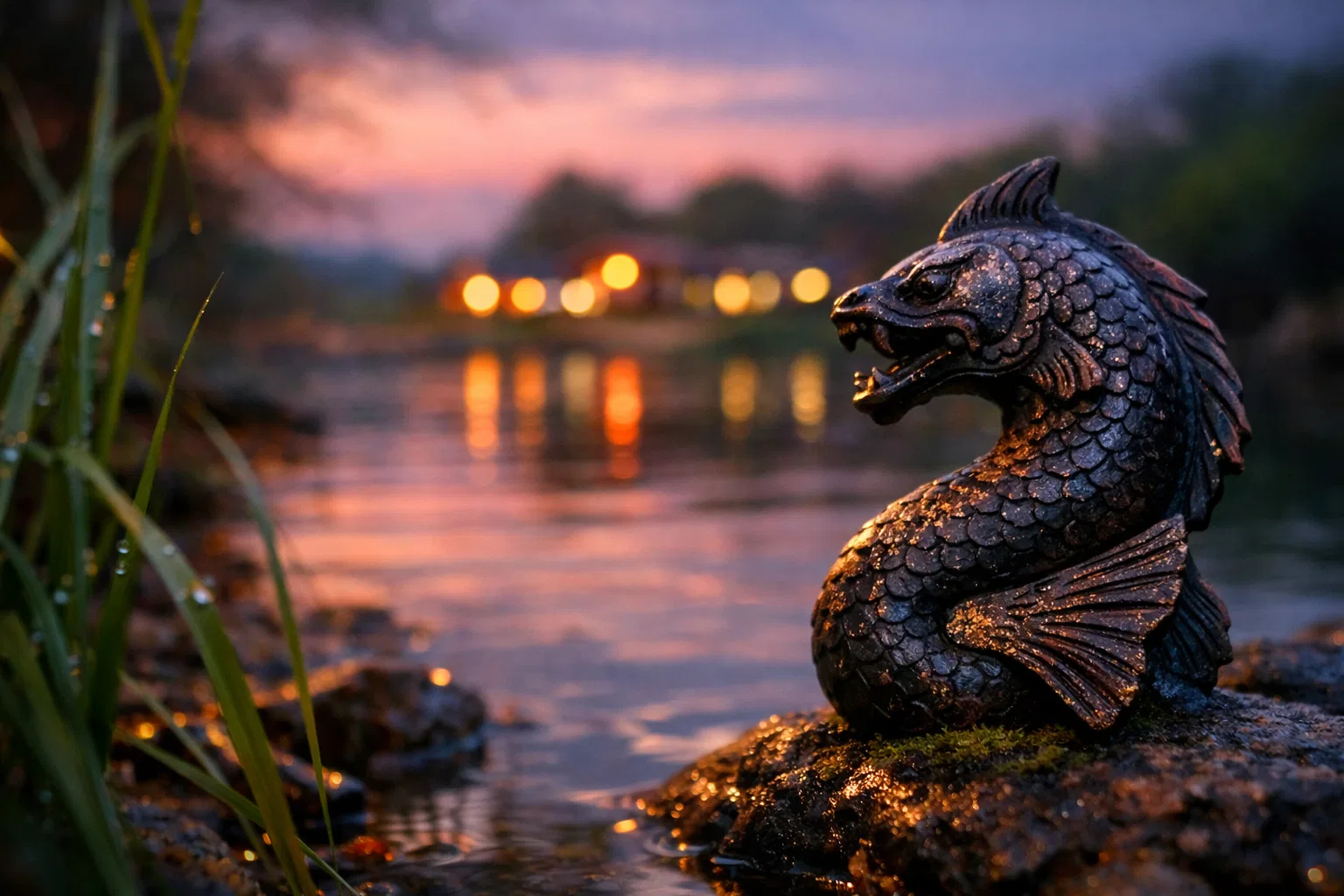
Zimbabwe’s most important monster-like figure is not a cryptid in the Loch Ness sense, waiting to be photographed from a tourist boat. Nyaminyami, the Zambezi River spirit associated with Tonga tradition around the Zambezi and Lake Kariba, is usually described as a serpent-like or dragon-like being with the body of a snake and the head of a fish. Its significance is spiritual, social and historical before it is zoological.[Zimbabwe Field Guide]zimfieldguide.comOpen source on zimfieldguide.com.
The legend became especially charged during the construction of Kariba Dam in the 1950s. Kariba Dam stands on the Zambezi between Zimbabwe and Zambia, creating Lake Kariba, one of the world’s largest artificial reservoirs by volume. The project displaced communities and transformed a river landscape into a vast engineered lake. In popular retellings, floods, deaths and construction difficulties were interpreted by some as signs of Nyaminyami’s anger, especially because the dam was said to have separated the spirit from its mate.[Wikipedia]WikipediaKariba DamKariba Dam
The sceptical explanation for the Kariba disasters is not hard to find: major dam construction in a powerful river gorge is dangerous, floods happen, and large colonial-era engineering projects often inflicted severe human costs. But that does not make the legend trivial. Nyaminyami gives symbolic shape to a genuine rupture: the drowning of places, the forced resettlement of people, and the replacement of a living river by a power scheme. The “monster” is therefore also a memory device. It keeps asking who paid the price when the river was trapped.
This is why Nyaminyami belongs in Zimbabwean Forteana even if no one treats it as a literal biological animal. It is a strange being attached to a real place, a real engineering project and a real history of disruption. Its modern life in carvings, jewellery, tourist imagery and local storytelling shows how a spirit can move from sacred geography into national folklore and commercial culture without losing all of its older force.
Mermaids, njuzu and the serious business of sacred water
In Zimbabwean folklore and religious thought, mermaid-like water spirits are often discussed under the name njuzu. English-language reporting tends to flatten them into “mermaids”, but the underlying belief is not simply a borrowed fairy-tale image of a woman with a fish tail. Academic work on Zimbabwean water spirits describes njuzu as beings associated with sacred pools, spirit possession, rainmaking, healing knowledge and environmental restraint.[Academic Journals]academicjournals.orgOpen source on academicjournals.org.
That background explains why Zimbabwe’s mermaid scares are more than comic oddities. In 2012, reports circulated that reservoir or dam work at sites including Gokwe and Mutare had been disrupted because workers feared mermaids. Voice of America reported that Water Resources Minister Samuel Sipepa Nkomo told a parliamentary committee that chiefs would perform rituals linked to mermaids believed to inhabit reservoirs where workers were afraid to go. Zimbabwean and international outlets repeated the story, often with amused headlines, but the local logic was tied to older ideas about dangerous or offended water powers.[voazimbabwe.com]voazimbabwe.comVoice of America'Mermaid' Sightings in Zimbabwe Spark Debate OverVoice of America'Mermaid' Sightings in Zimbabwe Spark Debate Over
Sceptics see these episodes as workplace fear, rumour, misidentification, labour avoidance, political theatre or traditional authority being folded into state infrastructure problems. Believers may see them as proof that certain waters are inhabited and must be approached ritually. The most useful interpretation is to see both the practical and symbolic layers. A pump installation that stalls because of “mermaids” is a modern bureaucratic problem; it is also a moment when older sacred-water ideas re-enter public life.
Research on water spirits and conservation in Zimbabwe argues that sacred-water beliefs have historically helped protect pools, forests and water sources by making some places morally and ritually restricted. One study of Shona customary practices notes that Mushongaende Pool in the Dande River was described as containing njuzu and other water spirits, with songs and drums heard there in local accounts; the point was not just supernatural drama, but rules around who could use the water and how.[GOV.UK]assets.publishing.service.gov.ukUK Shona customary practices in the context of water sectorUK Shona customary practices in the context of water sector
Chinhoyi Caves: the blue pool, the dead and the sacred forest
Chinhoyi Caves, north-west of Harare, offer one of Zimbabwe’s clearest examples of a natural site where geology, history and legend combine. The official tourism description emphasises the “Wonder Hole” and the striking blue Sleeping Pool, while environmental history research stresses that the caves were also a sacred religious centre for rainmaking ceremonies and were surrounded by a sacred forest where cutting trees was traditionally restricted.[zimbabwetourism.net]zimbabwetourism.netOpen source on zimbabwetourism.net.
The traditional name Chirorodziva is commonly translated as “Pool of the Fallen”. Local historical accounts connect the name with violence: people were reportedly thrown into the pool during conflict, and later legends describe the caves as a refuge, stronghold and place of danger. These traditions vary in detail, but their emotional structure is stable. The caves are beautiful, deep, useful, frightening and morally charged.[Wikipedia]WikipediaChinhoyi CavesChinhoyi Caves
The Fortean pull of Chinhoyi Caves comes partly from the pool itself. A still, intensely blue body of water descending into darkness is almost designed to attract stories. Yet the best evidence-backed reading is not that the cave is “haunted” in a simple tourist-board sense. It is that a real sacred landscape accumulated stories because it mattered: for water, refuge, ritual, memory and fear. Research on the caves between 1845 and 1945 connects them to water-resource management, indigenous environmental knowledge, colonial disruption, forest use and displacement, making the site a historical archive as well as a source of mystery.[Environment & Society Portal]environmentandsociety.orgge5 kwashiraige5 kwashirai
Chinhoyi also shows why Zimbabwean strange history is often ecological. Sacredness is not an ornamental detail added to a cave. It can function as a rule-system around water, trees and access. The uncanny story and the conservation story are not rivals; they are often the same story told in different registers.
Great Zimbabwe: archaeology, myth and the politics of false mystery
Great Zimbabwe is not “unexplained” in the way older colonial fantasists claimed. It is a major medieval African city, built and occupied by ancestors of Shona-speaking peoples between roughly the eleventh and fifteenth centuries, and recognised as one of Africa’s great archaeological landscapes. The Met notes that the site’s famous soapstone birds combine human and avian features and were found within the ruins; UNESCO material also links birds and bowls at the site to the importance of religion in daily life.[smarthistory.org]smarthistory.orgOpen source on smarthistory.org.
Its Fortean relevance lies in the history of misinterpretation. European and settler writers once tried to detach the ruins from African authorship, linking them instead to King Solomon, the Queen of Sheba, Phoenicians or other outsiders. Modern summaries of the site’s public imagination note exactly this transformation: in Euro-American fantasy Great Zimbabwe became Solomon’s mines or Sheba’s treasure-house before archaeology restored it to an African-built past.[prehistoricsociety.org]prehistoricsociety.org2021 10 04 great zimbabwe popular imagination revelations through years2021 10 04 great zimbabwe popular imagination revelations through years
This is a useful warning for all country-level Forteana. Some “mysteries” are created by bad assumptions. In Great Zimbabwe’s case, the supposed anomaly was not the stone architecture; it was the refusal to believe Africans had built it. The real mystery worth keeping is different and richer: what the birds meant, how religion and rule were expressed through architecture, how memory survived around the site, and why the national symbol of Zimbabwe still draws power from these hybrid stone creatures.[The Metropolitan Museum of Art]metmuseum.orggreat zimbabwegreat zimbabwe
Local imagination also preserved stranger motifs. A Prehistoric Society event summary on Great Zimbabwe’s popular imagination mentions local myths including a four-legged zoomorphic pot said to traverse nearby mountains. That kind of tradition is not archaeological proof of walking pottery; it is evidence that the ruins were never merely ruins. They were, and remain, a landscape of stories.[prehistoricsociety.org]prehistoricsociety.org2021 10 04 great zimbabwe popular imagination revelations through years2021 10 04 great zimbabwe popular imagination revelations through years

Goblins, school panics and the line between folklore and harm
Zimbabwean newspapers periodically report “goblin” scares: schools closed, police posts deserted, families seeking cleansing rituals, or communities blaming invisible beings for illness, misfortune or harassment. A 2025 Herald report described a Gokwe school closing after learners were allegedly terrorised by goblins, while also quoting a local sceptic who suggested psychological distress or mass hysteria as alternative explanations. A 2024 report from CITE described police officers leaving a base in Matabeleland South after claiming night-time goblin attacks.[Herald Online]heraldonline.co.zwHerald Online Gokwe school closes as goblins terrorise learnersHerald Online Gokwe school closes as goblins terrorise learners
These stories belong in Forteana because they show how a folkloric category can become a public explanation for distress. But they need careful handling. “Goblins” may stand in for sleep disturbance, rumour contagion, mental-health crises, social conflict, abuse allegations, fraud, prank behaviour, religious competition or unexplained local events. A 2022 report on pupils falling into hysteria quoted an education official saying authorities could provide psychosocial support and scientific assistance, while avoiding supernatural claims because the Witchcraft Suppression Act remained relevant.[Africa Press English]africa-press.netAfrica Press English23 High School Pupils Fall Into HysteriaAfrica Press English23 High School Pupils Fall Into Hysteria
That law is part of the story. Zimbabwe’s Witchcraft Suppression Act, in versions and amendments discussed by legal sources, has long tried to manage the social dangers of witchcraft accusation, fraudulent supernatural claims and witch-finding. The legal problem is not whether every citizen privately believes or disbelieves in occult forces; it is that accusations can destroy reputations, trigger violence or enable exploitation.[veritaszim.net]veritaszim.netOpen source on veritaszim.net.
The most humane reading of goblin panics is therefore neither mockery nor credulity. They are modern social events using old supernatural language. Sometimes the language may be playful or theatrical; sometimes it may be attached to fear, trauma or manipulation. As Forteana, they show folklore in motion. As public life, they require caution because “strange” explanations can have real consequences.
Strange rains and natural marvels: when the Fortean becomes meteorology
Classic Forteana loves anomalous falls: fish, frogs, stones, blood-coloured rain, ice and other things that appear to drop from the sky. Zimbabwe has occasional social-media and local-news claims of fish rain or freak storms, but strong, well-documented Zimbabwe-specific cases are harder to establish than the better-known folklore and UFO material. Where claims are thin, the honest answer is that they remain low-grade curiosities unless supported by reliable local reporting, photographs, specimen collection or meteorological context.
The general mechanism for animal falls is not supernatural. The Library of Congress notes that reports of raining frogs and fish go back a long way, and that strong winds such as tornadoes or waterspouts can lift small animals from water or land and deposit them elsewhere. Smithsonian coverage makes the same broad point: strange rain stories are fascinating, but many plausible cases involve violent weather moving lightweight animals or debris.[The Library of Congress]loc.govOpen source on loc.gov.
Zimbabwe certainly has dramatic weather: heavy rain, lightning, hailstorms and flood damage are regularly reported, and such events can easily become “freak” stories in local memory. But for a serious Zimbabwe Forteana page, anomalous falls should sit below better-attested material unless a specific, traceable case can be pinned to date, place and source. The lesson is useful: not every Fortean category is equally strong in every country. Zimbabwe’s weird record is richer in sacred water, school testimony and charged landscapes than in verified rains of animals.
Why Zimbabwe’s strange stories endure
Zimbabwe’s Forteana has cultural pull because it is anchored in places that already matter: Ruwa’s schoolyard, Kariba’s dam wall, the Zambezi Valley, Chinhoyi’s blue pool, Great Zimbabwe’s stone ruins, sacred rivers and rural schools where rumour and distress can spread quickly. These are not interchangeable spooky backdrops. They are sites where people negotiate power, memory, ecology, childhood, modernisation and the unseen.
The pattern is striking. Water is the strongest thread. Nyaminyami belongs to the Zambezi; njuzu inhabit pools and dams; Chinhoyi’s sacredness centres on a deep pool; rainmaking and water protection appear repeatedly in studies of traditional practice. Even the modern mermaid scares are really water-infrastructure stories. Zimbabwean Forteana often asks what happens when a river, pool or cave is treated as a resource by one system and as a living or guarded presence by another.[academicjournals.org]academicjournals.orgOpen source on academicjournals.org.
The second thread is testimony under pressure. Ariel School endures because children insisted something happened. Goblin panics recur because communities give a name to shared fear. Great Zimbabwe’s false colonial mystery shows how testimony and interpretation can be distorted by power. In each case, the reader’s task is not to choose between “all true” and “all nonsense”, but to ask what kind of claim is being made and what evidence would be needed to support it.
That is the best way to read Zimbabwe’s strange-history record: with curiosity, but also with manners. Let the river gods, schoolchildren, sacred caves, mermaids, stone birds and goblins remain vivid. Then ask the necessary questions: who reported this, who benefits from the explanation, what physical evidence exists, what older tradition is being activated, what ordinary causes might fit, and why this story, in this place, refused to disappear.
Amazon book picks
Further Reading
Books and field guides related to Zimbabwe's Strangest Stories, Sceptically Told. Use these as the next step if you want deeper reading beyond the article.
Extraordinary Popular Delusions and the Madness of Crowds
Rating: 4.0/5 from 5 Google Books ratings
Examines collective belief and extraordinary claims.

African religions & philosophy
Provides cultural background for Zimbabwean folklore and belief.

eBay marketplace picks
Marketplace Samples
Live-tested eBay searches with available results related to this page.
Endnotes
1.
Source: Wikipedia
Title: Ariel School UFO incident
Link:https://en.wikipedia.org/wiki/Ariel_School_UFO_incident
2.
Source: whyy.org
Link:https://whyy.org/segments/documentary-explores-the-ufo-sighting-that-changed-the-course-of-62-childrens-lives/
3.
Source: pmc.ncbi.nlm.nih.gov
Link:https://pmc.ncbi.nlm.nih.gov/articles/PMC3588562/
4.
Source: war.gov
Link:https://www.war.gov/ufo/
5.
Source: arxiv.org
Link:https://arxiv.org/abs/2305.18566
6.
Source: Wikipedia
Title: Nyami Nyami
Link:https://en.wikipedia.org/wiki/Nyami_Nyami
7.
Source: Wikipedia
Title: Kariba Dam
Link:https://en.wikipedia.org/wiki/Kariba_Dam
8.
Source: Wikipedia
Title: Lake Kariba
Link:https://en.wikipedia.org/wiki/Lake_Kariba
9.
Source: assets.publishing.service.gov.uk
Title: UK Shona customary practices in the context of water sector
Link:https://assets.publishing.service.gov.uk/media/57a08ca8ed915d622c0014a7/R8323-CHIKOZHO-C.pdf
10.
Source: wetlandscop15.gov.zw
Title: Chinhoyi Caves
Link:https://www.wetlandscop15.gov.zw/service/chinhoyi-caves-recreational-park/
11.
Source: Wikipedia
Title: Chinhoyi Caves
Link:https://en.wikipedia.org/wiki/Chinhoyi_Caves
12.
Source: smarthistory.org
Link:https://smarthistory.org/great-zimbabwe/
13.
Source: unesdoc.unesco.org
Link:https://unesdoc.unesco.org/ark%3A/48223/pf0000390400
14.
Source: prehistoricsociety.org
Title: 2021 10 04 great zimbabwe popular imagination revelations through years
Link:https://www.prehistoricsociety.org/events/2021-10-04-great-zimbabwe-popular-imagination-revelations-through-years
15.
Source: Wikipedia
Title: Great Zimbabwe
Link:https://en.wikipedia.org/wiki/Great_Zimbabwe
16.
Source: Wikipedia
Title: Zimbabwe Bird
Link:https://en.wikipedia.org/wiki/Zimbabwe_Bird
17.
Source: africa-press.net
Title: Africa Press English23 High School Pupils Fall Into Hysteria
Link:https://www.africa-press.net/zimbabwe/all-news/23-high-school-pupils-fall-into-hysteria
18.
Source: pdfproc.lib.msu.edu
Link:https://pdfproc.lib.msu.edu/?file=%2FDMC%2FAfrican+Journals%2Fpdfs%2FJournal+of+the+University+of+Zimbabwe%2Fvol8n2%2Fjuz008002003.pdf
19.
Source: Wikipedia
Title: Incidente UFO di Ruwa
Link:https://it.wikipedia.org/wiki/Incidente_UFO_di_Ruwa
20.
Source: Wikipedia
Title: UFO Sichtung bei Ruwa
Link:https://de.wikipedia.org/wiki/UFO-Sichtung_bei_Ruwa
21.
Source: Wikipedia
Link:https://en.wikipedia.org/wiki/Mermaid
22.
Source: Wikipedia
Title: Rain of animals
Link:https://en.wikipedia.org/wiki/Rain_of_animals
23.
Source: whc.unesco.org
Link:https://whc.unesco.org/en/list/364/
24.
Source: dsac.gov.za
Link:https://www.dsac.gov.za/Address%20by%C2%A0%20Minister%20Gayton%20McKenzie%20-%20handover%20ceremony%20of%20Zimbabwe%20Soapstone%20Bird%20and%20Ancestral%20Human%20Remains
25.
Source: justice.gov.za
Link:https://www.justice.gov.za/legislation/acts/1957-003.pdf
26.
Source: 2009-2017.state.gov
Link:https://2009-2017.state.gov/j/drl/rls/irf/2004/35390.htm
27.
Source: mg.co.za
Title: Mail & Guardian Remembering Zimbabwe’s great alien invasion
Link:https://mg.co.za/news/south-africa/2014-09-04-remembering-zimbabwe-s-great-alien-invasion/
28.
Source: academicjournals.org
Link:https://academicjournals.org/journal/IJSA/article-full-text-pdf/B5D05C941150
29.
Source: zimfieldguide.com
Link:https://zimfieldguide.com/mashonaland-west/nyaminyami-zambezi-river-god
30.
Source: theguardian.com
Link:https://www.theguardian.com/world/2026/jun/12/ufo-uap-files-us-government-release
Source snippet
Critics and skeptics argue the materials lack credible analysis and context, which may encourage conspiracy theories. Former AARO directo...
31.
Source: heraldonline.co.zw
Title: myth tale of karibas nyaminyami
Link:https://www.heraldonline.co.zw/myth-tale-of-karibas-nyaminyami/
32.
Source: hts.org.za
Link:https://hts.org.za/index.php/hts/article/view/10041/27685
33.
Source: voazimbabwe.com
Title: Voice of America’Mermaid’ Sightings in Zimbabwe Spark Debate Over
Link:https://www.voazimbabwe.com/a/zimbabwe-mermaids-problem-for-water-minister-138664059/1467126.html
34.
Source: heraldonline.co.zw
Title: mermaids stopping govt work sipepa nkomo
Link:https://www.heraldonline.co.zw/mermaids-stopping-govt-work-sipepa-nkomo/
35.
Source: zimbabwetourism.net
Link:https://zimbabwetourism.net/portfolios/chinhoyi-caves/
36.
Source: environmentandsociety.org
Title: zimbabwes chinhoyi caves 1845 1945
Link:https://www.environmentandsociety.org/mml/zimbabwes-chinhoyi-caves
37.
Source: environmentandsociety.org
Title: ge5 kwashirai
Link:https://www.environmentandsociety.org/sites/default/files/key_docs/ge5_kwashirai.pdf
38.
Source: metmuseum.org
Title: great zimbabwe
Link:https://www.metmuseum.org/essays/great-zimbabwe
39.
Source: heraldonline.co.zw
Title: Herald Online Gokwe school closes as goblins terrorise learners
Link:https://www.heraldonline.co.zw/gokwe-school-closes-as-goblins-terrorise-learners/
40.
Source: veritaszim.net
Link:https://www.veritaszim.net/sites/veritas_d/files/Witchcraft%20Suppression%20Act%20%5BChapter%209-19%5D.doc
41.
Source: voazimbabwe.com
Link:https://www.voazimbabwe.com/a/zimbabwe-family-jailed-after-witchcraft-dispute-with-traditional-chief-148305695/1464907.html
42.
Source: loc.gov
Link:https://www.loc.gov/everyday-mysteries/browse-all-questions/item/can-it-rain-frogs-fish-and-other-objects/
43.
Source: metmuseum.org
Title: great zimbabwe 11th 15th century
Link:https://www.metmuseum.org/essays/great-zimbabwe-11th-15th-century
44.
Source: mg.co.za
Title: 2014 09 04 remembering zimbabwes great alien invasion
Link:https://mg.co.za/article/2014-09-04-remembering-zimbabwes-great-alien-invasion/
45.
Source: heraldonline.co.zw
Title: the mysterious clay pots of great zimbabwe
Link:https://www.heraldonline.co.zw/the-mysterious-clay-pots-of-great-zimbabwe/
46.
Source: heraldonline.co.zw
Title: heavy rains claim 50 lives destroy schools and homes across zimbabwe
Link:https://www.heraldonline.co.zw/heavy-rains-claim-50-lives-destroy-schools-and-homes-across-zimbabwe/
47.
Source: heraldonline.co.zw
Title: tracing zims mass ufo sightings
Link:https://www.heraldonline.co.zw/tracing-zims-mass-ufo-sightings/
48.
Source: tripadvisor.com
Title: Chinhoyi Caves
Link:https://www.tripadvisor.com/Attraction_Review-g2053182-d4108078-Reviews-Chinhoyi_Caves-Chinhoyi_Mashonaland_West_Province.html
49.
Source: tripadvisor.com
Title: Chinhoyi Caves
Link:https://www.tripadvisor.com/Attraction_Review-g2053182-d4108078-Reviews-or10-Chinhoyi_Caves-Chinhoyi_Mashonaland_West_Province.html
50.
Source: environmentandsociety.org
Link:https://www.environmentandsociety.org/printpdf/7554
51.
Source: frontiersin.org
Link:https://www.frontiersin.org/journals/conservation-science/articles/10.3389/fcosc.2026.1790546/full
52.
Source: occult-world.com
Link:https://occult-world.com/njuzu/
53.
Source: lawportalzim.co.zw
Link:https://lawportalzim.co.zw/cases/criminal/940/witchcraft
54.
Source: zimfieldguide.com
Link:https://zimfieldguide.com/mashonaland-west/chinhoyi-caves-recreational-park
55.
Source: zambiatourism.com
Link:https://www.zambiatourism.com/destinations/lakes/lake-kariba/history/
Additional References
56.
Source: nypost.com
Title: ufo over zimbabwe in 2008 had cia on high alert new files reveal
Link:https://nypost.com/2026/06/12/world-news/ufo-over-zimbabwe-in-2008-had-cia-on-high-alert-new-files-reveal/
Source snippet
This 2008 incident echoes another renowned UFO sighting from 1994 in Ruwa, Zimbabwe, where 62 schoolchildren claimed to witness a silver...
57.
Source: youtube.com
Title: Ariel School’s UFO Incident That Refuses to Fade! | Expedition Unknown S1 E3
Link:https://www.youtube.com/watch?v=u4v6rSzXPjU
Source snippet
The UFO Incident That Shocked Ariel School: Telepathic Extraterrestrials...
58.
Source: youtube.com
Title: The UFO Incident That Shocked Ariel School: Telepathic Extraterrestrials
Link:https://www.youtube.com/watch?v=8L6M2mRcux4
Source snippet
Close Encounters: - The Ariel School UFO Incident // 3D CGI Animation...
59.
Source: youtube.com
Title: Close Encounters
Link:https://www.youtube.com/watch?v=StHCSSjbn44
Source snippet
Faces of Africa - Nyaminyami: The river god...
60.
Source: researchgate.net
Link:https://www.researchgate.net/publication/269679263_Water_spirits_and_the_conservation_of_the_natural_environment_A_case_study_from_Zimbabwe
61.
Source: skepticalinquirer.org
Link:https://skepticalinquirer.org/2025/10/a-closer-look-at-emencounters-em-and-the-ariel-school-sighting/
62.
Source: facebook.com
Link:https://www.facebook.com/WeArePindula/posts/a-ministry-of-primary-and-secondary-education-official-in-midlands-province-said/3191625764398549/
63.
Source: steno.fm
Link:https://www.steno.fm/show/b7bb2612-5f63-516a-9808-d59ece65ed61
64.
Source: reddit.com
Link:https://www.reddit.com/r/UFOs/comments/1cu9a2z/bbc_journalist_allegedly_threatened_by_cia_over/
65.
Source: marumeandfuridzo.com
Link:https://marumeandfuridzo.com/belief-in-the-supernatural-and-witchcraft-in-zimbabwean-law/
Topic Tree
Follow this branch
Related pages 192
- Afghan Forteana
- Antigua Uncanny
- Bosnian Mysteries
- Botswana Weird
- Brazil Strange
- +187 more in sidebar