What Makes Mexico's Strange History So Enduring?
Mexico’s strange-history record is unusually rich because it sits at a crossroads of ancient Mesoamerican cosmology, colonial religious fear, modern mass media, dramatic geology, and very real skies full of meteors, storms, volcano plumes and aircraft.
Page outline Jump by section
Introduction
The best way to read Mexican Forteana is neither as proof of the supernatural nor as a pile of silly mistakes. These stories endure because they do useful cultural work. They mark dangerous places, explain misfortune, turn environmental risk into narrative, and let modern Mexico argue — often with humour — about science, religion, memory, tourism and mistrust. Some cases have strong mundane explanations; others are chiefly folklore; a few remain interesting because the reporting itself is historically unusual.
Why Mexico produces such memorable strange reports
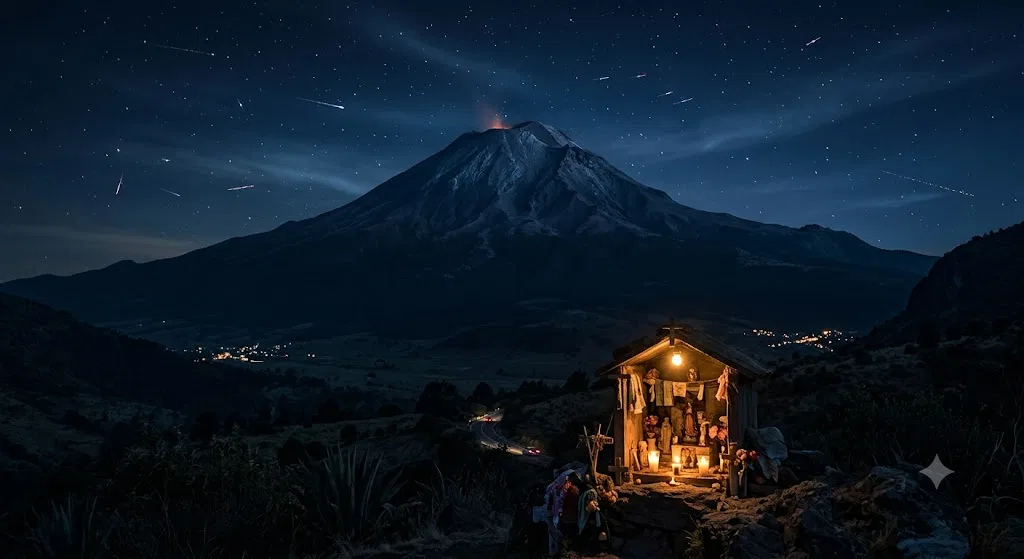
Mexico’s Fortean landscape is physical before it is mystical. Volcanoes loom over densely populated valleys, deserts swallow radio signals and rumours, the Gulf coast is vulnerable to storms, and old lake basins still carry stories of drowned cities and dangerous water. Popocatépetl, for example, is not just a picturesque smoking mountain: it is an active volcano close enough to major population centres that NASA has noted around 30 million people live within 70 kilometres of its summit, while the Smithsonian’s Global Volcanism Program describes it as a volcano threatening more than 20 million people in the Mexico and Puebla valleys. That gives every webcam flash, ash plume and night-time light a ready-made audience.[NASA Science]science.nasa.govScience Popocatépetl Continues to GrumbleScience Popocatépetl Continues to Grumble
The country’s older traditions add another layer. Stories of water spirits, omens, shape-shifters and dangerous night wanderers were not invented by internet forums; many sit in a long record of Indigenous, colonial and popular Catholic storytelling. The Library of Congress traces La Llorona as a Mexican and wider Latin American legend with deep historical branches, while Cambridge-published scholarship on colonial Mexico treats the nahualli not merely as a monster label but as a category tied to ritual specialists, healing, animal control, divination and accusations of harm.[The Library of Congress]blogs.loc.govOpen source on loc.gov.
Modern media then accelerates the old machinery. A blurry volcanic webcam clip, a military infrared video or a photo of a strange animal carcass can now become a national or international talking point in hours. Mexico’s country-level Forteana is therefore best understood as a conversation between landscape, folklore, journalism and sceptical explanation — with belief and debunking often travelling together.
The Bonilla observation: Mexico’s strange objects before UFO culture
One of Mexico’s most genuinely important anomalous sky cases happened in Zacatecas in August 1883, long before flying saucers, drones or modern UFO vocabulary. Astronomer José A. y Bonilla reported hundreds of dark objects crossing the face of the Sun while he was observing from the Zacatecas Observatory. The episode later became famous because Bonilla photographed some of the objects, making it one of the earliest cases retrospectively claimed as “UFO photography”.[Universe Today]universetoday.comUniverse Today Was the "First Photographed UFO" a Comet?Universe Today Was the "First Photographed UFO" a Comet?
The case matters because it has the rare Fortean virtue of being both strange and instrumentally recorded. Bonilla was not simply telling a campfire story; he was using astronomical equipment, and his report appeared in the French astronomical journal L’Astronomie in 1886. Later summaries note that he observed 447 objects over the course of the event, although the original meaning of those images remained disputed.[Universe Today]universetoday.comUniverse Today Was the "First Photographed UFO" a Comet?Universe Today Was the "First Photographed UFO" a Comet?
Sceptical and scientific explanations have changed over time. Early dismissals included birds, insects or dust near the telescope. A 2011 interpretation by Mexican researchers proposed a more dramatic natural possibility: that Bonilla saw fragments of a comet passing unusually close to Earth, with calculated distances ranging from hundreds to several thousand kilometres above the surface. The authors treated this as a working hypothesis, not a proven reconstruction, but it shows why the case remains fascinating: it can be read as a UFO story, a mistaken-observation story, or a near-Earth-object puzzle, depending on which evidence one weighs most heavily.[arXiv]arxiv.orgOpen source on arxiv.org.
For country-level Forteana, Bonilla is a perfect Mexican anchor. It is not a tavern rumour but an astronomical oddity; not evidence of aliens, but not easily dismissed as ordinary gossip either. It shows how a Mexican scientific observation can be pulled into later paranormal culture while still belonging to the history of astronomy.
Popocatépetl and the volcano UFO machine
Popocatépetl has become one of the world’s most productive engines for volcanic UFO clips. The basic ingredients are perfect: an active volcano, permanent cameras, night-time ash and gas emissions, aircraft routes, meteors, insects near lenses, digital compression artefacts, and a vast online audience primed to search every frame for anomalies. Reports of objects “entering” or “leaving” the crater have circulated repeatedly since at least the early 2010s, with mainstream outlets noting the volcano’s reputation for UFO sightings even while sceptics proposed aircraft and other ordinary explanations.[CBS News]cbsnews.comOpen source on cbsnews.com.
The volcano’s real behaviour is already spectacular enough to confuse interpretation. Wired’s volcanology coverage of a 2013 explosion described ash, shockwave effects and rapid changes in plume behaviour; NASA’s Earth Observatory has continued to document ashfall and official warnings around the volcano. In other words, Popocatépetl is a dynamic optical theatre, and its webcam footage often contains moving clouds, glowing ejecta, reflected light and aircraft-like tracks against a dramatic background.[WIRED]wired.comWatch the Shockwave of an Explosion at Mexico's PopocatépetlWatch the Shockwave of an Explosion at Mexico's Popocatépetl
This does not mean every witness is foolish. It means the setting is unusually good at manufacturing ambiguous imagery. A bright object crossing a long-lens view may look close to the crater when it is actually much nearer or farther away. A meteor may appear to “descend” into a volcano because the camera flattens distance. A plane can seem to vanish into smoke. The stronger reading is cultural rather than extraterrestrial: Popocatépetl has become a modern sacred screen onto which Mexico projects danger, wonder and suspicion.
The Campeche infrared UFO case: official footage, unofficial certainty
The 2004 Campeche UFO incident is one of Mexico’s most discussed modern cases because it involved military personnel, infrared equipment and an official release. Mexican Air Force pilots on an anti-drug-surveillance flight filmed eleven bright infrared objects over southern Campeche state on 5 March 2004; international news reports at the time noted that only some appeared on radar and that UFO investigator Jaime Maussan presented the footage publicly.[WIRED]wired.comMexican Air Force Films UFOsMexican Air Force Films UFOs
That combination — military source, infrared imagery, multiple lights, uncertain witness interpretation — made the case look unusually strong to believers. It also made it unusually testable. Robert Sheaffer’s analysis in Skeptical Inquirer argued that the lights matched burn-off flares from offshore oil platforms in the Bay of Campeche; the accompanying PDF analysis shows how the “objects” resolved into individual flares at maximum zoom and compares the aircraft’s path with the oil-field location.[Skeptical Inquirer]skepticalinquirer.orgOpen source on skepticalinquirer.org.
The Campeche case is valuable because it teaches a reader how “official” does not automatically mean “paranormal”. Military crews can record real things without correctly identifying them. Infrared cameras can make distant heat sources look mobile if the observing aircraft is moving. A case can be sincere, documented and still probably mundane. In Mexican Forteana, Campeche is less a solved embarrassment than a useful cautionary tale: the quality of the instrument matters, but so does geometry.
The Zone of Silence: where a rocket crash became a desert legend
The Mapimí “Zone of Silence” in northern Mexico is a classic example of a local anomaly becoming a tourist myth. The region overlaps the Mapimí Biosphere Reserve in the Chihuahuan Desert, a real and ecologically important area. UNESCO identifies Mapimí as a biosphere reserve, while other summaries describe it as a desert and semi-desert landscape with distinctive species and conservation value.[UNESCO]unesco.orgMa BNo information is available for this pageMa BNo information is available for this page
The Fortean legend centres on claims that radio signals fail, compasses behave oddly, meteorites are unusually common, and UFOs visit the area. A key historical trigger was the July 1970 crash of a US Air Force Athena test rocket that veered off course and landed in the Mapimí Desert while carrying small containers of radioactive cobalt-57; later accounts describe a recovery operation and soil removal. That real Cold War accident gave the landscape a powerful origin story.[Wikipedia]WikipediaMapimí Silent ZoneMapimí Silent Zone
The evidence for a true communications “dead zone” is weak. Atlas Obscura and later popular-science coverage both frame the Zone of Silence as a place where local legend, remoteness, meteorite lore and tourism have reinforced each other. The more grounded explanation is that an isolated desert, a rocket crash, patchy reception and entrepreneurial storytelling fused into a Mexican answer to the Bermuda Triangle.[Atlas Obscura]atlasobscura.comAtlas Obscura Exploring Mexico's Zone of Silence, Where Radio SignalsAtlas Obscura Exploring Mexico's Zone of Silence, Where Radio Signals
Its cultural pull is easy to understand. The Zone offers a safe form of cosmic unease: remote enough to feel uncanny, scientific enough to mention magnetism and meteorites, and folkloric enough to support stories of strange visitors. Yet the most certain wonder there is not alien radio silence but the desert ecosystem itself.
Fish from the sky in Tampico
In September 2017, civil-defence officials in Tamaulipas reported that a light rain in Tampico was accompanied by small fish falling to the ground. Associated Press coverage noted photos from the state civil-defence agency showing small fish in a bag and on a pavement.[AP News]apnews.comAP News Fish fall from sky with rain in northern MexicoAP News Fish fall from sky with rain in northern Mexico
This is exactly the kind of event Charles Fort would have loved: absurd, physical, witnessed in the modern era, and yet not necessarily supernatural. The Library of Congress explains that “rains” of fish or frogs have been reported since ancient times, but they are not rain in the normal water-cycle sense. A leading explanation is that strong winds, tornadoes or waterspouts can lift small animals from water and deposit them elsewhere, though the exact path is rarely observed from beginning to end.[The Library of Congress]loc.govOpen source on loc.gov.
The Tampico report is important because it shows how a Fortean event can be both real and natural. The fish may genuinely have been found after rainfall; the explanation does not need to be miraculous. What makes the case memorable is the gap between everyday expectation and meteorological possibility. A few small fish on a pavement can do more for the imagination than a hundred vague ghost stories.
La Llorona: Mexico’s most enduring haunted warning
La Llorona, the weeping woman, is probably Mexico’s most internationally recognisable ghostly figure. In broad form, she is a crying female presence associated with water, children, loss and danger. The Library of Congress describes her as a spirit in Mexican and wider Latin American folklore who may appear as a malevolent being, a warning of misfortune, or a dangerous figure encountered at night.[The Library of Congress]blogs.loc.govOpen source on loc.gov.
What makes La Llorona powerful is not a single fixed plot but her flexibility. Some versions treat her as a child-killing ghost condemned to wander; others emphasise her grief, her warning function, or her role as a frightening presence near rivers and canals. The Library of Congress’s discussion of the legend’s roots notes a long Mexican history and links some versions to early colonial records and the Florentine Codex tradition, while also warning that the legend has multiple branches rather than one clean origin.[The Library of Congress]blogs.loc.govla llorona roots branches and the missing link from spainla llorona roots branches and the missing link from spain
As Forteana, La Llorona is less about evidence for a ghost than about how haunting stories survive because they organise fear. She warns children away from water, gives grief a voice, and turns social anxieties about motherhood, abandonment, class and violence into a figure who can be heard before she is seen. That is why she travels so well across regions and media: she is simple enough to retell, but deep enough to keep changing.
Shape-shifters, animal doubles and the nahualli
The nahualli or nagual tradition belongs to the borderland between folklore, religion, accusation and social power. In popular retellings it is often reduced to a were-animal or witch who can turn into a dog, jaguar, owl or other creature. The historical picture is more interesting. Cambridge-published research on colonial Mexico describes nahualli figures as ritual specialists associated with healing, harm, animal control and prognostication, showing that the category was socially complex rather than merely monstrous.[Cambridge University Press & Assessment]cambridge.orgOpen source on cambridge.org.
This matters because it explains why Mexican shape-shifter stories feel different from imported werewolf tales. They are not only about a monster changing skin; they are about the suspicion that certain people have hidden relationships with animals, weather, illness or fate. The same figure can be feared as a witch, respected as a healer, mocked as superstition, or remembered as Indigenous knowledge distorted by colonial prosecution.
Modern stories of animal-transforming witches, glowing eyes and night predators still draw from this older reservoir. Some are probably misidentified animals, gossip, jokes or moral tales. Others preserve fragments of real belief systems under sensational labels. In a Fortean reading, the nahualli is important because it shows how “cryptid”, “witch”, “healer” and “accused outsider” can overlap in Mexican tradition.
Chupacabra: imported panic, Mexican afterlife
The chupacabra is not originally Mexican — the modern panic is usually traced to Puerto Rico in the mid-1990s — but Mexico became one of the creature’s most important afterlives. Reports of livestock found dead or supposedly drained of blood spread through Latin America and the US borderlands, and Mexico’s rural livestock settings made the story feel plausible enough to travel.[Wikipedia]WikipediaOpen source on wikipedia.org.
The sceptical explanation is relatively strong. Reviews of Benjamin Radford’s work note that alleged blood-draining often has ordinary forensic explanations, while wildlife experts have repeatedly argued that many “chupacabra” carcasses are canids with mange or other disease. Texas A&M material likewise explains that debilitated predators may attack confined livestock because it is easier prey, and that the wounds blamed on vampiric feeding can match ordinary predator bites.[IUScholarWorks]scholarworks.iu.eduOpen source on iu.edu.
Yet the chupacabra should not be dismissed as only a zoological mistake. It is a modern legend with excellent survival traits: livestock loss, economic stress, strange-looking sick animals, media repetition and the seductive idea of a new monster. In Mexico, it plugged into older fears of night predators and witch-animals while also sounding modern, almost alien. That hybrid quality is why it remains culturally alive even when individual carcasses are explained.
Ahuizotl and the old danger of water
The ahuizotl is one of Mexico’s most striking water monsters from Mexica-Aztec tradition. It is commonly described as a small dog-like aquatic creature with a hand at the end of its tail, associated with drowning and dangerous waters. The Mexicolore educational site presents it as a creature feared by fishermen, while other summaries connect it to Lake Texcoco and the broader world of water deities and lake danger.[mexicolore.co.uk]mexicolore.co.ukOpen source on mexicolore.co.uk.
Unlike modern lake monsters modelled on plesiosaurs or giant serpents, the ahuizotl is not mainly a “could it be a surviving animal?” puzzle. Its importance is symbolic and ecological. It encodes the danger of lakes, canals and deep pools in a society where water was sacred, useful and deadly. Some writers have suggested possible real-world inspiration in aquatic mammals with dexterous paws or tails, but the creature’s cultural role matters more than zoological identification.[Wikipedia]WikipediaAhuizotl (mythologyAhuizotl (mythology
For Mexican Forteana, the ahuizotl is a reminder that not every mystery animal belongs to modern cryptozoology. Some are mythic beings with environmental intelligence built in. They tell people where not to go, what forces deserve respect, and why the water is never merely scenery.
Tampico’s alien-protection legend
Tampico has its own modern cosmic story: the claim that an underwater alien base near the coast protects the city from hurricanes. Recent tabloid coverage traces the legend to a 1967 local flying-saucer story and notes that believers connect the city’s later avoidance of direct major hurricane strikes with extraterrestrial intervention. The same coverage also quotes climate-oriented scepticism, pointing instead to weather patterns, storm tracks and selective memory about flooding and tropical storms.[The Sun]thesun.co.ukOpen source on thesun.co.uk.
This legend is easy to mock, but it has a recognisable emotional logic. Coastal communities live with storm anxiety. If a city appears to be spared while nearby places suffer, people look for a pattern. The alien-base idea turns statistical luck and atmospheric steering into a protective myth. It is absurd in literal terms, but socially legible: a guardian angel updated for the flying-saucer age.
It also connects neatly with Mexico’s broader UFO culture. The story is not only about weather; it is about civic identity, local humour and tourist branding. A strange belief can become a mascot even for people who do not quite believe it.
How to judge Mexican Fortean claims without flattening them
A good Mexico Forteana page needs two instincts at once: enjoy the strangeness, and ask what kind of claim is actually being made. Bonilla’s 1883 observation is an astronomical anomaly with photographs and later modelling. Campeche is an infrared-video case with a strong oil-flare explanation. Tampico’s fish rain is a rare but plausible weather oddity. La Llorona and the ahuizotl are folklore with deep cultural roots, not laboratory claims. The Zone of Silence is mostly a legend built around a real desert, a real rocket crash and weak evidence for its central anomaly.
Useful questions include:
- Was anything physical recorded? Bonilla’s plates and the Campeche infrared footage are stronger records than anonymous anecdotes, even if their meanings are disputed.
- Could the setting create illusions? Volcano webcams, deserts, storms and infrared cameras are all excellent ambiguity machines.
- Is the claim older than the modern paranormal label? La Llorona, the ahuizotl and nahualli traditions should not be squeezed into “ghost”, “cryptid” or “UFO” boxes without care.
- Who benefits from the story? Tourism, media attention, local identity and moral warning all help explain why some claims survive.
- What would change the assessment? Better original documentation, precise locations, chain of custody, biological samples, instrument data or independent witnesses can shift a case from folklore to investigation.
Mexico’s weird-history record is strongest when treated as a living archive rather than a scoreboard of “real” versus “fake”. Some stories are probably misidentifications. Some are legends doing cultural work. Some are hoaxes or media exaggerations. Some are rare natural events that look impossible until the mechanism is understood. Together, they show a country where the strange is not separate from history, landscape or belief, but woven through all three.
Amazon book picks
Further Reading
Books and field guides related to What Makes Mexico's Strange History So Enduring?. Use these as the next step if you want deeper reading beyond the article.

Gods of Jade and Shadow
Introduces readers to mythic themes behind strange-history traditions.


eBay marketplace picks
Marketplace Samples
Live-tested eBay searches with available results related to this page.




Endnotes
1.
Source: science.nasa.gov
Title: Science Popocatépetl Continues to Grumble
Link:https://science.nasa.gov/earth/earth-observatory/popocatepetl-continues-to-grumble-153519/
2.
Source: cambridge.org
Link:https://www.cambridge.org/core/journals/americas/article/exhuming-the-nahualli-shapeshifting-idolatry-and-orthodoxy-in-colonial-mexico/EBAFF9FB819F4020208B762696C3A02F
3.
Source: arxiv.org
Link:https://arxiv.org/abs/1110.2798
4.
Source: arxiv.org
Link:https://arxiv.org/pdf/1110.2798
5.
Source: wired.com
Title: Watch the Shockwave of an Explosion at Mexico’s Popocatépetl
Link:https://www.wired.com/2013/06/watch-the-shockwave-of-an-explosion-at-mexicos-popocatepetl
6.
Source: wired.com
Title: Mexican Air Force Films UFOs
Link:https://www.wired.com/2004/05/mexican-air-force-films-ufos
7.
Source: unesco.org
Title: Ma BNo information is available for this page
Link:https://www.unesco.org/en/mab/mapimi
8.
Source: Wikipedia
Title: Mapimí Biosphere Reserve
Link:https://en.wikipedia.org/wiki/Mapim%C3%AD_Biosphere_Reserve
9.
Source: Wikipedia
Title: Mapimí Silent Zone
Link:https://en.wikipedia.org/wiki/Mapim%C3%AD_Silent_Zone
10.
Source: Wikipedia
Link:https://en.wikipedia.org/wiki/Chupacabra
11.
Source: mexicolore.co.uk
Link:https://www.mexicolore.co.uk/aztecs/aztefacts/ahuizotl
12.
Source: Wikipedia
Title: Ahuizotl (mythology)
Link:https://en.wikipedia.org/wiki/Ahuizotl_%28mythology%29
13.
Source: Wikipedia
Title: List of reported UFO sightings
Link:https://en.wikipedia.org/wiki/List_of_reported_UFO_sightings
14.
Source: Wikipedia
Title: La Llorona
Link:https://en.wikipedia.org/wiki/La_Llorona
15.
Source: Wikipedia
Title: Bonilla observation
Link:https://en.wikipedia.org/wiki/Bonilla_observation
16.
Source: Wikipedia
Title: José Bonilla (astronomer)
Link:https://en.wikipedia.org/wiki/Jos%C3%A9Bonilla%28astronomer%29
17.
Source: Wikipedia
Title: UFO sightings in Mexico
Link:https://en.wikipedia.org/wiki/UFO_sightings_in_Mexico
18.
Source: Wikipedia
Title: Rain of animals
Link:https://en.wikipedia.org/wiki/Rain_of_animals
19.
Source: Wikipedia
Title: Lluvia de peces
Link:https://en.wikipedia.org/wiki/Lluvia_de_peces
20.
Source: Wikipedia
Link:https://en.wikipedia.org/wiki/Nagual
21.
Source: cambridge.org
Link:https://www.cambridge.org/core/journals/latin-american-antiquity/article/ritual-transformation-deity-embodiment-and-nagualism-in-formative-period-oaxaca-mexico/A070B1C7756CC73193656531EACA6340
22.
Source: cambridge.org
Title: The Americas: Volume 78
Link:https://www.cambridge.org/core/journals/americas/issue/B28989A260646976B12B272C1296F714
23.
Source: cambridge.org
Title: The Americas: Volume 78
Link:https://www.cambridge.org/core/journals/americas/volume/2236BDB82A10DAEC4AF0D284B31F7AB1
24.
Source: cambridge.org
Title: Mesoamerican Magic-Medicine (Chapter 2)
Link:https://www.cambridge.org/core/books/women-who-threw-corn/mesoamerican-magicmedicine/58FAD5DA596DCEEEA6706F090C245882
25.
Source: resolve.cambridge.org
Link:https://resolve.cambridge.org/core/books/women-who-threw-corn/select-bibliography/C0F8492A7A28C38C175884AF4862678F
26.
Source: cambridge.org
Link:https://www.cambridge.org/core/books/women-who-threw-corn/inquisitions-sorcery-investigations-and-the-law-in-mexico-15211571/0C4E0CFC955FBEB9144D53567A353606
27.
Source: unesco.org
Title: La Michilía
Link:https://www.unesco.org/en/mab/la-michilia
29.
Source: blogs.loc.gov
Link:https://blogs.loc.gov/folklife/2021/10/la-llorona-an-introduction-to-the-weeping-woman/
30.
Source: universetoday.com
Title: Universe Today Was the “First Photographed UFO” a Comet?
Link:https://www.universetoday.com/articles/was-the-first-photographed-ufo-a-comet
31.
Source: cbsnews.com
Link:https://www.cbsnews.com/sanfrancisco/news/mexican-volcano-erupting-in-dramatic-explosions-of-lava-rock-ash/
32.
Source: skepticalinquirer.org
Link:https://skepticalinquirer.org/2004/09/the-campeche-mexico-infrared-ufo-video/
33.
Source: atlasobscura.com
Title: Atlas Obscura Exploring Mexico’s Zone of Silence, Where Radio Signals
Link:https://www.atlasobscura.com/articles/exploring-mexicos-zone-of-silence-where-radio-signals-fail-and-meteorites-crash
34.
Source: apnews.com
Title: AP News Fish fall from sky with rain in northern Mexico
Link:https://apnews.com/article/98b5cc684fe74d48840bbe66ed75ee0c
35.
Source: loc.gov
Link:https://www.loc.gov/everyday-mysteries/browse-all-questions/item/can-it-rain-frogs-fish-and-other-objects/
36.
Source: blogs.loc.gov
Title: la llorona storytelling for halloween and da de muertos
Link:https://blogs.loc.gov/folklife/2021/10/la-llorona-storytelling-for-halloween-and-da-de-muertos/
37.
Source: blogs.loc.gov
Title: la llorona roots branches and the missing link from spain
Link:https://blogs.loc.gov/folklife/2021/10/la-llorona-roots-branches-and-the-missing-link-from-spain/
38.
Source: blogs.loc.gov
Title: growing up with la llorona
Link:https://blogs.loc.gov/folklife/2021/10/growing-up-with-la-llorona/
39.
Source: scholarworks.iu.edu
Link:https://scholarworks.iu.edu/journals/index.php/jfrr/article/view/39300
40.
Source: thesun.co.uk
Link:https://www.thesun.co.uk/news/31686224/amupac-alien-base-mexico/
41.
Source: webcams.volcanodiscovery.com
Link:https://webcams.volcanodiscovery.com/popocatepetl
42.
Source: blogs.loc.gov
Title: la llorona
Link:https://blogs.loc.gov/folklife/category/la-llorona/?gca=68
43.
Source: blogs.loc.gov
Link:https://blogs.loc.gov/folklife/2021/10/
44.
Source: blogs.loc.gov
Link:https://blogs.loc.gov/folklife/category/holidays/?gcd=2021
45.
Source: blogs.loc.gov
Title: picante pero sabroso songs of la llorona
Link:https://blogs.loc.gov/folklife/2021/10/picante-pero-sabroso-songs-of-la-llorona/
46.
Source: blogs.loc.gov
Title: halloween songs
Link:https://blogs.loc.gov/folklife/category/halloween-songs/?gcd=2021
47.
Source: tile.loc.gov
Title: afc2014008 ms1903
Link:https://tile.loc.gov/storage-services/service/afc/afc2014008/afc2014008_ms1903/afc2014008_ms1903.pdf
48.
Source: youtube.com
Link:https://www.youtube.com/watch?v=d-jkZE8AdLA
49.
Source: youtube.com
Link:https://www.youtube.com/watch?v=JgnW-Uqar_E
50.
Source: youtube.com
Link:https://www.youtube.com/watch?v=GzOsdlJk-vg
51.
Source: youtube.com
Link:https://www.youtube.com/watch?v=1JjgJRh8iF0
52.
Source: cbsnews.com
Title: mexican af pilots film ufos
Link:https://www.cbsnews.com/news/mexican-af-pilots-film-ufos/
53.
Source: cbsnews.com
Title: the odd truth may 13 2004
Link:https://www.cbsnews.com/news/the-odd-truth-may-13-2004/
54.
Source: cbsnews.com
Title: raining fish in mexico
Link:https://www.cbsnews.com/detroit/news/raining-fish-in-mexico/
55.
Source: obscurban-legend.fandom.com
Title: Zone of Silence
Link:https://obscurban-legend.fandom.com/wiki/Zone_of_Silence
56.
Source: mythus.fandom.com
Link:https://mythus.fandom.com/wiki/Nagual
57.
Source: ndl.ethernet.edu.et
Link:https://ndl.ethernet.edu.et/bitstream/123456789/46979/1/George%20M.%20Eberhart.pdf
58.
Source: library.eshikshya.org
Link:https://library.eshikshya.org/kiwix/content/wikipedia_en_all_maxi_2023-05/A/Nagual
59.
Source: skepticalinquirer.org
Link:https://skepticalinquirer.org/wp-content/uploads/sites/29/2016/01/SI-JF-16-50.pdf
60.
Source: cenapred.gob.mx
Link:https://www.cenapred.gob.mx/es/Publicaciones/archivos/270-INFOGRAFAPOPOCATPETLSEMFORODEALERTAVOLCNICA%28ENINGLS%29.PDF
Additional References
61.
Source: popularmechanics.com
Link:https://www.popularmechanics.com/science/environment/a71170916/zone-of-silence/
Source snippet
The Zone gained international attention not only because of the crash but also due to burgeoning stories of UFOs, aliens, and strange occ...
62.
Source: youtube.com
Title: Inside Mexico’s Bermuda Triangle Of UFOs And Vanishing Signals
Link:https://www.youtube.com/watch?v=_pR08z2jqD4
Source snippet
Scientists Can't Explain the Mysterious Zone of Silence...
63.
Source: youtube.com
Title: Scientists Can’t Explain the Mysterious Zone of Silence
Link:https://www.youtube.com/watch?v=ZSg5HmLLzf0
Source snippet
The Myth of La Llorona in Mexican Folklore...
64.
Source: facebook.com
Link:https://www.facebook.com/groups/704609660332475/posts/1614308092695956/
65.
Source: instagram.com
Link:https://www.instagram.com/reel/CvKqrlsuU9b/
66.
Source: academia.edu
Link:https://www.academia.edu/127933190/High_Strangeness_and_Folkloric_Themes
67.
Source: researchgate.net
Link:https://www.researchgate.net/publication/381405238_The_cryptoterrestrial_hypothesis_A_case_for_scientific_openness_to_a_concealed_earthly_explanation_for_Unidentified_Anomalous_Phenomena
68.
Source: researchgate.net
Link:https://www.researchgate.net/publication/404377951_Ritual_Transformation_Deity_Embodiment_and_Nagualism_in_Formative_Period_Oaxaca_Mexico
69.
Source: researchgate.net
Link:https://www.researchgate.net/publication/51945342_Interpretation_of_the_observations_made_in_1883_in_Zacatecas_Mexico_Afragmented_Comet_that_nearly_hits_the_Earth
70.
Source: facebook.com
Link:https://www.facebook.com/TheIncredibleHumans/posts/a-strange-shiny-ball-was-seen-floating-above-pico-de-orizaba-the-tallest-volcano/1091485363111122/
Topic Tree
Follow this branch
Related pages 192
- Afghan Forteana
- Antigua Uncanny
- Bosnian Mysteries
- Botswana Weird
- Brazil Strange
- +187 more in sidebar