Within Azerbaijan
When Natural Fire Becomes a National Myth
Azerbaijan's famous flames show how gas seeps became sacred geography, tourist icons and enduring weird-history symbols.
On this page
- What burns at Yanar Dag
- Ateshgah's layered religious history
- Miracle, heritage display or geology
Page outline Jump by section
Introduction
Few places capture Azerbaijan’s reputation as the “Land of Fire” more effectively than Yanar Dag and the nearby Ateshgah Fire Temple. At first glance they seem to belong in myth: flames rise directly from the earth, burning without visible fuel, and for centuries travellers described the area as a landscape of eternal fire. Yet the reality is, if anything, more remarkable. Natural gas escaping through faults and porous sandstone created genuine flames that inspired religious devotion, attracted merchants and pilgrims, and eventually became one of the country’s defining cultural symbols. The enduring mystery lies not in whether the fires are supernatural—they are well explained by geology—but in how a natural phenomenon became sacred geography, tourist spectacle and a cornerstone of Azerbaijan’s historical identity.[wikipedia.org]WikipediaYanar DaghYanar Dagh
What burns at Yanar Dag?
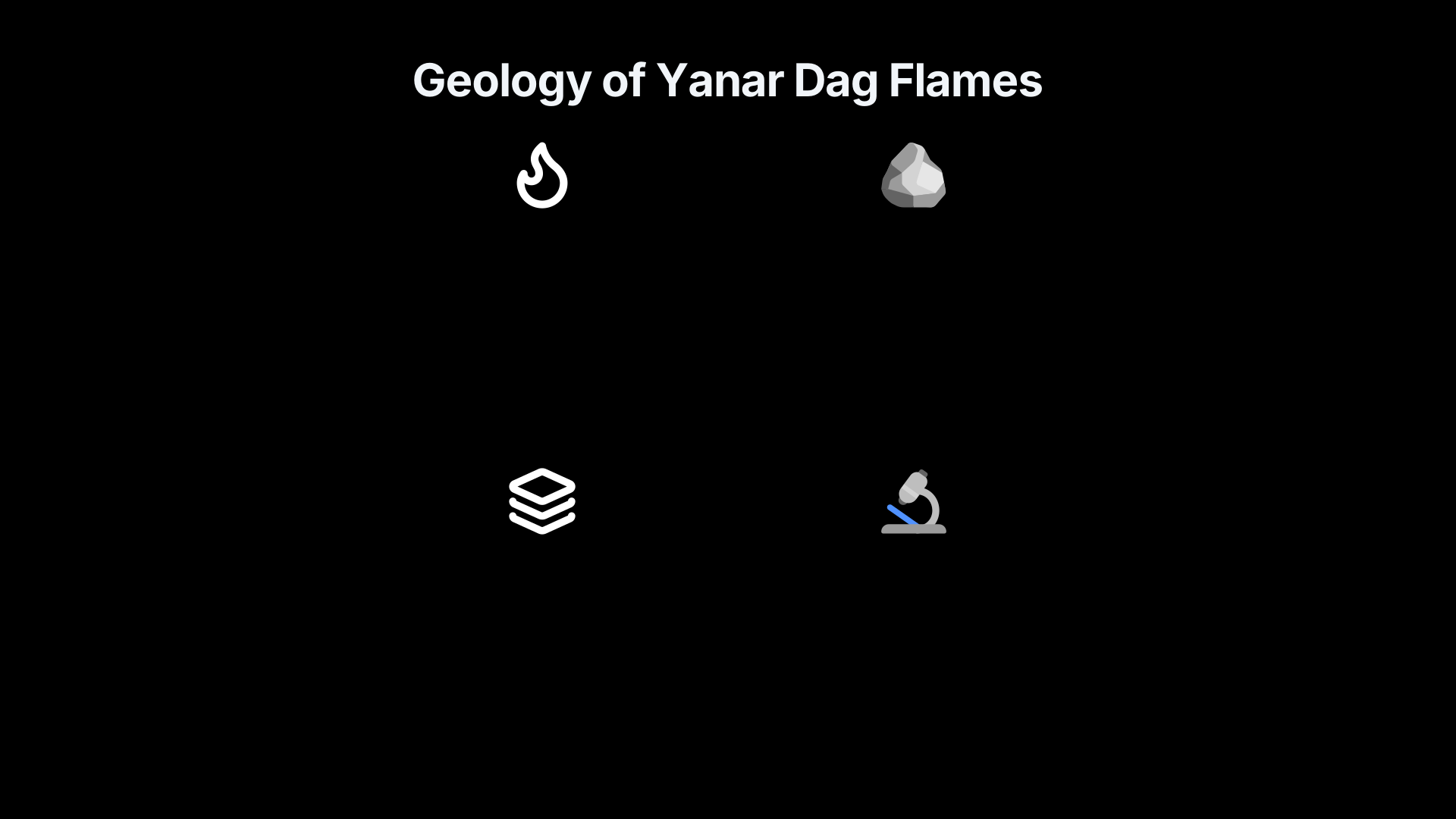
Yanar Dag, or “Burning Mountain”, is a hillside on the Absheron Peninsula where natural gas seeps continuously through fractured rock. Instead of erupting dramatically like a volcano, the gas escapes along a narrow fault line and burns as a ribbon of flame stretching across the base of the slope. Depending on conditions, the flames can reach around three metres high and continue through rain, wind and winter weather because the fuel comes from underground rather than surface vegetation.[Wikipedia]WikipediaYanar DaghYanar Dagh
The phenomenon is a consequence of the peninsula’s unusual geology. Absheron sits above hydrocarbon-rich sedimentary rocks that have leaked oil and methane for thousands of years. Before industrial extraction reduced pressure in many gas fields, spontaneous fires were reportedly much more common across the region. Historical travellers described burning springs, flaming ground and natural fires that seemed impossible to extinguish. Today, Yanar Dag is one of the few surviving examples still fuelled by a natural gas seep rather than an artificial supply.[Wikipedia]WikipediaYanar DaghYanar Dagh
Modern geological studies support this explanation. Measurements of methane escaping around the site show significant gas microseepage along a fault associated with the Balakhany-Fatmai structural zone, confirming that the fire is maintained by continuous underground gas emissions rather than any hidden fuel source or volcanic process.[Wikipedia]WikipediaYanar DaghYanar Dagh
One persistent local story claims the present fire began only in the 1950s after a shepherd accidentally dropped a match or cigarette onto the hillside. Whether or not the anecdote is literally true, it reflects a broader reality: natural gas may seep invisibly for years until an ignition source creates a long-lasting flame. Earlier natural fires undoubtedly existed elsewhere on the peninsula, but not every individual flame burned continuously for centuries.[Wikipedia]WikipediaYanar DaghYanar Dagh
Ateshgah’s layered religious history
Only a short distance from Yanar Dag stands the Ateshgah Fire Temple, where the relationship between natural fire and religious tradition becomes more complicated than popular mythology often suggests.
The temple occupies a site where natural gas once escaped through the ground, producing what visitors described as an “eternal flame”. That made the location spiritually important long before the surviving stone complex was constructed during the seventeenth and eighteenth centuries. Official heritage authorities trace the site’s sacred reputation back to much earlier periods when naturally burning gas vents attracted religious attention.[Ateshgah Temple]ateshgahtemple.azy natural gas oozed out of the surface being a reason of the Eternal Flames…Read more…
A widespread tourist narrative presents Ateshgah simply as an ancient Zoroastrian temple. The evidence is more nuanced. The surviving building contains inscriptions in Sanskrit and Punjabi as well as Persian, while architectural features—including a trident associated with Hindu worship—indicate that the existing complex was established largely by Hindu and Sikh merchants travelling trade routes between the Indian subcontinent and the Caspian region. At the same time, the location itself almost certainly held significance for earlier Zoroastrian communities because sacred fire already formed an important part of their religious tradition.[Wikipedia]WikipediaAteshgah of BakuAteshgah of Baku
This layered history explains why different guidebooks and popular accounts sometimes appear to contradict one another. They are often describing different phases of the same site:
- The location may have been revered by Zoroastrians long before the current structure existed.
- The surviving architecture is primarily a seventeenth- and eighteenth-century foundation associated with Hindu and Sikh merchants.
- The natural flame eventually disappeared after intensive gas extraction during the Soviet period and is now maintained using piped gas for heritage interpretation.[Wikipedia]WikipediaAteshgah of BakuAteshgah of Baku
Rather than diminishing the site’s importance, this complexity makes it a fascinating example of how natural wonders can be adopted by successive religious traditions without losing their symbolic power.

How natural fire became national myth
Yanar Dag and Ateshgah occupy an unusual position between science and folklore. Unlike many famous Fortean locations, there is little dispute over the physical mechanism behind the flames. The mystery lies instead in how people interpreted them.
For ancient visitors, a fire emerging directly from rock without visible fuel challenged ordinary experience. Without knowledge of methane seepage, such flames naturally appeared miraculous. Fire already possessed profound symbolic meaning throughout Iranian religious traditions, representing purity, divine order and spiritual illumination rather than being worshipped as a deity in itself. Natural gas seeps therefore reinforced existing beliefs rather than creating entirely new ones.[Wikipedia]WikipediaAteshgah of BakuAteshgah of Baku
Travellers’ accounts helped spread these stories beyond the Caucasus. Medieval and early modern visitors repeatedly described lands where the earth itself burned. These reports sometimes became exaggerated in retelling, contributing to European ideas of mysterious eastern landscapes filled with perpetual fire. Although modern geology explains the phenomenon, the historical descriptions were rooted in genuine observations rather than pure invention.[Wikipedia]WikipediaYanar DaghYanar Dagh
The result is a national myth that differs from a fictional legend. Azerbaijan’s identity as the “Land of Fire” rests on real geological phenomena that acquired cultural, religious and political significance over many centuries. The symbolism remains powerful precisely because the underlying phenomenon genuinely exists.
Miracle, heritage display or geology?
Whether Yanar Dag is viewed as miraculous depends largely on what one means by the word.
From a geological perspective, the explanation is straightforward. Methane generated within hydrocarbon-bearing rocks migrates upward through fractures until it reaches the surface, where ignition creates a self-sustaining flame as long as gas continues to escape. Similar gas seeps occur elsewhere in the world, although few remain continuously alight.[Wikipedia]WikipediaYanar DaghYanar Dagh
From a religious or cultural perspective, however, explaining the mechanism does not erase the site’s significance. Many sacred places around the world derive their importance from unusual natural features rather than supernatural violations of natural law. A mountain, spring or cave may be entirely explicable while remaining spiritually meaningful to generations of visitors.
The modern presentation of both sites reflects this balance. Yanar Dag is preserved as a historical, cultural and natural reserve, complete with museum facilities interpreting both its geology and its place in Azerbaijani identity. Ateshgah similarly presents the intersection of natural gas, religious history and architectural heritage rather than encouraging claims of paranormal fire.[Wikipedia]WikipediaYanar DaghYanar Dagh
Why the fire sites remain Fortean landmarks
For readers interested in Fortean history, Yanar Dag and the Fire Temple demonstrate that the most enduring mysteries are not always the least understood. Here, scientific explanation has not displaced wonder.
Instead, the sites illustrate a recurring Fortean pattern: an authentic natural phenomenon becomes extraordinary because people struggle to interpret it. Flames emerging from bare rock inspired stories of sacred ground, attracted pilgrims from different faiths, shaped travellers’ imaginations and eventually became one of Azerbaijan’s defining national symbols.
That combination of observable reality, historical misunderstanding, religious reinterpretation and lasting cultural resonance gives Yanar Dag and Ateshgah an unusual place in the country’s strange-history tradition. They are reminders that some of the world’s most memorable myths begin not with impossible events, but with landscapes so extraordinary that they seem to demand a story.
Amazon book picks
Further Reading
Books and field guides related to When Natural Fire Becomes a National Myth. Use these as the next step if you want deeper reading beyond the article.

Lonely Planet Georgia, Armenia & Azerbaijan
Covers Yanar Dag, Ateshgah and Azerbaijan's famous fire heritage.


Origins: How the Earth Made Us
Explains the geological origins of natural gas seeps and landscapes.
Origins
First published 2019. Subjects: Human evolution, Human beings, origin, Human beings, Origin, Effect of environment on.
eBay marketplace picks
Marketplace Samples
Live-tested eBay searches with available results related to this page.




Endnotes
1.
Source: Wikipedia
Title: Yanar Dagh
Link:https://en.wikipedia.org/wiki/Yanar_Dagh
2.
Source: Wikipedia
Title: Ateshgah of Baku
Link:https://en.wikipedia.org/wiki/Ateshgah_of_Baku
3.
Source: Wikipedia
Title: Fire temple
Link:https://en.wikipedia.org/wiki/Fire_temple
4.
Source: youtube.com
Link:https://www.youtube.com/watch?v=94FpouGLJYg
Source snippet
Wikipedia...
5.
Source: ateshgahtemple.az
Link:https://ateshgahtemple.az/en/
Source snippet
y natural gas oozed out of the surface being a reason of the Eternal Flames...Read more...
6.
Source: tripadvisor.com
Link:https://www.tripadvisor.com/Attraction_Review-g293934-d3587697-Reviews-Ateshgah_Fire_Temple-Baku_Absheron_Region.html
Source snippet
Fire Temple, BakuThe first mention of this place dates back to the 5th century. Here lived the Zoroastrians, people who worship fire and...
7.
Source: tripadvisor.com
Title: Yanar Dag
Link:https://www.tripadvisor.com/Attraction_Review-g293934-d2390504-Reviews-or20-Yanar_Dag-Baku_Absheron_Region.html
Source snippet
A fault in the earth's crust allows the...Read more...
8.
Source: tripadvisor.com
Link:https://www.tripadvisor.com/Attraction_Review-g293934-d2390504-Reviews-Yanar_Dag-Baku_Absheron_Region.html
Source snippet
Yanar Dag - All You SHOULD Know Before Going (2026...Yanar Dag, also known as the Burning Mountain, is a natural wonder situated in Azer...
Additional References
9.
Source: youngpioneertours.com
Link:https://www.youngpioneertours.com/yanar-dag-burning-mountain/
Source snippet
Yanar Dag: Burning MountainThe gas is thought to have been burning for hundreds of years. Yanar Dag is revered by Zoroastrians. concept o...
10.
Source: monsoondiaries.com
Title: the land of fire atesgah fire temple yanar dag
Link:https://monsoondiaries.com/2018/08/27/the-land-of-fire-atesgah-fire-temple-yanar-dag/
Source snippet
The Land Of Fire: Atesgah Fire Temple & Yanar DagAug 27, 2018 — Built in the 18th century by numerous Indian worshippers of Shiva who tra...
11.
Source: pickyourtrail.com
Title: why is azerbaijan called the land of fire
Link:https://pickyourtrail.com/blog/why-is-azerbaijan-called-the-land-of-fire
Source snippet
Azerbaijan: A Country of Fire and History28 May 2025 — Azerbaijan and its history has a very close association with fire, and hence the n...
Published: May 2025
12.
Source: sealthedealtravels.com
Title: ateshgah yanar dag azerbaijan 2021
Link:https://sealthedealtravels.com/blog/ateshgah-yanar-dag-azerbaijan-2021/
Source snippet
Fire Temple "Ateshgah" & Yanar DagJan 17, 2022 — You can learn about the ancient religion of Zoroastrianism and witness a natural gas fir...
13.
Source: reddit.com
Link:https://www.reddit.com/r/Damnthatsinteresting/comments/1r8skwo/yanar_dag_a_natural_gas_fire_that_has_been/
Source snippet
nuously on a hillside on the Absheron Peninsula...
14.
Source: trip.com
Title: poi atashgah zoroastrian fire temple 18692110
Link:https://www.trip.com/moments/poi-atashgah-zoroastrian-fire-temple-18692110/
Source snippet
This ancient temple was once used for rituals by Hindus, Sikhs, and Zoroastrians. · Built on a site where natural...
15.
Source: instagram.com
Title: Everywhere in Azerbaijan
Link:https://www.instagram.com/reel/DMz7yihsZxN/
Source snippet
The name Azerbaijan comes from Āturpātakān, a province in...Not far from Yanar Dag is the Atashgah #Fire #Temple, built on sacred ground...
16.
Source: youtube.com
Title: Miracles Land of Fire in Azerbaijan | Yanardag Fire Mountain
Link:https://www.youtube.com/watch?v=fJ80_FnVVuE
Source snippet
The fire Mountains near Baku Azerbaijan[https://www.youtube.com/watch?v=94FpouGLJYg](https://www.youtube.com/watch?v=94FpouGLJYg) Wikipedia...
17.
Source: leightontravels.com
Link:https://leightontravels.com/2025/02/02/fire-temple-burning-mountain-in-baku/
Source snippet
Fire Temple & Burning Mountain in Baku.2 Feb 2025 — Known in Azerbaijani as Ateshgah, this walled complex sprang up in the 17th century o...
18.
Source: instagram.com
Link:https://www.instagram.com/p/DX9VZhRDAlT/
Source snippet
3. Yanar Dag – the “...Read more...
Topic Tree